A free reading from The Next Chapter
A small way to decide what can end when work ends—and what is worth keeping
The week after her retirement party, Mara found a notebook in her kitchen drawer. Someone had given it to her with a cheerful instruction written on the first page: Make a bucket list!
She understood the kindness behind the gift. After forty years of work, perhaps she was supposed to travel, learn a new language, train for a race, and finally become the impressive person she had never had time to be.
But the first thing Mara wanted was to stop setting an alarm for 5:45.
The second was to keep the Sunday phone call with her sister.
Nothing about either wish would make an exciting photograph. Both belonged to the life she actually wanted.
Mara is fictional, but her problem is familiar: retirement can arrive with a second set of instructions, this time disguised as freedom. Make the most of every day. Stay busy. Find your purpose. Do everything you postponed. Those suggestions may be welcome; they can also sound like another performance review.
A bucket list asks, What have I not done yet? A goodbye list asks two quieter questions: What am I ready to stop carrying? What do I want to bring with me? You can answer without a new identity, a purchase, or a life plan.
Not everything from working life was a burden
It is easy to imagine retirement as a door that shuts on everything before it. Real lives are seldom so tidy. You might be relieved to leave a schedule yet miss the people who made it bearable. You might dislike the daily commute yet love having a reason to get dressed and leave home. You may want fewer obligations without wanting fewer connections.
Try separating the container from the good thing inside it.
A job can contain a daily walk, friendly conversation, a sense of usefulness, structure, or a small moment of learning. Leaving the job does not mean you must discard those things. You can keep the useful part in a lighter form.
For instance, perhaps Monday staff meetings gave you one thing you appreciated: seeing familiar faces. You can say goodbye to the compulsory meeting without saying goodbye to companionship. Perhaps the old morning commute felt exhausting, but its fifteen minutes of music gave you breathing space. The commuting can end while the music stays.
This distinction prevents two opposite mistakes: keeping a whole obligation because one part was good, or throwing away a good part because the obligation was difficult.
Three goodbyes you are allowed to make
You do not have to make any of these. They are possibilities to consider, not rules.
1. Goodbye to being immediately available. At work, messages and questions may have arrived with an expectation of a quick reply. Outside that setting, you can choose when to answer most nonurgent requests. The people you love still matter; they need not receive the same always-on service as your former workplace.
2. Goodbye to earning every quiet hour. Many adults learn to rest only after they have produced something measurable. A peaceful afternoon does not have to follow a productive morning. You can enjoy a library book, watch the rain, or sit outside without turning it into a reward system.
3. Goodbye to explaining yourself through a job title. Some people will ask what you used to do. You may answer. You may also say what interests you now: the garden you visit, the friend you walk with, the music you are getting to know. You are not required to produce a polished new title for yourself.
You might have very different goodbyes. Perhaps you want to stop being the organizer for everyone else, or to stop treating a small mistake as an emergency. The useful question is not Should a retired person stop doing this? It is Does this still deserve a place in my life?
Three things worth carrying forward
A goodbye list is not a list of losses. It creates room to notice what would be missed.
A rhythm. A familiar tea break, a morning walk to the mailbox, or the habit of reading for twenty minutes may give a day its shape without filling it up. If you liked having a pattern, keep one that belongs to you. If you prefer unstructured days, that is a valid choice too.
A connection. Think of someone you enjoyed seeing because circumstances brought you together. A former colleague, neighbour, bus driver, or volunteer might welcome an occasional hello. A relationship does not need to become a standing commitment to remain meaningful.
A strength without the old responsibility. Perhaps you were patient with newcomers, good at fixing small problems, or quick to spot what was missing. Those abilities are yours, not your employer's. You can share them when invited, in small amounts, or keep them for your own life. Being useful is an option, not a debt.
A carry-forward does not need to be permanent. Keep what works this season. Let your preferences change.
A small example: what to remove, what to rescue
After leaving a school office, fictional Daniel misses knowing everyone's name. He does not miss being the person who solved every last-minute problem.
He writes two sentences:
- Leave behind: Being on call for every interruption.
- Bring along: Knowing people well enough to greet them by name.
Daniel considers volunteering at a busy community desk five mornings a week. Then he notices he is rebuilding the same obligation he left. Instead, he decides to visit the local café on Thursdays, learn the staff's names, and see whether the routine is enjoyable. If it isn't, he can stop. Nothing has failed.
Daniel's story is not a recommendation to volunteer less or visit cafés more. It shows how to preserve a human pleasure without recreating its former burden.
The optional two-column goodbye card
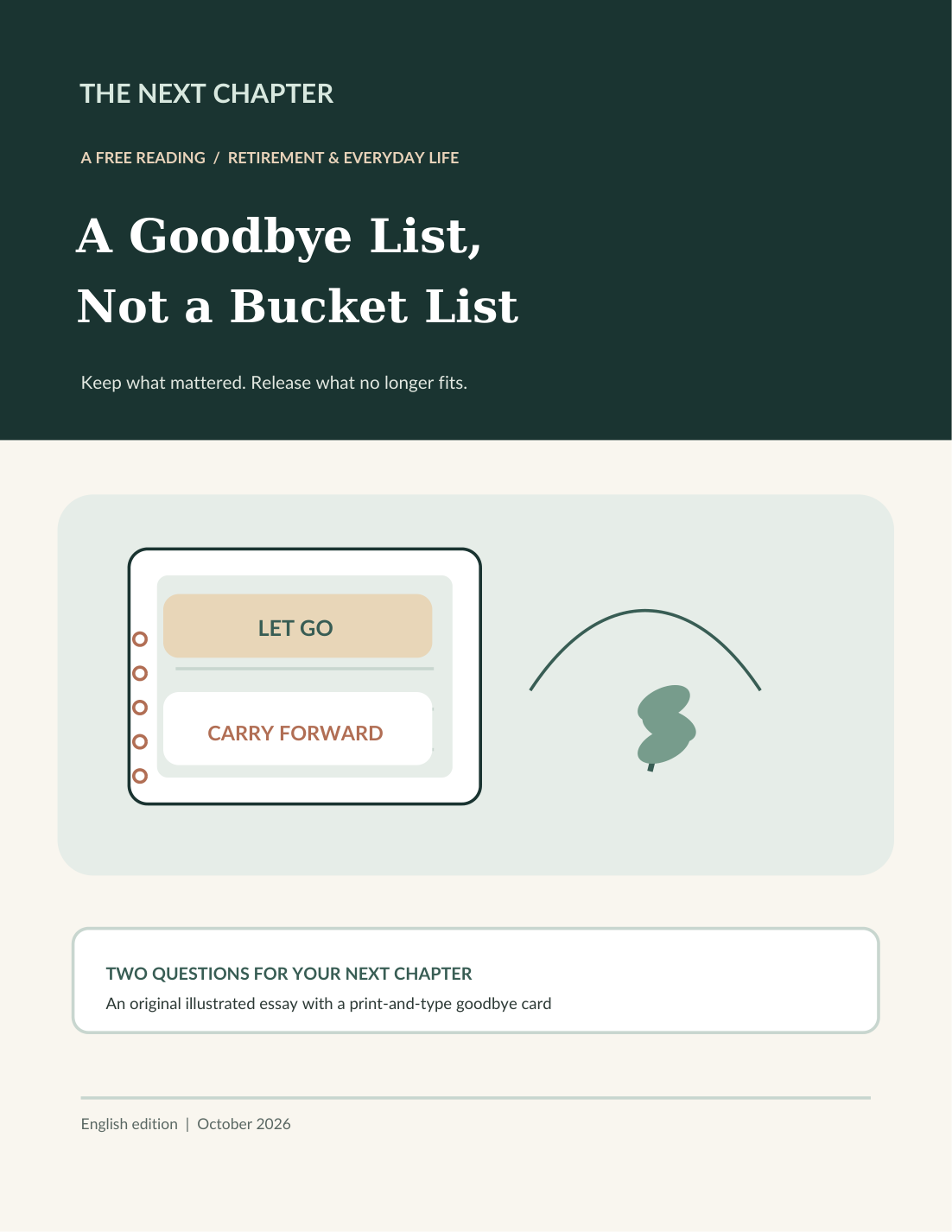
You can do this in your head. If you like paper, draw a line down a page. Give the left side the heading Let go and the right side Carry forward. One entry on each side is enough.
| Let go | Carry forward | | --- | --- | | A demand, habit, or role I no longer want to keep | A pleasure, connection, ability, or rhythm hidden inside it | | Example: Answering every message immediately | Example: A regular, unhurried call with one friend | | My own: __________________________ | My own: __________________________ |
Underneath, add one small sentence if it helps:
For now, I might ____________________.
For now matters. It means you are not signing a contract with your future self. You are trying a gentler arrangement. You can cross it out next week, keep it for years, or leave the line blank.
If a relationship or responsibility depends on other people, you may need a conversation rather than a private decision. And if you still work part-time, provide care, or face financial constraints, some obligations cannot simply disappear. The card is a tool for distinguishing genuine choice from habit, not a promise that every burden can be lifted.
What if you don't feel ready to say goodbye?
Some people retire by choice. Others leave because a role ends, their health changes, caregiving demands shift, or work becomes unavailable. You may feel relief and grief on the same day. You may not yet know what to keep.
You do not have to make a list on a timetable. If the word goodbye feels too final, write Less of this and More of this, or leave the page untouched. A difficult transition deserves room to be difficult. This reading is not a substitute for professional or personal support when you need it.
It may also be that work was a source of genuine joy and you hope to return in a different way. A goodbye list can honour that. You could leave behind an exhausting schedule while keeping occasional paid work, mentoring, or a shared project—provided it fits your circumstances and wishes.
A smaller question for tomorrow morning
Mara eventually wrote two lines in the notebook she had been given:
Goodbye to the early alarm.
Keep the Sunday call.
She did not fill the rest of the notebook that day. She made breakfast, opened the window, and enjoyed an ordinary morning that did not need a name.
A good next chapter does not have to begin with a grand plan. Sometimes it begins with knowing which part of yesterday you can leave behind—and which part you would be glad to see again.
About this reading. The people and situations are original fictional illustrations, not testimonials or verified accounts. This free resource offers reflective, optional choices; it is not financial, legal, medical, or psychological advice. No email, purchase, worksheet completion, or promised transformation is required.