THE NEXT CHAPTER — AN ORIGINAL FREE READING
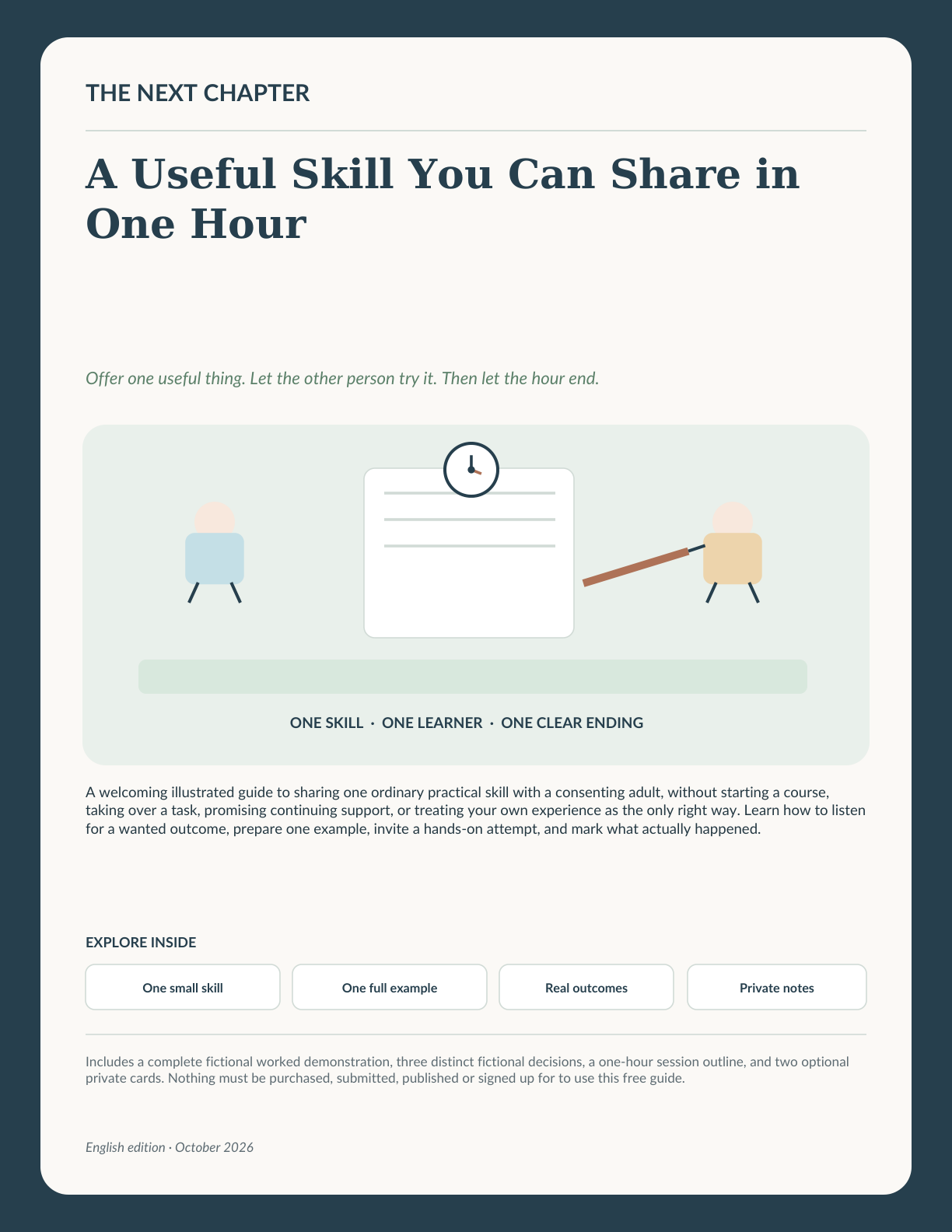
Offer one useful thing. Let the other person try it. Then let the hour end.
A welcoming illustrated guide to sharing one ordinary practical skill with a consenting adult, without starting a course, taking over a task, promising continuing support, or treating your own experience as the only right way. Learn how to listen for a wanted outcome, prepare one example, invite a hands-on attempt, and mark what actually happened.
Includes a complete fictional worked demonstration, three distinct fictional decisions, a one-hour session outline, and two optional private cards. Nothing must be purchased, submitted, published or signed up for to use this free guide.
English edition · October 2026
A lifetime of experience is not a lesson plan
ONE WANTED TASK IS ENOUGH
People sometimes tell a recently retired person, “You must have so much to teach.” The compliment can feel generous and surprisingly heavy. What part of your experience would be useful? Who needs it? Will somebody expect a workshop, a committee, a year of help, or answers you do not actually have? The first step is not to turn your entire working life into a curriculum. It is to notice one modest thing you can explain honestly.
Think of a person learning to put together a clear notice for a small gathering, label a set of ordinary folders so they can find them later, or fold one simple paper card for a personal message. Those activities are not important because they are impressive. They are useful when someone actually wants to do them and can use the result themselves. An hour with one small outcome may be more respectful than a long talk filled with expertise nobody requested.
You may know the skill but not enjoy teaching it. You may want to help one neighbour but not a roomful of strangers. You may have a method that works in your kitchen but does not transfer to another person's situation. All those limits deserve to be said aloud before an offer becomes a commitment. You do not need to explain your health, finances or past work history to say that a request is not for you.
This guide asks three questions in order: Does another person want this help? Can I show one safe part of it? Does our agreed session have a clear end? A yes to all three is a possible starting point, not an obligation. No is also a complete answer.
Ask what the learner wants to leave with
DO NOT GUESS FROM AGE OR EXPERIENCE
Before offering a skill, ask what the other person is trying to accomplish. Someone who says, “I want to understand notices,” might want to read a club announcement, write a three-line notice for a neighbour, or stop receiving confusing messages. Those are different outcomes. You cannot decide which one is best merely because you have been writing announcements for years.
A useful beginning sounds like this: “What small thing would you like to be able to do after we meet?” Follow with “Would you rather watch me first or try it as we go?” And “Is there a part you do not want to do?” These questions leave control with the learner. They also tell you whether the skill is small enough for one voluntary session.
Listen to the answer instead of correcting it immediately. If the request is “I want to make a short notice people can understand,” you can model one example and let the learner draft their own. If it is “Please write all of our club notices from now on,” that is a request for ongoing work, not a one-hour teaching encounter. You can decline it, or suggest a separate conversation with the person who actually organises the notices.
Do not assume older learners are afraid of technology, that a younger person knows everything about phones, or that an adult with a disability needs you to make choices on their behalf. Ask about their preferred format and access needs without seeking personal diagnoses. A learner who changes their mind during the session is not failing a test; their preferences are part of the information the session should respect.
Write down an outcome in plain language only with the person's agreement: “By the end, I would like to draft one short notice I can revise myself.” That is specific enough to guide an hour and modest enough to stop after it.
Shrink the skill until it fits
SHOW ONE MOVE, NOT AN ENTIRE PROFESSION
The most common mistake is to describe the subject too broadly. “I can teach you writing” or “I can show you computers” invites questions that could fill a month. “I can show one way to arrange a short announcement so readers find its main details” is a more honest offer. It gives the learner a result to practise while leaving room to discover whether another approach would suit them better.
Try putting a larger topic through three filters. One action: What can the learner actually do? One ordinary example: Can you demonstrate it without sensitive data, risky equipment or costly supplies? One finishing test: What would show that the learner had a real opportunity to try? A finishing test is not a judgement of their worth or talent. It is simply evidence that you offered more than a speech.
For example, a person who has organised events for years may know venues, permits, insurance, volunteers, catering and promotion. None of that needs to appear in a one-hour introduction to a clear notice. The useful subskill is to decide what a recipient needs to know first and arrange it on a page. The broader event-management responsibilities remain with the organisers.
Other small skills may be suitable if all parties agree and the actual setting is appropriate: making a simple personal shopping checklist, arranging an uncluttered label, or telling a short story from three ordinary pictures you own. Choose low-risk examples that do not require specialised authorisation. Avoid hands-on tasks involving medication, electrical wiring, finances, legal forms, food safety, hazardous tools, or confidential records unless a properly qualified and authorised professional owns the task. This publication is not such professional training.
If you cannot describe a single independent learner action, the requested topic may still be too broad. That is a design problem you can solve by narrowing the offer, not a reason to schedule a second lesson automatically.
Get permission to help—and permission to stop
THE OFFER AND THE ARRANGEMENT ARE TWO DIFFERENT THINGS
An invitation to show something is not permission to occupy a community room, use somebody else's equipment, photograph participants, or recruit strangers. If a venue or group is involved, ask the actual organiser what they have approved: the space, timing, attendance limits, supervision, materials and any rules that apply. Leave questions about children or vulnerable participants, safeguarding, insurance, professional qualifications and local requirements to the appropriate organiser or qualified provider.
Even in a private one-to-one session, ask whether the person wants your help and is free to stop. “Would you like me to show you a simple example?” gives a real choice. “I've brought everything, so we might as well do it” can turn an offer into pressure. The learner may say yes to observing but no to practising, or yes to trying while keeping their draft private.
Agree on who remains responsible for practical matters. If the person requested the lesson, you are not automatically responsible for transport, bookings, equipment purchases, participant invitations or follow-up support. An organiser must not silently assign those tasks to you. If help is offered by a friend, do not assume their time is available. Ask what they can realistically do and whether the arrangement is still welcome.
Say the limit positively: “I can demonstrate one version of this between 10 and 11 on the date we agree. I cannot run the event or become the group's ongoing writer.” A request for future help can be considered later as a new request. It does not become an entitlement because the first hour went well.
A safe, ordinary, voluntarily chosen task in a known setting is enough. If permission, setting or scope is uncertain, first make an enquiry. Mark it as an enquiry, not a booked or completed teaching session.
A complete worked example: a notice people can use
WHAT, WHEN, WHERE—THEN THE NECESSARY DETAIL
For this guide's demonstration, imagine someone who wants to write a short notice for a wholly fictional book-sharing hour. The organiser has already confirmed the occasion and authorised a draft; neither the activity nor the location is real. We are teaching clarity of presentation, not how to organise or authorise an event.
A draft begins with a large heading: “Fictional Book-Sharing Hour.” Beneath it, the reader needs the nature of the activity, its time and its place. A complete fictional practice card could read:
FICTIONAL PRACTICE NOTICE
What: Bring a book you are happy to discuss. No exchange is required.
When: Saturday, 2:00–2:45 p.m. (illustrative only).
Where: The imaginary community reading room; location not verified.
Before attending: Check the actual organiser's confirmed details. This example is not an invitation to a real event.
Notice the order. The reader sees what the meeting is, when it happens and where more certainty is needed. The last line is intentionally honest: an invented place is not presented as a destination. A practice notice should never circulate as a confirmed real event listing.
The transferable skill is not these exact words. It is to ask: “What must another person know to make a choice?” and then put confirmed details ahead of decorative language. If an essential detail is not confirmed, label it unknown rather than inventing it. A learner can use a blank imaginary example in the hour and draft a real notice later when they have permission and verified details.
For a full one-hour encounter, one completed fictional practice notice with clear unknowns is sufficient. There is no requirement to design a poster, open an account or promise to manage future communications.
Prepare less than you think
ONE EXAMPLE AND ONE BLANK SPACE
Preparation should support the learner, not become another project. For this particular fictional notice exercise, you could bring one harmless sample and a blank page. Use a pen and paper you already have. If the learner prefers a familiar device and is comfortable using it, a blank note on that device can serve the same purpose. You do not need to buy design software, pay for templates, print an elaborate workbook or collect the learner's personal information.
Prepare the minimum demonstration sequence: show the three essential questions; arrange them in a readable order; leave unknown information visibly unknown; invite the learner to try a fresh imaginary example. You can put the finished sample in front of you as a prompt. A guide who has an example to point to does not have to talk continuously.
Check the actual setting rather than assume it. Is the chosen seat usable for both people? Are the light, sound, seating and print size suitable? Is the room truly approved for the session? Does anyone prefer a break, a different pace, or no written notes? If an adaptation is needed, ask the learner what would help and follow the venue's actual arrangements. You cannot promise accessibility based on a photograph or a general label alone.
Do not require the learner to create an online account, reveal a password, share private contact lists, download a new app or give you control of their device. With real workplace or community documents, check the relevant organisation's privacy and authorisation rules. A fictional blank example is often enough to teach the underlying skill without creating an unnecessary data risk.
A good preparation test is this: if the meeting were cancelled, would you still be glad you had prepared only a small example? If you would be left with expensive purchases or unwanted commitments, the scope has already grown too large.
An hour that leaves room for another person
TEN + TEN + TWENTY + TEN + TEN = SIXTY
Here is one illustrative session plan. It is an offer you may adapt, not a standard pace or a promise of what every learner should achieve. First, spend 10 minutes listening for the learner's chosen outcome and confirming whether this is still the right task. Then spend 10 minutes showing one example. Use a short notice that contains no real personal information.
Use the next 20 minutes for a shared attempt. The learner decides what to write, and you demonstrate a single step when asked. The point is for them to make choices, not to watch you finish a perfect document on their behalf. Then offer 10 minutes for an independent try with a fresh imaginary scenario or a short revision of their own draft. The learner may prefer a verbal explanation instead of writing.
Reserve the final 10 minutes for a clear ending: ask what seems useful, where their own work will remain, and whether they want to stop. You may politely say that this is the complete session. A person who asks for more time has not failed; neither has the helper who cannot offer it. Ten plus ten plus twenty plus ten plus ten equals sixty minutes, but the blocks can be shortened, rearranged or ended early by agreement.
The one-hour label refers to the maximum teaching window you offered in this example. It does not include travel, set-up that happens at another time, venue access, or unpaid follow-up unless those were explicitly part of your offer. If an organiser expects you to arrive much earlier or stay to clean up, the proposed contribution may be larger than one hour. Ask about the whole time before you commit.
You can conduct a shorter session, offer no session, or conclude that another person or service is better suited. The best test is not whether the clock was filled, but whether expectations were clear, the task was wanted and both adults retained a real choice.
Demonstrate, then move your hand away
SHOW THE PRINCIPLE, NOT YOUR PERSONAL STYLE AS LAW
Begin with the simplest version you know. Point to the heading on the fictional notice and say, “This tells a reader the purpose.” Point to the time and say, “This lets a reader decide whether the event fits.” Point to the unverified location and say, “I have left this unresolved because I do not know it.” That is enough explanation to begin a shared attempt.
When you show how you work, describe the choice rather than the personal habit. “I put the time near the top because people often need it before deciding whether to read on” teaches a usable principle. “I have always done it this way, so everybody should” makes your history an unnecessary rule. Another arrangement may work equally well if the relevant details stay legible and accurate.
Ask before taking the learner's pen, paper or device. If they ask you to show one step, do so on your own example or with their permission. Do not overwrite their words, silently correct their choices, or hand back a polished result that they had no opportunity to create. People are more likely to learn the distinction between a known fact and an unknown one by making that decision themselves.
Pause at a natural point: “Which detail should a reader see first?” Wait for the answer. A quiet moment is not a reason to fill the space with more advice. If the learner prefers you to explain verbally rather than write, respect that format; the desired outcome can be a spoken explanation of the three essential fields.
A short demonstration is complete when the learner has seen one way to make the choice and knows what the next action is. You do not need a slide deck, a test, or a full account of every mistake you have made in the past.
Give the learner the meaningful part
AN ATTEMPT IS DIFFERENT FROM WATCHING
The learner's turn begins with a new fictional request, not with copying your exact finished example. Suppose the imaginary group wants a short announcement for a weekly reading hour but has confirmed only the day. Invite the learner to decide what can safely be written now and what must remain blank. The right answer does not require persuasive writing. It requires honest separation of details known from details not yet confirmed.
A first attempt might have a heading and the sentence, “Time and location to be confirmed by the organiser.” That is a legitimate draft; it is not a real invitation ready to publish. If the learner chooses a different heading or wants to draft on paper instead of a device, the variation is not an error. If a learner asks for a larger template, fewer words, or more time, the outcome can be adjusted without treating the person as difficult.
Offer feedback tied to the agreed result, not to personality: “The time is easy to see.” “This location is not verified yet.” “Would it help to put the activity first?” Avoid “You should know this” or “Everyone understands that.” The skill you meant to share is clarity of presentation and honest confirmation, not pleasing you.
If the person does not want to make a written draft, ask whether they would like to identify the main details aloud. That may fulfil a smaller agreed outcome. If they prefer to stop, stop. An adult retains ownership of the choice to participate. You can accurately say you demonstrated a step, or that the person tried part of it, without insisting that a fully independent final result exists.
At the end of the learner's attempt, invite them to keep their own blank or fictional draft if they want. Do not upload, post, copy or share it without appropriate permission. Participation and publication are two different choices.
Natural sentences for an ordinary hour
OFFER CHOICES WITHOUT TURNING THEM INTO TESTS
A relaxed session does not require a teaching persona. Ordinary sentences often work better than elaborate instructions. To ask permission: “Would you like to try making a small example together, or would it be more useful if I just showed you one?” To narrow scope: “I can explain the three basic parts of a notice today, but I cannot take over writing your group's announcements.” To check access: “Would a larger example or a spoken version be more useful?”
When the learner is uncertain: “There is no hurry to finish. We can decide which detail is confirmed first.” When a question is outside your knowledge: “I don't know the organiser's rule about that; let's leave it marked for them to answer.” When somebody wants a professional answer: “That is beyond this informal example. We should ask the person qualified and authorised to decide.” Saying “I don't know” can teach more integrity than filling the gap with confidence.
When the learner wants you to do the task for them: “I can show you one step, then you can decide how you want to write it. I cannot become the regular person responsible for it.” When there is an awkward pause: “Would you like time to think, or should we move to the next example?” When the session ends: “We've reached the end of the hour I offered. Which part would you like to keep?”
These are examples, not scripts a person must memorize. You can use different words if they are clearer, kinder and accurate. If there is a communication barrier, follow the other person's requested accessible method and any actual venue provision instead of assuming your own speech or device is suitable. Ask whether the person is comfortable with help rather than recruiting a third person to interpret or speak for them without consent.
The goal is a real conversation in which both people can say yes, ask, change their mind or end the exchange. Teaching one skill should not cost either person their ability to choose.
Shorter, different, or finished early are real outcomes
AN HOUR IS AN UPPER BOUND, NOT A DEMAND
The sixty-minute outline is not a contract to keep someone in a room for sixty minutes. A person may understand the idea quickly and prefer to stop after twenty-five minutes. They may need a break that uses up much of the available window. They may discover that the session is not helping or is not what they wanted. End by agreement, record what actually happened, and resist making a story of success or failure from the clock alone.
If the printed notice is difficult to read, try a version with larger letters, more space, or a spoken presentation if the learner wants it. If moving papers is inconvenient, the person may direct you verbally while retaining decisions. If the learner prefers to use their own familiar technology, ask before touching it, and do not require an unfamiliar app. These are examples of options, not substitutes for professional accessibility assessment or a guarantee that the setting meets someone's needs.
If the request drifts toward protected personal data, private company systems, money management, health records, official safeguarding obligations, legal documents or hazardous tools, stop that part. You may explain a generic principle using a fully fictional example if appropriate. You should not improvise access rights, take private documents home, or instruct someone to ignore applicable rules. When a task requires specialist skill or formal authority, hand the question back to an appropriate qualified person.
Be equally clear when an organiser changes the request. “We also need somebody to coordinate the next six weeks” is a new role. You can say, “I only offered today's demonstration.” It is not unkind to protect the boundary you actually agreed.
One session can end with a clear example, a partial attempt, an informed decision to seek different help, or no teaching at all. Accurately naming the outcome is part of respecting the people involved.
Fictional decision one: one hour actually shared
ASHA AND JO—A COMPLETED, BOUNDED SESSION
Asha has often made short public notices for ordinary events. Jo, a consenting adult, asks to learn how to organise essential information on a page. They agree on one fictional session at an authorised community room. The imagined host has approved the table, date and ordinary materials. No real venue, class or person is represented here. Asha does not promise to write notices for the host after the meeting.
In this fictional completed example, Asha leaves home at 9:15 a.m., arrives at 9:30, teaches from 9:30 to 10:30, and returns home at 10:45. Her door-to-door commitment is 90 minutes, while the actual teaching window is 60 minutes. These are separate measures. She buys an imaginary bus fare of USD 4 outward and USD 4 return, so the reported actual fictional new cash expense is USD 8. Pens and paper are already available; no additional purchase occurs in the case.
The teaching follows the five-part plan: ten minutes agreeing the outcome, ten showing one sample, twenty doing a joint attempt, ten for Jo's independent try, and ten to close. Jo makes a fictional draft notice with a readable heading and the confirmed details, while honestly leaving one imaginary venue detail unresolved. Asha helps with the structure but neither publishes the notice nor accepts an ongoing editorial role.
At 10:30, Asha says the hour is complete. Jo takes away the practice draft and chooses whether to use what was learned later. Asha does not promise another session. This is a completed one-hour demonstration and practice, not evidence that Jo mastered all communication tasks or that any real event was publicised. A clear result may be modest and still genuine.
Fictional decision two: only an enquiry
BEN—FOURTEEN MINUTES OF INFORMATION, NO CLASS
Ben used to help neighbours arrange readable notices. An imaginary club contact calls to ask whether Ben could run a brief introduction. Ben does not say yes. He asks whether anyone has requested this particular skill, whether the club has an approved room and whether a trained organiser will handle invitations and safeguarding questions that may arise. The caller does not yet have those answers.
The fictional conversation lasts 14 minutes. Ben takes a few notes about matters the club must confirm. He does not prepare teaching materials, travel anywhere, accept a date or meet learners. He does not buy anything. The accurate record is therefore 14 minutes of enquiry, zero teaching minutes, zero event bookings and USD 0 in actual new cash expenses. It would be inaccurate to describe the call as a delivered class simply because it concerned a possible class.
Ben replies, “Please confirm the audience, room and what you want people to be able to do. Then I can decide whether a one-time demonstration suits me.” This leaves open a future decision without making one now. The caller may never return with details. That possibility does not make the phone call worthless; it helped Ben protect his time and helped the club recognise what remains uncertain.
In a more private setting, Ben might make the same decision after reading a message. He need not ask for a person's sensitive personal details or prove his past experience to decline. Being helpful can mean identifying the one question that must be answered before an arrangement exists.
Status: enquiry only. No session took place, no attendee learned the skill from Ben, and no future time has been agreed. The difference between considering an offer and carrying it out matters whenever we describe our contribution honestly.
Fictional decision three: a respectful no
CORA—AN UNSUITABLE REQUEST LEFT UNACCEPTED
Cora has worked with simple records and is sometimes asked for help. An invented acquaintance asks her to take home several private financial statements, reorganise the information, and explain what decisions the family should make. That is not a one-hour lesson in arranging plain information. It involves sensitive records, potential advice beyond her role, and work on behalf of people who have not agreed to it.
Cora says, “I cannot take those documents or advise on the decisions. If you want a generic example of making a clear list without personal information, that could be a separate question, but I am not offering to do the financial work.” She does not collect, open, photograph, transmit or store any statements. She does not arrange a session or volunteer somebody else to do it.
In this wholly fictional case, the alternative is mentioned only, not accepted, scheduled or delivered. There is no teaching time, no completed class, no travel and USD 0 in new cash expense. The request has been declined. Cora does not owe a different activity merely because she knows how to organise information.
The boundary does not need to be dramatic. It can be an accurate distinction: a safe, authorised, one-hour demonstration using invented examples might sometimes be suitable; handling another person's private financial documents is a different task and can require proper permissions and qualified assistance. Cora is free to decline both.
Status: no. A person who offers only what they can appropriately do protects the requester as well as their own time. The truthfulness of the record matters more than adding a supposed success to a list of volunteer accomplishments.
Compare a completed hour with an enquiry and a no
DO NOT MIX A PROPOSED EVENT WITH WHAT HAPPENED
These three cases are invented to make the bookkeeping of an ordinary offer clear. They are not testimonials, actual service statistics or measured outcomes for older adults.
| Fictional person | What actually happened | Actual teaching | Other actual time | New cash spent | What remains unagreed | |---|---|---:|---:|---:|---| | Asha | One agreed notice demonstration and learner practice | 60 minutes | 30 minutes travel; 90 minutes total away | USD 8 bus fare | All future sessions and publishing work | | Ben | An information-only phone enquiry | 0 minutes | 14-minute call | USD 0 | Host details, date, space and any session | | Cora | Declined work involving private financial records | 0 minutes | No timed session recorded | USD 0 | Any generic alternative or later help |
Notice the important distinctions. Asha genuinely offered and completed a sixty-minute teaching window, but her time away from home was ninety minutes. Ben spent fourteen minutes discussing a possible session; those minutes are not teaching. Cora declined; the fact that she mentioned a safer idea does not create a booking. Only Asha's fictional bus fare is an actual new cash expense in these cases. There is no invented course fee or hidden earnings.
When you tell somebody about your own help, use honest words: completed, asked about, offered but not accepted, declined, partly tried or rescheduled by agreement. You do not need to turn each attempt into success, and you do not need to make the story smaller than it was. The distinction helps people understand the true size of a task and prevents an informal offer from becoming a fictional ongoing commitment.
If the invitation involved a real venue, account for the whole responsibility, including preparation, travel, room access and clean-up, before accepting it. A one-hour session can require more than one hour of your day, even when no money changes hands.
Leave the work—and the choice—with the learner
THE END OF THE HOUR IS A REAL END
At the close, you may ask: “Which part felt useful?” “What would you change if you tried again?” “Where would you keep the example?” These are invitations to reflect, not questions that require personal disclosure. If the learner made a private draft, it remains theirs. Do not upload, print for a group, distribute or keep a copy merely because you helped explain the process. Any later circulation should depend on appropriate permission and verified details.
Resist the temptation to promise an answer to every future question. A kind ending might be, “That is the part I offered to show today. I hope the example helps you decide what to try next.” If the learner wants a new subject, a repeated session, or help doing the actual task on behalf of an organisation, treat it as a new proposal. Ask yourself whether you want it and whether the responsibility is appropriate. A previous yes does not become a permanent yes.
A short private record can help, but keep it minimal. You may remember the skill you offered, whether you actually met, and whether the learner kept their own practice example. There is usually no need to write the learner's name, personal history, contact details or private documents into a teaching log. The cards on the following pages are optional personal reflection spaces and are deliberately designed without those fields.
If the session did not happen, your record can say enquiry only, declined, or not yet booked. Those are complete and respectable outcomes. If the teaching began but stopped early, name what was actually demonstrated rather than claiming an entire planned hour was delivered. Honest completion means you know what occurred, not that you reached a predetermined result.
A real contribution is small enough to end. You can share experience generously while letting another adult remain the owner of their learning, their document and their next decision.
Optional private card: before you offer
ONE SKILL, ONE CHOICE, NO REQUIRED DISCLOSURES
This is for your own use, on paper or in a private copy of the final reader. You may leave any or all spaces blank. Never enter names, addresses, contact lists, diagnoses, passwords, account details, protected records or information about another person without permission. Nothing is transmitted by this worksheet.
1. The one practical skill
Which small safe action could I show from actual experience?
Optional private writing space: ________________________________________
2. The learner's chosen result
What does the other person actually want to be able to do or understand? Is that preference confirmed?
Optional private writing space: ________________________________________
3. The demonstration example
Can I show the principle using a fictional or otherwise authorised example?
Optional private writing space: ________________________________________
4. My real time limit
What dates and times, including travel and preparation, can I truly offer?
Optional private writing space: ________________________________________
5. The organiser's responsibility
Who must approve the venue, participants, relevant rules and any follow-up? What remains unknown?
Optional private writing space: ________________________________________
6. The answer I can give
Is my answer yes to a bounded one-time offer, pending details, another offer, or no?
Optional private writing space: ________________________________________
No form is required to enjoy or use the guidance. A blank card does not imply consent or a booked lesson.
Optional private card: after the attempt
RECORD WHAT ACTUALLY HAPPENED, NOT WHAT YOU HOPED
You can use this separately from the first card. It is a private memory aid, not a certificate, a contract, a learner assessment or proof of any third party's agreement. Leave it entirely blank if that feels better.
1. Actual outcome
Was this completed teaching, a partial attempt, an enquiry, a decline, a cancellation or still only a proposal?
Optional private writing space: ________________________________________
2. Actual teaching time
If any demonstration or practice happened, how long did it really take? Do not count enquiries as teaching.
Optional private writing space: ________________________________________
3. Other time used
What travel, preparation or follow-up actually occurred, if any?
Optional private writing space: ________________________________________
4. Actual new cash spent
What was really paid? Keep unpurchased items and estimates separate. A blank is fine.
Optional private writing space: ________________________________________
5. The learner's own choice
What was the person free to try, keep private, change or decline—without recording their identity?
Optional private writing space: ________________________________________
6. My next boundary
Is this closed, or has someone proposed a NEW request that I have not accepted?
Optional private writing space: ________________________________________
Do not enter a real learner's private draft, identifying data or confidential organisational information. This card never authorises future work on your behalf.
Something useful can fit inside a clear ending
KNOWLEDGE IS A GIFT ONLY WHEN THE OTHER PERSON CAN CHOOSE IT
You do not have to write a manual about your career, become a volunteer coordinator, buy new equipment or teach an entire subject to share something worthwhile. Sometimes the right contribution is to show another adult one reliable move, let them try, and leave the result in their hands. Sometimes the right contribution is to answer an enquiry and ask for more detail. Sometimes it is to decline a request that crosses your limits or requires a professional role you do not have.
Begin with the other person's desired outcome, not your résumé. Shrink the idea to one action. Use an example that is safe, ordinary, authorised and free of private information. Ask what access and communication method is wanted rather than assuming. Count the whole time and any genuinely required expense before agreeing. Make the ending as clear as the beginning.
The imaginary Asha and Jo shared one real hour within their fictional story, with a longer door-to-door time. Ben made an enquiry only. Cora declined and did not take private documents. None of those examples is a measured result or a recommendation to copy particular spending. Their point is that an offer, a question, a completed meeting and a future possibility should never be quietly mixed together.
This is general informal skill-sharing guidance, not occupational training, safeguarding, accessibility certification, professional instruction, legal, medical or financial advice. Real venues, group rules, qualified roles, safety requirements and permissions must be confirmed with the appropriate responsible people. Nothing here guarantees that an hour will be useful for every learner or that future invitations will follow.
One welcome, one example, one chance to try, and an honest goodbye can be a generous amount of help. The whole worth of your experience does not need to fit into the hour. Only the part somebody freely chooses to learn.
THE NEXT CHAPTER — ORIGINAL FREE READING