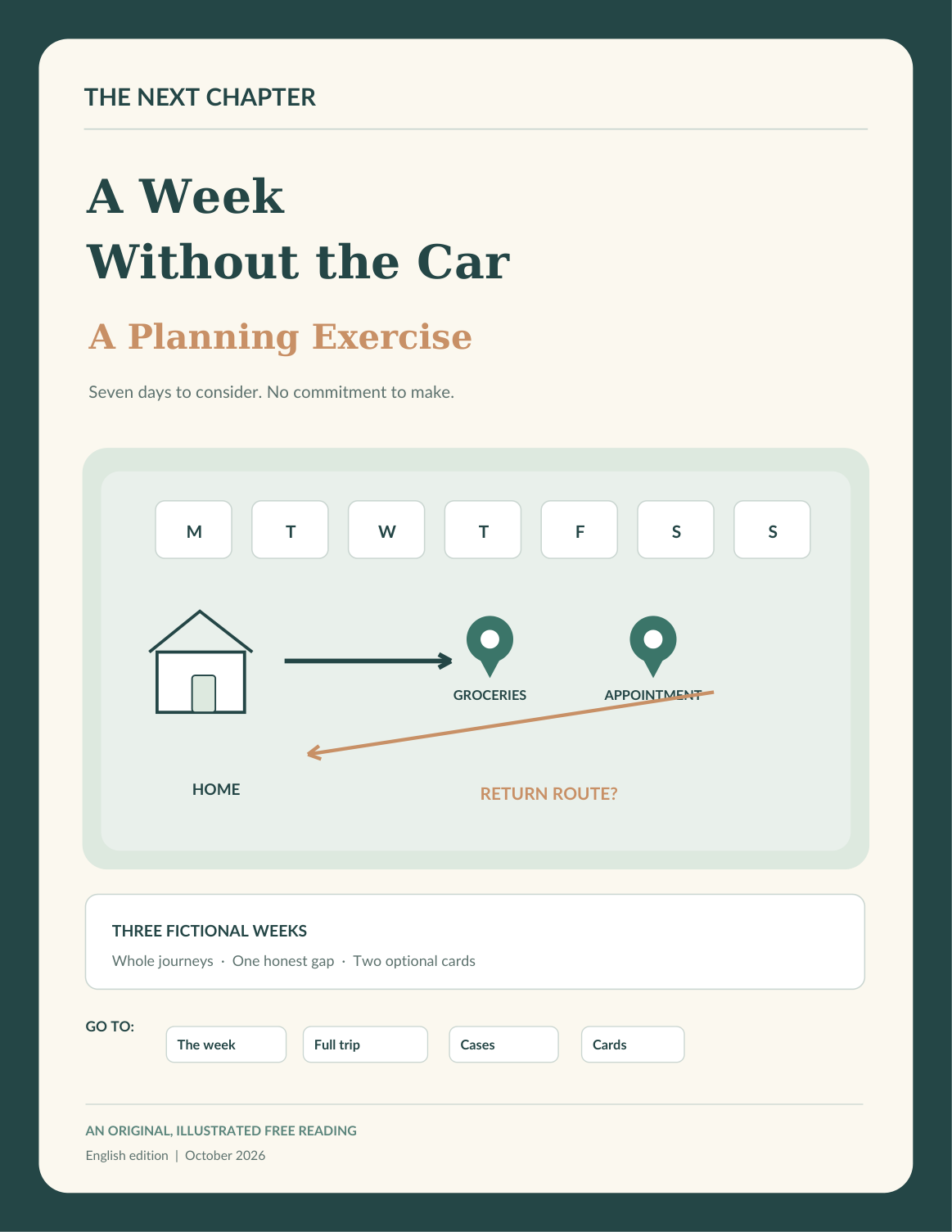
THE NEXT CHAPTER
Seven ordinary days. Real destinations. A return journey. Questions worth checking before any life-changing decision.
This free illustrated guide is a paper exercise, not a recommendation to stop driving or to give up a car. You will map an imaginary car-free week in the place where you live, separate what you know from what you hope might work, and find the questions that deserve a real answer. Three fictional households show different outcomes. Two optional private cards help if you prefer to write rather than merely think.
Try the idea on paper first
ONE WEEK, NOT A PERMANENT VERDICT
A neighbour says she hardly uses her car now. A relative suggests that delivery services can replace most errands. You see a bus stop near the library and wonder whether you could manage with fewer drives. These observations may be useful, but they do not tell you whether your own next Tuesday would work.
Instead of asking, “Could I live without a car forever?” ask something smaller: “What would an ordinary week require if the car were unavailable?” The answer might be a workable set of choices, a list of things to confirm, or a clear reason that the idea does not fit right now.
Keep the actual car and your current arrangements unchanged during this exercise. Do not miss an appointment, cancel transport, or change any driving decision to prove a point. If a real driving-safety or medical concern exists, the appropriate qualified professional or local authority—not this guide—must address it.
The exercise is successful when your unknowns are clearer. You are not failing if the resulting map says, “Not realistic at present.” That is valuable information about your circumstances, not a judgment about your independence.
Name the trips before the transport
START WITH YOUR ACTUAL LIFE
Write the next seven days across a page. Think about groceries, work, a regular appointment, collecting medication, meeting someone, a class, or visiting a person who relies on you. Include things that happen only once this week, rather than building a perfect schedule from what usually happens.
Each trip has more than a destination. It has a time window, a duration inside the place, the possibility of carrying something home, and often another person whose agreement is needed. Getting to a supermarket is a different task if you cannot carry your full order back. Reaching a class is only half the story if the last bus leaves before it finishes.
Do not guess that every obligation is fixed. Sometimes an organiser offers another session, or a pharmacy permits a different collection arrangement. Those possibilities need confirmation before they become entries in your plan.
The point is not to list as many trips as possible. Identify the few that would genuinely shape the week. One trip that absolutely must happen on Thursday may matter more than five pleasant activities whose dates are flexible.
Three kinds of commitments
GIVE EACH TRIP ITS RIGHT WEIGHT
Put each destination in one of three groups. Fixed means that for this example week, the date or time is not yours to move, such as a confirmed appointment. Flexible means you may be able to choose a different day or service, but have not yet assumed that change is available. Optional is something you would enjoy but can decline without pretending it is a failure.
These labels describe the trip, not the person. A family visit may be emotionally important even if its hour can change. A medical appointment may be essential, but this guide cannot decide whether it may legally or clinically be postponed. Keep sensitive health details off the worksheet; “Friday appointment” is enough.
For one fictional week, imagine grocery shopping on Tuesday as flexible, a Friday appointment at 2:00 p.m. as fixed, and Saturday gallery browsing as optional. You may discover that changing Tuesday's grocery hour has no effect on the Friday gap. That is why the categories matter.
Where another person is involved, a possible rearrangement is not an agreement. Ask before moving their part of the plan. Your imaginary car-free week should be honest about the lives around yours, not just your calendar.
Map the whole door-to-door journey
OUT, INSIDE, AND HOME AGAIN
Draw three boxes: leave home, the activity, and return home. Then fill the spaces between them with the real pieces of a journey: reaching a stop, waiting, boarding, walking from the arrival point, carrying items, waiting for the return connection, and getting home from the final stop.
A map may show a route between two pins without telling you whether it runs at the hour you need. Walking distances on a screen may not describe crossings, gradients, winter surfaces, seating, or an accessible path. A route found online is a research lead, not a promise of personal access or safe passage.
Estimate only what you genuinely know. Put a question mark beside an unverified service, and distinguish an operator's actual answer from a guess. You can complete the entire exercise at home without taking a test trip; there is no requirement to make an outing.
One useful question is: “If my outward trip works and the activity runs late, how would I still get home?” A plan with an answer only for the outward journey is not yet a complete transport plan.
Check the hour, not just the route
THE RETURN MAY BE THE DECIDING FACT
A bus icon on a map can make a neighbourhood feel connected. But the actual published service might run only on certain weekdays, stop before your appointment ends, or require booking. A community shuttle may have a defined eligibility rule, service boundary, fare, or reservation cut-off. Even a taxi service may not confirm your proposed time.
Ask about your exact outward and return windows, any booking requirements, the fare for both legs, and anything specific to your needs. Information can change; a cached timetable or an old discussion post should not be treated as proof of today's availability.
If you need space for a mobility device, assistance, a particular pickup location, or a seat during transfers, ask the operator about the actual service. Do not replace an operator's answer with this publication's optimistic assumptions. You need not record diagnoses or identifying account details in your private worksheet.
Keep the statuses simple: confirmed for the specified journey, possible but unverified, or not usable for this week. “Not usable” is about the fit of one route and one time, not about the worth of a place or a person.
Give the journey home equal space
DON'T FINISH THE PLAN AT ARRIVAL
Imagine a class ending at 8:15 p.m. There may be excellent daytime service to the building, but no appropriate return at 8:30 p.m. A map showing frequent morning connections would not solve that evening problem. A schedule that once existed is not necessarily still in effect.
For each essential trip, ask: When does the activity end? How long would it take to reach the boarding point? What is the latest usable return? If a service is missed, is there a real, previously agreed alternative? What happens if bad weather changes the accessible route?
Be careful with offers of help. “My friend sometimes drives in town” is not a confirmed ride. You can ask respectfully, and they can decline. When the answer is no, write no. If the trip depends on them and no other option is verified, mark it as a gap rather than an imaginary booking.
A good plan makes room for contingencies without demanding that other people remain on call. It is honest about return timing, costs, physical accessibility, and who is actually available.
Remember what you bring back
THE TRIP HAS A WEIGHT AS WELL AS A TIME
A nearby store may be easy to reach on foot when you only need a loaf of bread. The same trip may be awkward with a week's groceries, heavy items, fragile packages, or an unexpectedly large order. Your limits and preferences are yours to know; this publication does not assess lifting, mobility, or medical safety.
Possible alternatives include buying less per visit, using delivery if an actual local provider serves your address, combining shopping with a separate confirmed trip, or asking whether someone can help. Each option comes with its own possible cost, timing, eligibility, availability, or consent condition.
Don't write “delivery” in your completed plan unless you know the seller accepts the address and can provide a relevant delivery slot. Likewise, a friendly offer from a relative is still an offer that needs a specific agreement, not a substitute for a transport system.
Ask the same question in both directions: What leaves the house with me, and what needs to come home? A clear answer can change which shopping trip makes sense, without requiring a permanent decision about keeping or losing a car.
Ask for help without assigning a duty
OTHER PEOPLE HAVE THEIR OWN WEEK
It can be uncomfortable to ask for a lift. Some people avoid asking altogether; others feel they must promise a future favour before they have even discussed the journey. A small, precise request is kinder to everyone than an indefinite expectation.
You might say, “Would you be available to take me to the library on Wednesday at 11? It's entirely fine if that doesn't fit.” Be ready to explain the expected return time, where pickup would be, and whether costs are involved. You need not give someone personal medical details to make a simple transport enquiry.
If they cannot help, thank them without negotiating away their refusal. If they agree, confirm the particular time and return arrangement, and leave room to adjust if either person's circumstances change. Do not assume a yes to one trip is a weekly promise.
Your plan may end with “No confirmed assistance for Friday.” That is not a failure of friendship. It is the difference between a kind idea and something sufficiently reliable for a genuinely necessary journey.
Include the complete cost, then separate guesses
NOT EVERY QUOTE IS MONEY SPENT
If a bus fare is quoted for one direction, include a return fare unless the actual fare rules say otherwise. If a delivery service has a minimum order or compulsory service charge, do not omit it. If two people share one agreed ride fare, count the shared fare once, not once per passenger unless the provider charges separately.
Keep three columns: already paid, price confirmed but not paid, and price unknown. A membership you already own may mean no new charge for a particular visit, but that does not make the original membership free. An advertised vehicle service may be an option worth exploring, but it is not a booking or proof of availability.
Be especially careful when comparing an imaginary car-free week with actual car ownership. Fuel, insurance, maintenance, parking, depreciation, taxes, mobility aids, and other recurring costs are not settled by this small exercise. Do not treat one lower bus-fare total as proof you should sell a car or change your retirement finances.
This is a readiness and information exercise, not comprehensive transport-budget advice. The useful result is a list of real trip costs and missing facts that you can check without making a purchase.
Let the gap be visible
AN UNKNOWN ANSWER IS AN HONEST ONE
Sometimes a weekly map looks almost complete. Monday is easy on foot, Tuesday's shop is reachable, Wednesday's appointment has a bus. Then Friday arrives with a fixed time and no verified way home. It can be tempting to fill that box with a hopeful “probably a ride.” Resist the urge.
Circle the gap and identify what would resolve it: a timetable at the correct hour, a confirmed accessible return option, a genuinely available delivery slot, or a specific person who has independently agreed to help. Do not let one unresolved essential trip disappear because the other days look attractive.
There are at least three legitimate outcomes. Workable on paper with verified options means the critical facts exist, though the week has not been lived. Possible but requires answers means one or more claims remain unverified. Not workable for this example week means a necessary journey has no acceptable confirmed option. None is a permanent verdict on your future.
A small test that reveals one serious limitation has done its job. The next step may be to ask one operator a question rather than to make any personal lifestyle change.
A complete fictional trip in minutes
THE ARITHMETIC IS NOT A REAL TIMETABLE
For practice, imagine a wholly fictional Tuesday grocery trip. Ada leaves home at 9:40 a.m. She takes 10 minutes to the stop, waits 15 minutes, rides 25 minutes, walks 8 minutes to the shop, spends 35 minutes shopping, walks 8 minutes back, waits 15 minutes, rides 25 minutes homeward, and walks another 10 minutes home.
The total is 10 + 15 + 25 + 8 + 35 + 8 + 15 + 25 + 10 = 151 minutes. Starting at 9:40 a.m., she reaches home at 12:11 p.m. That is more than two and a half hours for a fairly simple grocery outing. The numbers are teaching examples and do not represent any existing bus route.
Suppose, only in this fictional example, that she buys an outward bus fare for CAD 3 and a return fare for CAD 3. CAD 6 is the actual transport spending. Groceries would be a separate cost of the shopping itself, not the transport comparison. She did not buy any hypothetical delivery plan or annual pass.
What the numbers cannot show is whether the bags are manageable, the stops are usable, or the service is genuinely available. Those questions need their own answers.
Ada: one outing fits, Friday does not
FICTIONAL JOURNEY ONE
Ada is not considering selling her car today. She is curious whether she could rely on it less, so she imagines an ordinary week with Tuesday groceries, a Thursday book club, and a Friday appointment. These people, journeys, times and prices are entirely invented.
She has already made the Tuesday practice grocery trip from page 12: 9:40 a.m. to 12:11 p.m., 151 minutes, with CAD 6 in actual round-trip bus fares in this fictional story. She enjoyed choosing what to buy, but the bags made her rethink whether she would want that trip every week.
Thursday's book club is optional. She considers a library session, but has not checked the return schedule, so it remains possible, unconfirmed. For Friday's fixed appointment, she has not found a verified return route. Her neighbour's past kindness is not a standing offer of a lift.
Ada's answer is neither a triumphant yes nor a permanent no: Tuesday worked once, Thursday is unknown, and Friday has an essential gap. The useful next action is one transport enquiry about Friday—not a promise to give up driving.
Ben: a trip replaced by a question
FICTIONAL JOURNEY TWO
Ben lives outside a town centre and initially writes “Monday library” on his weekly sheet. A catalogue search suggests a resource might exist, but he has not confirmed the title is held locally, that borrowing is permitted, or that an accessible journey is available.
Instead of taking an unnecessary trip, Ben spends 20 minutes making a preliminary enquiry from home. In this fictional situation, no travel occurs, no item is reserved and no membership is purchased. His additional cash spending is CAD 0 for this enquiry; that does not claim his existing phone or internet subscription is free.
The staff member suggests another possible way to request the material, but it is not yet approved or booked. Ben changes the Monday box from “library visit” to “remote enquiry completed; further service confirmation needed.” Tuesday's grocery problem and Friday's appointment are still separate questions; the phone call cannot solve them by magic.
His result is modest but genuine. One proposed trip has been replaced by information gathering. He has avoided treating a search result as an entitlement, and he has made no unsafe transport or access promises.
Ruth and Ellis: one shared trip, not two promises
FICTIONAL JOURNEY THREE
Ruth and Ellis share a home, but they have different priorities. Ruth wants to attend a Wednesday afternoon music session; Ellis needs to collect a parcel nearby. They consider travelling together, using a hypothetical shared return ride costing CAD 8 for both people together. This number and the entire situation are fictional.
The shared ride has been quoted, not booked or paid. Counting it twice would make the imagined transport cost CAD 16 when the single shared quote is CAD 8. More importantly, neither person has yet confirmed that the service can accommodate the parcel, the timing or the return destination.
Ruth's music session is optional and unreserved. Ellis's parcel collection may require identification and an opening-hour check. They do not transform the imagined joint journey into a completed outing; actual incremental transport spending on this proposal is CAD 0.
Their conclusion is possible but unverified. They agree only to ask the actual operator for conditions. They have not promised to make this a weekly habit or to travel together every time. A shared household may find a combined errand helpful sometimes without treating each person's time as permanently interchangeable.
Three results that deserve different labels
DON'T TURN A QUESTION MARK INTO A CHECK MARK
| Fictional decision | What is actually known | Current honest status | |---|---|---| | Ada's Tuesday groceries | Out and back completed, 151 minutes, CAD 6 transport paid | One completed trip, not a general solution | | Ben's library enquiry | Twenty-minute call, no journey, no booking, CAD 0 new cash | Information gathered; availability still unknown | | Ruth and Ellis's shared outing | CAD 8 shared return ride quoted, not paid or booked | Possible arrangement; operator confirmation needed |
Look across the three rows. A completed outing, a completed enquiry and an unbooked proposal are all forms of progress, but they are not interchangeable. The numbers describe only their respective fictional examples.
What would your table say? Perhaps most of the week is workable with confirmed routes. Perhaps every attractive route still needs an actual operator reply. Perhaps a fixed appointment reveals an unacceptable gap. A truthful label is more useful than a hopeful percentage of boxes filled.
Choose one fact to confirm next
ONE CALL IS BETTER THAN SIX ASSUMPTIONS
You now have a provisional week on paper. Do not try to turn it into a research project about every transport provider in the region. Select the one unknown that most affects a necessary journey. It might be the return after Friday's appointment, whether a delivery provider serves your address, or whether a community ride requires membership or advance notice.
Write a concise enquiry: “I need to arrive by 1:45 p.m. on Friday and leave after about 3:15 p.m. Does your service operate for both journeys, and what would I have to book or pay?” Change the details to yours; this is a script, not a claim about any real operator. Never assume a published example assures eligibility.
If you receive a reply, note when you obtained it, what it covers and what is still conditional. If no answer arrives, the correct status remains unknown. You can stop here. The map is useful even without a test trip or a purchase.
Your seven-day card
OPTIONAL PRIVATE WRITE-IN TOOL
A page for the smallest honest version of your example week. You may leave any or all spaces blank. Use broad labels instead of storing medical details or private accounts.
Week beginning: Which week are you imagining? A general week is fine.
Fixed essentials: Which confirmed obligations truly have limited time windows?
Flexible needs: What shopping, visits or tasks could move only after checking?
Optional pleasures: Which activities can you freely skip or choose another day?
Whole return journeys: Which outward and homeward segments are genuinely confirmed?
First honest result: Is the week workable, incomplete pending answers, or not workable now?
Your one-gap card
OPTIONAL PRIVATE WRITE-IN TOOL
A second page for one unresolved trip, not an instruction to disclose personal information or ask someone to help. Nothing here is an actual booking.
Trip and needed hour: Name the essential destination using no sensitive details.
Outward route status: What is confirmed, possible, or not currently usable?
Return route status: What is confirmed about getting home at the right time?
Cost or accessibility unknown: Which fare, eligibility, carry-home or access detail needs checking?
Specific question to ask: Who is the real operator or willing person, and what would you ask?
After the answer: What did they actually confirm, and what remains undecided?
A useful week can remain on paper
KEEP THE QUESTION SMALL
The value of this exercise is not that you proved a car is unnecessary. You may find that some errands are easy without it, that one joint outing might work, or that an essential appointment would be difficult to reach and return from. All three are legitimate observations when honestly labelled.
A week of destinations shows part of a life, not everything in it. Seasons, shifting family duties, service availability, weather, access arrangements, costs and changing preferences can make a second week different. These pages do not provide medical advice about driving, certify personal safety or access, settle insurance or finances, or replace a provider's actual terms.
You do not need to perform a real trial, ask a friend for help, buy a pass, stop driving or complete either card to use this free guide. If a genuine transport change is being considered, make it separately and with the real information and professional advice appropriate to your circumstances.
The ending can be as simple as “I know which journey to ask about.” You have learned something useful without having to change your life first.