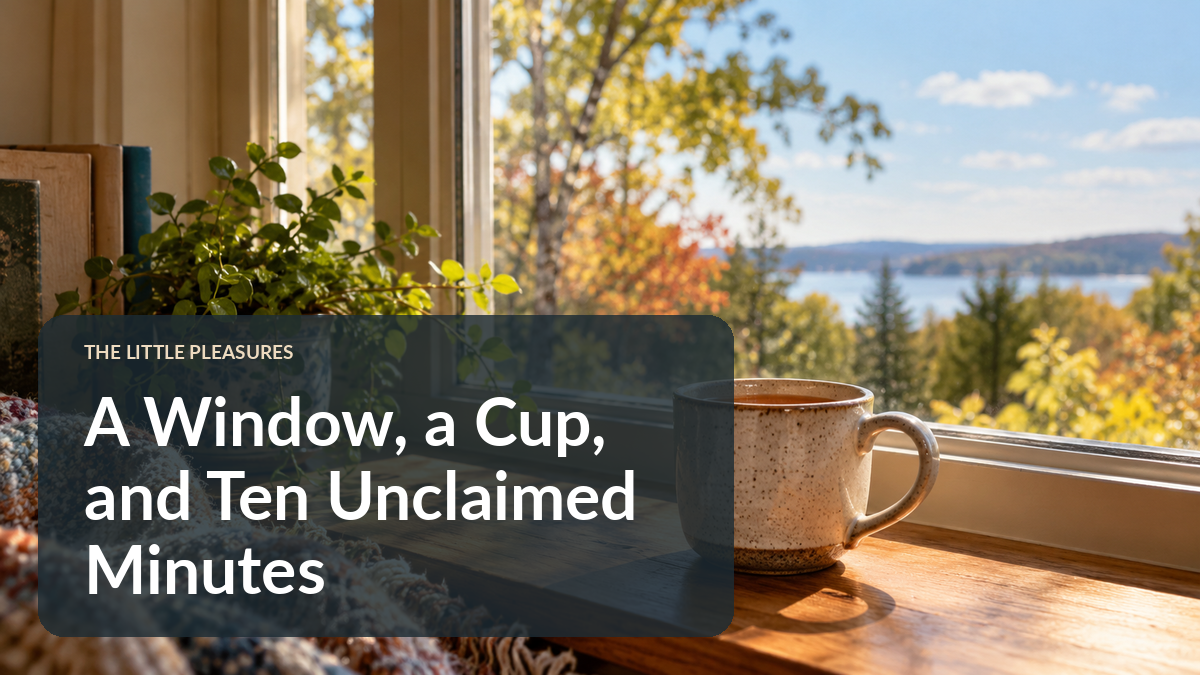
On the quiet pleasure of a pause that does not have to become a project
There is a particular kind of afternoon that never makes it into a photograph. The kitchen is almost tidy, but not quite. One envelope has been moved from the counter to the table and back again. The cup is clean; the teaspoon is not. Beyond the window, the same piece of sky is doing what it has been doing all day: changing without announcing it.
Nothing has happened. At least, nothing worth putting on a calendar.
And then, for ten minutes, you sit down.
Not because you have earned a reward for finishing everything. There is still the envelope, and something in the fridge needs using, and perhaps somebody is expecting a message. You sit down because the chair is there and, for once, you are willing to occupy it without an explanation.
That is the whole event. It may also be a small luxury.
The habit of filling an empty space
An unclaimed stretch of time can be unexpectedly difficult to leave alone. We learn to place things inside it, almost automatically. A phone call. A cupboard to sort. An article to read about how to sort cupboards more effectively. If the afternoon opens up, we ask what we ought to do with it, as though an open hour were a room that needs furniture.
For many years, that question has made perfect sense. Work, caring for others, journeys, appointments and all the small demands of ordinary life leave gaps that must be managed. Even after a working life changes, those habits do not disappear on the day the routine does. Nor should we pretend that everybody suddenly possesses hours of leisure. There may be a partner to care for, grandchildren to collect, medical appointments, bills, paid work or tiredness that consumes the rest of the day.
So the pleasure is not in possessing endless free time. It is in occasionally noticing a little pocket of time that belongs to no task at all.
Ten minutes is not much. That is one of its attractions. You do not need a special destination, a new interest, a carefully chosen outfit or a story to tell anyone later. You can simply sit by the window with something to drink, or without it.
What the window offers
Windows do not promise entertainment, but they frequently deliver it in miniature.
A shadow reaches the edge of a plant pot. A delivery van pauses across the street, and then it goes. Rain gathers on the glass in two different-sized drops; the larger one catches the smaller. On a clear day, a patch of light crosses the table so slowly that you notice it only when it has nearly left.
These are not profound revelations. They are wonderfully undemanding. You can watch a cloud without learning its name. You can enjoy the movement of tree branches without turning it into a lesson about trees. Some days the view is a brick wall, and even the brick wall has its changing tones: pale in the morning, ordinary at noon, unexpectedly warm before evening.
It is easy to think that a pleasant moment must be an impressive one. A weekend away, a concert, a view worth travelling for. Those pleasures matter too, when they are possible. But a window asks for no ticket. It lets the familiar scene arrange itself a little differently, and then a little differently again.
Of course, a window may face traffic, a building site or a street that feels anything but restful. Nothing about this requires pretending otherwise. The small pleasure might be the sound of a kettle finishing its work, the smooth handle of a mug, or the way a page turns when you find a comfortable place to hold the book. The view is only one invitation.
The cup you actually like
There is often one cup that wins a household's quiet competition. It is not necessarily the newest or the prettiest. Perhaps its handle fits two fingers just right. Perhaps it has survived three kitchens and a chip that everybody has agreed to ignore. Perhaps it is the large mug that makes a modest amount of tea look like a generous gesture.
Objects become familiar without our having to make grand claims about them. A favourite cup is not an heirloom because someone has officially declared it precious. It simply knows your hand, or rather your hand knows it.
You can drink tea, coffee, water or nothing at all. The drink is less important than the small sequence: find the cup; set it down; let the shoulders settle; take a sip when you remember. If you are inclined to be practical, you may already be estimating how long the pause should last. Resist the estimate for a moment. The cup does not need a performance review.
There is a gentle absurdity in the idea that we should optimise our own rest. We are told to make breaks productive, to return refreshed, to use silence to plan the next great thing. Sometimes a break will help with those things. Sometimes it won't. A good cup of tea does not become a failure because it has not improved anything.
The second voice in the room
The trouble with sitting still is that the busy mind comes along too.
It may offer a running commentary: You could be answering that email. The hall cupboard is a mess. Perhaps you should call someone. Shouldn't you be grateful? Are you wasting the afternoon?
That last question is particularly persistent. For people who have spent decades being useful—to employers, families, neighbours, clients, children or parents—usefulness can begin to feel like a condition of belonging. Stepping outside that role, even briefly, may feel strangely exposed.
But there is no rule that a person must be useful every minute in order to matter. Enjoyment is not an invoice that needs a matching achievement. Nobody has to approve a ten-minute pause.
This is not a demand to be serene. You might feel restless. You might stand up after two minutes. You might remember the washing and go to rescue it before the rain. All perfectly acceptable. The pleasure does not require you to become a different, calmer kind of person. It is simply an option available inside an ordinary day.
A tiny occasion, with or without company
One reason small pleasures endure is that they can change shape.
There are days when you would rather have the table to yourself. A quiet drink can be a small declaration that you do not need company at every moment. There are other days when the most welcome thing is another person coming into the kitchen and asking, “Is there enough hot water for me?”
Two cups do not automatically mean a deep conversation. Perhaps one person reads the newspaper while the other looks outside. Perhaps you talk about the ridiculous price of something in the supermarket. Perhaps you say very little. Shared time does not have to be memorable to be kind.
Equally, solitude need not be treated as either a triumph or a tragedy. Some people enjoy it; some find it difficult; many move between the two. If a quiet afternoon makes you long for contact, that feeling deserves to be taken seriously, not decorated with slogans about the joys of being alone. You may choose to make the call after all. The pause has not been spoiled by turning into a conversation.
The point is to let the moment tell you what it can offer, instead of insisting in advance what it ought to be.
Leave a little of the afternoon unclaimed
If you enjoy this sort of pause, you do not have to turn it into a daily ritual. A ritual can be lovely, but an obligation wearing a softer name is still an obligation. There is no streak to maintain and nothing to tick off.
On a crowded day, ten minutes may not be available. On a difficult day, a pleasant view may not make anything better. And on another day, the ordinary scene may surprise you: the slant of late light, the particular sound of a spoon touching porcelain, a bird that lands and leaves before you have decided what kind it is.
You may catch yourself thinking, I should remember this. You may even reach for your phone. But not every good moment needs to become evidence. It is possible to enjoy something without saving it, posting it, explaining it or even remembering it very well.
The cup will eventually need washing. The envelope will still be waiting. The day will continue to make its demands, many of them reasonable and some of them urgent.
For now, the table is holding the cup. The window is holding a small piece of the afternoon. And you, quite unnecessarily and quite wonderfully, are doing nothing in particular.
That is enough.
The Little Pleasures is a free reading column from The Next Chapter. This essay is an original reflection; its everyday scenes are illustrative rather than accounts of reported people or events.