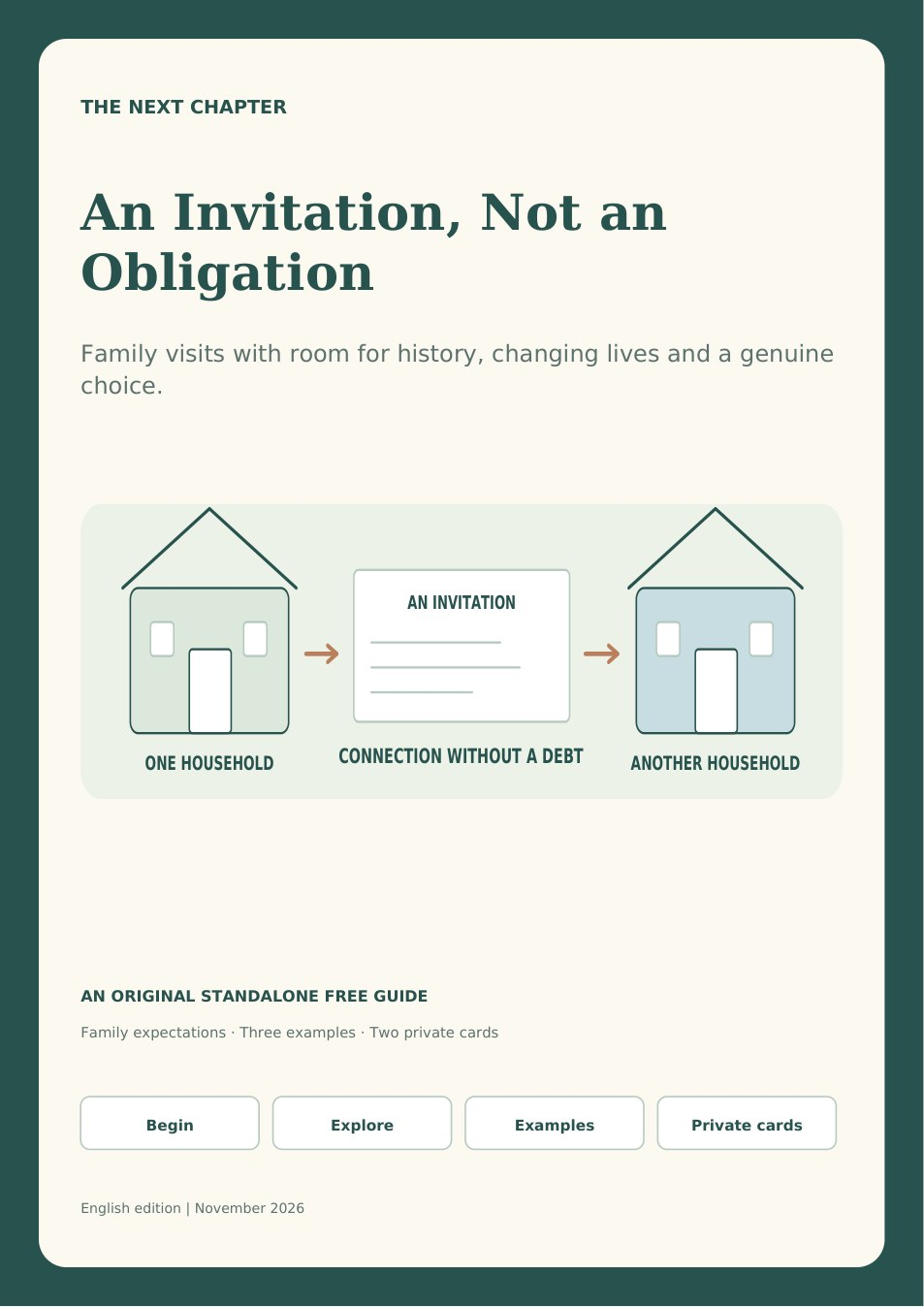
Family visits with room for history, changing lives and a genuine choice.
The invitation has a history
“Would you come over on Sunday?” can be a small question. In a family, it may arrive carrying years of earlier Sundays: who always cooked, who travelled, who was criticised for leaving early, and who was expected to explain an absence. A familiar sentence does not necessarily feel like a fresh choice.
This guide is for a parent who wants to invite an adult child without turning affection into attendance. It also offers words for an adult child making or receiving a family invitation. The task is limited: make one possible visit honest about what it includes, and leave space for an answer that is not the one you hoped for. It is not a plan to repair an entire relationship.
You can miss someone and still let them decline. You can value a tradition without assuming it continues unchanged. You can also decide that you cannot host, travel or join this time. A genuine choice belongs to both households, not only to the person receiving the message.
Start with the part you control. Instead of asking, “How can I make them want to come?”, ask, “What have I attached to this invitation, and what will I do if they do not accept?” The second question is less exciting, but it gives you something practical to change. No purchase, registration or completed worksheet is needed to use any of these ideas.
Separate the visit from the meaning
An invitation may contain three different things: the proposed visit, your hope, and a conclusion about the relationship. “Would you join us for lunch?” describes a visit. “I would enjoy spending time together” expresses a hope. “If you cared about this family, you would come” turns attendance into a verdict.
Keep the first two; do not require the third. A declined lunch does not give you enough information to decide what another person feels. Nor does an accepted lunch prove that everything between you is settled. A visit can be welcome and still be only a visit.
Try this private edit: write what you would actually like to offer, then identify what you wish it would demonstrate. Perhaps you hope to feel remembered, to keep a holiday familiar, or to reassure someone that your home is still theirs to visit. Those hopes deserve recognition, but the invitee does not have to deliver all of them by arriving on a particular day.
Words to use: “I would enjoy seeing you for lunch on Sunday. I know this month may look different for your household. Would that suit you?” This is not a magic formula. If you follow it with reminders about sacrifice or loyalty, the reassurance will not carry much weight. The useful change is in the condition you remove: the visit is no longer a test the other person must pass.
Yesterday's pattern is not today's agreement
A family may have met every Sunday for years without anyone naming it as a standing arrangement. When work, relationships, health, distance or simply preferences change, the pattern may no longer fit. You do not need to prove that one change is important enough before discussing it.
There is a difference between remembering a pattern and claiming a promise. “We used to have Sunday lunch together” is a memory. “You owe us Sundays because that is what we have always done” adds an obligation. If a real current commitment needs changing, discuss that commitment directly; do not silently treat every past visit as a new one already accepted.
A parent can say: “I've been assuming Sunday lunch still works as our usual plan. I'd like to check rather than assume. Would you prefer invitations for individual dates instead?” Only offer that change if you can actually honour it. The answer might be that occasional invitations are welcome, or that the person would rather initiate contact for now.
An adult child can say: “I have enjoyed those lunches. I am not committing to every Sunday now. Please ask about a particular date rather than counting us in.” They need not present a complete calendar to justify the change.
One conversation may clarify the next invitation without settling every future holiday. It is enough to stop treating an old pattern as automatic attendance this week.
Name the hidden work before inviting
“Come over” may mean eating together. It may also be understood to mean collecting relatives, fixing a device, supervising children, bringing a dish or staying to clean. Unspoken work can make a supposedly optional visit expensive in time and energy.
Before sending the invitation, distinguish what you are offering from what you are requesting. If you need help moving furniture, say that separately; do not announce the task after the guest arrives. A family member can accept lunch without agreeing to a repair job. Equally, a host can offer a simple meal without undertaking an elaborate celebration.
A clearer invitation: “Would you like to come for soup on Saturday, from about noon until two? I can provide the meal. There is no job or errand attached.” Use the last sentence only if it is true. If help is genuinely needed: “Separately, I need help with the boxes. I will ask about that another time; coming for lunch does not commit you to it.” Do not use this separation as a way to make two demands at once.
Guests, too, should check before enlarging the plan. “Could I bring someone?” is a question, not an announcement. An invitation does not automatically include overnight accommodation, childcare, transport or permission to share family photographs. Confirm the details that matter before either household relies on them. A smaller honest offer is kinder than a generous-sounding one that becomes a surprise assignment.
Two households, not one available calendar
Retirement may create more open hours for one person without creating them for anyone else. An adult child may have work, another household, friends, rest or plans they do not want to describe. A parent may also have commitments that are not visible. Neither person needs to demonstrate busyness before their time counts.
Ask about the arrangement, not for proof of the reason. “Would an afternoon visit be workable?” leaves more room than “What are you doing that is so important?” If the answer is no, an offer to discuss another date is useful only when both people want that discussion. A refusal does not create an assignment to find you a replacement slot.
Avoid assuming one adult can commit a partner or other adult relative. “Would you and anyone in your household who wants to join be interested?” still requires confirmation of who is coming. Where children are involved, their responsible adults need to make the relevant arrangements; this guide does not decide caregiving or access questions.
A host's limit: “I would like to see you, but I cannot host overnight this time.” A visitor's limit: “I can join for lunch, but not for the whole afternoon.” Neither sentence is a criticism of the other person's wish. If the limited version does not work, the visit can remain unarranged. The aim is not to engineer a compromise at any cost; it is to describe an option both sides can honestly choose.
Gifts and favours are not admission tickets
A past gift or generous act can sit quietly behind an invitation: “After all we have done…” You may genuinely remember the effort. Bringing it into the invitation, however, can make a visit feel like repayment rather than company.
Keep appreciation and attendance separate. If you gave a gift without agreed conditions, do not add a visit condition later. If there is a real unresolved practical arrangement, discuss it openly as its own matter rather than collecting it through a social invitation. This is a communication distinction, not advice about anyone's legal rights or financial agreements.
Replace: “We helped you last month, so surely you can manage one dinner.” With: “I'd enjoy dinner together. Would Friday work for you?” If you cannot yet make that offer without expecting repayment, pause rather than adding “no pressure” to a demand.
The recipient can respond without debating the entire family record: “I appreciate what you did. I am not agreeing to dinner this Friday.” Appreciation need not erase a limit. Similarly, a parent receiving an invitation can say, “Thank you for thinking of me. I won't be travelling this weekend,” without proving that gratitude and refusal can coexist.
Do not use access to ordinary support, affection or private information as leverage for attendance. If practical dependency or fear makes refusal unsafe, better wording alone is not an adequate answer. The person may need confidential support suited to their circumstances, not a more persuasive invitation.
A holiday can change without becoming a contest
A birthday or holiday can make one visit carry unusual weight. Separate households may have different traditions, travel limits or people they want to see. An equal division of hours is not automatically a fair or workable arrangement, and this guide offers no formula for distributing family time.
Name what matters to you without making it the only acceptable outcome. “I would love to share a meal around the holiday” leaves more room than “If you are not here on the day, you are choosing them over us.” Avoid asking people to defend another household's plans or disclose who invited whom first.
A flexible offer: “I'm planning a simple meal on Saturday. You are welcome if you would like to join. If this year is different, I won't assume we need to make up the visit.” An alternative date is an offer only when it is genuinely welcome to you and does not become the next required answer.
You can also have a real limit: “I can host on Saturday, but I cannot organise a second meal.” That does not cancel the invitee's freedom to decline Saturday. It means there may be no shared meal this time.
Do not turn grandchildren, siblings or group-chat reactions into votes on the decision. Tell others only what is necessary and agreed. A family occasion can remain important to you even when another person participates differently or not at all.
Make the response match the invitation
“No pressure” becomes believable through what follows it. If a family member declines, you can acknowledge the answer without asking them to comfort you, prove a reason or offer a substitute visit. “Thanks for telling me. I won't count you in” is sufficient.
If they accept a shorter visit, confirm the actual limit: “Lunch until two works. I'll plan around that.” Do not save an important announcement or extra course for the moment they are leaving in order to extend the visit. If a genuinely necessary practical issue arises, name it honestly rather than disguising it as hospitality.
When the answer is undecided and you need to plan food, describe your own next action: “I am planning the meal on Thursday. If we haven't confirmed by then, I will plan without you this time.” The deadline should reflect a real planning need, not a test of how quickly they respond. Do not book or spend on their behalf without agreement.
A cancellation can be disappointing. You can say, “I'm sorry we won't meet today. Thank you for letting me know,” while handling your feelings elsewhere. Real agreed booking costs may require a separate factual conversation; do not invent a cancellation debt after the event.
These are examples of proportionate responses, not a required script. The key family-specific question is: Will this answer be held against the person at the next invitation? If so, there is still pressure to remove.
Repair the pressure you already added
You may notice the pressure only after sending the message. Perhaps you wrote, “I suppose you will be too busy for us again,” or asked a sibling to persuade the person. You can withdraw that pressure without asking for instant forgiveness or a changed answer.
A useful repair identifies your action: “My message made the visit sound like a test of whether you care. That was unfair. You do not need to come or explain your decision.” Then state what you will change: “I won't ask your brother to follow up, and I won't count you in.” Keep that promise. A long explanation of why you felt hurt can put the responsibility straight back onto the recipient.
If the person says the correction does not feel convincing, do not argue them into trusting it. “I understand that a message does not undo the pattern. I will respect your answer” is more honest than “I've apologised, so why are you still upset?” Changed behaviour may matter more than another paragraph.
This repair does not guarantee renewed contact, a visit or reconciliation. Where the person has asked not to be contacted, do not use an apology as a reason to send another message, visit their home or route it through relatives. Respect the existing limit. Drafting an unsent note for yourself can still help you identify what you will stop doing.
One invitation can be corrected without demanding that the family settle its whole history today.
When not sending is the better choice
This guide assumes there is an appropriate, welcome route for ordinary contact. It does not recommend inviting someone who has asked for no contact, arriving unannounced, finding a new number through relatives, or treating a blocked channel as a technical obstacle to overcome.
A serious unresolved conflict is not made safe by calling it Sunday lunch. Do not invite someone to a meal and then surprise them with a confrontation, unwanted guest or discussion they have already declined. If a difficult conversation is appropriate, ask openly about that conversation; attendance at a visit is not consent to it.
There may be situations involving threats, intimidation, coercion or practical dependency in which these ordinary phrases are inadequate. You do not have to attempt a conversation or family visit to prove goodwill. Seek appropriate local, confidential support if needed; if there is immediate danger, prioritise safety and local emergency assistance. This book cannot assess an individual situation.
You can also choose not to invite for less dramatic reasons. You may not have the energy to host, may need more time to accept a refusal calmly, or may simply prefer a quiet weekend. “Not this time” is available to the inviter as well as the invitee.
The absence of a visit is not, by itself, evidence of either a healthy or an unhealthy family. What matters here is narrower: do not use an invitation to cross a limit you already know about.
Fictional example: changing the Sunday pattern
This is an invented situation, not a testimonial. Elena has hosted lunch on most Sundays. Her adult son Ravi has recently said that he no longer wants a standing weekly plan. Elena misses the familiar routine and drafts, “Will you finally make time for us this Sunday?”
She notices that “finally” turns the invitation into a complaint. She sends instead: “I have been treating Sunday as automatic. I understand you are not agreeing to that now. I'd enjoy lunch together this Sunday if you want to come, but I won't count you in unless we confirm.” She does not ask for his work calendar or compare him with his sister.
Ravi replies, “Not this Sunday. Please leave the next suggestion to me.” Elena answers, “All right. I won't send another date.” She makes her own lunch plans and does not ask his sister to find out when he might visit.
What happened in the example: one invitation was declined, and Elena respected Ravi's request to initiate any next suggestion. No visit, booking or new expenditure occurred. What did not happen: Ravi did not promise a future date, and the story does not establish that their relationship improved or that Elena stopped feeling disappointed.
The useful change is specific and observable: an old pattern was no longer treated as an accepted plan, and the response did not create a new obligation. Elena's disappointment and Ravi's freedom could both exist without becoming a negotiation about this Sunday.
Fictional example: a smaller visit, no hidden job
This is an invented situation. Martin wants his adult daughter Jo to come for lunch. On earlier visits he has asked her to sort household paperwork after the meal, making the afternoon longer than expected. He would still welcome help, but recognises that he has mixed two requests.
He says, “Would you like lunch here on Saturday, from noon until two? I won't bring out the paperwork. If I need help with that, I'll ask separately another time.” Jo replies that she would enjoy lunch but needs to leave at one-thirty. Martin decides that this shorter visit genuinely works for him and confirms it.
In the story, Jo arrives at noon and leaves at one-thirty: one ninety-minute visit. Martin provides the simple lunch as offered and does not ask her to work on the papers. No promise of another visit or later help is made. Travel costs and meal costs are not specified; the example does not imply that a home visit costs nothing.
What was agreed: a meal and a departure time. What was not agreed: administrative help, an open-ended afternoon or a recurring arrangement. Martin's need for assistance remains unresolved and must be handled separately.
The point is not that a ninety-minute visit is an ideal length. It is that the accepted version, including its limit, became the real plan. If Martin had not been willing to keep the work separate, the honest choice would have been to reconsider the invitation rather than conceal the request.
Fictional example: the holiday is not a score
This is an invented situation. Asha invites her adult daughter Leila and Leila's household to a holiday meal. Leila says they will not join this year. Asha is tempted to ask how many hours they are spending with another side of the family.
Instead she says, “Thank you for letting me know. I won't count your household in.” Asha considers offering a different day, then realises she would resent preparing another meal. She does not make an offer she cannot mean. She also does not tell the family group that Leila has “chosen the others.”
Leila later asks whether Asha would like a short call sometime that week. Asha says she would, but neither has chosen a day or time by the end of the example. The call remains a suggestion, not a confirmed appointment. Asha continues planning the original meal for those who have actually accepted.
What happened: the meal invitation was declined. What remains undecided: a possible call. What is not claimed: an equal distribution of family time, a booked visit, a completed call or a resolution of all holiday feelings. No new payment is made in the described exchange; costs of any eventual gathering are not given.
Asha did not have to pretend the holiday was unimportant. She stopped asking one attendance decision to settle whose family mattered more. Leila's later suggestion was voluntary, not compensation the original invitation required.
Private card: unpack one family invitation
This optional card is for your own thinking. You can leave it blank or write on ordinary paper. Do not send it to the invitee as a questionnaire, and do not record someone else's private history in a shared file.
- The visit itself: What activity, place and time am I actually offering?
- The inherited expectation: What past pattern am I assuming still applies?
- The hidden addition: Have I attached a job, guest, overnight stay or emotional test?
- My real limits: What can I honestly host, pay for, travel to or make time for?
- The separate matter: What belongs in another conversation, not this invitation?
- The genuine exit: What will I stop booking, assuming or asking if they decline?
A blank answer is useful if it shows that the offer is not ready. This card does not establish another person's agreement. Their actual words and any later changes matter more than your plan.
Private card: choose the next honest sentence
Use this second optional card only if words would help. You are not required to send a message. If contact is unwanted or unsafe, these exercises are not a reason to initiate it.
- Warmth without a test: What do I value about the possible visit, without mentioning loyalty or debt?
- The offer in plain words: What am I inviting them to, with no hidden work?
- The answer as received: What did they actually say, without my interpretation of their feelings?
- My matching response: How will I respect that answer and any limit they named?
- A repair if needed: What pressure did I add, and what specific action will I stop?
- What remains unagreed: What date, call, task or future visit must I not treat as settled?
Keep the note private. Do not collect signatures, scores or promises. One clear sentence can be enough; another message is not always the next useful action.
Leave the relationship larger than the visit
A family invitation can acknowledge history without making history a bill. It can express affection without asking for proof. It can name a real practical limit without declaring that closeness has ended.
Before sending, make one final comparison: What am I saying they may choose, and what will I actually allow them to choose? If those answers differ, change the offer or wait. “No obligation” is not a reassuring phrase to add at the end; it is a description of how you intend to behave.
You may still feel disappointed. The other person may still be uncertain. There may be matters between you that this visit cannot resolve. A clear invitation does not promise a warm reply or an improved relationship. It gives this one decision a more honest shape.
A sentence worth keeping is: “I would enjoy seeing you, and I won't treat this visit as something you owe.” Use your own words. Then keep the second half, whether or not the first half leads to a plan.
About this guide: These are original practical communication suggestions, not clinical findings, therapy, legal advice or a reconciliation method. All named people, dialogue and outcomes are fictional illustrations. Family customs and circumstances differ; no fixed visit schedule or response formula is prescribed. The private cards collect nothing for the publisher. No purchase or personal information is required to use this complete free guide.