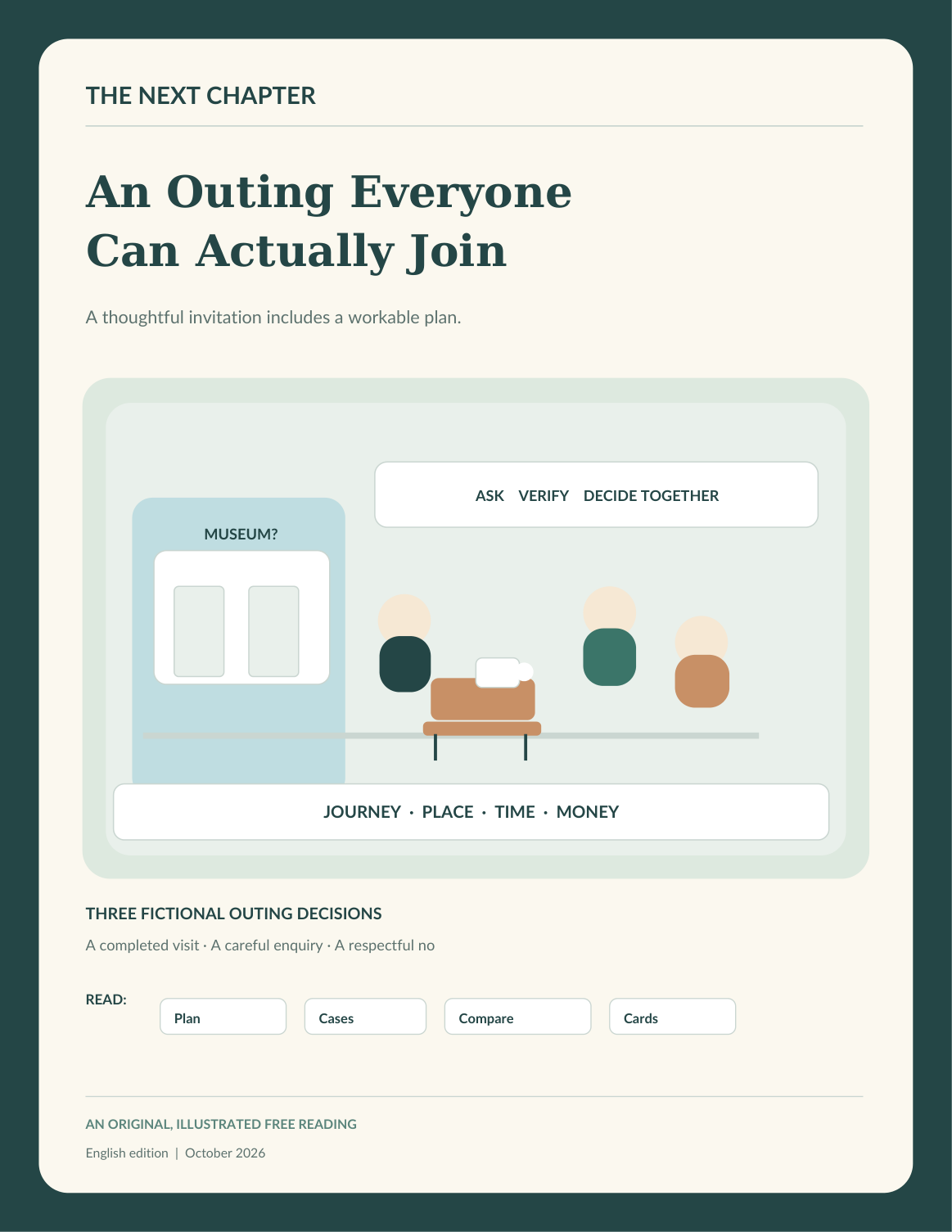
THE NEXT CHAPTER — AN ORIGINAL FREE READING
The best plan is not the busiest one. It is the one people can freely choose and realistically use.
A practical, illustrated guide to planning one shared outing without guessing at anyone's abilities, budget, comfort, or willingness. Check the whole journey, ask about access and atmosphere, leave room to change the plan, and be accurate about what really happened.
Three entirely fictional decisions. Two optional private cards. No purchase, sign-in, completed form, or related paid book is needed.
English edition · October 2026
A friendly idea needs a workable shape
THE COMPANY MATTERS MORE THAN THE PROGRAMME
Someone says, “We should all go to the museum on Saturday.” It sounds like an easy pleasure: a familiar face, something interesting to look at, perhaps tea afterward. Then the practical questions arrive. How will each person get there? Is there somewhere to sit? What does the outing cost from front door to front door? Who would rather leave early?
An invitation is not yet a plan. A beautiful venue can be the wrong choice for one particular day, and a short ordinary outing can be very satisfying. The aim is not to make every person fit one proposed activity. It is to find a shared option that the actual people involved want and can realistically use.
You do not need to know another adult's diagnosis, finances, or private history to plan respectfully. Ask what would make the outing comfortable, what information each person needs, and whether they would prefer something else. Do not turn age, disability, retirement, or a quiet personality into a prediction about someone's wishes.
This reader follows one optional outing from idea through verification and decision. It offers a small planning method, three invented cases, and two private cards you may leave blank. No promised friendship, physical benefit, or perfect accessibility is implied.
Four questions before anyone commits
JOURNEY · PLACE · TIME · MONEY
A shared outing usually has at least four parts. Journey: Can each person reach the meeting point and return by a route they actually accept? Place: Are entry, movement, seating, sound, light, toilets, and breaks workable for this group? Time: Can the visit fit each person's day, including travel and a comfortable finish? Money: What would each person actually spend, if anything?
These are not four tests a person must pass. They are four openings for useful conversation. Some groups need detailed answers to one part and hardly any discussion about another. Someone may prefer not to disclose a budget; offering a clear price and a lower-cost alternative can be more considerate than asking how much money they have.
Write down a fact only when someone has confirmed it. “A friend thinks the door is level” is a lead to check, not an access guarantee. “The café looks quiet in a photo” is not evidence about Saturday's crowd. An online listing, a telephone response, and a visit made months ago may each answer different questions.
If a part remains uncertain, decide together whether to ask, change the option, or postpone. A blank in the plan is not a failure. Pretending it is filled can leave a guest with an exhausting journey or an unwanted expense.
Ask about preferences, not private conditions
LET THE PERSON ANSWER FOR THEMSELVES
One common mistake is discussing someone while they are absent: “Helen probably can't manage stairs,” or “Paul doesn't like crowds anymore.” Both statements may be wrong; even if they were once true, they do not tell you what the person wants today. A practical question is more respectful: “Would a shorter visit, an easier entrance, or a quiet place to sit change your preference?”
Offer information without demanding an explanation. “The main entrance has three steps, and I have not confirmed another entrance. Shall I check before we decide?” gives everyone a choice. “Tell me why you can't do stairs” asks for personal information you may not need. A person can say that a route does not work without explaining their circumstances.
Ask each invited adult privately when that seems more comfortable, rather than turning their access or money concerns into a group vote. If someone uses assistance or has a companion, confirm the person's wishes and the arrangements with the people actually involved. Do not silently appoint a driver, carer, interpreter, or helper.
The answer may be yes, another option, “ask me after you know more,” or no. Keep those choices equally legitimate. This publication helps adults plan ordinary social outings; it does not assess anyone's health, capacity, or legal entitlements.
Count the whole journey, not just the visit
GOING HOME IS PART OF GOING OUT
The meeting may last forty-five minutes, but the day starts when someone leaves home and ends when they return. A walk from a bus stop, a wait for a ride, a transfer, a parking search, or an uphill block can matter more than the distance inside the venue. Ask about the approach, the departure point, and the return with as much care as the advertised activity.
Separate what a friend can genuinely offer from what has merely been suggested. “I could drive if my appointment ends” is not a confirmed ride. “The bus may be running” is not a verified timetable. If the return depends on a lift, agree who is providing it, where the pickup happens, and what the group will do if plans change.
Think about the spaces between steps: seating while waiting, weather shelter, drop-off location, the distance from the entrance to the activity, and the effort of the trip home. Not everyone needs these details, and nobody should be presumed to need them. People can choose which details would help their own decision.
A useful invitation describes the actual plan: “The proposed visit is fifty minutes. The bus stop is about two blocks away, but I have not checked the route or timing yet.” That is more honest than “It's very easy to get there.”
Verify the entrance, seating, and facilities
PUBLIC INFORMATION MAY BE INCOMPLETE
The word “accessible” on a website may not answer the question a visitor needs. Which entrance is step-free? Does it open on the day of the outing? Is there a usable route between the door and the main activity? Where can a person sit without being required to buy something? Is the toilet that someone needs actually available during the intended hours?
An organiser can ask the venue about these practical features without telling staff a guest's diagnosis. “Could you confirm which entrance is step-free and whether it will be open on Saturday?” is specific. If the answer is uncertain, note the uncertainty and ask the person concerned whether another venue is preferable. A photograph can help identify a question; it cannot guarantee how the entrance functions today.
Seating is more than a bench in a promotional image. It may matter whether seats are near the exhibit, can be reached without a long standing wait, or remain available if the café is busy. A booking may or may not provide a seat. Ask rather than assuming one will be available.
Local accessibility rules, transport services, and venue conditions differ. This is a planning prompt, not a certification of any site or an accessibility audit. For essential access requirements, obtain current information from the actual provider and the person who will use the route.
Ask what the place feels like
QUIET IS A PREFERENCE, NOT A PRESCRIPTION
Two people can enjoy the same exhibition in very different ways. One loves a lively crowd; another would rather visit when fewer people are present. Bright light, background music, a long queue, or an echoing hall may change the experience. You need not assume which of these matters to a guest. You can ask what atmosphere they prefer.
A helpful question is “Would you enjoy the busy Saturday session, or shall we ask about a quieter time?” The answer might be “busy is fine,” “I'd prefer another hour,” or “I'd rather do something outdoors.” None of those answers needs a medical justification. If you cannot verify the typical noise or crowd, call it an estimate, not a confirmed condition.
Allow the ordinary possibility of a pause. Is there a calm corner, a seat, or a way to step outside? Would a thirty-minute visit be better than two hours? A group can decide to stay for only the first room, share a drink, or skip an activity entirely. A shorter plan is not a lesser friendship.
The point is choice, not removing all uncertainty or claiming any place will suit everyone. If a venue cannot answer a crucial question, let the group choose whether to proceed, try another plan, or meet another day.
Name the costs without asking for anyone's finances
THE TICKET IS NOT THE WHOLE PRICE
A “free event” may still involve transport, parking, food, equipment, or a paid companion ticket. A modest admission fee can become a larger day out if the only practical route is expensive. Conversely, someone may be happy to pay more for convenience. Neither preference requires an explanation. Give people enough information to decide for themselves.
Make a small cost picture: known admission, likely round-trip travel, optional food, and uncertain extras. Mark estimates and quotes as such. Do not call money “spent” until it has actually been paid. For example, a hypothetical USD 7 café item that nobody orders is an option, not USD 7 of expense. A bus price checked online may still need confirming for the date and route.
A considerate invitation might say, “Admission appears free, but please check the listing. I expect to spend about USD 6 on buses; there is no need to buy food.” The first amount remains to be verified, and the second is the speaker's estimate. Different participants may have different fares and preferences.
Avoid public questions such as “Can everyone afford it?” Offer a low-cost plan alongside any priced option, make declining easy, and never promise to cover another person's expense without actually agreeing to do so. Price clarity is hospitality, not a judgement about means.
Make a beginning, an end, and an exit
LEAVING EARLY CAN BE PART OF THE PLAN
“Let's spend the afternoon together” can mean two hours to one person and five to another. Offer a proposed meeting time and a normal finish time. Include the journey, any line or booking, and the realistic time each person needs afterward. An outing can be warm and unhurried while still having clear edges.
Try “We could meet at 10:30, visit for about forty-five minutes, and finish around 11:15. If anyone wants to leave sooner, that's fine.” This gives a shape, not a compulsory timetable. Confirm the actual opening and entry conditions before treating a proposed schedule as booked or available.
Some people may choose to travel independently or depart at different times. Others may depend on an agreed return lift. If a ride is shared, an early departure needs a genuine plan rather than assuming the driver can leave immediately or another guest will take responsibility. Ask who would do what; do not assign a duty to someone absent.
If the venue is unexpectedly crowded or the journey changes, the group can shorten the visit, move to a different location, or cancel. A plan is successful when people retain agency, not when every minute of the original itinerary is completed.
Ask the venue a short, useful set of questions
SPECIFIC QUESTIONS BEAT A GENERIC PROMISE
Before making an essential promise to a guest, contact the actual venue or service and ask about the points that matter. You might say: “We are considering a short visit on Saturday. Which entrance will be open, and is there a step-free route from it to the main exhibit?” Ask one question at a time if the person answering has to check with someone else.
Next, confirm seating and breaks, toilet availability, hours or bookings, and any fees or companion arrangements that matter for the proposed visit. If sound or crowds matter, ask what the venue can genuinely tell you about the likely conditions. A busy venue may not be able to guarantee a quiet time or an empty seat.
Write down who or what answered and when, without collecting private information about guests. An emailed statement about the entrance for this Saturday is more specific than an undated photograph. If the venue says “We are not sure,” that is the truthful answer. Leave that fact open instead of silently replacing it with a reassuring guess.
Venue staff are not asked to decide whether a guest should attend. The guest decides with the information available. If safe, necessary access cannot be clarified, a different option may be better. This page is a question list, not a claim that every venue supplies these features.
Give people a real choice of plan
DIFFERENT IS NOT SECOND BEST
The group's first idea could be a museum. A second option might be a quiet library room, a short park visit with an agreed sitting point, or tea at someone's home. Those are examples, not promises that any particular place has suitable access, facilities, or hours. Check each proposed option before presenting it as workable.
Choices are useful when they change a meaningful feature: shorter travel, a more flexible finish, a different noise level, or no required purchase. Three nearly identical cafés may not help someone whose difficulty is the journey. One appealing option and one genuinely different fallback can be enough.
Avoid assigning the “easier” plan to one named person without asking. Instead say, “There are two possible versions. Which, if either, would you actually enjoy?” Someone may prefer the original outing even if it is a little complicated. Another may not wish to go at all. Making room for both replies helps preserve friendship.
Keep a tentative idea separate from a confirmed booking. A suggestion on Tuesday is not permission to purchase tickets on behalf of a group. Before money is spent or a ride reserved, check the specific agreement of each person whose time or resources are involved.
One conversation that leaves room to decide
THREE VOICES; NO ONE SPEAKS FOR ANOTHER
This is an invented exchange. Ari says, “Would either of you enjoy the Saturday photography exhibition? I haven't checked the venue yet.” Nina replies, “Maybe. I'd like to know where we could sit, and whether the exhibit is likely to be loud.” Bo says, “I like the idea, but a long trip across town isn't what I want this weekend.” Neither response is a refusal of the friendship.
Ari answers, “I can ask about seats and timing. Would a shorter visit work, or shall we think of a closer option?” Nina says, “A short one might be lovely, if there is a place to pause.” Bo replies, “Closer would be better for me. I haven't agreed to Saturday yet.” Ari does not interpret these comments as a booked group outing.
Later, Ari learns that the venue's staff cannot confirm the quietest hour. Ari reports exactly that. The friends decide to consider a nearby café instead, but no one has booked a table or promised a ride. A good conversation can end with a possible alternative rather than a compulsory date.
Notice what this exchange avoids: diagnosing another person, deciding what someone can afford, treating a tentative yes as final, or calling an unverified condition guaranteed. Each adult retains their own voice, and the plan remains honestly provisional.
Amina: a short visit actually happened
FICTIONAL JOURNEY ONE — COMPLETED
Amina and her friend Rosa want to see a small local exhibition. In this entirely fictional example, Amina asks whether the venue has an open step-free entrance, somewhere to sit, and a quiet time to visit. The fictional staff confirm the relevant entrance is open at their chosen hour and explain where the seating is. Amina and Rosa each agree to a short visit; Rosa has not been appointed to organise Amina's travel.
Amina leaves home at 10:00 a.m., arrives at 10:25, and enters the exhibit at 10:30. The friends finish viewing at 11:15, and Amina is back home at 11:40. Her actual time away is 100 minutes, including a 45-minute visit and the movement and waiting around it. There was no promise to spend the whole morning in the museum.
In the story, Amina actually pays USD 3 outward + USD 3 return = USD 6 for her own fictional bus travel. Admission requires no payment in this imagined venue; neither friend buys a café item. The USD figures are invented for illustration, not real fares or advertised prices.
The outing went ahead. Amina enjoyed the exhibition, Rosa enjoyed the conversation, and both chose to stop at the agreed time. Their later idea of another visit is only an idea; there is no further booking to count.
Theo: the answer was not yet clear
FICTIONAL JOURNEY TWO — ENQUIRY ONLY
Theo hopes to meet an old colleague at a community art centre. His colleague says that a step-free approach and a place to rest would make a visit easier to consider. Theo does not ask why; the requested information is enough. They discuss a possible Saturday, but nobody agrees to travel, buy a ticket, or reserve a seat.
Theo has a 12-minute telephone conversation with the fictional centre. Staff can describe the main entrance but cannot confirm whether an alternative entrance will be operating or whether the needed seating will be available. Theo records the answers as partly confirmed and still unknown, rather than telling his colleague that the venue definitely works.
The colleague decides not to commit to Saturday without those details. Theo replies, “I understand. I can ask again when they know more, or we could consider somewhere else.” The alternative is not selected or booked. Respect for the uncertainty prevents a hopeful conversation from turning into an unwanted journey.
In this fictional case, 12 minutes of enquiry occurred, but no outing, transport, admission purchase, or new cash expenditure occurred: USD 0 in new spending. His existing phone service may have ongoing costs, and this story does not claim otherwise. An enquiry is worthwhile even when the answer is “not yet.”
Lila: declining the fair preserved the friendship
FICTIONAL JOURNEY THREE — NO OUTING
Lila is invited to a weekend street fair. She enjoys seeing her friends but does not want the expected noise, crowd, or full afternoon this time. She says, “Thank you for thinking of me. I'm going to skip the fair, but I'd enjoy a quiet visit another day.” She does not need to give a personal or medical reason.
Her friend Cam replies, “Of course. Would tea at my place next week interest you, or would you rather leave it open?” Lila says she would like to think about it. Cam does not buy supplies, reserve transport, or put a date in the calendar on Lila's behalf. A polite idea about tea is not a confirmed appointment.
The fair takes place without Lila. In the fictional record she makes no journey, attends no fair, purchases nothing for it, and spends USD 0 in new cash. The conversation itself still matters. Cam did not argue that Lila should be able to attend, and Lila did not have to pretend she was going.
Not every decline should be followed by an alternative offer. Some people want a quiet day, and that is enough. An invitation is a choice. Friendship need not be measured by how often someone accepts the busiest option.
Three honest outcomes, three different records
WHAT HAPPENED IS NOT WHAT MIGHT HAPPEN
The examples are imaginary and do not describe a real provider, fare, or accessible facility. They make one distinction visible: a completed outing, an information-only enquiry, and a declined event are different outcomes. An organiser may feel equally caring in all three cases, but time and spending must be reported accurately.
| Decision | Actual time or activity | New cash actually spent | |:--|:--|:--| | Amina: completed short visit | 100 min away; 45 min viewing | USD 6 bus fare | | Theo: questions only | 12 min call; no visit or booking | USD 0 | | Lila: declined fair | No trip or confirmed alternative | USD 0 |
An estimated taxi quote, an unbought ticket, a friend's possible ride, and a suggested future meeting do not belong in the actual-spending column. Keep them as possibilities until the relevant person agrees and something actually occurs. Likewise, the amount of time someone would have spent on an outing is not time they used when they did not go.
The three cases suggest a modest rule: report the actual event faithfully, confirm what remains uncertain, and let each person decide whether there should be a next step. Sometimes the most successful shared plan is an honest postponement.
Confirm, change, postpone, or decline
EVERY BRANCH MAY BE A GOOD ANSWER
At the end of the conversation, ask three things. Do the people invited actually want this? Are essential details known well enough for their own decisions? Does the proposal fit their time and resources? If the answers are yes, confirm the specific plan, including the real meeting point, travel arrangements, expected finish, and any actual booking responsibility.
If an essential detail remains unknown, contact the provider or mark the plan pending. If the journey, atmosphere, schedule, or price is a poor fit, offer one genuinely different possibility without ranking anyone's needs. If someone does not wish to come, accept the no without asking them to prove that it is necessary.
Changes need fresh agreement. “The exhibit is busier than expected; would you rather leave now?” gives a useful choice. “We came all this way, so we have to finish” does not. A shared ride may require a conversation about a workable return plan, rather than assuming someone else will change their commitments on demand.
No booking, no expense, and no outing can still be a complete outcome for this planning exercise. Use the next two cards only if you find them useful. They are private reflection aids, not records for a venue or a means of collecting other people's personal details.
Optional private card: before the outing
ONE POSSIBLE PLAN, WITH ROOM TO SAY NO
This card is an optional memory aid, not a consent form or an assurance of access. Do not put anybody's diagnosis, address, bank details, transport account, or other sensitive information on it. Record only practical answers you are comfortable keeping privately.
The idea: What single place or activity are we only considering?
Whose choice: Have the invited adults actually said whether they want to consider it?
Route and arrival: What entrance, transport, meeting point, or return information needs confirming?
Place and comfort: What seating, toilets, sound, crowd, or break information matters here?
Time and price: Which complete hours and out-of-pocket costs are confirmed, estimated, or still unknown?
My honest answer: Is this confirmed, awaiting details, a different offer, postponed, or declined?
Optional private card: after the conversation
OBSERVE, DON'T TURN AN IDEA INTO A BOOKING
Use this second card only if it helps you remember the actual outcome. It is entirely optional. Keep the form private and do not record another person's confidential needs or circumstances.
What actually happened: Did an outing happen, or was it only an enquiry, change, or decline?
Time actually used: If there was a visit, what were the door-to-door and on-site times separately?
New cash actually paid: What expenses really occurred, if any, rather than merely being quoted?
What we verified: Which current facts came from the provider or from the people involved?
What remains unknown: Which details should still be checked instead of guessed?
What to say next: What respectful, accurate reply would close the conversation without assuming another booking?
A good outing belongs to the people in it
LEAVE ROOM FOR THE NEXT CONVERSATION
Picture a table with several chairs. The goal is not to make every chair occupied at any cost. It is to create a setting in which each invited person can decide whether being there sounds right. Sometimes that will be a museum visit, sometimes a short walk, sometimes a conversation over tea, and sometimes a day spent separately.
One person may value a direct route; another may want a lively atmosphere; someone else may care most about a definite finish. A respectful plan makes those differences discussable without turning them into faults. Information is something to share. Permission is something to ask for. Attendance remains a choice.
Remember the practical sequence: ask the people, verify the particular venue or journey, distinguish a tentative suggestion from a confirmed arrangement, and count only the time and money actually spent. If the essential facts change, ask again. If someone says no, let the invitation end kindly rather than turning it into a negotiation.
This is general social-planning guidance, not individualized medical, mobility, accessibility-certification, transport, safeguarding, legal, or financial advice. Confirm services, prices, opening conditions, accessibility information, and appropriate support directly with providers and the people using them. All characters, places, USD figures, and decisions in the examples are fictional.
An outing everyone can actually join begins with something smaller than a perfect itinerary: a choice everyone involved is genuinely free to make.