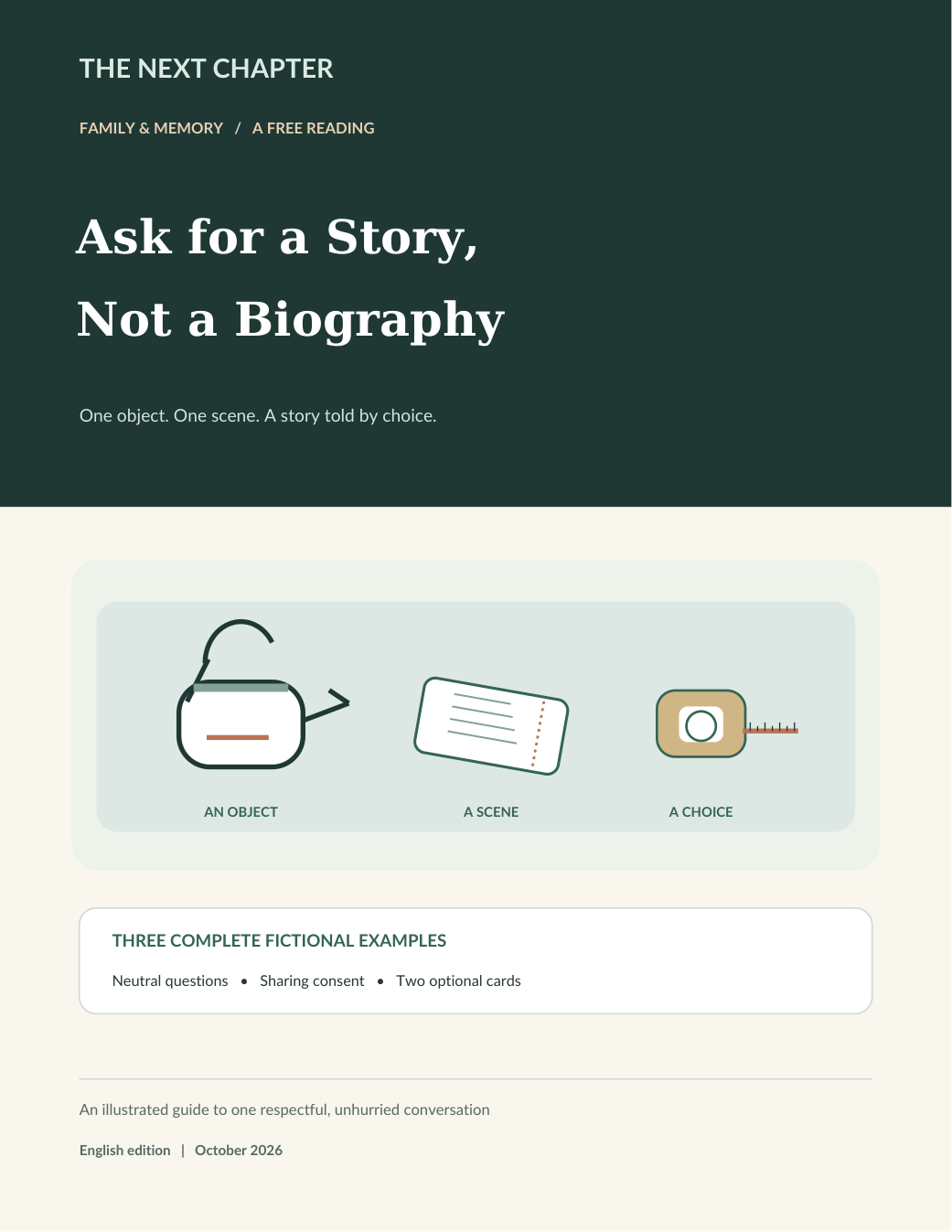
THE NEXT CHAPTER — A FREE READING
One object. One remembered scene. A story that belongs to the person telling it.
An illustrated guide to a small, respectful conversation—with two optional private cards.
A kettle with a history
The kettle on Mara's kitchen shelf is not beautiful. Its handle has a faded patch where years of hands reached for it, and there is a little dent near the spout. When her niece visits, she notices the dent and asks, “What happened there?” Mara laughs. She remembers the day she carried it to a neighbourhood picnic and forgot that an empty kettle could roll around in the boot of a car.
It is a tiny story: a hurried Saturday, a borrowed blanket, people calling across a park. It says something about Mara without asking her to summarise a whole life. Her niece listens, and Mara decides which details she wants to tell. Both are fictional people; the scene is an example, not a family's documented memory.
Often we approach someone we love with a generous but enormous request: “Tell me your life story.” A life may be too big, too private, too complicated, or simply not something the person wishes to recount. A much smaller question can be kinder: “Is there a story behind that kettle?”
This reading gives you one way to ask, listen and—only with permission—keep a few words. It is equally useful when the person says no, or when you choose to enjoy the conversation without recording it. No camera, subscription or family archive is required.
Choose one scene, not a whole life
Think of the difference between a portrait and a window. A biography tries to show the shape of a person's life. A window lets you look into one moment: the afternoon they first saw the sea, a favourite shop they visited, a button sewn onto a coat, the smell of onions from a kitchen next door.
A single scene often has enough to make a complete short story: someone was somewhere, something happened, and one detail remained. It does not need a dramatic ending. “We stopped for a cup of tea because the bus was late” is worthy of remembering if its teller finds it meaningful.
Pick only one opening. It might be an ordinary object, an old photo that the person is comfortable seeing, or a familiar activity: baking bread, repairing a bicycle, arranging flowers. You do not need an antique. A current grocery list can carry a story, too.
The useful promise is modest. You are offering ten unhurried minutes around one topic, not a formal interview. The speaker can tell a different story, give a single sentence, or change their mind. A memory shared aloud is not automatically a memory offered for publication.
If you are doing this for your own curiosity rather than a future project, say so plainly. An honest small request makes room for an honest small answer.
Ask whether the person wants to talk
Begin by making the choice visible: “I noticed that recipe box. Would you feel like telling me about one recipe sometime? It's completely fine if not.” A person may be delighted, tired, private, unsure, or simply busy. None of those replies requires an explanation.
Permission to talk and permission to record are different things. The first lets a conversation happen. The second concerns notes, audio, video, photographs or messages. Permission to share with a sibling, put a clip in a family chat, or post it online are separate decisions again. Do not treat a friendly answer to one request as agreement to every later use.
If the person is not interested, a graceful closing is enough: “Of course. I just liked the object.” You may still enjoy looking at it together, provided they want that. Do not press with “But the family needs to know” or imply that declining means they do not care about family history.
Choose a comfortable context. A short conversation at the kitchen table may be welcome where a crowded celebration would not be. Asking about someone else's childhood in front of an audience can turn curiosity into pressure. You can offer to speak another day or not at all.
The goal is a good exchange between people, not the collection of material at any price.
Begin with a question someone can answer
Some questions sound simple but contain too much: “What was it like growing up?” “Tell me everything about your mother.” A narrower question offers somewhere to begin: “Do you remember when this photo was taken?” “Who used to keep that tin?” “What did you make with this tool?”
A useful first question is concrete, optional and open. It does not assume the answer. “Did Grandad give you that ring when you married?” can accidentally plant a story the person never told. Try “Would you like to tell me how that ring came to you?” The speaker can correct your assumption without having to disagree with a whole narrative.
Let the first answer set the pace. If someone says “That was my aunt's,” you could ask, “What do you remember most clearly about her?” But you might instead hear, “I don't really remember,” and stop there. Silence is not automatically a request for another question.
Two gentle follow-ups usually do more than ten clever questions. “What could you see or hear?” invites a sensory detail. “What part of that day stayed with you?” invites meaning without demanding a lesson. You can also ask, “Would you rather leave that part out?”
The best question is not the one that extracts the most information. It is the one the other person still feels free to answer—or not.
Give the storyteller room
Listening is active, but it need not look busy. Put the phone away unless it is genuinely part of the agreed activity. Leave enough space after a sentence for the person to remember a name or decide what to say next. Resist the urge to fill every pause with another question.
People do not always remember events in chronological order. A person may begin with the shop where something was bought, jump to the neighbour who repaired it, and return to the morning they lost it. That is a perfectly ordinary way to tell a story aloud. You can follow the path without forcing it into a timeline while they are speaking.
You may hear a detail you think is wrong. Unless an immediate safety concern is involved, there is little value in turning a personal reminiscence into a quiz. Try “I had pictured that differently—would you like to say more?” rather than “That can't be right.” The exchange should not become a courtroom.
Notice the teller's energy. Some people enjoy another five minutes; others begin looking toward the window, the clock or their work. “Would you like to stop here?” gives a real exit. A memorable conversation may be three minutes long.
If you remember only one sentence afterward, that may be enough. A loved person's voice does not have to be captured in full to have mattered.
Keep a memory separate from a verified fact
A recollection is a person's account of how something seemed or happened to them. It may include exact details, impressions, gaps and changes over time. A receipt, calendar or photograph can provide a different kind of evidence. Neither should be quietly presented as the other.
Suppose someone remembers “a very snowy Christmas,” but the photograph you find has no snow. You do not have to choose which version will survive. You can write, with permission, “She remembers the holiday as snowy,” without claiming that an official weather record confirms it. You can also leave the question unresolved.
Avoid inventing connective tissue. If you know that a person kept a train ticket but not why, do not turn it into “the ticket from the day she met her husband.” A neat story can be less truthful than an unfinished one. “I don't know why he saved it” is an honest and interesting line.
Dates and names matter when they matter to the teller. If you plan to pass the story to others, check any specific details the person wants to be accurate. Mark uncertainties as uncertainties. Do not send unverified claims about third parties around a family group chat as if they were established facts.
A story can be warm without being certain about everything. The difference between “she remembers” and “this happened” is small in wording and large in respect.
Let an ordinary object stay ordinary
An object can help someone begin because it gives the conversation a place to rest. They can point at its worn edge, lift its lid or tell you they have never liked it. But do not demand that everything carry a grand symbolic meaning.
A chipped mug may be just the mug used at work. A folded map may have been left in a drawer by accident. An old photograph may remind somebody of a tiring day, not a golden era. Saying “This must mean so much to you” decides the feeling before the person has spoken.
Instead, ask a neutral question: “Would you like to tell me anything about it?” If the answer is “Not much,” that answer deserves space. You can follow their lead toward a different subject, such as the person who repaired the object or the place where it was used.
Handle possessions with the owner's permission. Do not take an object out of a drawer, borrow it for scanning, move it into better light, or send a picture to relatives just because the story interests you. Ordinary ownership and privacy still apply even within a close family.
There is no minimum age or special family role for the storyteller. A neighbour, friend, adult child or long-time colleague may have a scene worth sharing, if they want to. Likewise, you can tell a story of your own and decide to keep it to yourself.
Leave a door open to stop
A question about an everyday object can unexpectedly touch grief, conflict, separation or embarrassment. You cannot know in advance which memory will be comfortable. That is why the invitation to stop must remain genuine throughout the conversation, not just at the beginning.
If the person hesitates or says “I'd rather not go into that,” change course or end. “Thank you for telling me what you wanted to” is a complete reply. Do not offer a bargain—“Just one more detail”—or ask another relative to provide the private part they declined to tell.
Some people enjoy remembering aloud but dislike hearing the conversation played back. Others may be happy for a handwritten sentence to stay with you but not for their name to accompany it. These are ordinary preferences, not obstacles to overcome.
You can use a simple check-in: “Are you comfortable with me remembering this for myself? Would you prefer that I not write it down?” If you already took notes, honour a request to stop, correct or delete them to the extent you control those notes. If something has already been shared with others, avoid promising you can retrieve every copy; be clear about what you can do.
A respectful interview sometimes ends with no written story. The relationship is more important than the document you hoped to make.
Recording is a separate invitation
When a person is telling a story, it is tempting to reach for the record button so no detail is lost. Ask before you do. “Would you like me to write down a few sentences, or would you rather this stay just between us?” offers two real choices; you can also simply listen.
If they agree to a photograph or recording, say what it is for. Personal memory, a printed copy for the teller, and a publicly accessible social-media post are not the same audience. Ask separately about names, dates, faces and other people appearing in a photo or a story. Those other people may have privacy interests, too.
For a story involving a child, do not presume a family relationship gives you unrestricted permission to record or post. Follow the relevant caregiver's wishes and applicable rules, and consider the child's dignity and preferences. You do not need an image to keep a lovely sentence about a shared day.
Before sharing any finished short text, read it back to the storyteller if practical. Ask “Does this sound like the part you wanted told?” and “Who, if anyone, may see it?” A quiet private copy is a full result. A public page is not the default next step.
This guide is not legal advice about image rights or consent law. It offers a cautious everyday approach: ask, separate permissions, use less detail than you think you need, and let people change their minds where possible.
Nila and the recipe box
Nila's sister Leena keeps an old tin recipe box beside the microwave. The cards inside have several kinds of handwriting and a few stains. Nila has wondered about one card for years, but she has never wanted to make her sister feel that she is inspecting the family.
One afternoon Nila says, “I like the card with the blue corner. Would you feel like telling me about it? We don't have to write anything.” Leena opens the lid and smiles. She remembers her first attempt to make a sweet loaf for neighbours; the dough rose too far, and someone helped clean the oven. Nila laughs with her. Nothing more dramatic is needed.
When Leena finishes, Nila asks whether she may jot down the sentence about the oven. Leena says yes for Nila's private notebook, but not for the extended family chat. Nila writes the sentence and labels it as Leena's recollection, not an established recipe history.
A week later, Nila wonders whether to photograph the stained card. She has not asked yet, so she does not. The notebook stays closed until another occasion that Leena freely chooses.
What this fictional example shows: one narrow question, an enjoyable short exchange, private-note permission but no sharing permission. The unphotographed card is not an unfinished task. The story was complete when the people were content to stop.
Tomas and the faded ticket
Tomas finds a faded bus ticket in his own coat pocket while sorting a drawer. His adult son, Eli, asks about it. Tomas remembers taking the bus to a job interview years ago and feeling certain he had arrived at the wrong building. Then he remembers that he might have kept the ticket for another reason entirely.
Eli is tempted to call the ticket “the beginning of Dad's career.” Tomas laughs and shakes his head. “I really don't know why I saved it,” he says. “But I do remember the rain that day.” Eli follows the rain, not the grand conclusion. They talk about wet shoes and a kind stranger who pointed to the bus stop.
Eli does not press for the stranger's identity. Tomas asks him not to quote the interview details to cousins; the memory feels too personal. Eli agrees. When he later writes one sentence for himself, it reads: “Tomas remembers being caught in the rain on a bus journey around that period; the ticket's exact origin is uncertain.”
There is no dated receipt to prove the trip. Eli does not present a remembered afternoon as a verified timeline or publicly post a photograph of the ticket.
What this fictional example shows: uncertainty can remain in a warm account. You do not need to resolve every date, invent a life-changing outcome, or persuade a person to disclose details they prefer to keep private.
Erin and the measuring tape
Erin visits her longtime friend Sam, who is mending a small wooden shelf. A scratched measuring tape lies nearby. Erin asks, “Is that the one you used when you made the window boxes?” Sam says yes, and tells a story about measuring one board twice and still cutting it too short.
Erin asks, “Would you like me to write that down?” Sam smiles but declines. He wants to tell it, not turn it into something that might be passed around or corrected by people who were not there. Erin accepts the answer. They go back to discussing the shelf.
Several days later, Erin remembers the pleasure of the conversation but cannot recall the board's exact length. She does not guess a number. She tells her own partner only that she enjoyed hearing about Sam's woodworking, without retelling private details Sam did not authorise her to share.
The story exists in the relationship, even without a document. Erin might ask a new question another day, but she owes Sam no follow-up and Sam owes her no further memories.
What this fictional example shows: declining documentation is not declining connection. A listener can learn something human and still leave the words with the storyteller. The tape remains a tool, not an invitation to collect its owner's biography.
Write five honest sentences, if invited
If someone wants a short written keepsake, try a shape that is small enough to finish without inventing details. Use only information they chose to tell and any facts they approved for use. A five-sentence frame is a convenience, not a requirement.
1. The opening. Name the object or scene without claiming more than you know: “Leena kept a tin of recipe cards beside the microwave.”
2. The moment. Describe one event as the speaker remembers it: “She remembers a loaf that rose too far in the oven.”
3. A detail. Keep an exact sensory detail or small action they mentioned: “Someone helped her clean up afterward.”
4. The speaker's meaning. Only include an interpretation the person actually gave. If they did not offer a lesson, a plain sentence is enough: “She laughed while she told the story.”
5. The ending. End where the account ends: “She chose to keep the note private.”
Do not add a dramatic moral, an invented date, a name you guessed, or a claim that everyone in the family remembers the same thing. Read the short text back if the person wants to hear it. They may amend a phrase, say no to sharing, or prefer no written copy at all.
A record kept with permission is a gift. A story that remains only spoken can be one, too.
My one-story invitation card
This private card is optional. It is for choosing a single respectful question, not for collecting someone else's personal information. You can leave any field blank, print the page or type into it. Nothing here should be uploaded to a website or sent to us.
The object or moment I might ask about: One ordinary item or familiar scene—not someone's whole life.
A neutral opening question: An invitation that permits an easy no.
The setting or time I can offer: A comfortable moment, with no pressure or surprise audience.
How I will respect a no or pause: One calm response without bargaining.
My question about note-taking: Ask separately; never assume permission.
My preferred ending: A short thank-you or an easy change of subject.
My one-scene story and sharing card
Use this only if a storyteller wants words remembered or written. This card does not replace their own consent or applicable privacy obligations. Leave out details about other people that are not yours to distribute.
The scene in the speaker's own terms: What did they choose to tell?
One exact detail I know they said: Keep wording accurate; omit guesses.
What is uncertain or incomplete: A blank date or unknown name is acceptable.
Writing/recording permission today: None / private notes / audio / photo, and any limits.
Sharing permission and intended audience: Private only / named people / another clear choice; ask explicitly.
One follow-up, or no follow-up: Read back for approval if wanted, or simply stop.
One story can be enough
People sometimes worry that memories will disappear unless every detail is recorded. That feeling can lead to a rush of questions at the very moment a conversation needs to be ordinary. You can care about a person's past without appointing yourself its archivist.
Think back to Mara's dented kettle. The useful part of the exchange was not a complete inventory of picnic dates. It was a human voice, a laugh, a small recollection that she chose to tell. Some days a story will grow into a page; other days it will end after one sentence. Neither outcome measures your closeness.
If you want to try, choose one person you would enjoy listening to, one familiar object or scene, and one invitation they can easily decline. Then let their answer determine what comes next. If you are the storyteller, you may set the same limits: what to say, whether to be recorded, and who may see it.
You can finish this reading without interviewing anyone. You may instead remember one small scene from your own life, make a private note, or simply enjoy the quiet after the last page.
About this free reading. All characters, dialogue and events above are original fictional teaching examples, not testimonials or documented family histories. This is not a clinical, legal or financial guide. Ask the actual person about recording, use and sharing; check relevant rules where applicable. No purchase, email registration, upload or completed worksheet is required.