Understand the rally, the two-person court and the questions worth asking
Four people, one small shared challenge
Doubles badminton is a game of two players on each side of a net. That arrangement offers conversation, teamwork and a new kind of shared attention, but the first invitation can seem complicated. People speak about service order, back lines and the score while a shuttle moves quickly across the court. You may enjoy the idea of the game without knowing any of those details yet.
This guide explains the shape of a doubles rally, the major court and scoring distinctions and the questions to ask before attending a beginner session. It does not teach a physical stroke, choose a suitable level on your behalf or promise that any venue is accessible. A person can begin by watching or asking for information. There is no need to buy a racket or agree to join a league before understanding the particular programme.
Singles and doubles are related but not identical
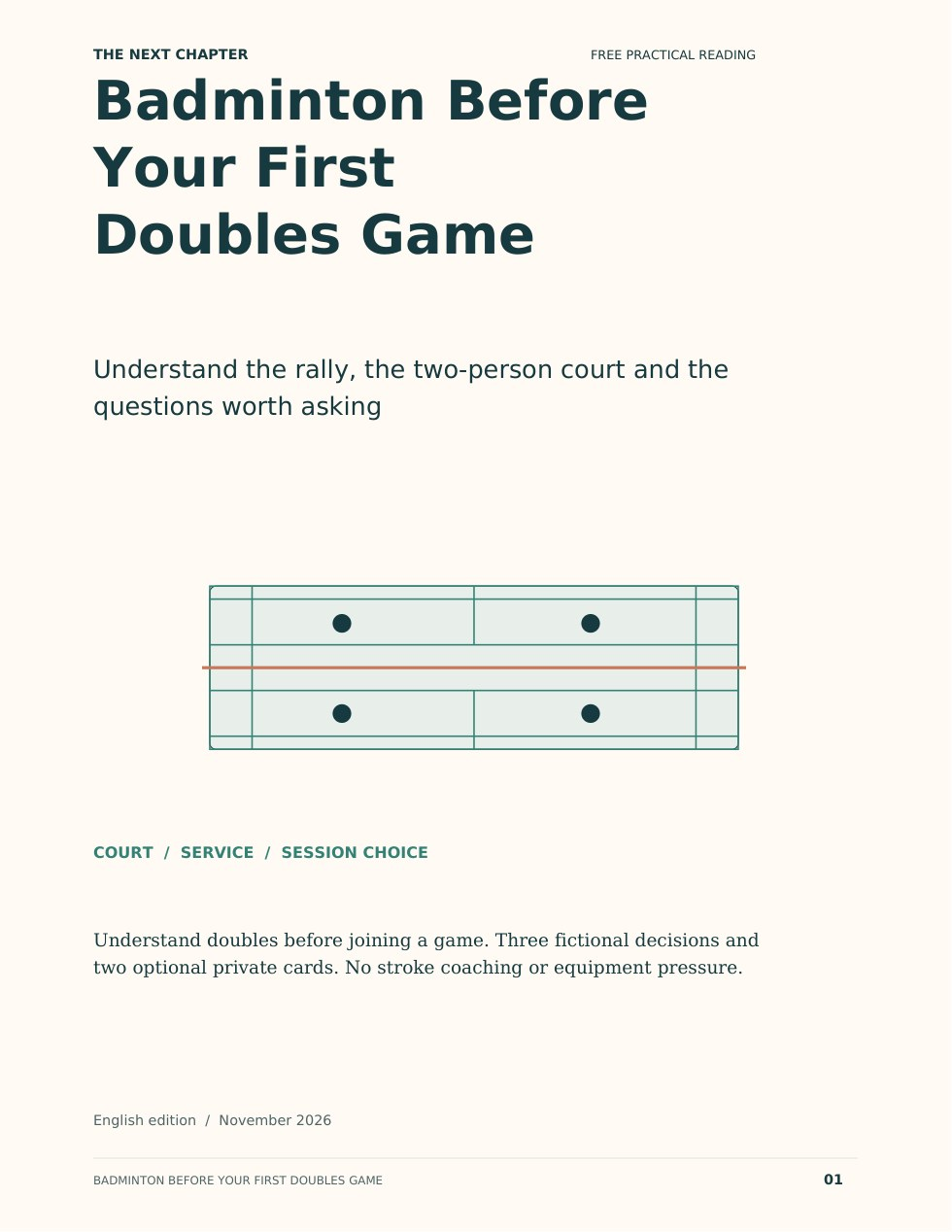
Singles has one player on each side; doubles has two. On a standard badminton court, doubles generally uses the wider side boundaries than singles. The area used for doubles service also differs from the area used during a rally: the back service line for doubles is short of the outermost back boundary. That distinction explains why a serve can be out even though a shot landing farther back during an ordinary rally would be in.
A local coach can point out the actual painted lines before anyone plays. New players should not be expected to decode a confusing set of colours without an explanation. If a facility has temporary courts or uses a different beginner format, ask which markings apply. Court diagrams are useful introductions, not a substitute for an instructor's current rules or assessment of the playing space.
What is in the game?
A badminton rally uses a shuttle, commonly called a shuttlecock, and rackets. The shuttle must travel over the net and within the relevant court area for play to continue. A rally ends through a fault, the shuttle landing on the floor or another event specified in the rules. The shuttle's light construction makes the sport look different from a ball game; overhead air movement and facility conditions may affect practical play.
For a first visit, find out whether the organiser provides rackets and shuttles, how many courts will be in use and whether beginners are expected to bring anything beyond suitable footwear. Do not buy high-end equipment because a promotional photograph shows it. A good introductory class should explain equipment options, what is actually available and whether a prospective participant may first observe.
A rally is one sequence, not a whole game
One rally begins with a serve and continues through permitted returns until the shuttle is out of play. The rally is smaller than a game, and a match usually consists of a series of games. A recreational introduction may also use a short warm-up exchange or modified points to help people learn; that should be clearly distinguished from standard competition.
Knowing this simple structure helps you listen to instructions. A referee may announce the score before the serve, players arrange themselves and the shuttle moves back and forth. When a rally ends, the participants reset. You do not need to memorise a competitive rulebook to understand this sequence. Do ask whether the organiser assumes familiarity with it, and whether it offers a slower teaching format.
The score should be explained, not shouted at you
As of 1 November 2026, the established BWF format uses rally points: the side winning a rally scores a point. Games are to 21, needing a two-point lead at 20-all, capped at 30. BWF has approved a change to best-of-three games to 15 from 4 January 2027, as Badminton Europe reports. Local adoption and alternative formats can differ. Ask which scoring system applies to your event and date; do not assume this dated 21-point explanation remains the standard after the change.
Ask whether the group is running a formal match, a simplified introduction or relaxed practice without keeping score. A casual session that agrees to stop early is not pretending to be a sanctioned tournament. If someone announces “twelve–eleven,” you can ask which side's score comes first and what that means for the next service. A welcoming introduction teaches the logic, not just the number.
Service goes diagonally
A legal badminton serve begins in the correct service area and travels diagonally over the net to the corresponding receiving service area. The positioning and execution requirements are detailed in formal laws, and some recreational introductions teach simplified versions before formal play. This reader is not a technical service tutorial or a guide to judging a borderline fault.
For doubles, it helps to know that the serving and receiving players need to identify the correct diagonal service courts. The position depends in part on the serving side's score. Let the instructor demonstrate the local markings and the initial arrangement. You can ask to see the court standing empty rather than attempt to understand everything while three other players are waiting.
Even score, right; odd score, left
In standard doubles, the serving side serves from its right service court when its score is even and from the left when its score is odd. That is the memorable part. The movement of partners and the order of servers are more complicated, so a beginner should learn them with an actual court diagram rather than rely on a one-sentence shortcut.
When the serving side wins a rally, it earns a point and the same server serves again from the alternate service court. When the receiving side wins a rally, it earns a point and takes the service. Partners do not simply swap courts after every rally: in the standard format they change their relative service courts when winning a point while serving. Ask the host to explain how this works in the introduction.
Partners share the court, not every shot
During an ordinary doubles rally, either player on a side can generally return the shuttle when it is that side's turn. That does not mean both players should reach for every shot or that one partner must do all the work. The game calls for communication, and different pairs may arrange their positions differently depending on their experience and the state of play.
You can ask an instructor whether it is possible to start with a gentle doubles activity focused on cooperation rather than a competitive match. If a session pairs experienced players with newcomers, ask how they explain the game. A partner who says “I'll tell you before I serve” is more helpful than someone who expects you to know hidden routines. This reading avoids tactical or movement prescriptions because those belong to qualified instruction.
The right clothing is not a costume
Badminton is often played indoors on marked court surfaces. Venues may require clean, non-marking indoor shoes, and may have restrictions on clothing, bags or outside footwear. You cannot verify a facility's current policy by looking at a photograph of another sports hall. Ask what footwear is required, whether rental or loan equipment is available and where belongings can be safely stored.
Someone who has not played for a long time should not assume that equipment stored in a cupboard is suitable. Conversely, no one should feel obliged to buy an expensive racket before deciding whether they enjoy the experience. The concrete first step is to understand what the event supplies and what the facility actually requires.
The court and arrival route matter
The court surface is only one part of the visit. Ask how you enter the building, whether the route to the court is step-free if that matters to you, where you can rest or observe, how washrooms and changing rooms are reached and whether staff can communicate instructions in an accessible format. Some facilities and programmes offer adapted badminton; accessibility is never established by a generic “all abilities welcome” banner alone.
Para badminton includes specific recognised forms of competition, including wheelchair events, as the International Paralympic Committee describes. That does not mean a particular community badminton hall offers the same adaptations or professional support. Ask what is actually provided. Do not infer an individual's preferences or ability from their age or appearance.
A social game versus a league commitment
An invitation to “doubles night” could mean friendly court hire, an instructed beginner class, an open social session or a team league. Their expectations differ. A league might require recurring attendance or membership; a recreational group might allow one session at a time. A lesson might include an instructor and equipment, while casual court hire assumes you bring a partner and know the rules.
Ask what is included in the price and what sort of participation the organiser expects. Are matches scored? Can you visit once? Is there someone who can explain the service order? Is a partner assigned, or must you arrange one? You cannot choose fairly between options until these questions are answered. A class with a friendly name can still have unfamiliar prerequisites.
Total time and cost, not just the court fee
A session advertised for one hour can occupy an afternoon. In a wholly fictional example, a person spends 15 minutes reaching a leisure centre, 10 minutes checking in and changing, 45 minutes watching an introduction and 15 minutes getting home. The complete outing lasts 85 minutes. This is not a description of any real class, nor proof of a suitable venue.
Record fees as quoted or paid. A court-hire price may be shared by several people, but a beginner course may charge per participant. Ask about shuttle supply, equipment rental, shoe policy, cancellations and whether registration is compulsory. Avoid dividing an uncertain group charge by four and calling it your actual cost before the organiser confirms who pays what.
A message you can send before booking
Here is a useful, short enquiry: “Hello. I'm interested in trying badminton doubles but have not played recently. Is your advertised session a beginner lesson, friendly play or league? Can a newcomer observe first? Do you explain the scoring and service order? Are racket and shuttle loans available, and what footwear is required? Could you confirm the total cost, cancellation conditions and access to the actual court? Thank you.”
This script does not disclose private health information, require a username or ask for a special exception that the venue may not provide. You can shorten it for a telephone call. A reply is information, not an enrolment. If an important fact remains unconfirmed, mark it as unknown rather than inventing a reassuring answer.
How to read the reply
A useful reply identifies a particular beginner session, who leads it, what equipment is supplied, the actual arrival and court arrangements and the applicable fee. An organiser might say “We do doubles every Thursday” while not explaining whether those are instructed sessions. It would be premature to assume the group is suitable for a first-timer.
One follow-up question may settle the matter: “Is there someone who explains the service order to a newcomer?” If the answer is yes, you may still want to know whether you can leave early or rest. If the answer is no, you might prefer a formal introductory class. The purpose of the questions is to discover the conditions, not to pressure the organiser to guarantee a particular experience.
Fictional case: Asha attends only an introduction
Fictional example. Asha has played badminton only at family picnics. She asks whether a fictional recreation centre offers an introductory observation and learns that a staff member will explain service courts before any game. She attends a 35-minute information and observation period, with invented 20-minute journeys each way. The whole outing occupies 75 minutes. No doubles match is played by Asha, no equipment is purchased and no fee is quoted in this story.
She decides to seek a lesson rather than join an open match immediately. That is a thoughtful outcome. The fictional organiser and duration are not a live programme, and her future lesson is not booked. The important distinction is between learning about a programme and actually registering for one.
Fictional case: Ben makes one enquiry
Fictional example. Ben sees an advert for a community “doubles social.” He phones the fictional host for 14 minutes and learns that the price includes court time but not a racket. The person on the phone cannot confirm whether loan equipment is available. Ben keeps the question open and does not reserve a place. There is no travel, game, payment or membership in this example; new cash spent is USD 0.
Ben might borrow a suitable racket later if the organiser permits it, but that possibility is not a claim about rental stock. A good first result is a list of what is known and what must be checked. An enquiry alone is never an accepted booking.
Fictional case: Lila chooses a different format
Fictional example. Lila loves watching badminton but learns that an imagined Wednesday group rotates players quickly through scored league-style matches. She is looking for a slow introduction with time to ask questions. After receiving the details, she thanks the organiser and declines. She has not travelled, paid or participated. New cash spent is USD 0.
She considers asking about a different beginner class on a later date, but no call or booking has taken place. Neither choice says anything about her age or ability. A person can be attracted to a sport and decline a particular event. The format matters as much as the sport's name.
Private card one: the session facts
Private, optional card; do not submit. (1) What kind of session is offered? (2) Who explains rules and supports beginners? (3) What equipment and footwear must I supply? (4) What does the entire trip require? (5) What total fees and cancellation rules are confirmed? (6) Which fact is still unknown?
You may enter “not checked” rather than guessing. Do not include personal identifiers, medical history, payment details or passwords. A suitable personal record helps you return to the decision later without promising attendance. You can skip the card entirely, keep it on paper or delete it when you are done.
Private card two: my participation choice
Private, optional card; not a booking. (1) What sounds enjoyable about doubles? (2) Which worries do I want the organiser to clarify? (3) Do I prefer observing, a lesson, casual play or a league? (4) What adaptation or facility detail matters to me? (5) What information is still missing? (6) My present choice: enquire / observe / register after verification / decline / decide later.
There is no points system for ranking your suitability. Someone who wants the social part of doubles can seek a group that welcomes conversation and rests. Someone who enjoys scoring can ask about formal matches. The choice should come from your interests and verified programme information, not a universal model of retirement sport.
The useful first win is understanding
Badminton doubles offers a clear shared game: two partners on each side, rallies over a net, a service sequence and a court whose markings change meaning between some serves and normal play. You do not need to master every formal detail to make a sensible first enquiry. Learn just enough to ask whether the organiser welcomes beginners and how the session actually works.
The next step might be a phone call, an observation, a lesson or a decision not to join. Remember that published scoring and service rules are not substitutes for the venue's current conditions, equipment policies and accessible arrangements. A good first encounter leaves you informed, unpressured and free to choose.
Sources and limits
Original references retained below. BWF PDF links returned 402 on 1 November 2026 and were not freshly inspected. Current checks also used Badminton BC, Badminton Europe and the BWF laws copy hosted by Badminton WA, linked below (not endorsements or live local listings):
-
Badminton World Federation — Other permitted scoring systems
-
Badminton Europe — New scoring system, 3 x 15 (25 April 2026)
Rules, programmes, eligibility, facilities and fees can change. Check the current organiser and relevant official rules before participating. This is a practical consumer reading, not coaching, medical advice or an assurance of accessibility.