Bring your curiosity back without assuming yesterday’s game is today’s game
The old sport can feel familiar and unfamiliar
You can remember a game vividly and still feel uncertain about returning to it. Perhaps you played badminton at school, bowled every winter with colleagues or joined a local football team years ago. You recall the jokes, the competition and the way an evening unfolded. But memories are not a current class description, and enjoying a sport in the past does not automatically tell you which version would appeal now.
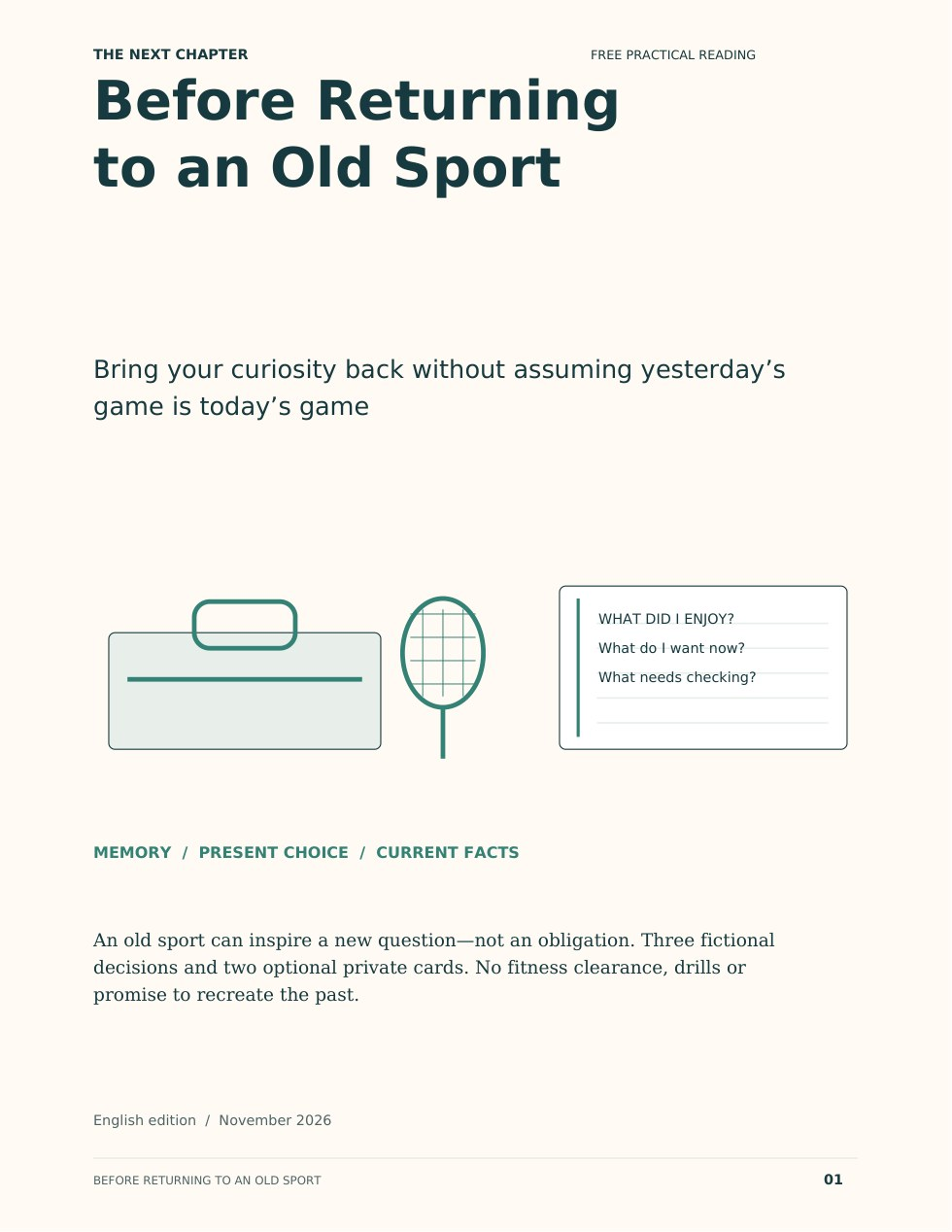
This reading helps separate three questions: What did I like about the old experience? What would I like today? What facts do I need about a real opportunity? It does not assess medical readiness, provide drills or promise that returning will recreate an earlier social circle. You may make one enquiry, observe a session, ask for professional advice where appropriate, or decide that the old sport belongs to a good memory rather than a future appointment.
Remember the pleasure, not only the score
When people remember playing a sport, the result may be the easiest detail to recall: a winning match, a personal best or an embarrassing miss. Yet the enjoyment may have come from something else entirely. Perhaps you liked travelling with friends, mastering a small skill, being outdoors, playing after work or having a fixed social evening. These are different qualities.
Write one sentence about the part you actually miss, if you want to. “I liked talking between games” can point toward friendly social play rather than league competition. “I liked learning technique” might lead to an introductory lesson rather than an open match. You are allowed to want only a portion of an old experience; you do not owe your past self a complete replay.
A familiar name can describe a different event
The club you once knew may have changed. A new venue may use different equipment, event formats, rules, membership terms and ways of pairing players. Even when the sport's official rules look familiar, the particular session's pace and social expectations may not. A “returning players” group could mean confident players coming back to competition, not people seeking a low-pressure introduction.
Check the programme's current description rather than assume it is the same as the one you remember. Ask who leads it, whether newcomers can observe and which rules or adaptations are used. The fact that you played a sport ten or twenty years ago does not establish your present knowledge of the venue or the event's prerequisites.
Your choice now may be different from your choice then
A sport once fitted around a work schedule, friends and transport you had at the time. Your present week may look different. You might prefer a shorter session, a different time of day or a setting where it is acceptable to leave without joining a league. Someone else might now have more time and want a more formal club role. Neither person is required to defend that change.
Look first at your real priorities, not an idealised image of the person you used to be. Would you like an occasional visit, a coaching session, friendly play or simply to watch? The practical starting point is a preference you can express clearly to an organiser. It is not a target for how quickly you must regain an old level of performance.
Old equipment needs a fresh decision
Equipment stored for years can carry sentimental value, but it may not be the right item for a new facility or current use. A venue might have specific footwear requirements; rackets, protective equipment or other items may have changed. You cannot decide from the appearance of an old bag that everything inside is suitable or accepted.
Ask the organiser what is required, whether equipment can be borrowed and what staff can inspect or explain. Avoid buying replacements before you know whether you wish to attend. An old favourite item can remain a keepsake. A first visit can be an enquiry about equipment instead of a purchase. No general article can certify a specific piece of ageing sports gear as safe.
A different surface changes the experience
A remembered game may have been played on one sort of surface, while today's invitation leads to another. An indoor sports floor, lawn, ice sheet or artificial surface can affect the venue's rules, footwear and access needs. Weather and facility maintenance also matter for outdoor settings. Do not infer the conditions from a generic sport name.
Ask exactly where the event takes place, whether the surface is indoors or outdoors, what staff expect from participants and whether the route to the playing space works for you. A venue's address and an accessible entrance do not automatically answer the full access question. If a surface or equipment requirement conflicts with your preferences, you can decline without making a judgement about the sport itself.
The difference between memory and current ability
A person may recall moving comfortably through an entire match years ago. That memory is a real part of their life, but it does not measure present capability or explain any current symptoms. This article cannot determine whether the person should participate, which level is appropriate or how quickly to progress.
Public health guidance encourages activity that is suitable for people's circumstances, and the CDC notes that people with chronic conditions or disabilities can seek advice from healthcare or activity professionals about appropriate types and amounts. For personal health concerns, speak with an appropriately qualified healthcare professional; activity specialists advise within their own training and scope. Separately, the event organiser can tell you what a session demands. Individual health decisions and local programme facts are not the same question.
Do not turn a first visit into a test
It can be tempting to arrive at a first session determined to prove you can still play as you did in the past. That framing may add pressure before you have even met the organisers. A first visit need not include a match. It may simply be a chance to see the space, hear the rules or ask about a suitable beginner format.
An organised sporting event has practical safety rules and participation requirements; follow qualified instruction rather than improvising a trial that is not offered. If you attend as an observer, respect the venue's spectator policy. If no observation is allowed, you can ask for a different way to understand the programme. There is no universal minimum that makes curiosity count.
The social group may have changed too
One reason people miss a former sport is the community around it. You may remember teammates, coaches or a relaxed conversation after a game. A new club can have a wonderful atmosphere, but an event listing does not guarantee that you will meet compatible friends. A reunion with old teammates is not automatically possible either.
Ask how a new person is introduced and whether there is a low-pressure social element. Do participants rotate partners? Is there an instructor or host who can answer questions? Is the session competitive, recreational or primarily instructional? You are choosing an environment, not purchasing a guaranteed friendship. Be open to a different experience without requiring it to replace the one you remember.
Ask what the day would really require
A one-hour sporting session can involve considerable time away from home. You may need to travel, change footwear, check in, receive instructions and get back afterward. For a wholly fictional outing, imagine a 20-minute outward trip, 15-minute arrival and briefing, 40-minute observation and 20-minute return: 20 + 15 + 40 + 20 = 95 minutes. The invented numbers are not a real club's schedule.
If there are ongoing family commitments or transport restrictions, a short session may still be inconvenient. Ask whether a single visit is possible, whether there is a recurring attendance expectation and how cancellation works. An organised experience is a practical choice among other uses of your time, not a compulsory demonstration of fitness.
Access and adaptation must be specific
An older advertisement promising a “welcoming club” cannot prove what facilities are available today. Ask the venue about step-free routes where relevant, equipment access, washrooms, seating, staff support, communication methods and any adapted formats it actually offers. Some sports have formal adaptive versions, but a particular community centre may not provide them at your chosen time.
There is no need to infer someone's mobility or wishes from their age. Likewise, the general existence of an accessible sport does not establish individual suitability. If the event requires an assessment, ask who conducts it and what information they genuinely need. Do not supply personal medical records in response to an unsolicited public form.
A shorter commitment can be a real choice
A club might sell a seasonal membership, a block of coaching sessions or a one-time introductory event. These are separate products. If you are uncertain about returning, ask whether observation or a single suitable visit is offered. The organiser's answer may be “no,” which is useful information rather than a reason to join something you do not want.
Prices should be verified with the actual venue. For a fictional example, a single introduction quoted at USD 16 and a season membership quoted at USD 120 are different financial commitments. A telephone enquiry about both costs USD 0 in new event spending. Any phone or data charges are separate. Neither quotation becomes money spent until a transaction actually occurs. Avoid buying equipment or membership on the strength of nostalgia alone.
A good message to the organiser
You could ask: “Hello. I played this sport some years ago and am curious about trying it again, but I have not decided to register. Is your session friendly play, a coached introduction or a competitive league? Can someone observe or discuss the current expectations first? What equipment and footwear are required, and are loan items available? Could you confirm practical access, the total cost and any commitment or cancellation policy? Thank you.”
You can add one question about the particular surface or adaptation you need. You do not need to announce your age, previous competition record or medical history just to learn the advertised conditions. A reply is information, not permission to disregard official rules or personalised professional advice where appropriate.
What a useful reply actually confirms
A useful reply identifies the current format, required prior knowledge, staff support, equipment, access arrangements, fees and the date to which those details apply. “We're just like we always were” is not a complete answer. It does not confirm how a newcomer is introduced or whether an accessible route still works.
Separate three things in your notes: the organiser's verified facts, any questions that remain open and your own preferences. If an important condition is missing, ask once more. If the event differs from the way you would like to return, you can decline. A fond memory does not create a debt to a particular sports organisation.
Fictional case: Celia observes a familiar sport
Entirely fictional case. Celia enjoyed badminton years ago but has no idea whether a community centre's doubles evening is now beginner-friendly. She asks if spectators are permitted and receives confirmation. She travels 15 minutes each way and watches for 30 minutes, spending 60 minutes on the entire fictional outing. The observation has no admission fee; no travel spending is specified.
Celia realises the event is a competitive club night and decides to look for an introductory format instead. She has not registered, played or booked a lesson. The imaginary venue does not represent a real local club or available date. Learning that this is not the right programme is a meaningful result.
Fictional case: Omar separates two questions
Entirely fictional case. Omar wants to resume a sport after a lengthy absence and has a health-related question that a general article cannot answer. He decides not to assume that old experience is sufficient. Instead, he makes a 10-minute enquiry to the venue about session format and prepares a separate question for an appropriately qualified healthcare professional about his personal circumstances.
No medical visit is depicted, no personal health outcome is predicted and no sports booking has taken place. New sport-event cash spent is USD 0. Any communication charges are separate from that event spending. The professional consultation is not assumed to be free, booked or completed. Omar's decision keeps personal advice and event logistics in their proper places.
Fictional case: Imani declines the old league
Entirely fictional case. Imani misses the friends from an old recreational football group. A fictional present-day league invites her to join, but its current commitment includes frequent matches and travel that she does not want. Imani replies: “Thank you. I have good memories of playing, but this schedule isn't for me now.” She might later reconnect socially with a former teammate, yet no visit or meeting is arranged here.
No fees have been paid, no match played and no alternative booked. New sport-event cash spent is USD 0. Declining the league does not erase the pleasure of the old games. A person can preserve a memory without turning it into a present obligation.
Private card one: what would I like to return to?
Optional, private card; do not submit. (1) The sport or setting I remember, (2) what I actually enjoyed, (3) what I would want from it now, (4) the current event format I need to check, (5) equipment, access or support question, (6) what I still don't know.
This is not a physical readiness score. Keep personal health information for an appropriate confidential professional conversation, not a public worksheet. It is fine to write “I like the memory more than the new idea.” A clear personal preference has practical value even without an immediate plan.
Private card two: an honest next step
Optional, private card; not a booking or assessment. (1) Name of the current source and information date, (2) possible venue or event, (3) actual participation prerequisites, (4) complete cost and time commitment, (5) advice or information still required, (6) current decision: ask, observe, seek qualified advice, consider one suitable visit, decline or wait.
Keep quoted prices separate from cash actually spent and tentative plans separate from confirmed appointments. Do not collect someone else's contact details, financial account numbers or health records. This card is yours to keep or ignore. Its goal is to support an informed choice, not to pressure you into a return.
You are allowed to enjoy a different version
Your past involvement may help you know which questions to ask, but it does not determine your present interests, circumstances or the right form of participation. You can return by observing, asking for an introductory class, joining an appropriately structured event after verification or choosing not to participate.
Where personal health or activity suitability is uncertain, seek advice from an appropriately qualified healthcare professional rather than relying on nostalgia or generic reassurance. Where venue details are uncertain, ask the organiser. And where your preference is simply “not this format,” you can say so. A next chapter need not repeat the previous one to be valuable.
Sources and limits
Official resources consulted for the distinctions described here (not endorsements or live local listings):
- CDC — Steps for Getting Started With Physical Activity
- CDC — Physical Activity for Adults With Chronic Conditions and Disabilities
- Government of Canada — Physical Activity: Being Active for Your Health
- World Health Organization — Physical Activity
Rules, programmes, eligibility, facilities and fees can change. Check the current organiser and relevant official rules before participating. This is a practical consumer reading, not coaching, medical advice or an assurance of accessibility.