THE NEXT CHAPTER — AN ORIGINAL FREE READING
An unexpected message does not get to choose how you check it.
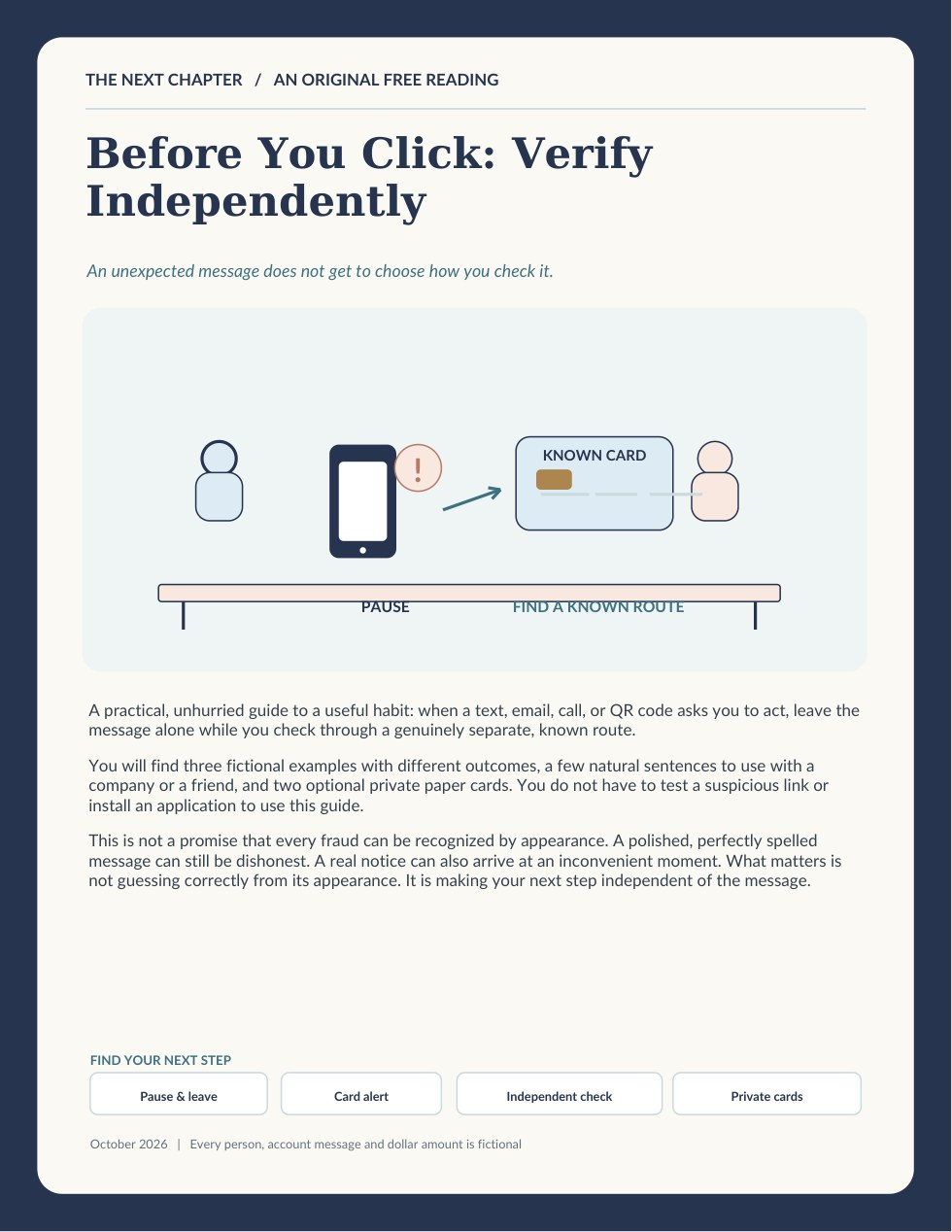
A practical, unhurried guide to a useful habit: when a text, email, call, or QR code asks you to act, leave the message alone while you check through a genuinely separate, known route.
You will find three fictional examples with different outcomes, a few natural sentences to use with a company or a friend, and two optional private paper cards. You do not have to test a suspicious link or install an application to use this guide.
This is not a promise that every fraud can be recognized by appearance. A polished, perfectly spelled message can still be dishonest. A real notice can also arrive at an inconvenient moment. What matters is not guessing correctly from its appearance. It is making your next step independent of the message.
The interruption is not the decision
The day is going quite well. Perhaps you are sorting a few photographs, watering a houseplant, or deciding whether to meet a friend. Then your phone makes that short, compelling sound.
Payment problem. Act now.
The message is brief. It may use your bank's colours. It may know your name, or look as if it came from a familiar contact. It may say that waiting will cost money, lock an account, cancel a delivery, or disappoint someone you love. Suddenly you are being offered two choices: obey immediately or suffer the consequence.
There is a third choice. You can take responsibility for a possible real problem without allowing the message to direct the way you investigate it.
A message can make a claim. It cannot prove its own identity by repeating that claim. The sender name on the screen, an impressive logo, an accurate detail about you, or a plausible-looking address is not independent evidence that the requested action is legitimate. Scammers can imitate trusted institutions and people. Some messages are genuinely sent by companies, too; it is sensible to check rather than assume either way.
You do not need to decide, within ten seconds, whether the message is fake. You need to decide which source will answer the question. If there is a true payment problem, the company's own verified account service or established telephone channel should be able to help you investigate. If a person needs help, a fresh conversation through a route you already trust can help establish what is happening.
The message can wait while you find that route. Your judgment does not have to hurry merely because a stranger's words do.
The habit: Treat the surprising message as an unverified claim until you have checked somewhere independent.
Pause. Leave. Verify.
This guide uses three ordinary verbs rather than a complicated security checklist.
Pause. Do not press the message's link, scan its QR code, open its unexpected attachment, reply with personal details, call the number it gives you, or send money because it declares an emergency. If you are in the middle of an unexpected call, you may end the call. Politeness does not require continuing a pressured conversation.
Leave. Move away from the suspicious message. You do not need to delete it immediately; you may want to use your usual app's reporting controls later. But stop using the message as a navigation tool. A link inside an email is still part of the email. A callback number supplied by the caller is still part of the caller's story. A website reached by scanning the message's QR code is still a destination that message selected.
Verify. Open a company app you already installed through a trusted route, type a known verified address yourself, use the number on the back of your own physical payment card, or find a company contact in a paper statement you already hold. Ask about the underlying issue without using a link, address, or number supplied in the suspicious message. For a person you know, begin a separate conversation using contact details you had before this request arrived.
Sometimes the independent service confirms a real issue. Sometimes it finds none. Sometimes it cannot yet tell. These are all more informative results than obeying the original demand.
You can say to yourself: I am not ignoring the problem. I am choosing where to check it. That distinction turns the pause from an act of fear into an act of care.
A different-looking link is not necessarily a different source
Imagine that a text contains a button labelled “Support.” Beneath it is a telephone number labelled “Fraud Department.” There is even a tidy row of security icons. You might reasonably think that calling the number is safer than clicking the button.
But both were supplied by the same unverified text. Neither is a genuinely independent route.
The same problem arises when a stranger on the phone offers to transfer you to the “real department,” sends a follow-up email, or asks you to search for a company name and select a particular result. A long chain of reassuring steps can still be controlled by the first unverified contact.
A good independent route existed before the incident, or can be established without relying on the contact's directions. Examples include an app you already use and recognize, a verified website saved long ago, the official number printed on your card, or a known company's contact information found after carefully checking the real organization's domain. Search results and advertisements can themselves be misleading, so a result's position or a paid label is not sufficient proof.
If you cannot confidently identify a safe route, postpone the action. You may ask someone you trust to help you find the organization's legitimate contact information, while keeping passwords, access codes and financial details private. You do not need to show that person the contents of a sensitive account merely to ask for help locating an official website.
Ask one test question: Would I know how to reach this company or person if that suspicious message had never arrived? If the answer is no, take time to establish the contact information separately.
Urgency is information about the message, not proof about reality
A deadline can be real. Bills have due dates; deliveries can have pickup windows; family members sometimes need help promptly. But a message that announces urgency does not establish the truth of the threat, the size of a charge, or the identity of the sender.
Notice what the message asks you to do. Is it directing you to provide a password or one-time code? To move money to a “safe account”? To pay a fee with an unfamiliar method? To open an attachment or scan a QR code before you can learn the details? These are reasons to stop and check. They are not a diagnostic test that proves every otherwise ordinary-looking message safe.
Good spelling is not a certificate. Neither is poor spelling a requirement for a scam. A sender may use professional writing, correct formatting, convincing names, or information exposed elsewhere. You can acknowledge the uncertainty without trying to win a guessing game.
If something truly requires urgent help, the independent institution or person can explain that need after you contact them through a trustworthy route. It may take effort, but it prevents a stranger's countdown from also determining your next click.
Try a useful sentence when speaking to an established provider: “I received an unexpected notice about my account. I did not use the notice's link or phone number. Can you tell me, through this official channel, whether there is a real issue and what I need to do?”
Your question does not confess fault, and it does not accuse the employee. It simply separates checking from complying.
Fictional case one: Mara and the card alert
Mara is waiting for a neighbour to return a borrowed book when a message appears on her phone. It claims a $24.60 charge has been placed on her payment card and warns that she has only twenty minutes to challenge it. A large button says “Dispute now.”
The amount is believable. Mara bought household supplies earlier in the week. She also knows that card problems sometimes are genuine. She feels the familiar pull to settle the matter at once.
Instead she puts the message down. She does not press the dispute button or call the number in the notice. She takes the physical card from her wallet and phones the issuer using the number printed there. She follows the normal verification procedure initiated by that official contact, without repeating credentials or security codes to the suspicious message.
Through the official service, she asks whether there is an unexplained posted or pending transaction. In this invented example, the representative finds no matching charge, explains the distinction between posted and pending transactions, and suggests watching the account using the issuer's official app. Mara is not charged for a dispute service. She sends no payment and gives the message no information.
This case deliberately does not say that a real charge can never appear later or that an apparent account balance is a complete security investigation. Mara has checked one specific claim at one moment. If the issuer had found a real problem, she would have followed the official issuer's procedure instead.
The $24.60 was claimed in the message, not paid, owed, or confirmed as stolen. Mara's new outlay during the exercise is $0. Her useful achievement is not the ability to recognize fake bank graphics. It is choosing a source that the message did not control.
What Mara learned—and what she did not
It is tempting to end Mara's story by saying, “The message was a scam, and everything is fine.” Real life is less tidy, which is why her smaller conclusion is more useful.
Claim made by the unexpected message: A $24.60 charge exists; a dispute link must be used within twenty minutes. Neither assertion has been independently established.
Action actually taken: Mara used the number printed on her existing physical card to speak to the issuer. She did not use the text's button, give the text information, authorize a payment, or complete a dispute through that message.
Result from the independent channel: In the story, the issuer found no matching charge at that check. Mara now knows where to look through the official account service if new evidence appears.
What remains possible: Account information can change. A pending transaction could later post, and a suspicious message can be one part of a wider attempt. Mara should follow any specific instructions her real institution gives her; the fictional account check is not a universal safety guarantee.
An ordinary arithmetic question has an important answer here: $24.60 appearing on a screen is not $24.60 spent. A claim is not a transaction receipt. Likewise, a phone call to a trusted issuer is not the same thing as filing a police report, disputing a posted transaction, or recovering money.
A reader facing a genuine payment problem should use the relevant institution's current official procedure. This story is about the first safe boundary between an unexpected message and an independent enquiry.
Useful phrase: “The notice may be important. That is exactly why I will check it somewhere other than the notice.”
Find the organization without following its invitation
Different people keep different kinds of records. You may use an app confidently; you may prefer paper statements; or you may rely on a family member to help you navigate a complicated website. None of these preferences determines your ability to be careful.
The goal is to find a reliable point of contact independent of the unexpected request. A phone number printed on your own physical card is often better evidence of the issuer's contact channel than a number pasted into a text. A bill or statement you already obtained through normal channels can be useful. A correctly verified app installed before the message arrived may display account notices inside the secure account. If you type a site address, first make sure the actual organization and domain are correct; guessing a domain or following an advertising result is not the same as verification.
No security image in a browser is a complete identity guarantee. A padlock indicates a connection property, not that the business behind the page is honest. A lookalike address with an extra word or changed ending can be misleading. A search-result headline may be sponsored. When uncertain, back away and use a stronger route such as the printed number on a known card or document.
If a message claims to come from government, tax, or benefit services, look for the real agency through an independently established government portal. Do not assume that any official-looking logo, department name, or caller ID verifies a request for payment or personal information.
If you choose not to resolve the uncertainty today, that is still a decision. Write only a non-sensitive reminder for yourself, such as “check utility account through saved app,” and return to it when you can think clearly. Do not copy the suspicious link into the reminder.
Fictional case two: Inez and a small delivery fee
Inez is expecting a parcel from a friend. A text arrives just before lunch: “Your delivery is being held. Pay $3.20 to release it.” A neat shipping icon appears beside a payment button. The price is low enough to feel like an annoyance rather than a financial decision.
Inez thinks, It probably costs more in time to argue than to pay. That is exactly the reasoning she decides to test.
She leaves the message untouched. From an app already installed and previously used for an actual delivery, she opens the courier's legitimate service. She checks the tracking information she obtained independently when the parcel was sent. In this fictional story, that record says the parcel is still awaiting pickup, with no matching request for a release payment. She contacts the courier through its established service to ask whether there is anything she needs to do.
The fictional service cannot confirm that the fee text relates to the parcel. Inez does not pay. She also does not announce that every delivery fee is fake. Some shipments and jurisdictions can involve genuine taxes, duties, or handling charges. The important fact is that this particular $3.20 demand remains unverified.
Inez sends her friend a separate ordinary message about the parcel's status, using contact information she already had. She does not forward the fee link and ask the friend to try it. The friend can answer what they actually know, not act as a substitute for the courier's financial records.
In this example, no payment occurs; the additional cost is $0, not $3.20. There is no completed collection trip or revised shipment booking. Her outcome is a cleanly bounded enquiry, not the resolution of every detail about the parcel.
Small amounts deserve the same independent question
A $3.20 demand can feel almost harmless. But the unknown is not only the stated fee. A link that asks for payment details can potentially expose card information or redirect a person to further requests. A file disguised as a receipt could be harmful. This does not mean every odd delivery message is malicious; it means an unknown payment route is not made trustworthy by having a low price.
Inez's case holds three quantities apart. $3.20 is an amount asserted by the message. $0 is the amount she actually paid in response. The legitimate costs of a shipment, if any, remain to be checked with the real courier. No one should use this invented example as a price list for delivery services.
If a fee is real, the courier can explain it through its legitimate account or support channel. If the parcel is not traceable there, there may be missing information, a different carrier, or a false claim. All three possibilities warrant verification rather than an automatic payment.
Notice another distinction. A visit to a familiar app is a check; it is not a guarantee that the complete parcel history has been confirmed. An app might show limited status or delayed updates. Use the service's current official support process if the result is important and still unclear.
The habit transfers beyond parcels. A toll notice, a membership renewal, an overdue parking claim, or a tax refund invitation may all be packaged as small, urgent interruptions. The subject changes; the independent route does not.
Useful phrase: “Before I pay even a small amount, I want to see the charge in the real account or hear it confirmed by the real provider.”
When the message seems to come from someone you love
Company impersonation is one problem. A message using a familiar person's name may be harder. It can make a request feel like a test of affection: if you delay, perhaps you will be abandoning somebody.
But caring about a person and trusting an unexpected payment instruction are two different decisions.
A new message thread or social-media account may use the name and photograph of someone you know. An existing account could be compromised. Even a convincing voice or image is not enough on its own to establish who controls a new request. The safe first step is a separate conversation through a channel you knew before this message arrived.
If you have a familiar telephone number for the person, call it yourself, rather than the number supplied in the strange message. If you can speak to them face to face or through another established, genuinely independent contact, that may provide a better check. If they cannot be reached, you can delay a financial action while taking reasonable steps to determine whether there is a real emergency. For a credible immediate threat to life or physical safety, contact local emergency services through their known official number, not a number supplied by a suspicious request.
A helpful sentence is simple: “I care about you. I am going to phone you in the usual way before sending anything.” It can be said with warmth, not accusation.
A person who truly needs your assistance may be frustrated by a delay. A temporary disappointment is not proof that a rushed transfer is the right response. Assistance can begin with checking what is actually happening.
Fictional case three: Leon and the familiar name
Leon receives a message that appears to come from a longtime friend. It says the friend is stranded after a vehicle problem and needs $180 immediately. The request is to send a transfer to a new contact address. It includes a reason for secrecy: “Please don't call. I'm embarrassed.”
Leon knows the friend has been travelling recently. He also knows that an unexpected new payment destination is a reason to verify, not a reason to treat the situation as certain.
Leon uses the phone number in his old address book. There is no answer. He leaves a short voicemail asking the friend to call. He does not send money or the payment details. He does not use the new address in the suspicious message as proof of identity, and he does not ask the apparent sender to provide more private information by text.
Later in this fictional case, he speaks to the real friend through their familiar channel. The friend says their messaging account has been misused and that they are safe. Leon points them toward the provider's official account-recovery and security resources without asking for any password or one-time code. He does not attempt to fix the friend's account by logging in as them.
Leon's example has an unambiguous money trail: $180 requested; $0 transferred. His old-number call initially failed to reach the person; that was an inconclusive attempt, not proof that the message was false. Independent confirmation came later. The story is not a general promise that an impersonation attempt will always be revealed by the next telephone call.
Being generous does not require delegating your judgment to the person requesting money. Leon's pause protects both the friendship and the possibility of providing the right kind of help.
Three cases, one habit, different answers
Let us keep the three stories separate rather than flattening them into a single reassuring slogan.
Mara received a claimed $24.60 card charge. She used the number printed on her existing card. The issuer found no matching transaction at that check. New money paid: $0. The account might still need monitoring according to the issuer's advice.
Inez received a claimed $3.20 parcel-release fee. She opened an established courier app and made an official enquiry. The fee remained unverified. New money paid: $0. The real shipment status still needed appropriate independent confirmation.
Leon received a request for a $180 transfer apparently from a friend. His first separate call did not connect; later the real friend confirmed misuse of their account. Money transferred: $0. That story included an actual later confirmation, whereas the earlier missed call alone settled nothing.
This is why an independent check is more reliable as a process than an eye for suspicious wording. The clues differed: a card charge, a tiny fee, and a personal emergency. The first sources of pressure differed: a timer, a low amount, and emotional closeness. The useful response was the same: do not let the incoming contact choose the link, number, or new recipient of money.
The outcomes are specific. “Checked” is not the same as “resolved.” “Unverified” is not the same as “proven fake.” “No new payment” is not the same as “there is no risk.” These careful words can sound less dramatic, but they help you make decisions based on what you actually know.
Try taking one fictional message from these pages and saying aloud: “What does it claim? What did I verify? What remains unknown? Who can answer from a genuinely separate place?” That is enough for a useful first rehearsal.
The same rule applies to QR codes, files and replies
It is easy to think a suspicious message is dangerous only if it contains a blue web link. The instruction may instead be hidden in a QR code, a document attachment, a calendar invitation, a shortened address, or a reply such as “Send YES to continue.”
All of these can be ways of moving you from the unverified contact to an action it controls.
A QR code is simply another route to a destination. If the code came in an unexpected payment or account message, scanning it is not independent verification. An unexpected attachment may carry harmful content or lead to another request for information. A request to reply with “STOP,” “YES,” or a code may confirm that your contact is active or extend the interaction. Use the relevant app's built-in reporting or blocking controls where appropriate, rather than experimenting with the sender's instructions.
You do not have to hover over a link, decode a QR code, or inspect a file to prove to yourself that it is dangerous. You may simply choose not to open it and check with the organization through a known route. On a touchscreen, trying to preview a link can occasionally activate it; it is reasonable to avoid that experiment altogether.
Nor should a familiar person's forwarded warning become your evidence just because it arrives in a friendly conversation. Your friend may have received the same misleading material. The origin of a claim still matters.
There is no obligation to investigate every unsolicited offer. For ordinary unwanted spam, your existing mail or messaging filters may be the simplest response. For claims that could affect your real account or plans, independent verification is the next step. These are different kinds of decisions, and neither requires following the suspicious material.
If you already opened something, start with what actually happened
People sometimes click before they realize a message is suspicious. Shame is not a useful security tool. What matters next is identifying the action and responding through legitimate channels.
If you only opened a link: Do not continue interacting with the site or enter information. A click does not, by itself, prove that money was lost or credentials were disclosed, but opening malicious content can carry risks. Follow the device manufacturer's current security guidance, keep the device and browser updated, and seek qualified assistance through a trusted source if a download or unexpected behaviour is involved. Do not install a “cleanup tool” supplied by the suspicious page itself.
If you downloaded or opened an unexpected file: Stop using the file. Follow current official device or workplace security guidance; on a managed work device, contact the proper IT/security team. Avoid guessing that deleting the visible file guarantees that every problem is gone.
If you entered an account password or verification code: Use the real service, reached independently, to secure the affected account promptly. Change the password through the official path, review account sessions and recovery details, and enable appropriate multi-factor protection. If a bank or another sensitive service was involved, contact its official security team immediately. Never read a fresh verification code back to the person who contacted you unexpectedly.
If you supplied card information or authorized a payment: Contact the genuine financial institution urgently through a verified channel and follow its instructions for protecting the account and reporting a possibly unauthorized transaction. Ask what can be reversed or disputed; do not assume recovery is guaranteed.
These are starting points, not a forensic assessment. The details depend on which system, account, file, and transaction were involved. You can seek direct official help without turning the incident into a personal failing.
When it is more than a suspicious message
Independent checking is a habit for before you act. If you believe information, access, or money may already have been taken, you may need more immediate and specific action.
Contact the relevant provider through a verified route. For a card, bank account, or transfer, the financial institution's fraud or security team is the place to discuss transaction protections and any available reporting or dispute process. For an online account, use the provider's official security and recovery tools. For a device provided by an employer or organization, use that organization's incident-response process.
If identity documents or sensitive personal information may have been exposed, ask the relevant organizations and qualified official resources what protective steps are appropriate where you live. Do not post the exposed information into public forums as a request for help. If the matter involves immediate personal danger, contact local emergency services through known official channels.
You may also report suspected scams and fraud to the appropriate national or local agency. In Canada, the Canadian Anti-Fraud Centre provides current guidance on reporting fraud. The exact route and requirements can change, and a report to a public agency is not the same thing as contacting your bank to protect a payment or account. Both may matter.
Beware of a second approach claiming it can retrieve lost money for an upfront fee. An alleged recovery specialist contacting you unexpectedly may be another fraud attempt; verify any service independently. Do not pay or disclose more sensitive details merely because someone promises to undo a prior loss.
The aim is timely, appropriate action—not a perfect memory of every digital security term. A calm initial pause matters, but when real money or credentials have been exposed, contacting the genuine institution promptly matters more than finishing a worksheet.
Help someone else without taking their judgment away
A spouse, friend, or neighbour may ask you whether a message is legitimate. It is tempting to take their phone, inspect every button, and declare the answer. A kinder and more durable kind of help is to make the independent-check habit visible.
Ask, “What is the message claiming?” Then ask, “Where would you normally go to check that?” Offer to find a trusted official contact without reading their account details. If they want you to help make a call, let them remain in charge of sharing any information properly requested by the actual institution.
If someone says, “But the text knows my name,” you might say, “That makes it convincing, but it does not tell us who sent it. We can still check through the real company.” If they feel embarrassed, you can say, “We do not have to decide whether it was fake from the way it looked. We only have to find out what the real account says.”
A person may have language, vision, hearing, or mobility preferences that shape how they verify. An accessible official phone service, a trusted person reading an independently obtained statement, or an existing verified app may all be more workable than a new website. Avoid making somebody prove digital competence under pressure.
Keep privacy intact. Do not photograph their documents, collect their passwords, or copy their codes into your own notes. You can help them locate a legitimate support channel without becoming the keeper of their credentials.
For a purely imaginary rehearsal, say this out loud: “I will not use the information in the unexpected message to decide where I check it.” A sentence rehearsed during an ordinary afternoon may be easier to remember when the next urgent-looking message arrives.
One small habit to keep—and where to check official guidance
You do not have to memorize every example. Remember one boundary: the message does not choose the verification route. Set it aside. Find the organization or person using an independent contact source. Ask about the real underlying issue. Record only what you truly confirmed.
The examples and amounts in this guide are fictional. The general steps draw on public consumer-protection guidance reviewed in October 2026. If you want current reporting instructions or provider-specific steps, start from the official organization itself, checking that you are on its genuine site. The following are reference titles and published domains, not links from any unexpected message:
- Canadian Centre for Cyber Security, “Spotting malicious email messages (ITSAP.00.100)” —
cyber.gc.ca/en/guidance/spotting-malicious-email-messages-itsap00100. Its guidance describes why unexpected attachments, links and QR codes should not be the route for logging into accounts. - Canadian Anti-Fraud Centre, “Phishing” —
antifraudcentre.ca/scams-fraudes/phishing-hameconnage-eng.htm. It describes sender impersonation, urgency and other common tactics; use its current official reporting pages when needed. - U.S. Federal Trade Commission, “Protect yourself from phishing scams” —
consumer.ftc.gov/consumer-alerts/2025/04/protect-yourself-phishing-scams. It recommends contacting organizations via contact information you already know is genuine instead of using an unexpected message.
These public references do not endorse this publication, and this guide is not an official incident-reporting portal. Security practices and services evolve, so the current provider instructions matter more than a printed example.
If you have only one minute, do not spend it trying to spot a perfect fake. Spend it finding an independent path. If you discover a real issue, act through that path. If you cannot verify, it is reasonable to leave the original request untouched while you seek appropriate help.
Optional private card: Before I act
Print this page or leave it blank. This is for your own use, not for uploading, forwarding or showing to a stranger. Do not write passwords, security codes, account numbers, personal addresses, or message links here.
1. What is the message asking me to do (in general terms)?
2. What exactly is still only a claim?
3. Which established source could check the real issue?
4. How will I reach that source without using the message?
5. What action will I avoid until I have checked?
6. If I cannot verify it today, what safe next step can wait?
The card is complete even if you write only one line. You are not required to investigate every unsolicited message.
Optional private card: What I actually know
Use this privately after a fictional rehearsal or a safe real check. Do not record sensitive identity, health, account, payment, or recovery details. If you already disclosed information or money, seek official help promptly instead of completing this card.
1. Which independent contact method did I actually use?
2. What did the genuine source confirm, if anything?
3. What is still unknown or unconfirmed?
4. Did I actually pay, disclose, download, or merely enquire?
5. If action is needed, which genuine institution can advise me?
6. What one sentence will I remember next time?
You can stop here. An unexpected message is not a test you have to pass. A careful, independent check is a practical skill you can keep.