Know the difference before choosing a first visit
Two target games, two different experiences
A neighbour invites you to play bocce. Another talks about the lawn bowls club. The words may sound like variations of the same activity: players send larger balls toward a smaller target and compare which ball ends up nearest. Yet a local bocce court and a lawn bowls green can look and feel quite different.
This guide is for someone who wants to recognize the difference and decide whether one introductory visit sounds interesting. It is not a formal rulebook, an equipment catalogue or a program that teaches physical technique. The best first question may be “What will I actually see if I go?” rather than “Which sport should people my age play?”
You can be interested in the social atmosphere, the geometry of a good shot or simply spending time outdoors. You can also prefer watching to participating. A particular venue may not suit you, even if the sport appeals in principle. We will separate the verified basics of the games from the local conditions that need a real enquiry.
The shared idea: get close to a target
In both sports, a small target is established and players deliver larger balls toward it. The relative position of the balls at the end of a phase of play is important. A nearby ball may be more valuable than an impressive-looking one that ends up far away. Balls can also interact: one may move another or alter the target's position, depending on the rules of the particular sport and format.
At a casual viewing, you can understand the purpose without calculating every point. Watch where the target begins, where players deliver their balls and how everyone decides which is nearest. Ask someone who knows the local game to explain when a round, frame or end finishes.
The shared idea does not mean equipment is interchangeable. Do not bring a random household ball and assume it is appropriate for organized play. Similarly, a rule you know from lawn bowls is not automatically a bocce rule. Learn the name, surface and format first.
Bocce: the pallino and the bocce balls
In bocce, the smaller target ball is often called the pallino or pallina, depending on the context and governing rules. Players deliver larger bocce balls in an attempt to place them favorably relative to that target. Special Olympics' bocce materials explain this basic target-ball structure and describe particular competition formats.
Different forms of bocce and different local programs can vary in how the game is run, the construction of the court, the number of balls delivered, or the scoring target. One organized competitive ruleset should not be presented as the universal casual rule for every garden or community game. For a new spectator, first learn which version the organizer actually offers.
You might hear terms such as frame, point, pallino and court. You do not need to memorize a full technical glossary to appreciate a relaxed first observation. It is enough to recognize that the smaller ball is a target, not another player's attempt.
Lawn bowls: the jack and the green
Lawn bowls uses a small target called the jack. Players roll larger, specially designed bowls toward it on a flat playing surface, traditionally a carefully maintained grass green. Bowls Canada describes the green, jack and strategic objective in its official introduction. Some facilities use synthetic playing surfaces or indoor arrangements; verify the actual local setting.
The green is not just a lawn anyone may walk onto. Clubs may have footwear requirements and rules that protect the surface. A visitor should ask where to enter, whether public observation is possible and whether club equipment is available for a first-time introduction.
You may hear an end described: a phase in which bowls are delivered and their positions are compared around the jack. Different sessions and competitions can use different match lengths and formats. Do not infer that every club evening consists of a fixed number of ends or that every invitation implies a season-long membership.
The surprising difference: lawn bowls curve
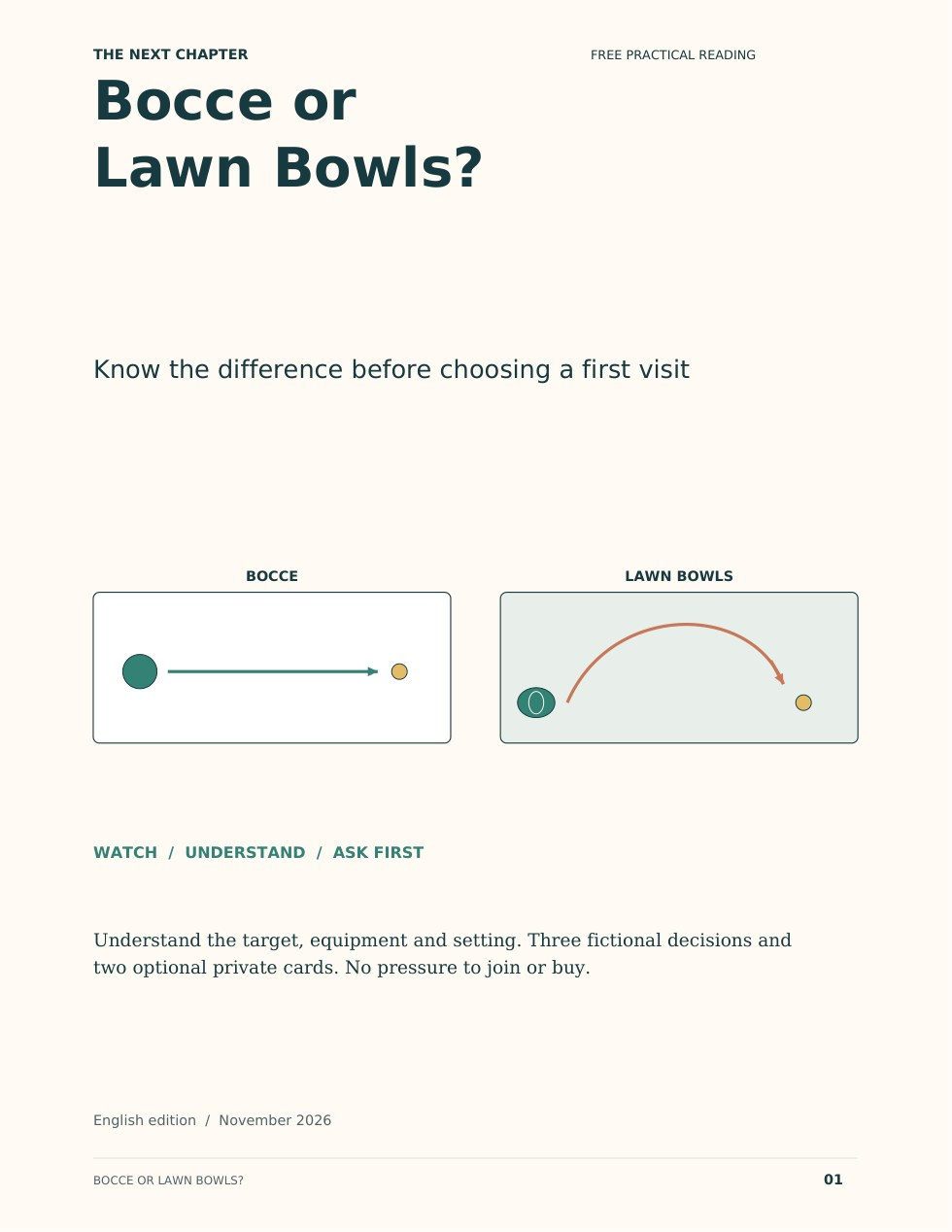
One of the clearest differences is the behavior of a lawn bowl. Bowls Canada explains that a lawn bowl is biased: its construction causes it to follow a curved path as it travels across the green. This gives aim and choice of line an important part in the game. You may see a bowler send the bowl away from the jack and watch it curve back toward the target.
Bocce balls are typically delivered using different approaches to a target on their own court surface; they do not have lawn bowls' intentional built-in bias as the defining feature of the sport. A first-time spectator may therefore find the visual strategy quite different.
This is a description of what is seen, not instructions for positioning the body or delivering a shot. For supervised learning or adapted participation, follow a qualified local instructor and the relevant rules. A person who enjoys observing strategy may find the curved path interesting even without wishing to play.
Court and green are different places
Bocce may be offered on a dedicated bounded court, in a recreational community facility or in another locally appropriate playing area. The exact surface and boundaries depend on the sport version and organizer. Lawn bowls is typically associated with a green divided into playing rinks, with special attention to protecting the surface. Some places operate indoor or synthetic-greens sessions.
The setting affects practical attendance. A bocce court might be part of a public recreation center; a lawn bowls green might be operated by a member club. Neither model is universal. Check public-access rules, observation possibilities, washrooms, paths, seating and whether equipment must be borrowed or booked in advance.
Pictures can mislead. A photograph of an immaculate green says nothing about a club's current hours, membership policies or accessibility, and a picture of people playing bocce in a park says nothing about whether the same arrangement exists near you. Verify the actual local site rather than assuming.
A few words you will hear
On the bocce side, you may hear pallino, pallina, bocce ball, court and frame. On the lawn bowls side, you are more likely to hear jack, bowl, green, rink, bias and end. Local communities may use additional names or explain certain terms differently. Do not correct a friendly demonstration based on terminology from another region.
If you see players measuring a distance, that may be because two balls appear very close to the target. The measurement is a way of settling a positional question, not necessarily a sign that the setting is intensely competitive.
Try asking one plain question when invited: “What do you call the small target ball in this version?” That question gives the instructor a starting point, but names can overlap. Also ask which sport and local ruleset the session uses. You do not need specialist words to make a respectful enquiry.
How scoring is similar—and where it can differ
A useful general idea is that balls closer to the target than the opponent's nearest ball may count toward the scoring side's result after a phase of play. Bowls Canada and Special Olympics materials describe scoring based on closeness in their respective games. That basic concept helps make sense of why players sometimes wait for an entire set of deliveries before finalizing points.
Do not assume every program has the same winning score, number of deliveries or exact handling of ties. Formal bocce variants, Special Olympics competition formats, lawn bowls leagues and introductory social events may use different procedures. A friendly demonstration might simplify its scoring to help newcomers understand the purpose.
You can enjoy an observation without recording points. If the details matter because you are considering a competition, request that event's current official rules. This reader does not replace a referee or claim that an illustrative diagram settles every situation.
What a social session might feel like
People sometimes describe both bocce and lawn bowls as sociable. A local club may host casual introductions, friendly matches, structured coaching or competitive events. The presence of a shared target does not guarantee a friendly group or mean the activity is suitable for every participant.
Ask how newcomers are greeted. Is there a named host? Will someone explain the rules before play begins? Are participants assigned partners? May observers leave early? Is there a quiet space to wait? An organized league and a one-off open house can be pleasant in very different ways, and one might suit you much better than the other.
If you dislike the pressure of a full team season, inquire about occasional observation or instructional visits instead. If you love structure, you may prefer a clear schedule. The useful choice is between real local formats, not stereotypes about what older adults should enjoy.
Borrowing the right equipment
A newcomer should not have to guess which set of balls to purchase. A lawn bowls club may provide different sizes of bowls and demonstrate how they behave, while a bocce group may supply sets suited to its surface and local rules. Availability is not guaranteed at every venue; ask directly. Some facilities have footwear or clothing policies to protect the green or keep pathways clear.
Find out whether equipment is included in a visitor session, whether it can be borrowed for a trial, and whether any personal item is compulsory. Costs and liability policies vary. For a first enquiry, information is often enough; purchasing your own kit can wait until you know whether a particular program appeals to you.
There is no reason to purchase a sporting product simply because a brochure declares it beginner-friendly. An organizer's verified current requirements are more relevant than a generic shopping list. This article recommends no specific retailer or brand.
Accessibility must be checked locally
A target-ball sport can be offered in a range of settings, and an individual may have needs involving routes, surfaces, mobility aids, seating, vision, hearing, communication or equipment adaptations. Neither the title of a sport nor an advertisement's promise that everyone can play confirms the suitability of an actual local facility.
Ask whether there is step-free access to the viewing area and the playing surface, where accessible washrooms are located, whether seating is available and what adaptations are offered in the specific session. Special Olympics bocce resources include competition and coaching approaches for diverse participants, but they do not establish that a particular neighborhood group has the same equipment or trained staff.
Medical or individualized physical suitability cannot be determined from this reading. For personal clinical uncertainties, seek relevant qualified advice. The venue remains responsible for accurately describing its access and services. An honest “we do not know yet” is better than a misleading assurance.
Weather, surface and season affect the decision
For an outdoor lawn bowls session, weather and maintenance can affect whether a green is usable. A bocce court may also be outdoors and subject to conditions. Indoor programs can have their own constraints such as reservation, noise or limited capacity. Do not assume that a game listed for a particular season is available today.
Ask how cancellation notices are sent, what happens to prepaid fees if weather prevents a session, and whether an alternative venue exists. Check the actual current local forecast and any official warnings before a real visit; this article supplies no forecast or personal weather risk assessment.
If you are planning a casual observation, know whether sheltered seating and safe transport are available. Some people will decide to wait for another day. A delay is not lost progress. A sport can be interesting in principle while an outing on a particular date does not make sense.
The full fee and time matter
A hypothetical bocce observation might have no admission fee but require a USD 6 round-trip fare. A fictional lawn bowls trial might quote USD 12 for equipment and instruction plus USD 4 in return transport. If that trial actually took place with all such expenses, the illustrative essential total would be USD 16 (12 + 4). These are invented comparison figures, not current prices or recommendations.
The whole day matters as well. An event described as 45 minutes could include travel, waiting and a return trip. Ask whether you need to arrive early and whether a first visit requires a membership purchase. Keep quoted future costs separate from money actually spent. The aim is an accurate decision, not a bargain-hunting contest.
A real organizer can tell you about its present fees, equipment policies and cancellation rules. Check these before registering. You need not provide private financial information to this website to use the comparison.
A question that works for either sport
If you find a legitimate local club, a useful message could read: “Hello, I am curious about an introductory visit to your bocce or lawn bowls program. May a newcomer observe first? Is this a social demonstration or organized competition? Will equipment be available to borrow? What is the complete first-visit cost and cancellation policy? Can you confirm the actual accessible entrance, seating and washroom details? I have not booked anything yet. Thank you.”
Send it only through independently verified organizer contact details. You may simplify the message or ask for an accessible communication format. There is no need to disclose a medical history, family circumstances or private finances when requesting ordinary program information.
If a venue cannot provide the details you need, your next step may be another question or a different location. A positive reply does not become a confirmed registration unless an actual authorized booking is made. A promotional invitation is not a guarantee of availability.
Case: Elena views lawn bowls once
Elena is a fictional retired architect who enjoys geometry and quiet outdoor settings. She is curious about the curve of a biased bowl but wants to watch before joining a group. A completely imaginary club confirms one public demonstration, visitor seating and a suitable return route. She does not book a playing session.
In this fictional case, Elena leaves home at 10:00, arrives at 10:25, watches from 10:35 until 11:20 and gets home at 11:45. The total outing is 105 minutes door-to-door; the demonstration is 45 minutes. She pays an invented USD 6 return fare and spends nothing on admission or equipment.
Elena enjoys seeing the curve and learns the word jack. She does not join the club or promise to return. She has a new question about occasional noncompetitive sessions. Her result is one completed observation, not a season of lawn bowls.
Case: Dominic asks about bocce
Dominic, a fictional part-time tutor, hears about a community bocce program and likes the idea of a relaxed team game. He is unsure whether his variable schedule would permit a regular commitment. He makes one phone enquiry to a fictional center and asks how teams are arranged, which equipment is supplied and whether drop-in attendance is possible.
The invented staff member describes a one-session trial at USD 9 and a separately quoted required registration at USD 3. The provisional total would be USD 12 before any transport, if the actual program were later booked on those terms. Dominic spends 10 minutes asking questions, but does not reserve, attend, travel or pay anything. His actual new cash expenditure is USD 0.
The response leaves attendance rules unclear, so he does not enroll. That is a legitimate outcome: he has learned what to ask next without turning a quotation into a purchase or pretending the program is available.
Case: Sonia declines a club commitment
Sonia, a fictional amateur gardener, likes playing informal target games with friends. Someone invites her to join an imagined lawn bowls league that requires a fixed weekly attendance schedule and a season-long membership. She is not looking for that type of obligation and cannot confirm whether a casual one-off observation is permitted.
She thanks the person who invited her and declines. She suggests—without arranging—a separate relaxed afternoon gathering later in the year. No venue is booked, no membership is bought, and her new cash spending is USD 0. Her possible gathering is an idea, not a confirmed event.
Sonia has not judged lawn bowls or bocce as unsuitable for anyone. She has decided that one specific organized format does not fit her interests. Saying no to a club is different from losing curiosity about a game.
Optional private card: choose one first question
This optional card is for your own notes. The website does not collect answers, and no health or personal identifiers are needed. You may complete only one field, or none.
- Which attracts me? Bocce, lawn bowls, both, or neither for now?
- Why? Social time, outdoor setting, curved-ball strategy, casual observation or another reason?
- Actual local format: What is known about the specific program I might contact?
- Access and travel: What entrance, facilities, surfaces or return-route details need confirmation?
- Equipment and price: What is supplied, mandatory or still unknown?
- One next question: Whom could I ask through a verified local contact?
This is not a ranking test. If the facts are missing, leave them missing instead of guessing. If neither option appeals, you are free to stop.
Optional private card: what happened?
A second optional private card may help after a conversation or observation. It is not a formal score sheet or a medical assessment. Do not include other participants' identities or sensitive personal information.
- Status: Did I observe, call, actually play, or decide not to pursue it?
- What I learned: One reliable fact about the sport or local setting.
- Confirmed conditions: Access, equipment, times, fees and any relevant source.
- Actual time: Enquiry minutes or the full outing, if it happened.
- Actual cash: Expenses paid, separated from quotations and possible future amounts.
- Decision: Another question, one possible visit, a pause or a decline?
A kind response from a club is not an enrollment. A plan is not a completed visit. An imagined price is not a confirmed offer. Keeping those differences clear makes the card useful later.
The better choice is the experience you want
You now know the broad distinction: bocce uses its own target ball and playing arrangements, while lawn bowls uses biased bowls that travel in curves toward a jack across a green or analogous surface. Both can involve careful placement, attention and social play, but a particular first visit depends on the actual organizer.
If one sounds appealing, look for a legitimate public introductory opportunity and ask the questions that matter to you. If you prefer to watch, request viewing permission. If a venue cannot provide suitable access or a format you want, another choice or no outing is reasonable. No activity earns more respect because its name sounds traditional or its community is larger.
A new interest does not have to become a membership. One verified question, one genuine observation or a clear no can close this small chapter honestly. The experience belongs to your interests, circumstances and choices.
Sources and further reading (official references, checked 28 October 2026)
- Bowls Canada Boulingrin, Bowls Explained: https://bowlscanada.com/en/start-playing/bowls-explained/
- Special Olympics, Bocce (rules and resources): https://resources.specialolympics.org/sports-essentials/sports-and-coaching/bocce
- Special Olympics Canada, Official Sports and Rules (bocce): https://www.specialolympics.ca/what-we-do/official-sports-and-rules/