Two inviting indoor games, two very different first visits
Two places to send something toward a target
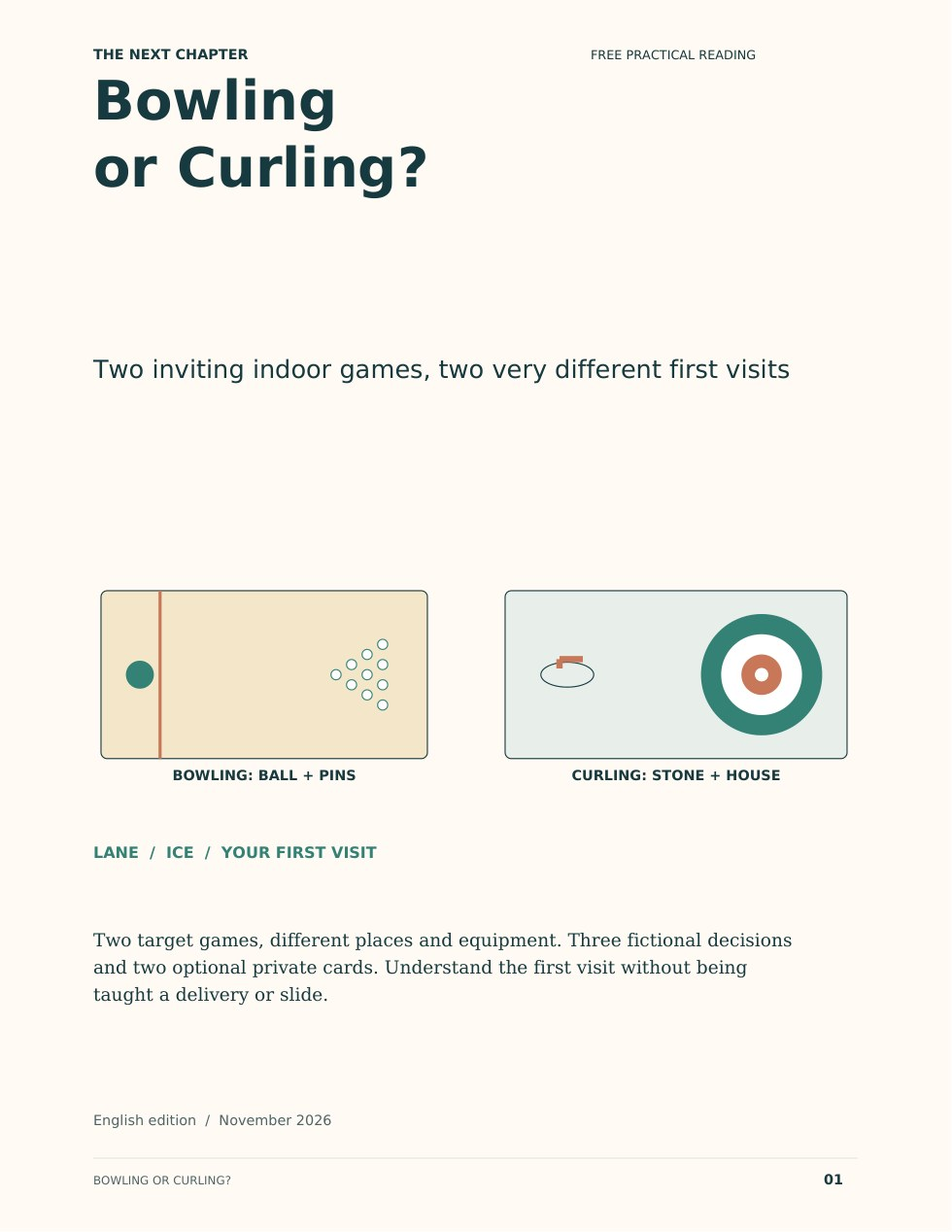
Bowling and curling both invite players to send something toward a target, and both can be social games. From a distance, they may even share the feeling of taking turns while friends watch. But a bowling lane and a curling sheet demand very different arrangements. One involves a ball and pins on a lane; the other involves stones travelling along ice toward a marked target known as the house.
If you are curious about one of these sports, the first decision does not have to be which one you are good at. It can be what kind of place you would enjoy visiting. This guide compares their broad rules, equipment and practical first-visit questions. It is not an instructional manual for delivering a bowling ball or sliding on ice. The beginner session, accessible facilities and real costs must be verified with the actual host. There is no available booking or real venue recommendation here.
The setting changes everything
Ten-pin bowling usually takes place in a bowling centre with lanes, automated pin-setting and scoring equipment. Curling takes place on a prepared ice surface in a curling club or arena. Curling also generally involves a colder environment and equipment designed for traction on ice. Neither setting should be reduced to “an indoor sport” as though the buildings and participation conditions were equivalent.
A bowling centre may offer casual lane bookings alongside league nights; a curling club may have a learn-to-curl course or introductory event distinct from ordinary club play. Ask whether the advertised activity includes instruction and whether a first-time visitor may watch. A photograph of a busy venue does not verify that a particular event welcomes people who have never played.
Bowling: pins, frames and turns
In standard ten-pin bowling, ten pins stand at the far end of a lane. The United States Bowling Congress explains that a game has ten frames. In most frames, a player has up to two deliveries to knock the pins down; special scoring applies to strikes, spares and the final frame. A leisure session may simplify the way results are displayed or offer house variations.
You need not do the scoring by hand before attending. Modern scoring displays often keep track of it. For a first visit, ask whether staff explain the scoreboard, whether the venue offers a casual lane and whether there is any time limit per booking. A lane advertised at one price might be priced per person, per game or per block of time. Confirm the unit before choosing.
Curling: stones, houses and ends
Curling uses polished stones and a marked target area, the house, on a sheet of ice. Teams take turns delivering stones, and the scoring is usually considered after a sequence called an end. Sweeping, teamwork and strategy are part of the sport, but the safe handling of equipment and moving on ice are skills to learn from a qualified instructor, not from a general article.
Curling Canada's introductory resources distinguish formal games from programmes created for people who are new to the sport. A visitor might be able to attend a learn-to-curl class, watch a match or learn how a club operates. The right first question is what the actual event includes, how instruction works and whether the participant must already have any ice experience.
Do not treat strikes and curling points as interchangeable
Bowling and curling both use numbers but their scoreboards describe different events. In bowling, strikes and spares have particular bonus consequences, and the game progresses through frames. Curling uses ends and the relative positions of stones in the house to determine points. A bowling pin count is not a curling points count, even when both games seem to involve accuracy.
For a beginner, knowing the distinction is enough to ask a useful question: “Will someone explain the score before we begin?” It is perfectly reasonable to choose a social observation or a taster session in which enjoying the setting matters more than keeping competitive score. Do not assume a casual class uses formal tournament scoring simply because a screen or scoreboard is visible.
A bowling lane comes with its own rules
Bowling centres have rules about where players may stand, how to share the approach and which footwear may be used. The USBC describes a foul line and other basic playing rules, but a general guide cannot replace instruction in a particular venue's safe procedures. Even a casual game should begin with attention to staff directions and the lane's marked areas.
Ask which shoes are required, whether rental is included and whether the venue provides balls suitable for the advertised activity. Some locations have bumpers, ramps or other adaptations; the existence of such equipment elsewhere does not prove it is available for your chosen time. A newcomer should be able to receive a clear explanation of the facility's rules without purchasing equipment first.
Curling ice requires specific safety information
A curling sheet is not an ordinary indoor floor. Curling Canada maintains dedicated safety material about ice movement, footwear, grippers, head protection and the handling of stones. These topics are too important to improvise from a photograph or a general description. Ask the club what an instructed beginner is expected to wear, how equipment is supplied and what staff will explain before the visitor steps onto the ice.
If someone has balance or other physical uncertainties, the organiser can describe its facilities and an appropriately qualified healthcare professional can advise on personal health concerns. A generic article should not promise that a beginner can safely play just by renting a pair of shoes. Information, suitable supervision and the freedom to decline are essential.
Shoes can be part of the price
Both sports may have footwear requirements, but they are not interchangeable. Bowling venues commonly require bowling shoes or specify acceptable alternatives. Curling clubs use equipment designed for controlled movement on ice, with their own policies about clean footwear and grippers. Always ask the specific provider; equipment descriptions from an unrelated venue are not sufficient.
Is the necessary item supplied? Is there a rental charge or deposit? Can a first-time observer enter the spectator space without it? What happens if the required size is not available? Answers could influence whether you book at all. You should not buy equipment because a sports article lists it; you should find out what a genuine introductory event will provide.
Casual lane hire and learn-to-curl are different products
At a bowling centre, a casual visit might involve paying for a lane and using the venue's equipment without a dedicated coach. A curling “learn-to-curl” experience may include instruction, scheduled practice and staff supervision. Neither format is universally superior; they serve different purposes. A club might also offer a one-time taster separate from a several-week course.
Ask what the advertised fee buys: coaching, access, necessary equipment, number of sessions and cancellation rights. If a venue offers only a full membership, you need not accept it merely to satisfy your curiosity. A one-off recreational activity and a recurring club commitment should be compared honestly, including what happens if you decide not to return.
The atmosphere differs too
A bowling centre can be lively, with music, several lanes operating at once and groups celebrating loudly. A curling club may have a viewing area separated from the ice and different social routines before or after games. Actual noise, lighting, temperature, seating and communication arrangements depend on the facility and time. Some readers will enjoy a crowded environment; others may prefer a quieter introduction.
You can ask about an off-peak viewing opportunity or a beginner-focused event without claiming special treatment. An accurate description of a venue's atmosphere is more useful than assuming all bowling centres are noisy or all curling clubs are quiet. The people you will meet and the event's pace matter as much as the sport.
Access is a route, not a logo
A “wheelchair accessible” icon beside a venue name does not answer every practical question. A bowling centre may have an accessible entrance but an approach area that needs a closer look. A curling facility may provide accessible viewing while having separate requirements for ice access. Ask specifically about the route you need, seating, washrooms, changing facilities, staff assistance and the adaptations available for that activity.
Some sports offer recognised adapted participation, but local availability is not guaranteed. Do not infer a person's ability or wishes from their age, disability or a general claim that the sport is for everyone. A facility can explain its own capabilities; where individual health or mobility questions matter, an appropriately qualified healthcare professional is the appropriate source for personal health advice.
The whole outing may be longer than the game
A bowling reservation might be for a game or set time; a curling taster may have a scheduled introduction and equipment briefing. Add travel, arrival, changing, actual participation or observation and return. For an invented example, a person makes a 25-minute journey, checks in for 10 minutes, observes an introductory session for 40 minutes and returns in 25 minutes. The complete outing occupies 100 minutes. This is not a real class duration or local travel estimate.
Also ask whether the session has a fixed end, whether leaving early is acceptable and what happens if the venue cancels because of maintenance or weather. A thoughtful choice considers the entire day instead of making a promise based on the advertised activity alone.
Questions worth asking a bowling centre
For bowling, a short enquiry could say: “Hello. I've never visited your centre and I'm interested in trying a casual game. Is the price per person, game or lane time? Are rental shoes and suitable balls included? Is there someone who explains the basic scoreboard and facility rules to newcomers? Can I observe first, and could you confirm the route to the actual lane and seating area?”
The questions do not reserve a lane. Add a query about bumpers or a ramp only if you want to know whether the venue has one. You need not disclose medical or personal details to ask for equipment availability. Verify that the reply concerns your desired date, not an old event advertised somewhere online.
Questions worth asking a curling club
For curling, your first message may be: “Hello. I'm curious about curling and have not been on a curling sheet. Do you offer an introductory or observation session? Is qualified instruction included before anyone enters the ice? Which footwear and safety equipment are supplied? What is the total fee, and can you explain viewing-area access and the cancellation terms?”
A club that offers several weeks of instruction may be the right choice for someone who wants a sustained commitment, not necessarily for someone who wants a single taster. Ask whether there is an actual one-time option before inferring it from a promotional photograph. A response is information, not a booked visit.
Fictional case: Rosa chooses one bowling visit
Entirely fictional case. Rosa wants an uncomplicated social outing with a friend. A made-up bowling centre confirms that one casual game is available and explains its shoe rental. Rosa books and attends that single fictional event. She pays USD 18 for the game and USD 4 for mandatory shoes, for USD 22 actually spent. The friend pays separately; no division of an unknown group bill is assumed.
Rosa plays once and decides not to join a league. The venue, prices and access arrangements are invented. Her interest is not a promise that bowling improves any health condition. The outcome is a complete, self-contained experiment rather than the beginning of a compulsory routine.
Fictional case: Aaron asks about curling
Entirely fictional case. Aaron has watched curling on television but has never visited a rink. He spends 16 minutes speaking with an imagined club volunteer about a learn-to-curl programme, footwear and the difference between viewing and going onto the ice. The volunteer cannot confirm whether a one-time taster will be offered this season.
Aaron writes “taster date not confirmed.” He has not booked a place, travelled, stepped onto ice or paid a fee. New event cash spent: USD 0. Any phone charges are separate from event spending. A welcoming phone conversation is not proof of a schedule, just as a programme description is not a place reserved. He may follow up, but the story does not invent a future booking.
Fictional case: Inez declines both options
Entirely fictional case. Inez discovers that a hypothetical bowling time falls during another commitment and an imagined curling course requires several consecutive weeks. Neither fits her current plans. She replies with thanks and declines both, without making a reservation or purchasing equipment.
There is no travel, lost deposit, class attendance or other new event cost: USD 0. She might enjoy watching a broadcast of either sport later, but that possibility is not an appointment or instruction. Curiosity can be satisfied by learning about a game, and choosing “neither for now” does not need to be explained as a lack of ambition.
Private card one: compare the first visit
Optional, private card — no submission. For each sport, fill in only useful confirmed details: (1) actual event or venue, (2) observation or instructed participation available, (3) required footwear and supplied equipment, (4) access and seating conditions, (5) total charge and cancellation rules, (6) remaining essential question. Keep unknowns visible.
Do not record passwords, personal financial information, health diagnoses or someone else's contact details in a shared form. If only one sport interests you, use one column. A blank space is more honest than a made-up fee or a guessed accessibility feature. This worksheet is for your private decision, not a venue registration.
Private card two: choose a next step
Optional, private card — not a booking. (1) What attracts me to this experience? (2) Which format do I prefer—observation, casual game, instructed class? (3) What date and source supplied the details? (4) What would the entire outing require? (5) What must still be confirmed? (6) My current decision: ask, observe, one visit after verification, decline or wait.
No score or medical suitability test is attached to the card. One reader might prefer the familiar setting of a bowling centre; another might enjoy learning about curling's teamwork without touching the ice. Both choices have value. You can also leave the whole card unused and decide later.
You can choose a venue before choosing a sport
The next useful step is not “become a bowler” or “become a curler.” It is find out which actual session, space and social arrangement might appeal to you. Bowling and curling are distinct games, with distinct equipment and safety conditions. Learn the basic shape of each, then let the particular venue provide the information that a general article cannot.
You may attend one beginner event, watch without playing, ask a question or decline. Keeping those possibilities open respects your preferences and practical limits. A good next chapter can begin in an unfamiliar sports hall—or it can begin with the satisfying recognition that this activity is not the one for you.
Sources and limits
Official resources consulted for the distinctions described here (not endorsements or live local listings):
- United States Bowling Congress — Keeping Score
- United States Bowling Congress — Basic Rules
- Curling Canada — About Curling
- Curling Canada — Getting Started for Adults
- Curling Canada — Safety First
Rules, programmes, eligibility, facilities and fees can change. Check the current organiser and relevant official rules before participating. This is a practical consumer reading, not coaching, medical advice or an assurance of accessibility.