THE NEXT CHAPTER — AN ORIGINAL FREE READING
Before deciding whether to apply, decide what you are willing to promise.
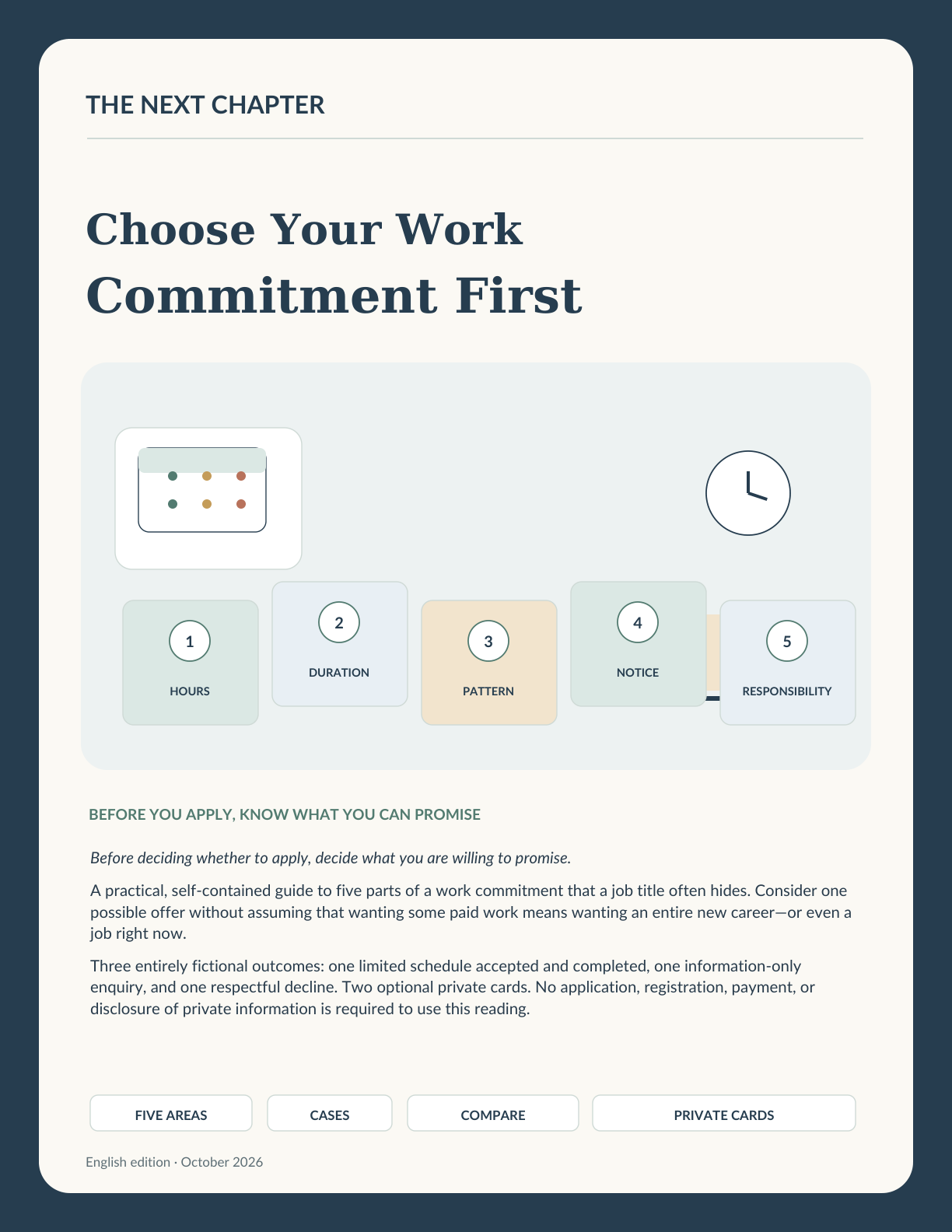
A practical, self-contained guide to five parts of a work commitment that a job title often hides. Consider one possible offer without assuming that wanting some paid work means wanting an entire new career—or even a job right now.
Three entirely fictional outcomes: one limited schedule accepted and completed, one information-only enquiry, and one respectful decline. Two optional private cards. No application, registration, payment, or disclosure of private information is required to use this reading.
English edition · October 2026
The job title is not the whole promise
WHAT MATTERS IS HOW THE WORK FITS INTO A REAL WEEK
Someone says, “There is a part-time position at a local shop. You would be good at it.” The description sounds familiar and the work might even be enjoyable. But “part-time” does not tell you whether you would work two predictable mornings, be called at short notice, remain for an entire season, or become responsible for closing the premises alone. Those differences may matter more than the title.
A person considering work after retirement or a long break is not necessarily looking for a second career. They may want a little income, a reason to go out, contact with other adults, a familiar skill put to use, or an experiment with something new. They may also decide that no additional work is right for now. This guide does not rank those motives. Instead, it helps define one possible promise you could realistically keep.
For this small exercise, separate five questions: How many hours each week? For how long? How regular is the schedule? How much notice comes before a change? What responsibility actually belongs to the role? A job can sound modest on one dimension and demanding on another. Six hours on a predictable Tuesday is different from six possible hours spread across days you must keep available.
You need not tell a recruiter your private health, family, or financial circumstances to know your own limits. Ask for the terms in ordinary language. If an answer is unknown, write “not yet confirmed” rather than converting hope into an agreement. A job that is not yet understood remains a question, not a commitment.
Five dimensions worth separating
HOURS · DURATION · PATTERN · NOTICE · RESPONSIBILITY
Hours are the paid or scheduled hours you would agree to work, but they are not necessarily the whole time the activity takes from your day. Duration is the period for which you are considering the arrangement: perhaps one event, a defined set of weeks, or an ongoing appointment. Pattern describes whether shifts recur reliably or change. Notice tells you how early the schedule is confirmed and whether extra work may be requested. Responsibility identifies the tasks, decisions, and obligations that you would actually accept.
The five questions work together. Imagine a fictional offer of six hours each week, over eight weeks, generally on Tuesdays, with seven days' notice for any change, and duties limited to greeting visitors and directing them to an information desk. You could describe that proposal quite clearly even before knowing whether you want it. Contrast it with an offer of “up to six hours, whenever we need someone, as long as it takes, helping with everything.” Both are called part-time; only one is sufficiently defined to judge.
These examples are descriptions, not predictions about real workplaces. Their details are invented, and a genuine employer may use different terms or have policies and legal obligations that the reader must check. The point is not to force every role into the same five boxes. It is to notice when a box contains an unanswered question important to your decision.
Do not assign numerical scores to every answer. One person may tolerate change because the role is interesting; another may need a regular day to protect commitments already made. Neither preference is a character defect. The practical goal is a sentence of conditions, not a ranking of workers.
Six paid hours may use more than six hours of your week
ASK ABOUT THE WHOLE COMMITMENT, NOT ONLY THE NUMBER ON THE POSTER
Start with the actual scheduled hours. Are they three hours on each of two days, a single six-hour block, or several visits whose lengths vary? For the same paid total, the shape of the time commitment can feel very different. A morning shift might fit easily between other activities. Four scattered short visits might divide several days into workdays without filling the hours on a payslip.
Make a small private estimate of the time you would spend preparing, travelling both ways, working, and returning to ordinary life. Keep it separate from the hours that an employer would pay; payment treatment for preparation and travel depends on the actual arrangement and local law. Do not assume the examples in this reading determine what must be compensated. If the journey is unknown, label it unknown.
For illustration, imagine a proposed three-hour shift with a 25-minute journey each way and ten minutes of personally chosen preparation. That example would occupy four hours of the person's day (180 + 25 + 25 + 10 = 240 minutes). Two identical visits would occupy eight hours of their week. These are invented planning figures, not a wage calculation or a travel guarantee.
When an offer says “flexible hours,” ask which part is flexible. Can you choose a day? Can the employer move the shift? Could a three-hour visit become five hours on short notice? You can appreciate the opportunity while still seeking a complete answer. A visible limit is more helpful than saying “any time” and discovering too late what it requires.
How long would you be agreeing to this?
ONE SEASON IS DIFFERENT FROM AN OPEN-ENDED PROMISE
A short assignment may be appealing because it has an identifiable end. A continuing role may offer familiarity and regular contact. Neither is automatically better. Before applying, distinguish an actual defined end date from a hope that you can leave whenever you wish. Ask whether an advertised fixed period is guaranteed, tentative, renewable, or dependent on work being available. Actual contracts and local rules matter; this reading cannot set them for you.
The question can be simple: “Is this for a particular eight-week period, or does it continue until somebody gives notice?” Follow with, “If it is continuing, when do we review whether the schedule still fits?” You are not demanding a special deal by asking to understand the duration. You are deciding how much of your future calendar is being offered.
Avoid inventing an exit right where none has been explained. Different regions and kinds of work use different notice periods, seasonal terms, and probation arrangements. Do not rely on a friendly verbal assurance alone when a written offer provides a different condition. Seek clarification from the employer and, where important, an appropriate official employment resource or qualified adviser.
A private review date can still be useful for yourself even when it has no contractual effect: “After three shifts I will ask whether the travel and responsibility fit my life.” That is an invitation to reassess your own preference, not a promise that the employer must change or release you at that point.
A repeating day may be more valuable than the word “flexible”
PREDICTABLE AND VARIABLE ARE TWO DIFFERENT DESCRIPTIONS
A regular pattern helps some people keep other commitments intact. They can arrange a class, a visit, or a household task around known working days. Others actively prefer varied work or seasonal events. The important point is to ask who controls the changes and what is truly expected of the worker.
Picture two fictional patterns. Pattern A is Wednesday from 9:00 a.m. to noon each week for six weeks. Pattern B is three hours at some point between Monday and Friday, with the date confirmed late in the preceding week. Both may total three paid hours, but Pattern B potentially holds several days in uncertainty. Some readers will welcome that unpredictability; others will not.
Ask whether the stated pattern is typical, guaranteed, a preference, or merely a recent example. A recurring calendar entry does not necessarily establish a contract, and a promised day may be subject to local scheduling rules. You may also ask about the procedure for exchanging a shift or declining an additional invitation. Do not assume that a friendly manager's usual practice is the policy that will govern every future week.
If you share your home or care for another person, avoid announcing that their time is now available to cover your new work. A choice that changes somebody else's commitments deserves discussion. It is still acceptable to explore a job privately before presenting a proposal; exploration is not a decision or a duty for your family.
How much warning comes before a change?
BEING CONTACTABLE IS NOT THE SAME AS SAYING YES
Two jobs with the same nominal hours can demand different levels of attention outside work. In one, the schedule is agreed in advance and the worker can make other plans. In another, the worker must remain available for possible calls, sometimes with little notice. An offer that says “occasional extra shifts” may hide an important question: Are those invitations, contractual requirements, or expectations that need clarification?
You can ask, “When is the schedule normally published?” “How far in advance are additional shifts requested?” and “Am I required to answer or accept a call on days that I am not rostered?” These are questions, not allegations. Listen for the difference between a manager describing what usually happens and an actual obligation written into the role.
A person may welcome extra hours without welcoming a permanent state of readiness. It is reasonable to prefer notice so that appointments, rest, other work, relationships, and ordinary plans remain possible. On the other hand, some people intentionally choose on-call work because the uncertainty fits their life. What matters is an informed choice and compliance with applicable employment standards, not a blanket judgment about variable work.
Never assume an informal text message automatically alters a signed agreement. Equally, never assume you may ignore a confirmed contractual obligation without consequence. If a detail matters and remains unclear, ask for the employer's actual written policy or seek independent local guidance before committing.
What work would you own, and what decisions could you make?
RESPONSIBILITY NEEDS A CLEAR BEGINNING AND END
“Help at the front desk” may mean greeting visitors, handing out prepared information, taking payment, handling complaints, opening the premises, or covering a coworker's absence. Those tasks can involve different training, permissions, supervision, and accountability. Avoid treating a friendly label as a complete description of what the role requires.
Ask what a normal shift actually includes. Then ask what is explicitly outside the role: “Would I have authority to change a booking?” “Who handles a complaint or a cash discrepancy?” “Who is responsible if a task requires training I do not have?” These questions protect the workplace as well as the worker. The answer may be that somebody else makes the decision and you hand the matter to them.
If the role involves confidential records, keys, money, safety decisions, vulnerable people or regulated activities, obtain real training, supervision and authorization before acting. This free reading does not provide that training or define legal duties. Nobody should assume that age, former professional experience or enthusiasm grants current authority in a different workplace.
Some readers have extensive experience and enjoy taking responsibility. Others are seeking deliberately limited duties. Neither must conceal a preference. “I would like a customer-facing role but not solo closing responsibility” is clearer than a vague yes followed by discomfort. A precise boundary is useful only if the employer understands and accepts it; a private preference by itself does not rewrite a job.
Five questions before any application
YOU MAY ASK ABOUT A ROLE WITHOUT PROMISING TO TAKE IT
If you see an interesting opportunity, you can begin with five plain enquiries. Hours: “How many scheduled hours are involved, and how are they distributed across days?” Duration: “Is there a defined beginning and end, or is this continuing?” Pattern: “Are the working days predictable or variable?” Notice: “How early are shifts confirmed, and are additional calls optional?” Responsibility: “Which tasks and decisions belong to this position?”
You can send these as a concise message, or ask them during a conversation if an appropriate contact invites enquiries. The questions are not an application, an acceptance, or permission for someone to share your contact details. Use an independently confirmed employer channel, not an unverified third-party link requesting sensitive identification or advance payment.
If some answers arrive and others do not, do not fill the empty spaces with the answer you wish had been given. “Four hours weekly, term unknown, rota variable, notice unknown, front-desk responsibilities partly described” may not sound elegant, but it is a better description of a real enquiry than “easy casual work.”
A genuine employer may answer later, or may decide not to offer the arrangement you prefer. That outcome does not invalidate the questions. Your task at this stage is not to persuade someone that your limits are admirable. It is to decide whether the offer, once understood, would fit the life you want to protect.
Compare real time before comparing income
A SMALL JOB CAN OCCUPY LARGE PIECES OF A CALENDAR
Pay is important to many people. It is also only one component of a work decision. Before using an advertised hourly rate to imagine how the job will feel, understand the actual shift arrangement and total personal time it would require. A six-hour week on one nearby afternoon is not necessarily the same as six hours split across several distant mornings.
Keep three columns in your own thinking: scheduled or paid work hours, other time your participation may require, and information still unknown. Travel time and cost are often personal planning inputs, not universally paid employment time. Some tasks such as mandatory training may have legal pay requirements depending on your location and actual arrangement. Do not make up a net pay figure by subtracting costs without checking employment, tax and benefit rules.
If an employer quotes USD 19 an hour for six hypothetical paid hours, the multiplication is USD 114 gross scheduled earnings (6 × 19). That example is not an offer, not a promise of available shifts, not take-home pay, and not an estimate of tax, pension or benefit effects. If commuting would require two separate round trips at USD 4 each, the illustrative new transport expense would be USD 8, but no tax or legal conclusion follows from subtracting the two.
Those figures alone cannot tell you whether an activity is worthwhile. A reader may value the work itself, or may find the total days disrupted too great. Write the hours and uncertainties first. Do not let a pleasing hourly rate silently decide the five dimensions for you.
Write one provisional sentence about what you want
YOUR PREFERENCE IS A STARTING POINT, NOT A CONTRACT
Try a provisional sentence: “I am interested in up to six scheduled hours per week, on two agreed mornings, for an initial eight-week period, with shifts confirmed at least one week ahead and duties limited to greeting and directing visitors.” The numbers here are invented. Their purpose is to show how the five dimensions can sit together in ordinary language.
Your own sentence may look very different: “I can discuss one event at a time but cannot promise a recurring weekly commitment.” Or: “I am open to a continuing role if the days are predictable and there is a named person for decisions outside my training.” You may also write, “I am not available for paid work now.” A useful boundary does not have to sound enthusiastic to be legitimate.
Avoid presenting a personal preference as a right that an employer has already agreed to. Some conditions are negotiable, some are fixed, some are governed by local rules, and some are simply incompatible with what the employer needs. A clear sentence can help you decide whether to explore further; it cannot compel an organization to create a particular role.
Do not overshare the reasons for your limit. You may need to provide relevant information later for legitimate legal or accommodation processes, and those processes vary. But at this first personal thinking stage you can often state the practical boundary itself without describing medical history, finances, caregiving details, or another person's private circumstances.
A message that asks rather than agrees
CONFIRM THE SHAPE BEFORE YOU MAKE A PROMISE
Here is a fictional example you can adapt: “Hello, I saw your notice about the visitor-assistant position and am considering whether it would suit me. Before applying, could you clarify the usual hours, whether the role is fixed-term or continuing, how far ahead shifts are confirmed, whether extra shifts are optional, and who handles decisions outside the listed duties? Thank you.”
Notice what the message does not say. It does not claim availability at any time, promise to cover absences, disclose a personal diagnosis, or demand that somebody else rearrange their life. It does not send an identity document, payment or account details in response to an unverified notice. Most importantly, it does not say yes.
If the employer replies with a complete description, you can compare it with your preferred sentence. If the reply contains partial information, you can ask one more specific question. If the answers show the work is not suitable, a brief courteous decline can end the enquiry. You do not have to keep negotiating forever to prove that you are serious about returning to work.
Real hiring practices differ by organization and location. There may be formal application channels, equal-opportunity processes, background checks, or legitimate documentation requirements at appropriate stages. This guide does not replace those rules. Use trustworthy, independently found official channels and treat this message as an example of asking for facts, not as a guaranteed way to get a reply.
Fictional case: Vera tries two agreed mornings
ONE BOUNDED COMMITMENT IS ACTUALLY COMPLETED
Vera, an invented person, hears about a short visitor-assistant trial. In the story, Vera asks about the five dimensions before accepting anything. The organizer replies that the work consists of two agreed mornings, each with three scheduled paid hours, limited to greeting visitors and directing them to a staffed information desk. Extra shifts are invitations, not part of the agreed trial. For the purposes of this story, the trial lasts one week and Vera accepts those exact conditions.
Vera works both fictional three-hour shifts. Each visit also involves a 25-minute journey each way and 10 minutes of personal preparation. That makes each visit 240 minutes of Vera's day (180 + 25 + 25 + 10) and the two visits 480 minutes, or eight hours, in total. Of those eight personal hours, six are the explicitly scheduled paid hours in this invented story. These categories do not decide what a real employer would legally have to pay for.
The story uses an invented wage of USD 19 per paid hour, making USD 114 gross scheduled earnings for the six hours. Vera spends USD 4 on transport for each complete round trip, or USD 8 actually spent across the two visits. No tax, payroll deduction, government benefit effect or take-home amount is calculated. Those matters depend on actual law and circumstances, not this example.
Vera decides that the time pattern felt manageable and might ask whether a similar arrangement is available later. That is a preference, not a renewed contract, a job offer or a guaranteed future shift. Vera's actual result is only what the story says: two agreed visits, six hours worked, eight hours personally occupied, USD 114 fictional gross pay and USD 8 fictional travel cost.
Fictional case: Ellis asks about an unpredictable rota
FIVE POSSIBLE HOURS ARE NOT FIVE HOURS WORKED
Ellis sees a fictional notice saying “up to five hours weekly, flexible.” It sounds attractive until Ellis learns that shifts may be offered during several different days, sometimes with only one day's notice. Ellis has an existing class on two afternoons and values knowing when a week will be free. The uncertainty might still be acceptable, but Ellis wants to understand the expectation before applying.
Ellis spends 14 minutes writing an enquiry and reading the reply. The reply says there may be up to five hours when events are busy, but does not yet clarify whether an extra shift may be declined without consequence. Ellis does not accept a role, book a shift, attend an orientation, or provide banking information. The employer has not made a confirmed offer with conditions that Ellis can compare fully.
In this invented episode, actual paid work is zero hours, actual new cash received is USD 0, and actual new cash spent is USD 0. The five possible hours are merely a ceiling mentioned in the advert, not hours assigned or wages earned. Ellis's 14 minutes are real enquiry time inside the fictional story, not paid job time.
Ellis may ask for the written scheduling policy, or may choose a different opportunity. Neither course is required. The useful result here is that one unknown commitment was made visible before anyone promised to rearrange a week. Saying “I need to understand the notice rules” is a responsible enquiry, not a failure of enthusiasm.
Fictional case: Noor declines a wider role
A RESPECTFUL NO CAN PROTECT A REAL LIMIT
Noor enjoys meeting people and has thought about returning to a familiar kind of work. A fictional organization asks whether Noor can take responsibility for reception across four afternoons every week, handle closing checks, and remain available if a coworker is unexpectedly absent. Noor had been considering something nearer one or two limited visits, without solo closing decisions.
Rather than saying yes and hoping the arrangement will shrink, Noor replies: “Thank you for explaining the duties. I cannot commit to four afternoons or the closing responsibility. I will not apply for this role, but I appreciate knowing the actual conditions.” No alternative task is promised. No other household member is volunteered as a substitute. The organization remains free to hire someone suited to its legitimate needs.
This is an actual decline inside the fictional story, not an unsuccessful application. No shift was booked, no work was performed, no wages were earned, and USD 0 of new cash was spent. Four afternoons describes what was requested, not Noor's future schedule. It would be inaccurate to say Noor tried the job and discovered it was unsuitable after working there.
Sometimes an employer needs exactly the duties that a prospective worker wishes to avoid. That is not a moral failing on either side. The honest outcome is that the opportunity and Noor's current availability do not match. If Noor later changes preferences, that will be a new decision, not a broken promise.
Three results that must not be mixed together
AN OFFER IS NOT WORK, AND AN ENQUIRY IS NOT ACCEPTANCE
The cases are fictional and exist only to make the five dimensions easier to think about. They are not advertisements, employment records, average wages, or evidence that one choice produces a better life.
| Person | What happened | Actual paid work | Personal time described | Actual fictional cash | Outcome | |---|---|---:|---:|---|---| | Vera | Two agreed mornings completed | 6 hours | 8 hours including invented personal travel and preparation | USD 114 gross pay; USD 8 transport spent | DONE for this one-week trial; nothing further agreed | | Ellis | Asked about up to five possible hours; did not accept | 0 hours | 14 minutes of enquiry | USD 0 earned; USD 0 spent | ENQUIRY ONLY; notice rules unclear | | Noor | Declined a proposed four-afternoon role | 0 hours | No work time stated | USD 0 earned; USD 0 spent | DECLINED; no assignment |
The crucial difference is not the amount of activity but what was actually confirmed. Vera's example describes completed work and invented gross earnings, but not net income or pension consequences. Ellis's possible shifts cannot be counted as wages. Noor's requested four afternoons were never accepted and therefore cannot be treated as appointments Noor missed.
If you later compare genuine opportunities, create similarly honest categories: described, asked about, offered in writing, agreed, worked, ended, or declined. These words prevent the imaginary benefits of a possible job from being recorded as if they had already happened.
One honest sentence, then one next step
YOU CAN KEEP THE DECISION SMALL
Take what you have learned and make your preference sentence a little more specific. An example is: “I could consider two scheduled mornings each week for a defined trial period, with the rota confirmed beforehand and duties that do not include working alone with cash.” It says what may be possible without pretending that an employer has already offered it.
Now choose one realistic next action, if you want one. You might ask for clarification from a verified employer; look at the detailed terms of a genuine opening; discuss the practical effect on someone who shares a commitment with you; or decide not to explore paid work this month. None of those steps is a job, an acceptance, or a promise to continue.
If an actual written offer arrives, compare it again with all five dimensions. A heading that sounded friendly may be attached to duties or notice terms you did not expect. A verbal conversation that seemed clear may need a written clarification. If there is a conflict between a friendly summary and a formal agreement, do not guess which one governs: seek accurate local advice before accepting an obligation.
What this guide can give you is a small amount of order in the decision, not a work permit, a legal interpretation, or a guarantee of hiring. The two following private cards are entirely optional. They help you keep the facts separate from wishes, and they do not require storing any employer's secret information.
Optional private card: a shape of work I might consider
YOUR PRIVATE PREFERENCE IS NOT A SIGNED OFFER
You may fill this in privately or leave every field blank. Use general descriptions rather than names, contact information, medical conditions, bank details, or family members' confidential circumstances. This is a thinking tool, not a form to send to an employer.
1. Weekly hours I could consider
What total would fit, and how many separate days could it occupy?
Optional private writing space: __________________________________________
2. Duration I could consider
A single event, a limited trial, a season, or continuing with a review?
Optional private writing space: __________________________________________
3. Pattern that would suit me
Predictable days, variable days, or particular agreed windows?
Optional private writing space: __________________________________________
4. Notice I need to understand
How far ahead do I want to know about changes or extra calls?
Optional private writing space: __________________________________________
5. Responsibility I would accept
Which ordinary tasks and decisions fit, and which need another trained person?
Optional private writing space: __________________________________________
6. My provisional one-sentence preference
How can I say these limits clearly without pretending a job has been offered?
Optional private writing space: __________________________________________
You do not need to keep a written copy. These questions can be read once and put away. Nothing here creates or changes a job contract.
Optional private card: what has actually been confirmed?
DESCRIBED · ASKED · OFFERED · AGREED · WORKED · DECLINED
This card is for one possible opportunity. Record only facts you personally know or an employer has actually confirmed. Do not enter passwords, government identification, private contact details or other people's information. If you have not applied, it is fine to leave the whole card blank.
1. What is the opportunity said to be?
Record a neutral description, not a speculative promise of work.
Optional private writing space: __________________________________________
2. What hours and duration are confirmed?
Separate written terms from a casual example or advertisement.
Optional private writing space: __________________________________________
3. What pattern and notice are known?
What remains unclear about changes or extra calls?
Optional private writing space: __________________________________________
4. What tasks and support are confirmed?
Who makes decisions that need training, permission, or supervision?
Optional private writing space: __________________________________________
5. What has actually happened so far?
Only enquiry, application, offer, agreement, work, decline, or nothing yet?
Optional private writing space: __________________________________________
6. My next truthful sentence
What will I ask, confirm, decline, or simply leave undecided?
Optional private writing space: __________________________________________
These notes are neither proof of employment nor a contract. If an offer becomes serious, review the actual written terms and any applicable official guidance separately.
Keep the promises you actually mean to make
WORK SHOULD BE AN INFORMED CHOICE, NOT AN ACCIDENTAL AGREEMENT
An opportunity can sound small because the title is familiar or the advertised hours seem modest. Yet what shapes the week is the full combination of hours, duration, pattern, notice, and responsibility. A person who wants some paid work may still want mornings free, a known ending, a clear supervisor, or a firm limit on extra shifts. Another person may choose more responsibility or unpredictable hours. Those are choices to understand, not personality tests to pass.
Return to the five plain questions before you attach your name to an application or accept an arrangement. How many hours? For how long? On what pattern? With how much advance notice? And what must I actually do or decide? If the answer matters and is missing, ask. If a role does not match, you may decline it. If you want to think for a month, that is also a decision.
Keep your private preference separate from actual employment terms. A polite enquiry does not create a job. An attractive advert does not guarantee work. A stated hourly rate does not establish net pay or the effect on taxes, retirement income, government benefits, or insurance. Those matters require actual local official information and, when appropriate, qualified advice. Any real commitment should be judged under the relevant contract, laws, training and safety requirements.
The aim is not to persuade you back into employment or away from it. It is to help you protect what matters while considering one possibility at a time. You do not owe the world a new work identity simply because you have experience. Equally, you do not need to apologise if a carefully chosen job sounds interesting.
One clear beginning may be this sentence: “Before I say yes, I want to understand what a normal week would ask of me.”