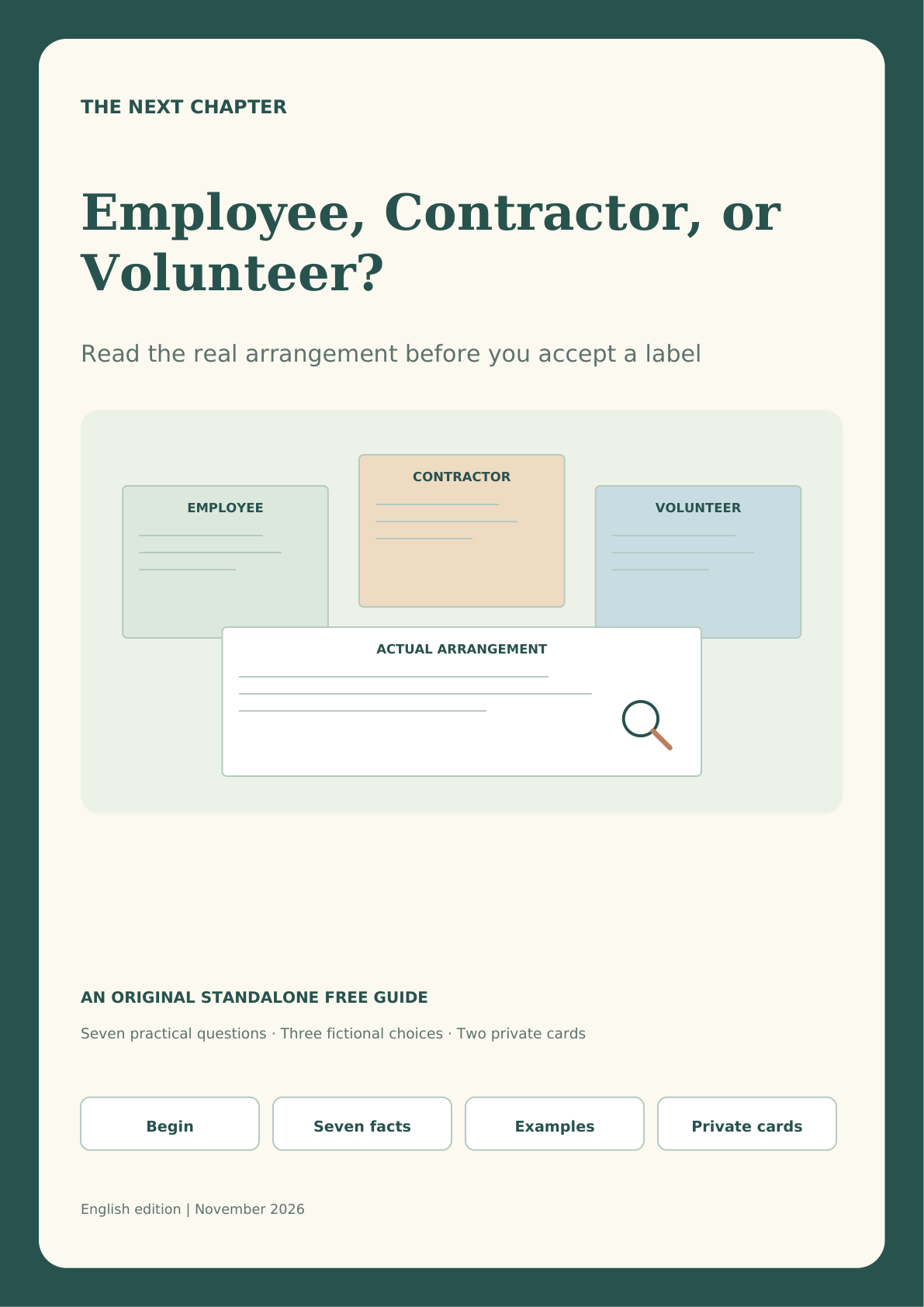
Read the real arrangement before you accept a label
An invitation to do something useful can arrive in many forms. A small shop might suggest paid hours, a community organisation might welcome help at an event, or a neighbour might ask whether you would take on a one-time project for a fee. The arrangement may be attractive precisely because it looks different from the full-time job you once had. Then a word appears: employee, independent contractor, or volunteer.
Those words are not interchangeable, but they are not always self-explanatory either. The practical questions behind them concern who controls the activity, what you are asked to do, whether pay or reimbursement is involved, who supplies tools, how risk and responsibility are shared, what support exists, and what the actual agreement says. Laws differ significantly by jurisdiction and even by the particular purpose for which employment status is being determined. An advertisement or verbal label does not settle the legal outcome.
This original guide helps you make a useful first comparison without deciding legal status for you. It offers ordinary questions to ask, three entirely fictional decisions, and two private six-line cards. You might decide to ask for written information, seek an official local explanation, accept a clearly understood suitable invitation, or decline. You do not need to become self-employed, volunteer or return to work simply because somebody thinks your experience would be helpful.
1. A title is a starting point, not a final classification
Imagine someone saying, “It's only a casual contractor role, so we don't do employee paperwork.” Or, “We call everyone a volunteer during their first week.” Those statements describe what the speaker calls the arrangement. They do not tell you whether that classification is correct under the relevant rules, or whether the proposed conditions are appropriate for you.
Official guidance from the Canada Revenue Agency, the U.S. Internal Revenue Service and provincial employment authorities examines the real relationship, not just a chosen title. The details they consider vary with the law in question. An agreement might call a person self-employed, yet the actual working conditions could raise questions about employment. Equally, an occasional paid project could genuinely involve a person running their own independent business. Neither can be determined responsibly from a single word.
Rather than argue about labels at the first conversation, ask what the role requires. “Who would decide my hours and duties?” “Would I be paid a wage, a fee for a result, or not paid?” “Who supplies the equipment?” “What is expected if I cannot attend?” If the answers are uncertain, keep the classification uncertain. A pleasant first invitation is not a reason to rush past a question that may matter for pay, tax, insurance, responsibility or legal protection.
2. Write down what the organisation actually wants
Try describing the arrangement without using any of the three labels. For instance: “A person would greet visitors at the desk from nine until noon every Wednesday, use the organisation's computer, follow its instructions and receive an agreed payment.” Or: “A person would deliver a completed poster by a date, choose their own working hours and invoice an agreed project fee.” Or: “A person would help with a community event for an afternoon by choice, without expectation of wages.” These are factual descriptions of invented possibilities, not legal decisions.
The exercise matters because a title can distract from specific obligations. “Contractor” may sound independent but leave little room to choose how work is done. “Volunteer” may sound informal but still involve training, safety procedures and responsibilities to others. “Part-time employee” may describe only the hours, not the extent of supervision. In a real situation, the law also matters, and those facts need proper local interpretation.
Write a one-sentence description before you sign, register, submit identification or buy anything. If you cannot explain what you would do and who would direct it, you probably need more information. A good first question is: “Could you describe what I would actually do on an ordinary day, and who would be responsible for supervising or accepting the work?”
3. Who controls the hours and the method?
One useful area of inquiry is who determines when, where and how the activity is performed. An organisation may set specific shifts and direct the worker step by step. Alternatively, a person providing a project service may have substantial independence to choose the method and timing while still meeting the agreed result. Neither arrangement is automatically good or bad. They are different facts that can be relevant to worker status and to whether the role suits you.
Ask: “Would you tell me exactly how to carry out each task, or would I be responsible for choosing how to deliver an agreed result?” And: “Are the hours set by the organisation, or would I arrange my own time?” Do not assume that freedom on one point decides the whole relationship. A highly skilled employee may work with little day-to-day instruction. An independent service provider may still have to meet safety requirements, client specifications or a delivery deadline.
If an employer uses phrases like “work whenever you want,” ask for an example of how the schedule is actually agreed. This article is not the place to determine minimum pay, overtime, employment insurance or tax status. It is the place to recognise that control may be a significant fact to ask the appropriate authority about.
4. Who provides the tools, and who pays the costs?
A role may use the organisation's computer, cash drawer, protective equipment or vehicle. Another arrangement might expect the person doing the work to bring software, tools, materials or transport. Those differences can affect an individual's costs and may be relevant when official authorities look at the actual relationship. They are not conclusive on their own.
Ask what is provided, what is required, who pays for consumables, and whether any expense must be approved in advance. Do not buy equipment just because a stranger promises a job. Verify the organisation and the actual arrangement independently. If an invitation requires an expensive tool before the role or payer can be confirmed, that may raise both affordability and fraud questions. A legitimate business expense is different from a demand to send money to an unverified recruiter.
For your personal comparison, distinguish the amount an organisation says it will pay from expenses you may have to bear. A project fee is not automatically take-home income. A reimbursed bus fare is not necessarily a wage. The tax or employment meaning of any payment depends on the actual facts and law. Write the financial responsibilities plainly and seek proper jurisdiction-specific advice where they matter.
5. A wage, a project fee and reimbursement are not the same thing
When discussing an activity, ask how any money would be handled. An employee may be paid wages or salary under an employment arrangement. A person operating an independent service business might invoice a client for a project or deliverable. A volunteer organisation may sometimes reimburse approved expenses. But the presence of a wage slip, invoice or reimbursement alone does not settle classification or the proper treatment of a particular payment.
Try these simple questions: “Is the proposed amount a wage rate or a fee for a completed project?” “What must be delivered to become entitled to payment?” “Would I incur necessary costs?” “Would ordinary expenses be covered or reimbursed?” “What official paperwork would I receive?” For a real role, verify any written terms through the organisation itself and consult the relevant authority on legal obligations.
Avoid turning the discussion into a complex tax calculation. A person trying one new activity should first know what is being proposed. If the financial effect on retirement income, taxes, insurance, pension arrangements or benefits could be significant, obtain advice from the appropriate official source or qualified professional before acting. A friendly invitation does not replace that analysis, and this free reading cannot provide it.
6. Is this one task, a season or an ongoing role?
A short arrangement can be an excellent fit when you prefer a clear ending. But “only occasional work” does not explain whether you will be expected to remain available or repeat the task whenever asked. A one-off project may have a defined deliverable and fee. A continuing arrangement may have regular attendance, supervision and ongoing responsibilities. These are facts worth discovering before you decide.
Ask: “What would count as completion?” If the role repeats, “How much notice would I receive, and can I choose not to take future work?” If the organisation says the work is seasonal, ask when that period begins and ends, whether any hours are guaranteed, and how cancellation is handled. None of these questions classifies the worker legally; they help you understand your practical promise.
Do not confuse a limited duration with independent contracting. Employees can be engaged for short periods, and independent service arrangements may continue over time. Likewise, a volunteer may assist regularly while remaining a volunteer under applicable conditions. The whole relationship, its actual operation and the law determine the consequences. You are free to prefer a short experiment, but should still know what you have agreed to do.
7. Who trains, supervises and accepts the work?
For some activities, the organisation demonstrates a method and supervises the person doing it. For others, it describes a result and expects the individual to supply their own working method. This difference can be significant in official employment-status analyses. But it is not a simple test: skilled employees often work independently, and independent contractors may follow client specifications or professional standards.
Ask what training is provided and whether you are expected to arrive with particular qualifications. Who answers questions when something goes wrong? Who decides whether the final work is adequate? What happens if a mistake must be corrected? If the work involves vulnerable people, safety-critical systems, money or regulated activities, clarify the required checks and authorisations before starting.
A sensible answer should not depend on a vague claim such as “you'll figure it out.” Nor does a generous training offer necessarily establish employment. The practical question is whether you would be safe, informed and appropriately supported in the actual arrangement. The separate legal question may require a qualified local assessment. Do not pretend to answer the second with an informal checklist created for the first.
8. Responsibility cannot disappear behind an attractive label
Imagine being asked to run a small event, collect payments or handle participant information. You might be called a “helper,” “contractor,” “casual assistant” or “volunteer.” Those words do not explain who has authority to make decisions, who keeps records, who handles emergencies, what insurance applies, or who must obtain required permissions. You need answers appropriate to the actual activity.
You can ask: “Which decisions would be mine, and which would need approval?” “Who is responsible if the venue closes or the project changes?” “What training and procedures would apply?” “What official insurance or safety arrangements exist?” The goal is not to assign blame before anything happens. It is to understand the boundaries of an invitation you are considering.
Do not assume that a volunteer has no responsibilities, that a contractor automatically bears every risk, or that an employee never has personal obligations. Real arrangements and applicable rules are more complicated. A reader may choose to seek official guidance if the proposed role involves substantial financial exposure, public safety, regulated work or handling confidential information. If the organiser cannot explain an important responsibility, it is reasonable not to proceed yet.
9. Volunteering is a real choice, not a free staffing label
Many people enjoy contributing to charitable, civic or community activities. A genuine volunteer role might involve welcoming visitors, organising a local event or sharing a skill. It should be entered freely and with a clear understanding of duties, time, support and any approved reimbursements. But calling an activity “volunteer work” does not automatically settle whether it may legally be unpaid.
For example, U.S. Department of Labor public guidance explains that volunteering for charitable and public-service purposes has particular conditions and cannot simply be used as unpaid labour for ordinary commercial activity. Those U.S. rules are not universal, and other jurisdictions have their own distinctions. The important editorial lesson is to ask what the organisation is, what the activity serves, and what the actual agreement requires.
If a business proposes an “unpaid trial shift” or says you should volunteer at a commercial operation before being considered for paid work, do not assume the label makes it permissible. Check the official labour authority for your location or get qualified advice. You do not need to accept unpaid work as the price of being treated as helpful, experienced or deserving of an opportunity.
10. Read the actual written terms, not only the heading
When a role becomes serious, ask for the relevant written terms. They may be an employment agreement, a service contract, an appointment letter or a volunteer policy. The heading can be useful, but read the clauses that describe tasks, hours, supervision, payment, expense treatment, duration, confidentiality, responsibility, termination and required training. If something matters to you and is missing, make a note.
A written statement should help you understand what each side expects. It does not necessarily bind a regulator or court to the status printed on the first page. Official Canadian and U.S. resources explain that the real relationship is relevant to classification. A contract that states “independent contractor” cannot on its own make that classification correct if the actual facts and applicable law point elsewhere.
Do not sign simply because you are grateful to have been asked. You can ask for time to read the document and check the important provisions. If the arrangement raises employment, tax, insurance or benefit questions that this general reading cannot answer, identify the relevant local authority. A friendly organiser may not be qualified to give you a legal answer, even when they are acting in good faith.
11. Two decisions are being made, not one
The first decision is personal: Would I like this activity, and does it fit my time, interests, responsibilities and preferences? The second is institutional or legal: What is this working relationship actually classified as, and what duties or rights follow? You may know your answer to the first without knowing the second. That uncertainty is a signal to seek the right source, not a reason to pretend both answers are obvious.
A person can be enthusiastic about helping a community organisation while still needing to understand the limits of responsibility. Another person may be interested in a one-time paid project but unwilling to take on an undefined financial risk. Someone else may prefer no work or volunteering at all. None of those choices demonstrates selfishness or lack of community spirit.
If you must resolve a legal classification, general internet checklists are not substitutes for applicable official guidance. Different legal systems and agencies can consider different criteria for different purposes. In Canada, for example, the CRA explains a tax/employment-status approach; provincial employment standards can address related but distinct questions. In the U.S., tax and wage-and-hour questions may also have distinct applicable standards. Do not combine them into a single universal answer.
12. The seven facts worth asking for
You can start with seven ordinary points, without deciding a person's legal status. Purpose: What will this activity actually achieve? Control: Who chooses how and when work is done? Payment: Is money paid as wages, a fee, or only expense reimbursement? Tools: Who supplies what is needed and bears the cost? Risk: Who handles correction, loss or unexpected problems? Duration: Is the task one-time, seasonal or ongoing? Support: Who trains, supervises and answers questions?
These are prompts to gather facts, not a point-scoring diagnosis. A role with some features of independence may still be employment under the relevant law. A short unpaid community activity may be a lawful volunteer role, or it may raise issues that need professional review. A paid short-term role is not automatically self-employment. Pay attention to how the parties actually behave, not only what the first conversation promises.
When you receive an answer, write it down plainly. “Organiser sets Wednesday attendance; provides computer; pays an hourly amount; requires supervisor approval for changes” is more useful than “probably a contractor.” You can decide whether to pursue the activity based on those real terms while leaving any unresolved classification to the proper authority.
13. Fictional case: Rina asks about a labelled contractor role
Rina receives an invented proposal to assist a local office three mornings a week. The organiser calls it a “freelance contractor role” and says she should send invoices. But the description also says she must work fixed hours at the office, use the company's systems, follow detailed daily instructions and obtain permission to change the schedule. She notices that the label and the reported arrangements warrant clarification.
She asks for the written terms and the official process used to determine the arrangement's status. She does not argue that she has already proven herself an employee; she does not know enough to make such a legal conclusion. In this fictional story she spends fourteen minutes on an information request, accepts no assignment, submits no invoice, performs no work, and receives USD 0. She has made no expense to investigate.
Rina pauses the proposal while she seeks a proper local explanation. Her outcome is an unanswered classification question, not a verdict that the organisation broke any rule. The case is useful precisely because a thoughtful person need not pick a legal label from a checklist before choosing whether to proceed.
14. Fictional case: Owen completes an independently arranged project
Owen undertakes an invented one-time task creating simple wayfinding signs for a neighbourhood exhibition. The fictional organiser agrees to pay USD 180 for the finished signs. Owen proposes his own design process and delivery date, uses his own ordinary tools, and is responsible for the agreed deliverable. He spends USD 26 on materials and USD 12 on travel. After delivery, the organiser accepts the work and pays the agreed USD 180 fee.
His example is genuine within this fictional story: one task completed, USD 180 actually received, and USD 38 actually spent (26 + 12), leaving USD 142 before other business costs, taxes or legal obligations. That amount is an illustration of simple cash arithmetic, not a net-profit or tax assessment. Whether the fictional relationship would meet a particular legal classification depends on more facts and the applicable law. The story does not pronounce him legally an independent contractor.
Owen decides that an occasional bounded project suits him better than an ongoing schedule. He keeps the project description and expense information for himself and would consult relevant official requirements for any real self-employment activity. The useful distinction is between the fee, actual costs, an independently agreed result and the legal status that must not be guessed.
15. Fictional case: Mei chooses a limited community role
Mei enjoys telling stories about plants and chooses to help at a fictional nonprofit community-garden afternoon. The organisers explain that this is a voluntary civic activity: she will greet visitors for two hours, receive a short orientation, have a named contact for questions, and may decline future invitations. No wage or other compensation is expected. They explain how materials and participant safety will be handled.
In this invented story, Mei freely participates in one two-hour session. She receives USD 0 in wages or fees and incurs USD 0 in newly purchased materials or travel. She has not promised to join the organising committee or return every week. The illustration does not prove a legal volunteer classification in every jurisdiction; a real organisation would have to comply with applicable local requirements, including those relating to the actual purpose and activities.
Mei's choice is as complete as Owen's paid project or Rina's decision to defer, although the financial and practical outcomes are different. A reader can find value in a short contribution without being obliged to turn it into employment, and can find value in paid work without becoming a volunteer. Clear facts and freely understood boundaries matter in both cases.
16. What to do when the label and the facts do not match
If a description raises a classification concern, start by asking for an explanation of the actual arrangement and the written terms. You might say: “You described this as a contractor role. Can you explain who controls the schedule, how the work is supervised, what expenses I would carry and which official rules apply?” Or: “This was presented as volunteering. Could you clarify the organisation's purpose, expected duties and whether paid staff usually perform this work?”
Do not demand that an inexperienced organiser decide the law on the spot. An honest answer may be that they need to consult their own adviser or authority. You can also use official local resources, particularly if pay, insurance, training, benefit implications or responsibility could be significant. In some cases professional legal or tax advice is the appropriate next step. A free article cannot replace it.
If the explanation remains vague, you can defer or decline. If you receive a well-defined, suitable arrangement and reliable official guidance about any material legal issue, you may choose to proceed. Either decision can be sensible. The point is to avoid letting a catchy label make a decision that belongs to the facts, the law and your informed preference.
17. You do not need to choose a label today
The next chapter of a person's life need not be measured in paid hours or volunteer commitments. You may want a little income, enjoy sharing a skill, explore a hobby, or leave more time unclaimed. It is possible to be curious about a role and decide not to accept it. Asking what an organisation means is a contribution to a clear working relationship, not a rejection of its purpose.
Choose one small next action only if you want one. That could be requesting the actual written terms, asking the organiser who supervises a task, looking at the official local classification guidance, or speaking with a qualified adviser. If the arrangement does not suit your life, “thank you, not this time” can be a complete decision. You do not have to submit sensitive information or agree to a trial period to earn the right to ask a question.
Keep the most important distinction in mind: the word on the invitation and the facts of the relationship are not the same thing. Facts deserve an accurate description. Legal conclusions deserve the proper authority. Your time and interests deserve your own decision. This small exercise has done its job if you know what is being asked and what you still need to check.
Optional private card A — What is actually being offered?
For your own use only; this site does not collect your answers. Leave private identifiers, accounts and personal history out of it.
- Neutral description of the task: _________________________________________
- Who chooses the schedule and working method? ____________________________
- Payment, project fee, expenses or no pay: what was actually stated? ______
- Who supplies tools, training and supervision? ___________________________
- What responsibilities and limits were explained? ________________________
- Which official rule or written term still needs checking? ________________
This form deliberately contains no field for “my proven legal status.” A real status is not established by completing a worksheet.
Optional private card B — One informed next step
For private reflection only. No registration or submission is required.
- What interests me about this activity, if anything? _____________________
- What part of the proposed arrangement fits my life? _____________________
- What commitment or risk would I rather not accept? ______________________
- What has the organiser genuinely confirmed in writing? _________________
- What will I verify through the relevant local authority? ________________
- My choice: inquire / consider / seek advice / decline / stop here: _______
An unresolved question can remain unresolved while you choose not to proceed. You do not have to promise work or volunteer hours to use this guide.
Official sources and scope limitations
The reading's questions, case studies and worksheets are original. Its careful treatment of work status reflects the following jurisdiction-specific public information reviewed November 1, 2026. These sources are not one international set of rules, and legal standards may differ between agencies and legal purposes.
- Canada Revenue Agency: Employee or Self-employed, RC4110. Factors include real control, tools, financial risk and the full relationship, beyond the parties' chosen label. https://www.canada.ca/en/revenue-agency/services/forms-publications/publications/rc4110/employee-self-employed.html
- U.S. Internal Revenue Service: Independent contractor (self-employed) or employee? U.S. federal tax/common-law relationship factors; not a global or comprehensive wage-law ruling. https://www.irs.gov/businesses/small-businesses-self-employed/independent-contractor-self-employed-or-employee
- U.S. Department of Labor: Fact Sheet #14A: Non-Profit Organizations and the FLSA. U.S.-specific considerations for genuine volunteering and commercial activity. https://www.dol.gov/agencies/whd/fact-sheets/14a-flsa-non-profits
- Ontario Ministry of Labour: Employee status, employment standards illustration showing why actual working arrangements can matter more than a contractor label. Ontario-specific. https://www.ontario.ca/document/your-guide-employment-standards-act-0/employee-status
This article gives no legal, employment-status, financial, tax, payroll, insurance or government-benefit determination. An accurate real assessment requires all relevant facts, current local law and potentially professional assistance. All characters and engagements are fictitious. No personal information is requested or stored.