THE NEXT CHAPTER — AN ORIGINAL FREE READING
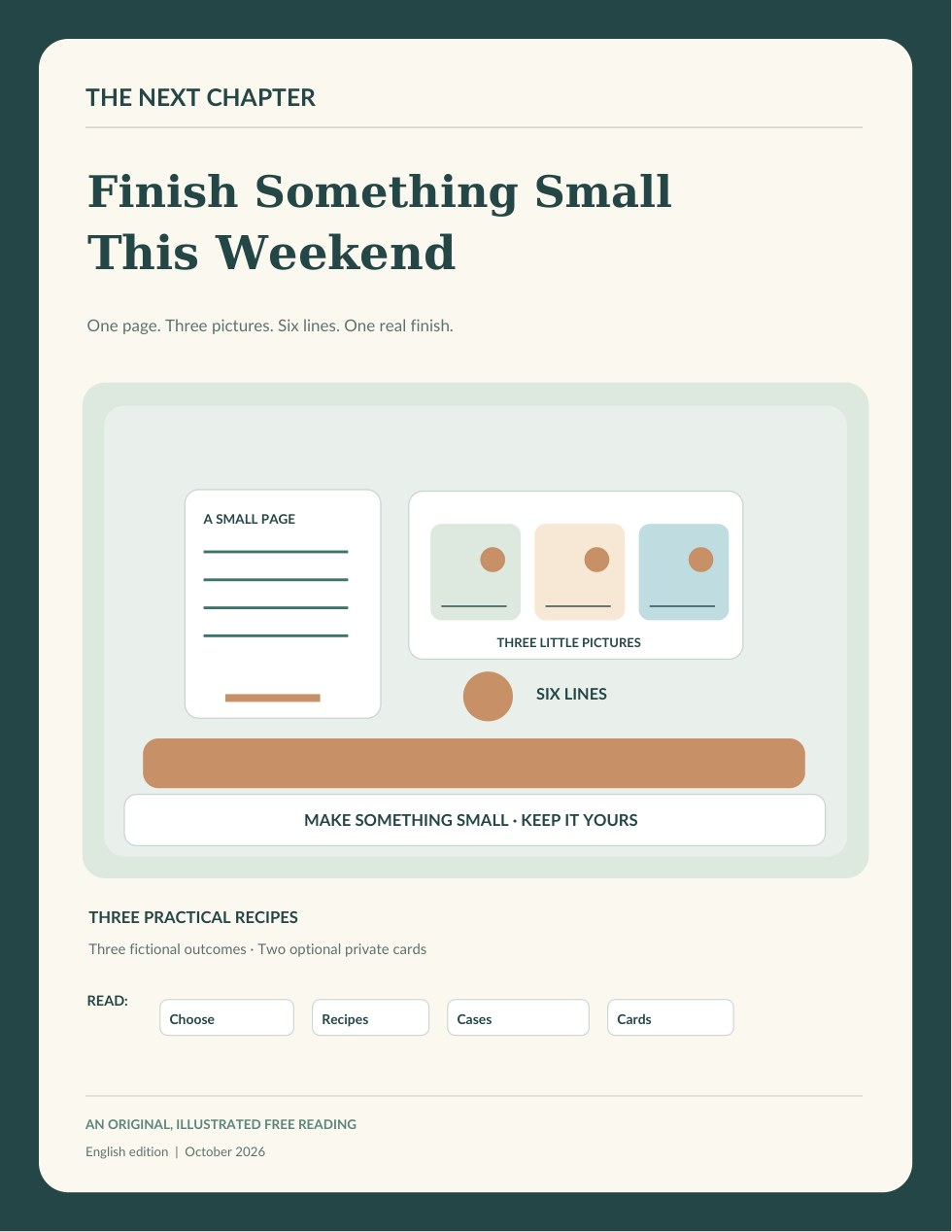
One page. Three pictures. Six lines. A finished small thing can be enough.
A practical illustrated invitation to make one tiny creative work with what you already have, choose a clear stopping point, and decide privately what to keep or share. Includes three complete project recipes, three entirely fictional outcomes, and two optional private cards. You do not need special equipment, a class, an account, a purchase, or another book to use it.
English edition · October 2026
A small finished thing is a real thing
YOUR WEEKEND DOES NOT NEED TO BECOME A PROJECT MANAGEMENT EXERCISE
There is a familiar moment at the start of a new interest. You imagine a collection of paintings, a beautiful family history, a photo book, or a story substantial enough to show other people. The idea is pleasant. Then it becomes so large that it is hard to begin. You do not know what to buy, what to learn first, or how many hours the result will require. You may put it aside without ever finding out whether the making itself is enjoyable.
Try a different scale. Choose one finished item for the next available stretch of time: a single sheet describing a place you like, three photographs of everyday objects with captions, or a six-line scene. You may make something in a notebook, on plain paper, on a familiar device, or by speaking the words to someone who agrees to help. The format is less important than knowing what “finished for today” means.
A small creative work does not need to be good by competition standards. It should be recognizably yours, within a scope you can choose, and finished on your own terms. Finishing might mean keeping it in a drawer. It does not mean selling it, uploading it, or proving that it is worth anybody else's attention.
This is not a therapy exercise, a promise of better memory, or a test of artistic ability. It is an ordinary way to explore the satisfaction of making something. The reader provides three actual recipes and shows one completed page, one completed picture set, and one honest decision to stop before completing. Those are different outcomes, and all deserve accurate names.
Choose one of three small shapes
DO NOT SIGN UP FOR ALL THREE
A one-page place portrait. Give a familiar place a title. Write three details you noticed, then a final line about what makes it yours. The place could be a window, a bus stop, a favourite chair, or a quiet corner of a park. The result is one page, not a history of the neighbourhood.
Three pictures, three captions. Make or select three of your own pictures of ordinary objects or surfaces: a teacup, a patch of morning light, a coat hanging by the door. Give each picture a short caption. Keep all three together on paper or a device. If taking photographs is inconvenient, three small sketches or descriptions can do the same job.
A six-line scene. Describe one small moment in six lines: where you were, what you saw, what moved or sounded, what you noticed, a thought you had, and one last line. You do not have to rhyme, and the scene does not need a dramatic ending. Handwriting, typing, dictation, and an audio recording for private use are all valid ways to create it.
Choose by interest and realistic access, not by what a “creative person” is supposed to do. If you dislike cameras, select the page or scene. If writing is difficult today, draw, photograph something you own, or record a short spoken description. The point is to end with one small object of attention, not a whole new routine.
Decide what “done” means before you begin
A FINISH LINE SHOULD FIT ON ONE SENTENCE
An open-ended goal invites endless additions: “I will start writing memories” or “I will take better photos.” For this exercise, make the sentence measurable without making it rigid. “By the end of this session, I will have one titled page with three observations.” Or “I will choose three of my own pictures and give each one a caption.” Or “I will make six lines, then stop.”
Avoid promises about quality, publication, daily habit, or how other people will react. You can finish a page without becoming a writer. You can keep three photographs without becoming a photographer. If you enjoy the activity and later want a larger project, that is another decision, not a hidden obligation in today's plan.
Say what you will not add: no shopping, no new software, no more than one page, and no requirement to show a relative. A boundary protects the small project from turning into a long one. The useful question is not, “Could this be better?” Nearly anything could be better. The useful question is, “Does this version meet the simple promise I made to myself?”
Sometimes you discover that the original aim is too large. Shorten it before beginning or before spending money. Changing “ten photographs” to “three photographs” is a better project decision than abandoning an unwanted ten-picture obligation. Changing scope is not dishonesty, as long as you record what you actually finished.
Give your project a simple completion test
A TITLE, AN ACTUAL RESULT, A PLACE TO KEEP IT
Use three plain checks. Can you point to the result? It might be one sheet, one saved file, one recording, or three captions below three pictures. Thinking about a project does not make a completed work; neither does buying a notebook. That distinction keeps the activity light and the satisfaction real.
Does it contain what you chose? For the place portrait: a title, three observations, one closing thought. For the photo set: three pictures you can legitimately use and three captions. For the six-line scene: six lines. You can change your own definition of a finished work before the end, but don't silently count a sketch as a finished twelve-page booklet.
Do you know where it is? A page tucked into a particular notebook, a file saved in a folder you can find, or a private voice note with a recognizable title counts. A project need not be public to have a home. If you use a phone, choose a familiar location on it, not a new cloud account created merely for this exercise.
Those checks are practical rather than artistic. They do not judge style or talent. A page with uneven handwriting can pass; a three-picture collection can be modest and still complete. If you only planned, experimented, or stopped early, call it a plan or an experiment. You can feel pleased with the attempt without pretending a finished item exists.
Start with what is already in reach
NO SHOPPING LIST IS REQUIRED
A blank envelope can hold a small handwritten piece. The back of clean scrap paper can be a page. A device you already know how to use may offer a notes app, basic camera, or voice recorder. Use whichever method lets you pay attention to the small work without spending the whole session learning an unfamiliar tool.
If you prefer a pen but writing by hand is uncomfortable, write fewer words, type on a larger display, dictate privately, or ask a willing helper to act as your scribe. If a camera is impractical, make three brief sketches or textual image panels. The outcome is still three observations arranged together; no physical capability or preferred technology needs to be assumed.
You do not need specialty paper, editing software, a printer, decorative materials, or a subscription. If a supply you already own was purchased long ago, using it today does not create a new cash payment. It is equally inaccurate to assume the material was always free. For this particular project, the useful question is whether you actually had to spend anything new.
Stay with ordinary safe materials and existing access. No cutting tools, ladders, unsafe positions, road crossings for photographs, or changes to someone else's property are required. If the easy version cannot be done comfortably, use an easier version, a different subject, or a different day.
A small piece can fit between other plans
ESTIMATES ARE NOT PROMISES
Imagine a plan with two optional work windows: perhaps 15 minutes to choose and begin, then 20 minutes to finish. That is an illustrative 35-minute plan, not a claim that everyone should complete a project in 35 minutes. The number is useful only if it helps you see that you are choosing something genuinely small.
In the first window, settle one subject and begin the actual work. In the second, remove an unnecessary detail, add the last line or caption, and put the result somewhere you can find it. Leave yourself room for ordinary interruptions. Neither an uninterrupted afternoon nor a formally booked appointment is required.
You might finish in a single ten-minute burst or across several days. If you need longer breaks, stop without apologizing. If another person is involved in helping you, ask whether they have time; do not assume their help is available. A personal project should not quietly assign somebody else an unpaid deadline.
If you stop before producing the chosen result, you have not failed as a person. You have learned something about the size or timing of this particular task. Mark it started, paused, or changed rather than calling it completed. You may pick it up later, or you may decide that the experiment has run its course.
Pick a subject that is yours to describe
ORDINARY THINGS HAVE DETAILS
Choose something you can observe or remember without collecting other people's private information. A lamp by your reading chair, the way a shadow reaches a wall, the colours of your favourite mug, or the sound of rain at your window can hold plenty of material. You do not need to travel, interview strangers, or obtain somebody else's photographs to begin.
Try these three questions. What can I see, hear, or feel about this scene? Which detail would another person overlook? What changes if I look for one extra moment? You may answer through words or pictures. A detail is more helpful here than a grand claim about the meaning of life.
If you want to include a living person, an identifiable photograph, another person's private message, or a story that belongs partly to a family member, ask for appropriate permission before recording or sharing. For a child's identifiable image or information, follow the relevant parent or guardian's directions and local requirements. When permission is uncertain, choose a private, non-identifying subject instead; creative work does not require an argument about consent.
This page uses invented ordinary scenes, not verified observations of named real people or locations. A small project can stay personal without becoming a permanent public record. You control whether to keep it private, revise it, or discard it later.
Recipe one: a portrait of one place
FOUR SMALL PARTS MAKE ONE PAGE
Take one page, or open one blank note. At the top, write a working title such as “The Corner by the Window.” Below it, write three specific observations: one about light, one about an object, and one about a small change you noticed. Then finish with one line about why you chose that spot. You may use short sentences. The page can be smaller than the paper.
Here is a wholly original, fictional example: “The Corner by the Window.” At ten, the light reaches the left arm of the chair. A blue cup sits on the low table with the handle turned toward the room. When the clouds move, the wall turns pale again. I chose this corner because ordinary mornings happen here without asking me to arrange anything.
Notice what is absent. There is no biography of the chair's owner, no research, no list of perfect adjectives, and no explanation of how a place ought to make someone feel. The example is a compact piece of attention. You can borrow its four-part structure, but choose your own subject and words.
To finish, give the page one quiet read. If an observation is vague, exchange it for something more exact. If you like the page, leave it alone. A title, three details, and one closing line are enough for this recipe. Put the page in a chosen place and mark it complete only when it actually exists.
Recipe two: three pictures and three captions
THE ORDER CREATES A SMALL STORY
Choose an everyday subject you may freely photograph or depict. Make three pictures from safe, permitted positions: for example, the closed book, the book beside a cup, and the patch of light where the book was. Alternatively, arrange three sketches or three descriptive panels. You are showing a sequence or a relationship, not proving you can operate complicated equipment.
Give each picture a caption of perhaps two to eight words, if that length suits you. A fictional set might be: “Before the morning cup.” “Where I put the book down.” “The light after lunch.” Place the three panels in an order that makes sense to you: before–during–after, near–middle–far, or simply first–second–third.
If you use existing photographs, use images you made or have genuine permission to use. Avoid other people's faces, private rooms, documents, addresses, vehicle plates, or account information unless use is clearly appropriate. Do not claim that a copied picture is your original work. Choosing to keep the collection private does not excuse taking images where photography is prohibited.
A set is complete when the three pictures and captions are together in one place you can return to. It need not be printed, shared online, or seen by a friend. A set of two because you ran out of time can still be a useful start; call it two panels, still in progress rather than pretending the third exists.
Recipe three: a scene in six lines
NO RHYME, NO PLOT TWIST, NO PRESSURE
If you enjoy words but do not want to write a long memoir, try six lines, each doing one small job. Line 1: Where am I? Line 2: What is there? Line 3: What moves or sounds? Line 4: What small detail catches my attention? Line 5: What thought passes through? Line 6: What is the final image or action? The order is a helpful starting frame, not a literary rule.
Here is an original fictional scene, written in six lines:
The kitchen is quiet after breakfast.
One orange sits beside the empty plate.
The old clock clicks above the sink.
A thin strip of sunshine crosses the table.
I notice how little the morning asks of me.
I turn the orange once and leave it there.
You may write about a room, an ordinary errand, or a harmless memory. If remembering a painful event is not what you want today, do not choose it. An ordinary scene is enough. The aim is not emotional treatment or a claim that creative writing will change anyone's health.
Read your six lines once. If you want, replace one vague word with something you can actually picture. Do not keep adding lines after you have met your own finish line. Give the piece a title or a date only if that helps you find it later, then call it finished when the six lines are actually present.
Make a rough version, then stop editing
EDIT THE PIECE YOU HAVE, NOT THE IMAGINARY PERFECT ONE
A small work may look awkward on the first attempt. A sentence repeats a word; two pictures look too similar; the third detail is less interesting than you hoped. That is normal information, not evidence that you should buy a class or expand the project. The most useful revision is often one exchange: replace one vague observation, move one panel, or shorten one line.
Try a single revision pass. Look for one detail that would make the piece clearer to you. Then stop. If you choose to do no revision, that may be perfectly reasonable. This is a weekend experiment, not a writing workshop with a grade. The instruction to stop is a protection against accidentally turning a small pleasure into a permanent unfinished obligation.
Use a simple name such as “Window Corner — Saturday” or “Three Cups — First Set.” If you save on a device, confirm the file opens before deleting any rough version you might need. If you write on paper, keep it in one chosen folder or notebook. Neither cloud backup nor public upload is required to finish this exercise.
The difference between an early sketch and a finished tiny work is your deliberate decision about the scope. You may say, “This page meets the four parts I chose. I am leaving it here.” That is a real stopping point. If you have not yet made anything tangible, call the project a plan and keep the future open.
Mira finishes one page in two visits
FICTIONAL CASE: ONE COMPLETED PLACE PORTRAIT
Mira is fictional. She likes a particular seat beside a window but does not want to start a large family memoir. On Saturday, she spends 9:10–9:30 a.m. (20 minutes) choosing a title and writing three observations. She puts the sheet aside. On Sunday, she returns from 11:00–11:25 a.m. (25 minutes), writes the closing line, and reads the page once. The actual activity time in this invented story is 20 + 25 = 45 minutes across two separate sessions.
Her result is one titled page, three observations, and a closing thought. It exists in her notebook. It is not a finished memoir, a promise of weekly writing, or a book offered for sale. She uses paper and a pen she already owns. New cash paid for this particular piece: USD 0 in the fictional example. That does not mean that the supplies never cost anything in the past.
Mira decides not to send her page to anyone. She likes having made something, but she does not wish to explain the feeling to a reader or turn it into a discussion. Her private choice does not reduce the work's completeness. If she later shows a friend, that will be a separate choice.
Mira's story is not a model of the “right” speed. The meaningful facts are the small pre-agreed shape, the actual two work sessions, and the visible result. A reader who makes a shorter page, uses voice notes, or takes longer can use the same idea without borrowing Mira's schedule.
Dev finishes a three-picture set
FICTIONAL CASE: A COMPLETED PRIVATE COLLECTION
Dev is fictional. He likes noticing how familiar kitchen objects look in different light. On Saturday he uses a camera he already owns to make three permitted photographs of his own everyday objects from his own room. He works from 1:00–1:18 p.m. (18 minutes), then takes a break. From 1:25–1:37 p.m. (12 minutes) he chooses the three pictures, orders them, and types a short caption for each. The actual making time is 18 + 12 = 30 minutes; the seven-minute break lies between sessions and is not part of that activity sum.
His pictures show a cup, a folded cloth, and a rectangle of light. They are not a street photograph of a stranger or an image borrowed from the internet. His result contains exactly three original images and three captions saved together in a folder he can reopen. Dev has actually completed the chosen small set. New cash paid: USD 0 in the fictional story because he made no new purchase.
Dev had briefly considered adding a photo his neighbour sent him, but he leaves it out; he has not asked for permission to include or publish it. He also chooses not to post the collection online. Completing the piece does not grant permission to use somebody else's work or information.
He might make a second set someday, but no second set is scheduled or counted. An idea for later is not a completed work today. Dev's example is useful because it shows a real end point: three images together, the captions attached, the file found again, and the sharing choice made separately.
Len discovers that the first idea is too large
FICTIONAL CASE: AN HONEST START, NOT A FINISHED WORK
Len is fictional. She begins with the idea of making a large family photo album that would require sorting decades of pictures, checking dates, and asking several relatives what they are willing to have included. She has not yet received those permissions. On Saturday, from 4:00–4:12 p.m. (12 minutes), she sketches an album plan on paper. She realizes that the job would be much larger than one weekend's small creative experiment.
Len decides not to continue with the album that day. She has produced a rough plan, not a completed one-page portrait, three-picture set, or six-line scene. She does not invent a completion badge for herself. She also leaves a hypothetical USD 18 binder in the shop rather than buying it; new cash actually spent: USD 0 in this fictional account. The binder price is an imagined example, not a real quotation.
Later, Len may choose a truly small project, such as writing six lines about a familiar room. That remains a possibility, not a finished sixth-line scene. The uncertainty is part of the story. Sometimes the useful result of a short experiment is realizing what you do not want to take on yet.
The lesson is not that Len should have worked harder. A twelve-minute investigation, a decision to pause, and a completed creative artifact are different things. This guide treats them honestly. If you discover that your idea involves other people's consent, purchases, or much more time, a respectful pause can be the right stopping point for now.
Count the outcomes without embellishing them
COMPLETED, COMPLETED, OR STILL ONLY PLANNED
The three fictional people made three different decisions. Mira chose a limited writing project and actually finished it; Dev chose three pictures and actually finished his set; Len evaluated a larger plan and stopped before making a small completed work. Saying exactly what happened is more useful than an encouraging label that erases those differences.
| Fictional reader | Actual activity | Confirmed creative result | New cash actually paid | | --- | --- | --- | --- | | Mira | Sat 20 min + Sun 25 min = 45 min | One titled page with three observations and closing line | USD 0 | | Dev | Sat 18 min + 12 min = 30 min of making; separate 7-min break | Three original pictures with three captions | USD 0 | | Len | Sat 12 min reviewing larger idea | A rough plan only; no finished small work | USD 0; proposed USD 18 binder not purchased |
Nothing in these stories is a service promise, a real retail price, or a time target for you. They simply separate actual work, completed result, proposal, and spending. A hidden purchase, a future plan, or an imagined reply does not become real through optimistic wording.
For your own project, you can use the same four questions: What did I actually make? What, if anything, was completed? What remains only an idea? Did I really spend any new money? You may answer privately without writing a formal report.
You decide what happens to the result
CREATIVE WORK DOES NOT AUTOMATICALLY BELONG ONLINE
A finished small work can be put in a drawer, saved on a device, read to a willing friend, or discarded. Those choices are all open. If you want feedback, ask one person whether they would enjoy seeing it; do not assume that a finished piece imposes a duty on somebody else to praise or analyse it.
Before any sharing, look for identifying material: other people's faces, private messages, addresses, documents, household details, or a story that someone else has a right to keep private. If you used a helper, distinguish the helper's own contribution and respect their wishes. You can preserve the idea of a piece while replacing an identifying detail with one that is yours to share.
Do not post images or text merely because an app makes public sharing easy. Check who can see it and what rights you have to the content. If you are unsure about permissions, keep the piece private or make a new version using your own observations. Your enjoyment of a hobby does not depend on public performance.
If you feel like continuing, choose whether the next project is new, larger, or not now. A second small work is not automatically owed to the first. This exercise ends with the work you have actually made, or with an honestly marked partial attempt. Either way, your time remains yours.
Optional private card: choose a tiny finish
YOU MAY LEAVE EVERY SPACE BLANK
This card is a voluntary reminder of your own project, not a public form. Do not enter passwords, account numbers, private medical information, or identifying details about another person. A paper note or no note at all is equally acceptable.
My one small format: Which single recipe, or genuinely equivalent small alternative, appeals to me?
My subject: Which ordinary place, objects, or moment can I describe appropriately?
My finish line: What exact pieces or parts will count as done this time?
My materials already available: Which familiar paper, device, or accessible method will I use?
My preferred work window: When might I try it, without promising a fixed time?
What I will not add: What extra buying, sharing, or expansion is outside this small plan?
Optional private card: what actually happened?
DIFFERENT OUTCOMES DESERVE ACCURATE NAMES
This private card helps you distinguish a finished work from a start or an idea. It is not a score. You may use it after the activity, or simply answer the questions in your head. No upload or registration is required.
What I actually made: What tangible page, pictures, words, or recording now exists?
My status today: Was it completed, started, paused, changed, or not attempted?
The parts I can point to: Which chosen completion elements are present, and which are not?
Time actually used: What sessions occurred, if recording them is useful to me?
New cash actually spent: What did I really pay, excluding imagined or unpurchased items?
Keep, share, or leave private: Where is the work, and what is my choice about showing it?
The small thing can stay small
YOU DO NOT HAVE TO TURN IT INTO A SECOND CAREER
Imagine taking a page out of a notebook at the end of the weekend. It has a title and three observations. Or imagine opening a folder and seeing three photographs with three short captions. Or imagine six lines about an ordinary room. None of these is a masterpiece by decree. Each may nevertheless be a complete, real small work, made by a person who chose its limits.
You do not need a public audience or a promise to repeat the exercise. A hobby can belong to your life without becoming a business, a challenge, or an obligation. Smallness can be a deliberate artistic choice. Sometimes the most generous gift you can give a new interest is a finish line it is allowed to reach.
If you made the item you chose, name that actual accomplishment. If you only explored an idea, name the exploration. If the idea needed other people's permission or more resources than you wanted to commit, respect that reality. No worksheet, purchase, special equipment, or online account is needed to use this free publication.
The methods here are general creative-planning suggestions, not individualized medical, accessibility, therapeutic, financial, or legal advice. Choose safe and appropriate activities for your own circumstances, and follow relevant consent, privacy, copyright, and location rules. Nothing in this reader guarantees enjoyment, health benefits, lasting habits, or a particular result.
Make one small thing if you want. Know what you made. Let that be enough.