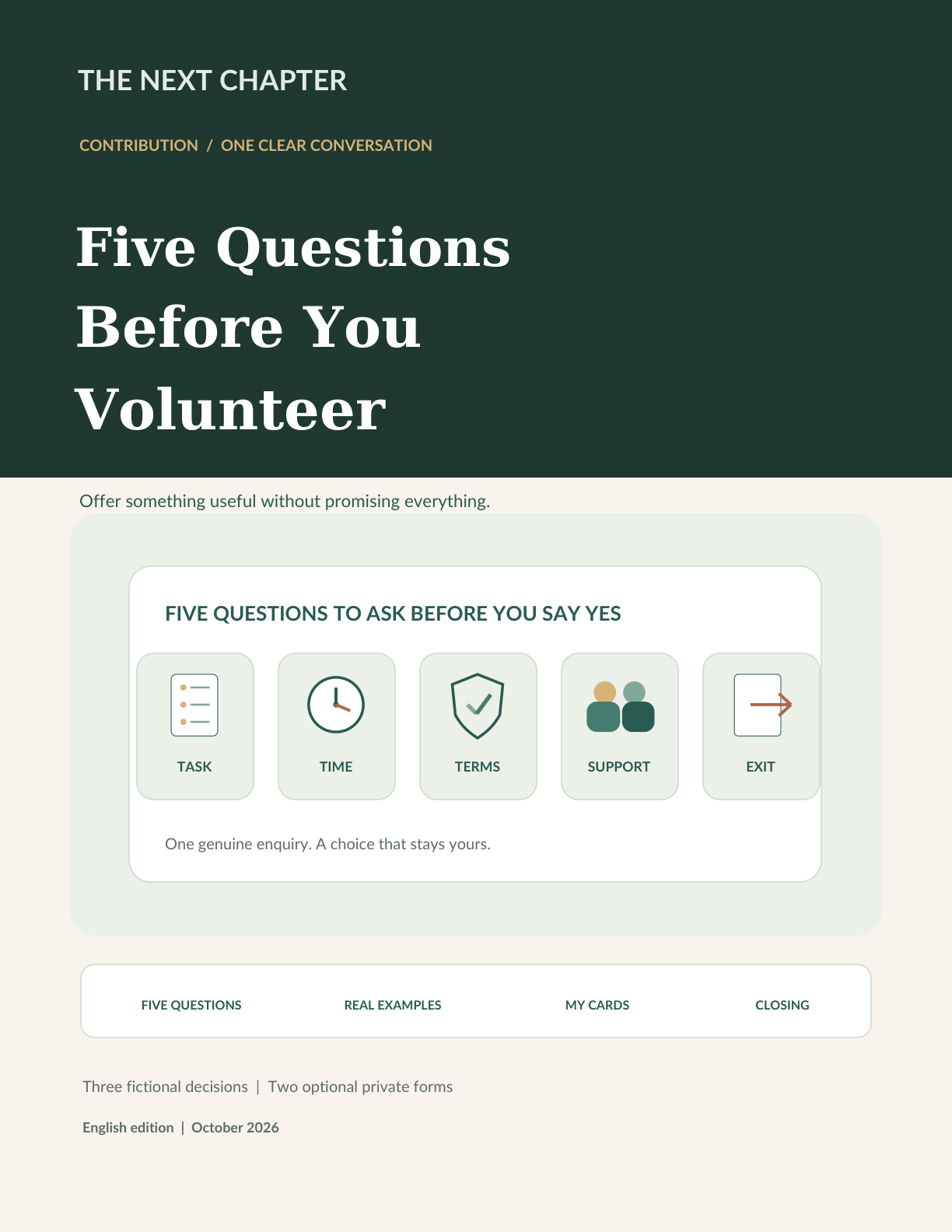
THE NEXT CHAPTER
Offer something useful. Learn the actual terms. Keep your right to say no.
An illustrated, free guide to one informed conversation before accepting a volunteer assignment, with three fictional decisions and two optional private cards.
English edition · October 2026
You may want to help without wanting another job
A poster on a community noticeboard says, “Volunteers wanted.” It is easy to picture a cheerful hour spent helping other people. It is harder to picture the parts the poster does not mention: who unlocks the room, how participants' information is handled, whether you must come every Wednesday, or who takes over when something goes wrong.
A wish to contribute is a good starting point. It is not a promise to take whichever task happens to be vacant. You may have retired from paid work, may still work part-time, or may have never had an office job. You may be caring for someone, learning a new place, or simply curious about a local activity. Your available time and boundaries matter as much as your enthusiasm.
This short guide does one job: it gives you five useful questions to ask the actual organiser before agreeing to a particular volunteer role. One clear inquiry can be a complete result. It may lead to a bounded invitation, a request for more information, or an easy no.
You do not have to volunteer, complete a card, disclose private circumstances, buy anything, or join a mailing list to use this reading. A cause can matter to you even when this particular assignment does not fit.
Five questions worth asking first
A volunteer opportunity is more than a title. “Help with events” might mean putting out name tags in the presence of a coordinator. It might mean collecting payments, handling confidential registration forms, or becoming the only person expected to manage a crowd. Those are different roles, with different permissions and expectations.
Before a yes, try these five questions:
- The task: What would I actually do, and what would be outside my responsibilities?
- The commitment: What is the full time, travel, frequency and possible cost, including preparation?
- The conditions: What orientation, eligibility, safeguarding or other checks apply before beginning?
- The support: Who is responsible for supervision, questions, accessibility arrangements and unexpected problems?
- The exit: How can I decline, change my availability or stop, and what handover would be needed?
You may ask them by email, telephone or an authorised in-person conversation. Use an official contact route rather than replying to an unfamiliar personal message that asks for sensitive details. Answers need not be elaborate; they should be specific enough to let you choose.
Five questions are not five boxes you must tick to prove generosity. If one essential answer is missing, “I cannot decide yet” is a sound response.
1. What would I actually do?
Ask for one ordinary example of a completed shift. “What would I be doing from the time I arrive until I leave?” often tells you more than a promotional description. A coordinator might say, “You will place labelled cards beside donated books, then return unused cards to the office.” That is something you can understand and ask about.
Now ask what is not part of the role. Will you ever handle money, keys, medication, confidential information, children on your own, powered equipment or another person's personal device? The answer changes both the competence needed and the organisation's obligations. Do not assume that friendliness or prior professional experience grants permission to do sensitive work.
The most useful clarification can be a small sentence: “I could help prepare materials, but I would not be the person responsible for collecting payments or supervising visitors.” A well-run organiser can tell you whether that limited offer helps. If the task cannot be separated from a responsibility you do not want, you have learned something valuable.
A title can change after you arrive. If someone asks for a different duty, you may check its requirements and say, “That was not the task I agreed to. Who should handle it?” Being present does not make you responsible for everything nearby.
A useful offer is one that has edges
“You can call me any time” may feel warm, but it leaves your availability to be decided by somebody else. Replace it with a true description of what you might offer. For instance: “I could help prepare public information sheets on one weekday morning, provided the assignment and supervisor are clear.”
You do not have to explain why an evening, a deadline or a particular environment will not work. “That time is not available to me” is a complete boundary. If accessibility adjustments would make participation possible, ask what the actual site or software provides. Do not rely on an advertisement's word “accessible” to settle a personal requirement.
An email you can adapt: “Hello, I saw the request for volunteers on your official noticeboard. I might be interested in a clearly defined, occasional task. Could you tell me what volunteers actually do, the expected time including orientation, and who coordinates the work? I have not committed to a shift yet. Thank you.”
A telephone version: “Before I say yes, could I check the exact work and its time requirement? If you do not have those details, who should I contact?”
A good inquiry gives the organiser useful information while protecting your own decision. It is neither an application nor a reservation unless the actual organisation explicitly treats it that way and you have agreed.
2. How much of my day would it really take?
A “one-hour shift” may require more than one hour away from home. Ask about check-in, preparation, required orientation, clean-up, travel and whether attendance is expected every week. If a venue is difficult to reach at your preferred time, the trip can be the deciding factor even when the task sounds ideal.
Consider a fictional one-hour information-table task. It calls for ten minutes to check in, sixty minutes of assigned work, ten minutes to hand items back, plus fifteen minutes of travel each way. That is 110 minutes from door to door, not an ordinary one-hour commitment. It is a planning illustration, not a real opportunity or service timetable.
Costs need the same care. Confirm whether there are required fees, training materials, protective clothing, parking, transport or meals. Some organisations reimburse particular approved expenses; others do not. A rumour that “volunteers get everything free” is not a reliable budget. Ask who pays, when and under what conditions.
A regular weekly commitment is different from an explicitly agreed one-off visit. So is an optional information meeting different from a completed assigned shift. Keep the dates and statuses separate in your notes: inquiry / possible orientation / approved assignment / actually attended.
You may offer less time, ask about another location or decide the whole trip is not worthwhile. The cause remains worthy even if the travel does not fit your life.
3. What checks or training apply?
A responsible organisation may need to confirm identity, eligibility, background-screening requirements, relevant training, confidentiality arrangements or safe handling procedures before assigning certain duties. The exact requirements depend on the role, organisation and location. They are not interchangeable across countries or across jobs within one organisation.
Ask: “Which steps are required for this task before I may begin, and who confirms that they are complete?” This prevents an enthusiastic visitor from being given an unapproved responsibility. It also prevents a volunteer from guessing that a previous check from a different organisation automatically counts.
When personal information is requested, verify the organiser and its approved process. Do not send identity documents, financial details, passwords or sensitive records to an unverified personal address. If a fee or screening service is involved, ask for the official written requirements before paying or sharing data.
You can acknowledge that training is useful and still decline the role if the time, requirements or subject matter do not suit you. Training is not punishment for inexperience, and experience is not a substitute for being authorised to do a task. The most practical answer tells you what happens first, who approves you, and what you are not yet permitted to do.
This guide cannot certify anyone as eligible, screened, trained, insured or safe to work with a particular group. Those decisions belong to the actual organisations and competent authorities.
Helping does not grant access to private information
Volunteer roles can put ordinary people near names, addresses, medical details, registration lists, passwords, payment records and sensitive family stories. Being trusted in the room is not general permission to copy, discuss or keep any of that information.
Ask what material you will handle, what approved system or device must be used, and who is responsible for keeping records secure. If somebody suggests moving personal files to your own email or home computer, do not assume that is allowed. Follow the organisation's documented instructions and seek clarification from its designated contact before handling anything uncertain.
There is a simpler alternative when you want to contribute without handling private records: perhaps the organisation has genuinely public flyers to prepare, signage to place, or publicly released items to sort under supervision. Those are only possible examples, not claims that any particular organisation offers them.
A useful sentence when a new task appears: “I am happy to ask the coordinator, but I will not take these records home or photograph them without authorised instructions.” The sentence protects the people whose information is involved as well as the volunteer.
If you are asked to skip an established screening or safeguarding requirement because “we are short-staffed,” you may decline that work. A staffing shortage cannot confer permissions that have not been granted.
4. Who will support me while I do it?
“Someone will show you” may be reassuring, but which person, on which day, and with what authority? Ask for the named role—not necessarily a personal phone number—of the supervisor or coordinator who will welcome you, give instructions, answer questions and deal with changes.
If the assigned person is absent, what happens? Can you pause the task, or will you be expected to operate alone? Is there a published way to report concerns? If you are asked to use specialised equipment, a vehicle or a secure system, who authorises and supervises that activity? A supportive answer identifies a real process rather than putting every problem on the newest volunteer.
Access arrangements deserve equally concrete questions. A step-free doorway may not tell you whether the assigned work table, washroom, seating, software interface, sound level or breaks fit your needs. Ask the actual provider to confirm the specific parts relevant to you; an organisation's general reputation cannot certify an individual route or shift.
A volunteer can offer a useful contribution without becoming the manager. “Who do I call if the room is locked or the equipment is missing?” is not a silly question. It is one of the most responsible things a newcomer can ask.
You may also ask what to do if the required support is unavailable on the day. Sometimes the proper answer is to wait rather than improvise.
A friendly reply is not necessarily an answer
Imagine a coordinator says, “It is casual, just come whenever you like.” A second person says, “Please commit to every Friday for three months.” Both may believe they are being helpful; the information is inconsistent. Do not decide by picking whichever version sounds more attractive.
Try one focused follow-up: “I have heard two different descriptions. Is this task one-off or a regular shift? Could the person responsible for assignments confirm the current arrangement?” Asking for one accurate answer is easier for everybody than guessing.
Specific: “One Saturday, ninety minutes on site, supervised by the event lead. Screening is not required for this particular non-sensitive task, subject to our written assignment rules.” That is a concrete statement you can assess—although you still need the actual organisation's confirmation.
Unclear: “It hardly takes any time, and anyone can help.” That does not tell you the task, conditions, support or end point. The uncertainty should remain visible rather than quietly becoming a yes.
If the provider cannot answer a question essential to your decision, you can pause or walk away. Your time can be limited even when somebody else wants help urgently. Repeating the same question endlessly is not a requirement of kindness.
5. What if the role needs to change—or end?
Ask this before the first shift, not because you expect a problem but because plans change. What notice would be considerate? Is a replacement needed before you leave? Which keys, files, badges, equipment or documents must be returned? Can you take a break without silently being counted on a rota?
A one-off contribution should not become an indefinite weekly promise through habit. If you prefer occasional work, say so while the terms are being discussed. You may accept one authorised assignment and decline a second. You may be unable to accept any after learning more.
A practical decline: “Thank you for explaining the role. I cannot commit to the ongoing hours, so please do not add me to the schedule. I hope you find someone for whom the role fits.”
A practical exit after involvement: “I can finish the task we agreed for this date, then I need to stop. Please tell me how to return the materials and transfer any necessary notes through the approved process.” If circumstances or safety make that impossible, contact the relevant supervisor promptly rather than assuming you must complete work regardless.
Some organisations have formal agreements, safeguarding procedures and specific handover expectations. Read their actual terms; this guide is not legal advice about contracts or an instruction to ignore existing responsibilities. What matters is to understand the arrangement before you enter it.
Compare answers, not glossy descriptions
Two posters may look equally welcoming while offering very different levels of detail. The helpful comparison is not a star rating. It is whether a real person has answered your questions well enough for you to make a free choice.
| A fictional reply | What you actually know | What remains unresolved | |---|---|---| | “Come help with our archive.” | The organisation wants volunteers | Task, records, time, supervision and screening | | “One supervised label-sorting session, forty-five minutes; orientation first.” | Some task and duration details | Exact date, approval, access and whole-trip costs | | “Remote proofing is flexible; please send all your documents.” | It might be done from home | Official contact, privacy, authorised files and data requests |
These are invented replies, not three actual organisations or a verified directory. Do not infer that the second one is automatically safe or approved. It is simply more precise about some parts of the task.
Try placing each answer beside the same five questions. A blank answer stays blank. A promise not yet confirmed by the organisation is not a confirmed programme or booking. The next step might be a single clarification rather than an immediate commitment.
Useful volunteer work begins with a real match between a need and a willing person. Neither a vague advertisement nor a beautifully designed brochure can create that match on its own.
Words you can use without apologising
The aim is not to sound impressive. It is to speak accurately enough that the organiser knows what you may be able to do and what you have not yet agreed to do.
Ask: “I am interested in helping on a small, clearly defined task. Could you describe the actual duties, any required checks or training, the total time and the person supervising it? I will decide once those details are clear.”
Clarify: “Thank you. You mentioned a short first session, but the sign-up form says every week. Which is correct for the task I asked about? I have not booked a shift.”
Accept only what is offered and confirmed: “That particular supervised session works for me, subject to the stated orientation and approval. Please confirm the actual date, location, instructions and required equipment before I attend.” The phrase subject to matters if conditions remain unfinished.
Decline: “I appreciate the invitation, but I cannot take that level of responsibility. Please do not schedule me. Thank you for explaining it.”
A positive reply from a coordinator may still require eligibility confirmation, orientation or a formal booking step. Do not treat a pleasant exchange as completed permission to handle records or start a task. Equally, no reply from an organiser does not enrol you: it means you do not yet have the information or agreement needed.
Inez: the archive request that grew larger
Fictional example. Inez enjoyed local history and noticed a request to “help make our town archive easier to use.” The phrase sounded like an hour sorting labels on published photographs. She sent one inquiry through the organisation's official page and asked for the exact duties, schedule, screening rules, supervision and exit route.
A reply described “some organising” on two afternoons a week. When Inez asked for an example, the coordinator explained that the volunteer would also keep a contact list of private donors, answer unsolicited requests for family details and arrange access independently when staff were away. Inez had not offered to handle any of those responsibilities.
She wrote: “Thank you for explaining the work. I can prepare public labels under supervision, but I cannot manage donor contacts or open the archive alone. If you have a genuinely separate task within that limit, please let me know; otherwise I will decline.” The coordinator had no separate assignment to offer.
Actual status: One inquiry and one response; no orientation, no booked shift, no private records handled, no travel and no additional cash spending. Inez declined that assignment. She did not need to become responsible for an archive to keep her interest in local history.
Her decision did not assess the organisation's worth. It assessed the specific role against the boundaries she honestly held.
Arun: one clearly bounded afternoon
Fictional example. Arun saw an invitation to help place preprinted, publicly approved plant labels at an invented community garden event. He first contacted the actual organiser in the story and received written confirmation: a forty-five-minute task beside a named event lead, no money or attendee records handled, no powered tools, an orientation at check-in, and the option to stop after this single session. The role was explicitly authorised for him under the fictional organisation's requirements.
He left home at 1:30 p.m., arrived for check-in, completed the agreed supervised work from 2:00 to 2:45 p.m., returned supplies to the lead and reached home at 3:15 p.m. The full time away was 105 minutes (1:30–3:15), not simply forty-five minutes. He paid a fictional CAD 3 outward and CAD 3 return bus fare, for CAD 6 actually spent; there was no admission fee or equipment purchase.
The coordinator later mentioned a possible three-hour weekly garden role. Arun did not accept it or book another shift. He liked the single event and was satisfied with having done exactly what he promised.
Actual status: One approved, completed, supervised assignment; CAD 6 spent; 105 minutes door-to-door. The possible recurring role is unbooked and unaccepted, not part of the completed work or cash total.
Tessa: a remote offer that stayed uncertain
Fictional example. Tessa was comfortable proofreading public-facing text and considered a remote request described as “flexible support with captions and short documents.” The invitation came from a group whose official contact she could independently identify. She scheduled only an introductory telephone call, not any work assignment.
The twenty-minute fictional call ran from 11:00 to 11:20 a.m. The coordinator could describe the broad project but could not say which documents a volunteer would see, whether they contained personal information, whether approved software was supplied, what accessibility and confidentiality arrangements applied, or who would check the final material.
Tessa asked for written answers and said she would not open project files until the access process and scope were confirmed. She did not send private identity records or accept an account invitation by default. No reliable follow-up information arrived. She chose not to proceed.
Actual status: A twenty-minute information call from home, no assigned work, no approval or booking and CAD 0 in new cash purchases. That does not make her existing phone or internet service costless. The promise of remote flexibility was not proof of a usable or properly supported assignment.
Volunteering from home can be convenient, but remote work still needs accurate duties, authorised information handling, a responsible contact and a way to stop.
One answer is enough to move—or to stop
After the five questions, you need a decision rather than a score. Three useful outcomes are available, and none creates a duty to keep asking forever.
A defined yes. You have confirmed the task, total commitment, prerequisites, support and ending. You want it, have actually completed any required approval, and accept only that particular arrangement. Confirm the date and process before arriving or opening files.
One remaining question. Most of the terms fit, but a material detail is unresolved. Name only the missing answer: a supervisor, required screening, accessible entrance, actual return transport, or permission to work with a dataset. Do not record the role as booked while it remains tentative.
A considered no. The role is too vague, requires an unsuitable responsibility, demands time you cannot offer, or simply does not interest you enough. Reply politely if appropriate and move on. It is reasonable to support a cause in another way—or not at all.
A fourth honest result is not now: a different season may suit you better. Leave the line blank if you prefer not to set a future date. The organiser should not count on an unspecified promise.
The next two pages provide optional cards for private use. They are not applications, registration forms or invitations to upload your information anywhere.
My five-question enquiry card
Use this privately before contacting a real organisation. Write as little as helps. You may print the page, type into its fields or leave it blank; do not record passwords, identity numbers or another person's personal details.
Role and official organiser contact: Which actual organisation and verified channel would I ask? What role is being advertised?
Exact task and what is excluded: What do I understand the work to be? Which responsibilities would I decline?
Whole commitment and costs: Include frequency, orientation, travel both ways, required supplies and any fees still to confirm.
Eligibility, training and privacy: Which conditions must the organiser confirm before I do any work?
Named support and practical access: Who is responsible, and what worksite or software details matter to me?
Changing or ending the arrangement: What would I ask about stopping, breaks, notice and handover?
Keep this card with you, not as an attachment to an unfamiliar public sign-up form. A good inquiry is a way to discover terms, not a promise to accept them.
My answer-and-decision card
Use this only after a real reply. Separate a possibility from what is confirmed. A blank line is more honest than a guessed answer.
Actual duties confirmed by: Who explained the task, and which parts remain unanswered?
Approval or screening status: Not required for this task / required and pending / completed and authorised / unknown; record only what is true.
Dates, full trip and actual costs: What has been booked or attended? What is merely quoted or possible? Do not count future offers as spent money.
Supervisor and needed arrangements: Whom would I contact on the day? What access, instruction or support has actually been confirmed?
My present choice: Accept this defined task / ask one question / decline / not now. The choice belongs to me.
One optional next message or handover: What should I actually send or return, if anything? If I choose no, this can remain blank.
The information stays yours. This book offers no application portal, booking service or volunteer placement, and no completed card is needed to finish it.
Helping is a choice, not an open-ended promise
Volunteering can be an enjoyable way to use a skill, support a place you care about or take part in a shared effort. It can also become inconvenient or unsuitable when the role is not clear. A short conversation before saying yes respects both the people receiving help and the person offering it.
The five questions are simple: What will I do? What will it take? What conditions apply? Who supports me? How can I stop? The answer to one may settle the decision. You do not need a ten-page application to learn that an advertised role does not fit.
Inez chose not to manage private archive records. Arun enjoyed an authorised one-off task without signing up for weekly work. Tessa discovered that a remote offer did not yet have adequate information-handling terms. All three cases are invented and illustrate different legitimate decisions, not real organisations, advertised opportunities or current fares.
Verify each actual role's policies, eligibility, screening, supervision, accessibility, insurance, security and costs with its authorised organiser and, where necessary, appropriate local professionals. This guide does not provide legal, insurance, medical or safeguarding certification and cannot guarantee any placement or benefit.
A useful contribution can be small, specific, freely chosen—and complete.
No payment, personal-data submission, registration, future appointment or completed worksheet is required to use this free guide.