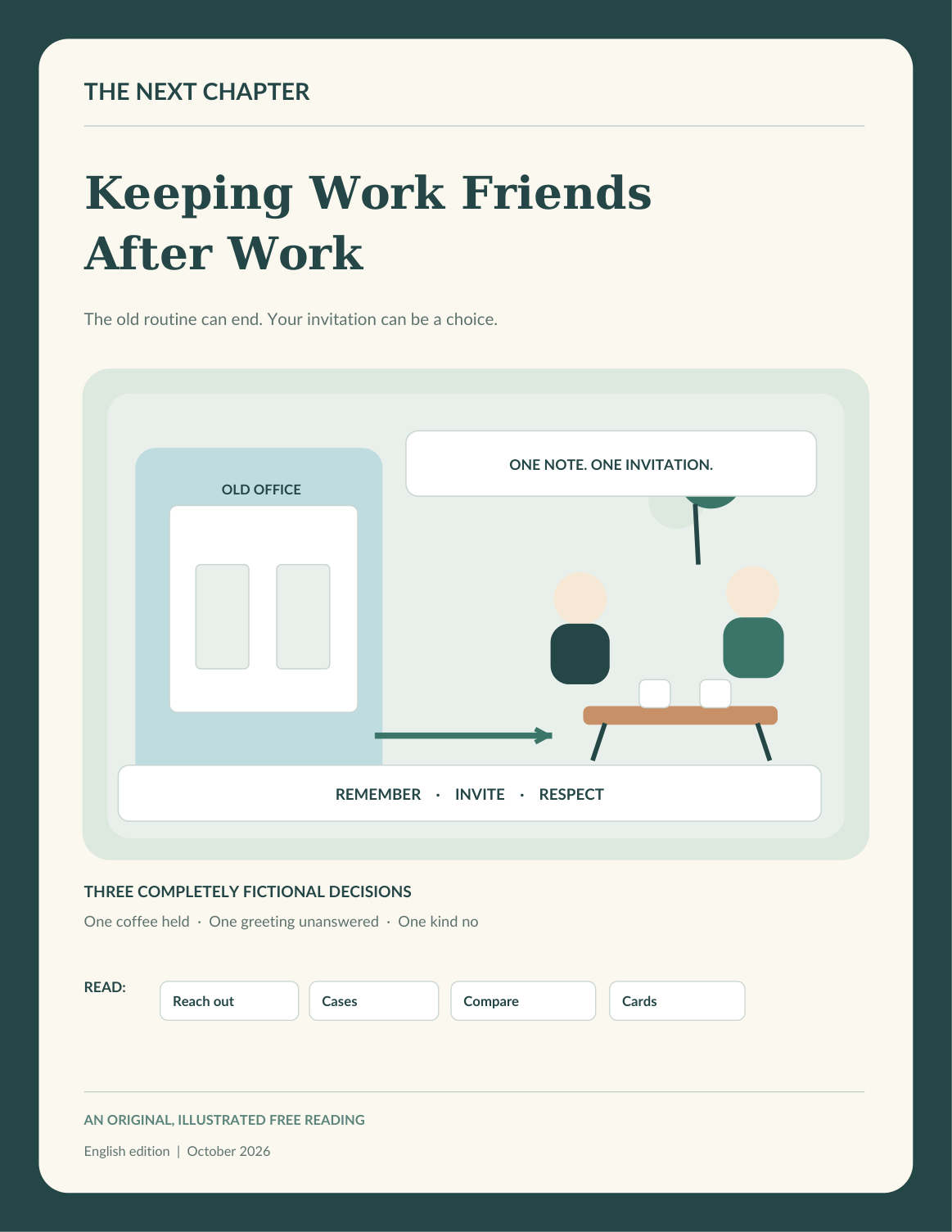
THE NEXT CHAPTER — AN ORIGINAL FREE READING
The office may be gone from your day. The connection does not have to disappear—or become an obligation.
A practical, illustrated guide to reaching out to someone you knew through work after retirement, a career change, or a move. Choose a considerate first message, notice the other person's schedule, offer a manageable way to meet, and respect whatever answer comes back.
Three entirely fictional decisions. Two optional private cards. No purchase, registration, reply, or completed worksheet is required.
English edition · October 2026
The daily routine was only one part of knowing them
WORK MAY HAVE INTRODUCED YOU; CHOICE WILL KEEP YOU IN TOUCH
You used to see Morgan by the office kettle every morning. There was always a small exchange about the weather, a difficult project, or a photograph of a grandchild. Then your last working day arrived. Weeks passed. Without the shared hallway, even a warm relationship could feel strangely distant. Did you lose a friend, or did you simply lose the place where you met?
Those are not the same thing. Work once provided a ready-made time and location. Staying in touch now means that at least two people must choose when and how it happens. You cannot recover the daily routine by sending more messages, and you do not need to. A single comfortable conversation may be enough to discover what the relationship can become.
This guide focuses on one respectful invitation and the response that follows. It is not a promise that old colleagues will become close friends, and it is not a programme for building a large social circle. You may want to reconnect, exchange occasional updates, offer a brief coffee, or simply send a good wish. Every one of those can be a sensible outcome.
Retirement can change your hours without changing someone else's. If the other person is still working, a contact that feels leisurely to you may arrive during a crowded day for them. Thoughtfulness begins before you ask for any of their time.
Decide what kind of contact you actually hope for
FRIEND, COLLEAGUE, OR SOMEONE YOU WOULD ENJOY SEEING?
Think about one real person, rather than making a general plan to “keep in touch with everyone.” Perhaps the two of you shared lunch for years. Perhaps you often worked well together but rarely discussed life beyond the job. Perhaps you were friendly whenever you met, without ever making plans outside work. None of these histories is defective; they simply call for different expectations.
Ask yourself two private questions: “Would I enjoy hearing how they are, even if we never talk about work again?” and “What small contact would feel natural for both of us?” You may prefer a short email, a call, a walk near their workplace, or just a holiday greeting. Do not decide in advance that one reply must lead to monthly meetings.
A working relationship may also carry unequal power. A former supervisor, direct report, client, or professional contact might respond politely without wanting a personal friendship. Make your invitation free from a request for favours, confidential business information, introductions, or career assistance. Avoid turning a friendly note into a hidden professional obligation.
You do not have to tell someone that they were your “best friend at work” to justify writing. A simple memory—“I still smile about our Thursday lunch conversations”—can carry warmth without deciding the other person's feelings for them.
Your free morning may be their busiest hour
KEEP THEIR WORK, COMMUTE, AND HOME LIFE IN VIEW
A retired person's Tuesday morning and a working person's Tuesday morning can be entirely different. That difference does not imply that one life matters more. It only affects what an invitation asks. The friend who once chatted freely at eleven may now have meetings, a shift, a long journey home, family commitments, or the need for an undisturbed break.
Do not write, “You must have ten minutes somewhere,” or assume someone can talk because their calendar looks open. You may not know their workload. Instead try, “I know your weekdays may be full. No need to answer quickly; would a brief catch-up ever appeal to you?” It allows them to express interest before they are asked to reserve an hour.
Different kinds of work create different constraints. Weekend shifts, evening work, unpredictable rosters, and remote schedules can make ordinary suggestions awkward. Ask what times might suit them if they want to meet. Do not insist that someone rearrange childcare, transport, or another person's schedule for you.
Likewise, protect your own time. Retirement does not make you permanently available. You can offer two times that genuinely suit you, or decline a late-evening meeting. The point is a voluntary connection between adults, not the exchange of one rigid timetable for another.
Use a contact channel that feels appropriate
DO NOT TURN A LOST ADDRESS INTO A SEARCH FOR PRIVATE DETAILS
If you already exchange personal messages with the person, you have an obvious channel. If you only know a former work email, consider whether it is still appropriate and active. A message sent to an old employer's account may no longer reach the person, and a professional platform may be better suited to a short greeting than a personal demand.
Use contact details you have legitimately and are permitted to use. Do not ask another colleague to supply a home address or telephone number without permission. Do not copy a workplace mailing list, search private records, or involve an employer simply because you feel curious about someone's life. Respect an existing boundary, including someone who has asked not to be contacted.
The first contact can be light. “Hello, I was thinking of our old lunch conversations and wanted to wish you well. If you'd ever enjoy catching up, I'd be pleased—but no pressure.” It says why you are writing, offers a choice, and does not presume a reply. If your channel is uncertain, avoid including sensitive stories or personal information.
A message can also be complete on its own. You might write a kind note and leave it there. Friendship is not measured by whether you can reach someone through every available app. Their silence or choice not to answer is not permission to keep trying new channels.
A useful first note is warm, brief, and easy to answer
REMEMBER SOMETHING REAL; MAKE ONE SMALL OFFER
A message need not contain your entire retirement story. Begin with a recognizable memory, say why you thought of the person, and offer a low-pressure option. For example: “Hi Mina, I passed the little park near our old office and remembered our Friday walks. I hope you're well. Would you like a short coffee sometime next month? If not, no worries at all.”
Notice what this note does not do. It does not say the recipient owes you a reply because of past kindness. It does not ask why they have failed to stay in touch. It does not announce a date and expect confirmation. It offers one approachable idea while allowing the other person to decline, suggest something different, or simply answer with a friendly hello.
If you do not want a meeting, be even simpler: “I was thinking of the team today and remembered how much I enjoyed our conversations. I just wanted to send a good wish.” The best message matches your actual intention. Do not attach an artificial invitation merely because an advice book says to arrange coffee.
Before sending, read the note once through the recipient's eyes. Is it clear who you are if a long time has passed? Is the request specific enough to understand but small enough to accept? Can the other person say no without being made to feel unkind? Those checks matter more than perfect wording.
Offer a format rather than a demanding reunion
THE BEST CATCH-UP MAY BE SHORTER THAN YOU IMAGINED
A two-hour meal can be lovely when both people want it. It can also be a large first request after a long gap. A fifteen-minute telephone call, a quick coffee near a convenient location, a brief walk, or occasional written updates may be easier starting points. Give one or two real options, not a list that asks the other person to organize your social life.
Remember that a call does not have to include video. A friend may prefer voice only, written messages, or a quiet in-person meeting. Do not assume everyone wants an online calendar link, a group chat, or a photograph posted publicly. If you propose a venue, confirm opening hours, seating, travel, and cost before describing it as convenient.
A specific but flexible offer might be: “I could meet near your office for about forty-five minutes after work one day, or we could simply exchange a few messages. Does either sound good to you?” If the person says neither, that answer is useful information—not a challenge to solve.
If you were once part of a large work group, avoid inviting additional people without asking. Private, one-to-one time and a reunion with former colleagues are different events. Someone may be happy to hear from you but unwilling to revisit a whole workplace chapter.
Let the other person choose the pace
AN OFFER IS NOT AN APPOINTMENT
There are three stages worth keeping separate: an invitation sent, an invitation accepted, and a meeting actually completed. “That might be nice sometime” expresses possibility, not necessarily a booking. “Tuesday at 5:30 works; let's meet at the café entrance” is much closer to an agreed plan, provided both adults confirm the details.
Do not reserve a non-refundable seat, purchase tickets for someone else, or announce a reunion to mutual friends before agreement. Even a familiar colleague can have changed circumstances, needs, or preferences. The person may welcome a greeting yet not want a recurring social commitment.
A genuine yes can be small: “Let's try one coffee and see how it feels.” Avoid turning that into “Every first Tuesday from now on.” Likewise, a friend who declines once has not necessarily rejected your whole history. You can respect a no without demanding an explanation or reassuring yourself that another invitation must change their mind.
Your own comfort counts, too. If reconnecting brings back unpleasant office dynamics, you can decide not to proceed. It is fine to remember someone kindly while keeping the relationship in the past. This is a guide to choices, not a test of generosity.
If both agree, settle just enough detail
ONE PLACE, ONE TIME, ONE WAY HOME
A plan is easier to keep when neither person has to guess. Confirm the day and local time, approximate duration, meeting point, and whether anyone needs to travel far. A shared venue name is not always a clear meeting point; a café may have two entrances, and a park may stretch over several blocks.
Ask ordinary practical questions without assuming another adult needs assistance. “Would meeting near the station be easier for you, or do you prefer somewhere else?” is respectful. If the person chooses a different location, consider your own journey as well. A meeting that requires an exhausting return trip may not be a good offer for you either.
Agree on a natural end: “I can stay until about 11:05, then I need to catch my ride home.” A clear finish can make a working friend more comfortable accepting. It also avoids the awkward expectation that the invitation should consume an entire morning or evening.
If circumstances change, send a short update through the agreed channel. Do not publish the meeting time or someone else's location on social media without their agreement. If one person cancels, any replacement date is a new invitation, not a debt to be repaid.
Count travel and optional spending honestly
A FRIENDLY MEETING SHOULD NOT HIDE ITS PRICE
The cost of reconnecting is sometimes modest, but it is not always zero. A café drink, parking, public transport, fuel, a ticket, or a paid activity can turn “just a coffee” into a larger outing. Check the full journey—outward and homeward—rather than naming only the price of one item.
Separate confirmed prices, estimates, optional purchases, and money actually paid. If a hypothetical café drink is priced at USD 4 but nobody orders it, USD 4 is an option, not a purchase. If two hypothetical bus fares of USD 3 each are actually bought, that is USD 6 of travel expense. Do not add someone else's possible spending to your own.
A considerate invitation allows a person to join without buying food: “There are seats in the public garden nearby if you'd rather meet there. I'd be happy just to talk.” But check whether the location really has suitable public seating and access; a suggestion is not a verified amenity.
You may offer to pay for someone only if you genuinely intend to and can do so. Never assume a former colleague's financial circumstances, and do not require either adult to explain a budget limit. Choosing a short, inexpensive meeting can support the friendship rather than diminish it.
No reply is information, not a puzzle to solve
SILENCE IS NOT CONSENT TO SEARCH FOR ANOTHER CHANNEL
You send a friendly note, then see nothing in return. It is tempting to invent a story: perhaps you offended the person, perhaps they have forgotten you, perhaps they are too busy, perhaps the message was filtered. You usually do not know. None of those guesses gives you the right to demand an answer.
Depending on the history of the relationship, one brief follow-up after a reasonable interval may feel appropriate. “Just making sure my note wasn't lost. No need to reply if a catch-up isn't convenient; wishing you well.” It should not contain guilt, a second request disguised as a reminder, or a demand for a reason. When in doubt, you can simply stop after the first note.
If there is still no answer, leave the matter there. Do not ask colleagues to investigate, watch someone's online activity for clues, or move across several platforms to get noticed. A message that was not answered is not a booking, a completed conversation, or evidence of spending time together.
You can still value the years you shared. A good memory does not become worthless because a new friendship does not follow. Put your attention into relationships that are mutually chosen now, including people you are already seeing in ordinary life.
Find a new subject without forcing a confession
LET WORK BE A MEMORY, NOT THE WHOLE AGENDA
When you meet, it can feel natural to begin with an old workplace story. A familiar laugh often makes conversation easier. But a former colleague may not want a detailed replay of difficult managers, confidential projects, or a team conflict. Notice whether the shared memory creates warmth or keeps one person stuck in an unwanted chapter.
Try an open invitation: “What's been enjoyable for you lately?” or “Have you found any new places you like?” It leaves room for ordinary answers, including “Not much, really.” If someone is still working, do not treat them as a source of current office gossip. Confidentiality and professional boundaries continue after you leave.
Be curious without interrogating. Avoid assuming a colleague's marital status, family plans, health, finances, or retirement date. You may mention your own activities, then pause so the other person can choose how much to share. A comfortable meeting does not require either adult to account for every year since you last spoke.
End with accuracy. “I enjoyed this; I'd be pleased to talk again sometime” offers interest. “Let's do this weekly” asks for a commitment. These are different messages. Match your words to the actual conversation, and accept that a perfectly good catch-up may remain a one-time event.
Frances: one coffee that really happened
FICTIONAL CASE — A COMPLETED, LIMITED CATCH-UP
Frances retired last autumn. She remembered talking with Mina, a colleague who still worked near their old office. After an ordinary exchange of messages, Frances asked whether Mina might enjoy a short coffee on a day when her schedule allowed it. Mina proposed a morning she could spare, and both agreed to meet at 10:20 and finish by 11:05. They did not promise a recurring meeting.
On the agreed day, Frances left home at 09:55, reached the café at 10:20, talked with Mina from 10:20 to 11:05, and returned home by 11:30. That was 95 minutes away from home, including 45 minutes actually together. The story makes no claim about Mina's commute or what time Mina returned to work; only Frances's route is described.
Frances actually purchased two hypothetical bus tickets at USD 3 each, outward and return, and one tea for USD 4. Her actual new cash spending was USD 10. A suggested USD 7 lunch was never ordered and is not counted. All amounts and places are fictional examples, not current prices or public-service advice.
They spoke about Mina's garden and Frances's new reading habit. When they parted, Mina said she'd enjoyed the conversation, and Frances said the same. Neither booked another date. Frances had successfully completed one welcome meeting; she had not secured an ongoing schedule, and nothing about this friendly outcome proves that future invitations will be accepted.
Samir: a greeting sent, not a meeting held
FICTIONAL CASE — AN OPEN QUESTION, NO COMMITMENT
Samir was curious about Lee, whom he had worked beside many years earlier. He spent six minutes writing and sending a brief message through a previously used, appropriate personal channel. It read, “I hope you're doing well. I thought of our lunchroom chats today. If you ever want a quick catch-up, I'd enjoy that—but absolutely no pressure.”
Ten days later, in this fictional example, no response had come. Samir did not know whether Lee had read the message or wanted contact. He considered another note, then decided to leave the original one as it was. He did not ask mutual colleagues to find Lee, did not try a second app, and did not book a table on Lee's behalf.
The outcome is precise: one message sent, six minutes of Samir's time actually spent, no conversation or outing held, no follow-up scheduled, and USD 0 of new cash paid for this contact. This does not assert that his existing device or connectivity carried no routine costs. It means the example identifies no additional purchase.
Samir felt a little disappointed and also glad that he had written kindly. Both feelings can exist without a second action. If Lee writes later, that would be a new event to consider—not something this example has already accomplished.
Nora: a clear no can preserve dignity
FICTIONAL CASE — INVITATION DECLINED, NO EVENT BOOKED
Nora had once shared a lively project team with Ben. She heard about a reunion lunch and sent him an invitation. Ben replied warmly but clearly: “Thanks for thinking of me. I won't be joining a work reunion. I hope everyone has a good time.” He did not offer a different day, and he did not explain why he preferred to stay away.
Nora could have asked him to justify that preference or suggested he should attend for old times' sake. Instead, she wrote, “Of course. Thanks for letting me know, and I wish you well.” She did not name Ben as an attendee, pay for his place, or tell mutual colleagues he would probably change his mind. She treated his answer as complete.
In this fictional case, the reunion invitation was declined; Ben did not attend; Nora made no booking for Ben; and no new cash was paid on his behalf. Ben's message was a response, not agreement to future contact. Nothing here claims that Nora herself did or did not attend a separate lunch.
There is no villain in this story. A person may treasure old colleagues and still prefer a different life now. Nora can remember Ben's contribution kindly without revising a respectful no into a problem she needs to fix.
Record what happened, not what you hoped would happen
THREE FICTIONAL DECISIONS — A COMPARISON
A completed catch-up, a message without a reply, and a declined invitation should not be reported as if they were the same achievement. Each can involve a thoughtful decision. Only one of the following examples includes two people actually meeting. The times and cash amounts relate only to the described person or invitation, not to anyone's unreported activity.
| Person / actual action | Actual time or meeting | New cash actually paid | |:---|:---|:---| | Frances: met Mina once | 95 min away; 45 min together; no new date booked | USD 10: two USD 3 fares + USD 4 tea | | Samir: sent one greeting | 6 min writing/sending; no reply or meeting | USD 0 newly paid for the contact | | Nora: Ben declined reunion | No meeting or booking for Ben; response accepted | USD 0 paid on Ben's behalf |
Do not turn an unaccepted invitation into a “confirmed visit” in your own notes. A suggested lunch that nobody purchases costs nothing in that example; an unbooked date is not an appointment. This is not a scoreboard of relationship success. It is a way to keep details truthful and avoid inventing obligations for anyone else.
Your next step can be smaller than another invitation
CONTINUE, ADJUST, LEAVE OPEN, OR STOP
When a connection resumes, you do not need to decide its entire future immediately. You might exchange occasional notes, suggest another brief meeting, keep the conversation as a one-time pleasure, or discover that your daily lives no longer overlap much. These are different but legitimate endings to the same sincere first contact.
If both people enjoyed meeting, “Would you like me to send a note in a few months?” can be clearer than promising constant availability. If the other person prefers written updates, use that format rather than insisting on phone calls. If they say they are too busy, believe them. Do not translate “not now” into a calendar date they have never accepted.
Notice reciprocity without counting messages obsessively. Over time, a friendship usually needs willing attention from both people; one person can initiate more often without that automatically being unfair. Still, if reaching out repeatedly leaves you feeling pressured or ignored, you may reduce your efforts. You do not need to assign blame to choose a more sustainable pattern.
Sometimes the kindest next step is to invest in a different connection. Reaching out to one former colleague need not prevent you from meeting neighbours, visiting the library, or sharing time with existing friends. Your social life is wider than your employment history.
Optional private card: before reaching out
A FEW NOTES FOR YOURSELF, NOT FOR A PUBLIC LIST
Use this card only if it helps you prepare one voluntary invitation. You may leave every field blank or print it and write by hand. Do not record private facts about someone else's finances, health, home, workplace systems, or contact details.
A person I genuinely want to contact: What makes me think a brief greeting would be welcome?
A shared memory I can mention: What is one ordinary and respectful detail we both might recognize?
An appropriate contact channel: Do I already have a legitimate way to write without asking for private records?
A small, optional offer: Would a greeting, short call, quick coffee, or no request fit my real intention?
Their freedom to choose: Can the person decline or remain silent without feeling pressed?
My own comfortable limit: What time, travel, or cost would I genuinely be happy to offer?
Optional private card: after the response
DISTINGUISH WHAT HAPPENED FROM WHAT IS STILL POSSIBLE
This is an optional private memory aid, not an agreement and not a list of other people's obligations. Leave any space empty. Record only information that helps you remember your own choice and avoid writing sensitive details about anyone else.
What I actually did: Did I send a greeting, have a call, meet, or choose not to contact?
What the person actually answered: Was there a clear yes, no, alternative, or no response so far?
Confirmed detail, if any: Was a single time and place mutually agreed, or merely suggested?
Time I actually spent: How long did my completed contact or journey take, if I wish to note it?
New money actually paid: What expenses were paid, and what prices remained estimates or options?
My respectful next step: Will I follow an agreed plan, make one gentle enquiry, or leave the matter open?
A connection can change shape without losing its meaning
KEEP THE WARMTH; RELEASE THE OBLIGATION
When work ends, the little structures that made contact effortless may disappear. It is natural to miss them. You can honour the people who mattered by offering a considerate invitation, sharing a small memory, or simply wishing them well. Your part is to communicate clearly and kindly, not to manufacture someone else's enthusiasm.
Keep three ideas close: remember honestly, invite lightly, and accept the actual answer. An invitation is not a confirmed appointment. A friendly reply is not automatically a recurring commitment. A completed visit is a pleasure in its own right, even when there is no second date. And an unanswered note does not erase years of ordinary good company.
Treat every person as an adult with a life that continues outside your view. Ask rather than assume, use appropriate contact channels, respect confidentiality, and allow both of you to protect time and money. Do not turn friendship into an informal demand for work introductions, care, or emotional labour.
This is general reflective guidance about ordinary adult social contact, not individualized counselling, mental-health treatment, workplace, legal, privacy, or financial advice. The people, places, dates, times, and USD amounts in the examples are fictional. Nothing here guarantees a response, restored relationship, or improved health.
The old hallway may be gone. A real connection, if both people want one, can begin again with a message small enough to be freely answered.