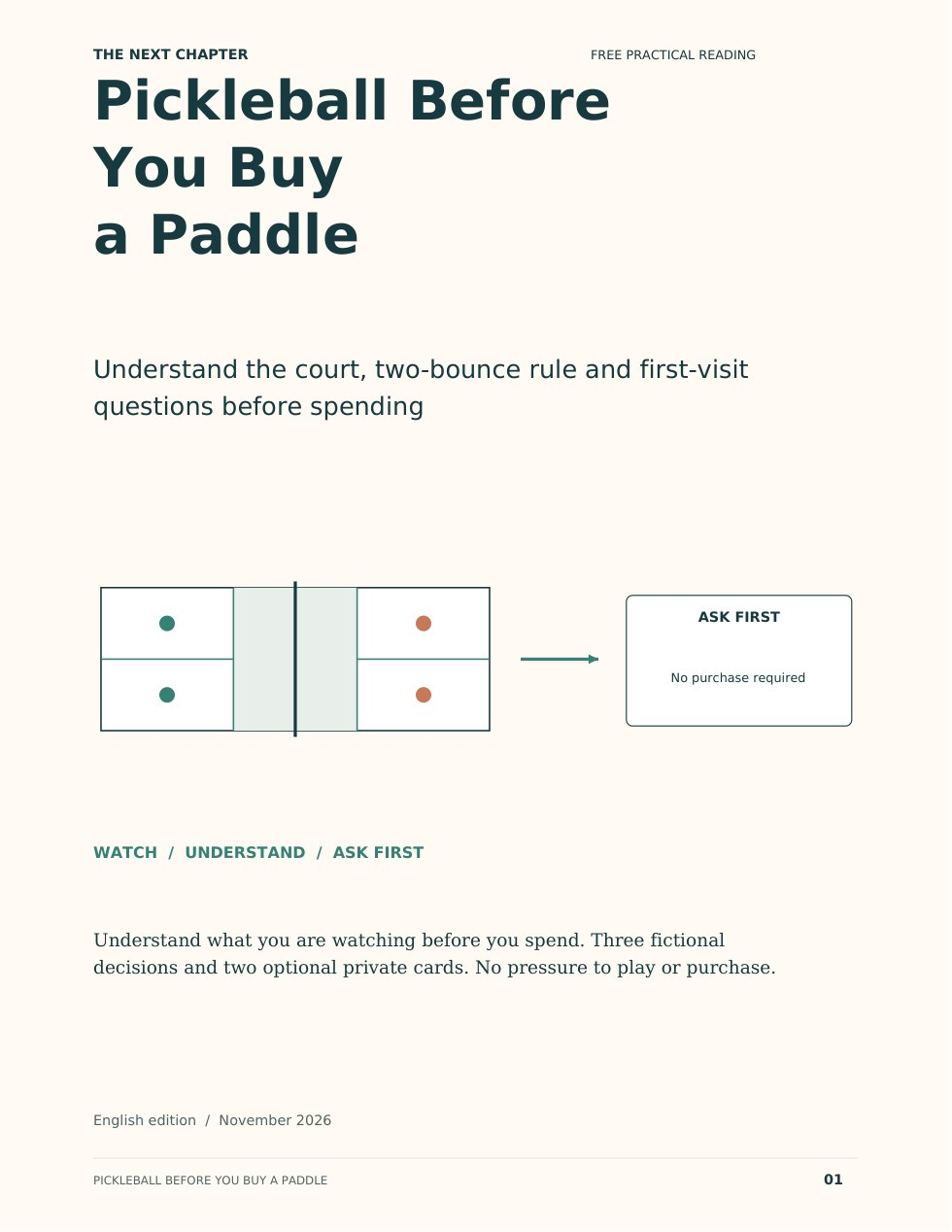
Understand the court, two-bounce rule and first-visit questions before spending
Start by watching the court, not shopping for a paddle
Pickleball can look immediately inviting. A bright ball travels back and forth across a net, and people often play in pairs. Someone nearby may say that it is easy to learn or that everyone in the neighborhood has started. Yet the first useful question is not which paddle to buy. It is whether the particular game and local experience appeal to you.
A court may hold beginners learning the rules, experienced doubles players enjoying competitive rallies, or a structured session with a coach. The basic game is recognizable across those settings; the atmosphere and demands are not identical. A promotional picture cannot tell you whether the session fits your interests or circumstances.
This reading introduces the court, equipment, a few foundational rules and what to ask before an observation or trial. It is not a personal exercise prescription, and it does not certify that pickleball is appropriate for any individual's health. You can finish the entire guide without playing, purchasing, booking or sharing private information.
A small court with distinctive equipment
At a glance, pickleball combines some visual features of racket and net games. Players use a solid paddle and a lightweight perforated ball. They exchange shots across a net on a marked court. The game can be played as singles, with one person on each side, or doubles, with two partners per side. USA Pickleball explains both formats and notes that doubles is common.
For a first visit, this vocabulary may be all you need: paddle is the striking equipment, ball is the perforated plastic ball, court is the marked area, and net divides the two sides. You need not memorize equipment specifications before you know whether you like the sport. An organizer can tell you whether they lend beginner equipment.
Court size and markings are standardized for formal play, but a local introductory demonstration may use teaching arrangements or temporary lines. If the configuration looks unusual, ask whether you are watching formal gameplay, a basic lesson or an adapted session. Do not assume a makeshift court follows every competition requirement.
The first shape of a rally
The rules are easier to understand when you watch one complete exchange. A serve starts the point and travels diagonally to the opposite service area. The receiver lets that served ball bounce before returning it. Then the serving side lets the returned ball bounce before playing it. Only after these two required bounces can either side choose to hit the ball before a bounce, which is called a volley. This is the familiar two-bounce rule in USA Pickleball's official beginner summary.
A spectator might mistake the first two bounces for tentative play. They are actually part of the game. Watch for a player who waits rather than charging forward immediately after a serve. A brief explanation from an instructor can make the rhythm clearer than a paragraph of technical terms.
The rule does not promise that all rallies are slow or that a doubles game is automatically suitable for everyone. The pace can vary widely with players and format. Personal medical or physical questions should be addressed with an appropriately qualified professional rather than inferred from a general description of the rules.
The kitchen is not a forbidden room
Near the net, pickleball has a marked area on each side called the non-volley zone. You will hear many players call it the kitchen. USA Pickleball specifies that the zone extends seven feet from the net on each side. This is a rule-defined zone, not a place where players can never stand.
The essential distinction is between striking a ball after it bounces and striking it before a bounce. A person can enter the non-volley zone to play a ball that has bounced. What they cannot legally do is volley the ball while touching that zone or its line, including when momentum carries them into it after the volley. Observing a few points may help you recognize why people stop short of the line.
You do not need to practice movements to learn that concept. If you attend a genuine beginner session, follow the instructor's demonstrations and local safety instructions. Formal rule wording matters for organized play, and the official 2026 rulebook should be consulted if a disputed detail becomes important.
Serving is a way to begin, not a performance audition
In standard play, a serve begins from behind the baseline and is directed diagonally across the court into the receiving service area. USA Pickleball describes conventional volley serves and a drop-serve option in its official materials. Rules apply to how the serve is delivered, but a novice does not need to become a technical expert before observing a game.
Watching a service exchange tells you about the order of play and how a rally begins. The serve must travel to the proper area, and a ball that lands in the non-volley zone on a serve is not a good serve. After a legal serve and return, the two-bounce rule shapes the first moments of the rally.
When considering a local lesson, ask whether the instructor explains serving to people who have never held a paddle. Do not interpret this article as personalized technique coaching or permission to perform a movement despite pain or a health concern. A real instructor should teach within their qualifications, and medical uncertainties belong with appropriately qualified professionals.
Singles, doubles, and the atmosphere around them
Two people playing singles and four people playing doubles are playing the same sport but may have very different experiences. Doubles includes teamwork, communication and sharing court coverage. Singles places all the exchanges on one participant per side. Neither format has a universal difficulty rating for every person; how a session feels depends on the actual level of play, instruction and individual circumstances.
Ask what the organizer offers. Is a beginner introduced through doubles? Are partners assigned? Can friends register together? Are games rotated so a visitor can watch before deciding? Is attendance competitive, casual, instructional or something else? If you dislike the idea of being placed with strangers without an introduction, that preference deserves respect.
You may decide that watching doubles is appealing but playing in a group is not. You might enjoy a practice demonstration more than a match. A venue that advertises “social pickleball” still needs to explain what social means in that particular session. It is an experience to investigate, not a promise of automatic belonging.
How do points work?
Scorekeeping can sound mysterious if you arrive in the middle of a doubles game and hear three numbers shouted before each serve. In standard side-out scoring, the server's team can win a point while serving; an exchange won by the receiving side changes the opportunity to serve but does not award that side a point. For doubles, the familiar three-part call is the serving team's score, the receiving team's score and the server number.
USA Pickleball's beginner materials describe this traditional format and a common game target of 11 points with a two-point winning margin. You may encounter different scoring arrangements in events or instructional sessions. Ask which format a particular organizer uses rather than treating a brief summary as a universal rule for every activity.
If score calls distract you, watch without trying to record every point. A beginner class should be able to explain the local format. You can enjoy the game before understanding every nuance of who serves after a side-out. The point of this reading is recognition and informed choice, not referee certification.
What you can learn from ten minutes of observation
If an organizer confirms that a viewing visit is allowed, a short observation can answer several questions. Is there clear instruction for newcomers? Does the group rotate players kindly? Is the sound of ball contact comfortable for you? Are there places to sit and wait? Does the pace look attractive? Can you enter and exit through a suitable route?
These observations are personal impressions, not safety certifications or an assessment of anyone else's ability. A highly competitive game might be enjoyable to watch yet unlike the actual beginner class. An empty court is not proof that equipment, coaching or public access will be available later. Ask about the exact session you are considering.
Do not photograph participants or publish identifying details without consent. If the facility requires a visitor pass, supervision or other rules, follow them. The genuine result of observing might be “I am curious enough to ask about a lesson,” or it might be “I prefer watching from the side.” Both are valid endings.
Do not buy a paddle before answering key questions
An online retailer can offer many paddles, yet it cannot tell you what a specific beginner program provides. Before purchasing anything, ask the organizer whether they lend paddles and balls, whether special shoes or clothing are required, and whether observation or the first lesson is included in a trial fee. Also ask about cancellation and refund terms: if you reserve a session, can it be changed or cancelled?
Equipment costs are not interchangeable with program costs. A paddle you hope to buy later is not a mandatory expense if the group supplies loaners. Shoes may have venue-specific requirements even though equipment advertising does not mention them. The right model or specifications for organized competition can differ from what is practical for a first observation.
If you eventually decide to buy, check current equipment rules and your own needs rather than relying on a list of “best paddles for seniors.” This independent free reader does not endorse a brand, a product or a shop. Curiosity can remain cost-free while you gather information.
The booking page is not the whole outing
A sixty-minute lesson may require a journey, early arrival to find the facility, and a workable way home. Ask whether the visitor should arrive before the official session, whether changing space is available and whether equipment must be collected from staff. If transport is limited, make sure the trip works in both directions.
Consider a completely fictional outing: a person leaves home at 13:10, arrives at 13:30, attends an observation from 13:45 to 14:25, and returns home at 14:50. That is 100 minutes door-to-door, even though the observed activity lasts 40 minutes. The extra time may be convenient or inconvenient depending on the reader's other commitments. These are invented clock times, not real facility hours.
Do not assume that an inviting class advertisement guarantees accessible entry, reserved parking, a nearby bus or a safe return route. Ask the genuine organizer and verify current travel details through suitable official channels.
An honest budget includes the trip
In a fictional example, a single introductory visit costs USD 10, a required temporary equipment rental costs USD 3 and return transport costs USD 5. If all three are necessary, the illustrative total is USD 18, calculated as 10 + 3 + 5. This is not a quotation from any actual venue. If equipment is included, the example would change; a real visitor must check the genuine conditions.
Also ask whether a membership is required before attending. A drop-in fee can differ from a league or multiple-session package. If an organizer offers a trial for free, find out whether there is still a booking requirement, required clothing, insurance rule, attendance limit or transport cost. Identify what is truly mandatory and what is optional.
One way to avoid an unnecessary purchase is to make the first goal information rather than commitment. An enquiry that ends with a complete price list and no booking is productive. A price published on a website is not proof that you have paid it.
Accessibility and adapted formats are specific questions
People have different preferences and access needs, and neither age nor disability determines a universal answer about pickleball participation. USA Pickleball publishes wheelchair-specific rules and adaptations. That establishes that organized variants exist; it does not prove that a particular local club offers adapted equipment, accessible court access, trained instructors or a suitable program.
Ask the actual venue about step-free entry, court approach, washroom facilities, noise, seating, communication assistance and any relevant adapted instruction or equipment. If you need an individual medical or rehabilitation assessment about participation, consult appropriately qualified professionals rather than relying on a sports marketing claim.
Be wary of advertisements that imply a sport is automatically gentle for everyone or that doubles eliminates physical risk. Rules descriptions do not amount to personal suitability advice. A courteous group should be able to answer practical questions accurately, acknowledge uncertainty and direct you to a knowledgeable contact when necessary.
One email that asks the right things
If you have found a legitimate local organization, use its independently verified official website or contact details. A simple message could read: “Hello, I am interested in learning what a beginner pickleball session involves. Could you please tell me whether I may observe first; whether the session is instruction or competitive play; whether paddles and balls are provided; what the complete first-visit cost and cancellation conditions are; and which entrance and accessible facilities are available? I am asking for information only, not booking at this stage. Thank you.”
You may omit any question that is not relevant to you. There is no requirement to explain personal medical history or family responsibilities to the organizer. If the answers depend on a specific location, request written directions or accessible transport information from a verified source.
An enquiry is not a contract. Until you submit an actual registration and receive confirmation, do not treat a program as booked. Preserve that distinction in your notes even if a staff member sounds encouraging.
Case: Nora watches before deciding
Nora, a fictional retired school administrator, enjoys seeing team communication but is uncertain whether she would enjoy the sound and pace of a court session. A hypothetical club confirms that a public demonstration may be watched without a booking fee. She verifies a suitable route. In this invented case she actually visits, but only as an observer.
Nora leaves home at 13:10, arrives at 13:30, watches from 13:45 to 14:25, and returns by 14:50. Her total outing occupies 100 minutes, while the demonstration occupies 40 minutes. She pays a fictional USD 5 return fare and no court or equipment fee. She does not handle a paddle, register for lessons or join the club.
She likes the cooperation of doubles but wants to ask about a quieter introduction. That question remains open. Her result is one completed viewing visit and an informed preference, not a new recreational routine.
Case: Theo asks, but does not book
Theo, a fictional self-employed translator, likes learning games but has an irregular schedule. He telephones an imaginary recreation provider to ask whether a beginner group has consistent days and whether paddles can be borrowed. The provider describes a possible three-session package for USD 36 and a separately quoted mandatory once-only registration of USD 4. Whether additional travel costs apply is still unknown.
Theo spends 11 minutes on that information-only call. The quoted package plus registration would be USD 40 before any travel, if he eventually chose it. But he has not enrolled, traveled or paid anything; actual new cash expense is USD 0. He writes down two unresolved questions about dates and cancellation. The quoted figures do not represent a real program or a confirmed price.
His next action may be another enquiry later. He does not order equipment simply because a lesson was discussed. Keeping estimates separate from expenditures lets him decide with fewer invented assumptions.
Case: Yasmin declines the proposed format
Yasmin, a fictional adult returning to recreational games after many years, receives an invitation to join a competitive pickleball league. She likes the sport's general idea, but the invented league expects fixed attendance and replaces casual learning with ranked games. The organizer cannot offer a spectator visit within the dates she is considering.
Yasmin replies that she will not join that season. She thanks the person who invited her and suggests—without arranging—watching a community game on another occasion. She makes no registration, booking, travel or payment (USD 0). Her hypothetical future suggestion is not a plan that has actually happened.
The sport has not failed her; the proposed version was not appealing. She may want an introductory lesson elsewhere, but no such lesson is confirmed. Distinguishing a decline from a postponement or a booking prevents a good story from turning into inaccurate reporting.
What the rules cannot tell you
You now know enough terminology to follow the beginnings of a rally: paddle, serve, two bounces, the non-volley zone, doubles and a standard score call. Those concepts make watching less confusing. They cannot tell you whether a club is friendly, what fees are charged, whether a program has appropriate supervision or whether participating would suit your personal medical situation.
Formal rules are periodically revised, and local recreational sessions may use teaching adaptations. Refer to the current official USA Pickleball rules when a specific technical detail matters, and ask organizers to explain their session format. A sporting description that remains accurate for several years can still become outdated in the details of an annual rule revision.
Do not use the number of people on a court to estimate how strenuous a session will be for you. Do not infer accessibility from a photograph of someone else participating. The right information comes from the relevant source, with uncertainty left visible where no answer has yet been checked.
Optional private card: the first visit I might consider
You may copy the following fields into a private note, answer only one or leave them all empty. The website does not collect responses. The card is not medical clearance, a registration form or a promise to participate.
- What draws me in? The game, social format, curiosity or watching?
- What format? Beginners' demonstration, casual doubles, singles observation or league?
- Equipment question: What may be borrowed, and what is truly required?
- Access and travel: Which entrance, facilities and return route need confirmation?
- Complete price: Which fees are required, optional or still unknown?
- One enquiry: Who can answer the most important remaining question?
A filled card is useful only if it leaves facts in their correct status. “I am considering a viewing” is not “I visited.” “USD 10 advertised” is not “USD 10 paid.”
Optional private card: observation versus commitment
This card is optional and private, for a genuine observation or a conversation. No details about other players, addresses, medical history or private finances need to be entered. If you choose to visit, follow the facility's actual rules and instructions.
- What happened? A phone enquiry, a viewing visit, a trial or no action?
- What I noticed: A specific aspect of the game or setting, without identifying others.
- What was confirmed: Current format, equipment, access and costs, with sources.
- Time and money actually used: Include the full trip if one took place; keep quotes separate.
- What remains unknown: Another rule, lesson time, access detail or personal consideration?
- Decision today: Ask again, try once, watch again, or decline?
There is no “correct” card outcome. A reliable answer or a comfortable no may be more useful than an impulsive purchase.
A paddle can wait
The title asks you to consider pickleball before buying a paddle. That does not mean a purchase is eventually required. You might discover a club that lends equipment, a lesson with a format you like, or a public match you simply enjoy watching. You might also learn that your available time, budget, preferred atmosphere or access needs point elsewhere.
For a new reader, understanding the ball's first two bounces and the non-volley zone may make the sport less mysterious. Knowing whom to contact and which costs to verify may make a first outing more realistic. Neither knowledge nor curiosity creates an obligation.
Choose one honest next action, if any: ask a verified organizer whether observation is allowed, compare actual local trial conditions, discuss a personal clinical question with a qualified professional when needed, or decide not to participate. A sport can be part of a next chapter without becoming the next thing you must accomplish.
Sources and further reading (official references, rechecked 1 November 2026)
- USA Pickleball, Official Rulebook (2026): https://usapickleball.org/rules/
- USA Pickleball, Rules Summary for Beginners (2026): https://usapickleball.org/rules/summary/
- USA Pickleball, How to Play Pickleball: https://usapickleball.org/pickleball-skills/level-one/how-to-play-pickleball/