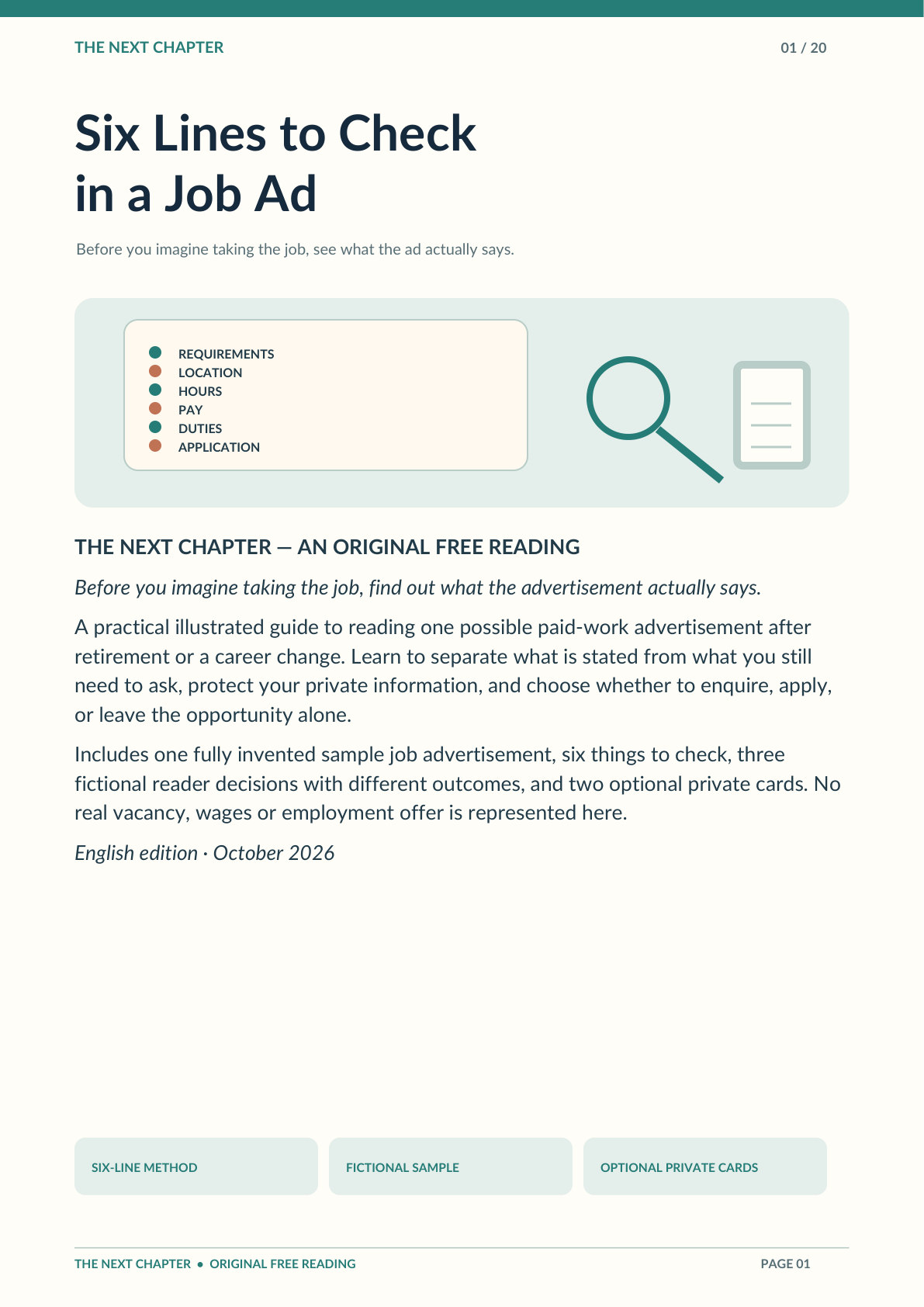
THE NEXT CHAPTER — AN ORIGINAL FREE READING
Before you imagine taking the job, find out what the advertisement actually says.
A practical illustrated guide to reading one possible paid-work advertisement after retirement or a career change. Learn to separate what is stated from what you still need to ask, protect your private information, and choose whether to enquire, apply, or leave the opportunity alone.
Includes one fully invented sample job advertisement, six things to check, three fictional reader decisions with different outcomes, and two optional private cards. No real vacancy, wages or employment offer is represented here.
English edition · October 2026
Look for six answers, not one attractive headline
AN ADVERTISEMENT IS AN INVITATION TO INVESTIGATE
A job advertisement is designed to attract attention. The title may sound appealing: Friendly team needs a part-time assistant. You may immediately imagine interesting work, a pleasant daily rhythm, or a chance to use experience you already possess. None of those hopes is wrong. But the headline is only the beginning of the information you need.
Before deciding whether the role belongs in your life, look for six answers: What qualifications or conditions are really required? Where would you actually work? When would you be expected to work? What compensation is specifically described? What would you do and be responsible for? Where would a genuine application go? If any answer is missing, mark it as unknown rather than filling the blank from imagination.
An advertisement is not an offer to you personally. A posted wage is not income you have received. A location named in a header does not prove that every shift occurs there. A phrase such as flexible schedule does not tell you who chooses the hours. A friendly image of staff at a table says nothing certain about training, closing duties, or the time needed to travel home.
You can read the advertisement carefully without disclosing your age, pension, health history, savings, previous income or family circumstances. Those details do not belong in a first private reading exercise. Later application rules, lawful recruitment practices, accommodations and privacy obligations vary by place and role; this short guide does not determine them.
A useful first reading has a modest finish: one statement about what is known, one question worth asking, and one voluntary next step. That might be an enquiry, an independently verified application, a decision to wait, or no action. A good result is information you can trust, not necessarily a job application.
Keep the advertisement separate from the actual arrangement
POSTED DOES NOT MEAN CONFIRMED OR ACCEPTED
A role can move through several stages. There may be an advertisement. You may ask a question. You may apply. An employer may invite you to speak. Eventually there might be a real offer with specific terms, which you may accept or decline. Nothing guarantees that the next stage will happen. The advertisement alone proves only that the text was displayed somewhere, not that every claim has been verified.
Make room for three labels when reading: STATED, UNKNOWN, and VERIFIED SEPARATELY. Stated means you can point to actual words in the ad. Unknown means those words do not answer your question, even if you could make a plausible guess. Verified separately means you have checked a claim through a trusted independent channel, such as the employer's official career page or a direct conversation with a verified representative.
Suppose a posting says, “Regular weekday hours.” Is that five days a week? Does it include opening shifts before 8 a.m.? Are weekends ever required? Does regular refer to a reliable schedule or merely a repeated request for availability? Without further detail, you know the employer used the word regular. You do not yet know your days or finish times.
Likewise, the word competitive before pay is not an amount. Training provided does not tell you how long the training takes, whether you are paid for it, or what the employer expects you to handle independently afterwards. You may ask, but do not write the imagined answer on your private card as if it were confirmed.
This distinction protects employers and applicants alike. You will ask more precise questions and be less likely to promise availability or competence you never intended to offer. It also keeps one company's advertisement from becoming a story about your entire future before you have established the basic facts.
First line: what is truly required?
SEPARATE ESSENTIAL CONDITIONS FROM A WISH LIST
Start by looking for an explicit description of the skills, qualifications, availability or licences the employer actually requires. Some advertisements distinguish must have from preferred or nice to have. Others place both in one long list. Before ruling yourself out—or declaring yourself fully qualified—find out what the language really says.
For example, “Must be able to use a basic scheduling program” is more specific than “digital skills preferred.” Yet even that does not identify the program or whether training is available. A reader who can use an email calendar may be comfortable with the general task but unfamiliar with the employer's software. That uncertainty can become a straightforward question: “Which scheduling system is used, and what orientation is provided?”
Beware of treating every adjective as a measurable rule. “Energetic,” “positive” and “team player” can describe aspirations without explaining the physical, cognitive or interpersonal demands of a shift. If a condition could meaningfully affect whether you want the job, ask for the actual tasks and the way they are performed. Do not infer inability from age or appearance; likewise, do not assume a workplace can meet a specific accessibility requirement without confirming the arrangement.
A posting may list a licence, professional registration, criminal-record check, language level or a right-to-work requirement. Rules differ across places, and some requests may involve sensitive personal information. Verify the employer and the actual stage at which documentation is legitimately needed. Do not send identification documents to an unknown address merely because the posting sounds official.
Your first-line outcome is not a personality judgment. Write a short factual note: “One required software task; training unspecified,” or “Two clearly listed qualifications; I have not checked how they apply.” The question is whether this opportunity's stated conditions can be evaluated, not whether your previous career makes you valuable in general.
Second line: where would you actually work?
THE PLACE NAME MAY NOT BE THE WHOLE LOCATION
Look for the full practical location of the work. An ad may name a town, describe a region, or call the role hybrid. Those terms do not tell you whether you will report to a specific building, cover several sites, attend training somewhere else or occasionally travel between venues.
An attractive position in the next town may still require a difficult journey at the advertised start time. Conversely, a workplace farther away may be easier to reach because the route is reliable or the hours suit your day. Distances printed in an ad are not a substitute for checking how you would genuinely get there and back. Route availability, traffic, weather, schedules, accessibility and operating hours change; never treat an invented journey in this guide as current travel information.
Ask about the actual report-to address, any other required work locations, expected travel during paid time, parking or transit considerations, and how early you must arrive. If you need a particular entrance, seating arrangement or accessible route, confirm that with the workplace through a trusted channel. A generic online accessibility label is not a personal guarantee.
For remote or hybrid work, the same principle applies. Is attendance at a central office mandatory once a week or only occasionally? Does training require travel? Are equipment and a secure workspace provided or expected from you? The word remote on an aggregator page is not proof that every aspect of the role can be performed from wherever you live.
You need not publish your home address in a message to an unverified recruiter to explore these basics. A private note such as “Advertises one site; Saturday location unknown” is enough until an official contact explains the arrangement. This guide is about choosing whether a role deserves more attention, not sending personal travel details to strangers.
Third line: when would you really be working?
HOURS, DAYS AND NOTICE ARE DIFFERENT THINGS
“Part-time” is a category, not a complete schedule. A person might work two predictable mornings, an uneven roster, occasional evenings, or shifts assigned at short notice. Find the days, start and finish times, expected hours in a week, how far ahead the schedule is published, and whether additional shifts can be required.
Read carefully for phrases such as up to, approximately, as needed, availability required, on call, weekend rotation and subject to operational needs. None is automatically unacceptable. Each can alter what the role would ask of your real week. “Up to 20 hours” does not promise 20 paid hours. “Flexible” might mean you choose shifts, or it might mean the employer varies them. Ask who has the practical decision-making power.
If the ad says a shift lasts from 9:00 to 13:00, that is four clock hours. It does not reveal whether a break is unpaid, whether you must arrive earlier, or whether there are preparation or closing duties outside the advertised period. Verify how paid time is defined in the real arrangement and what applicable rules require, rather than deducing your legal rights from this illustration.
A schedule that fits today may not fit your ongoing commitments. You may choose to protect time for family, friends, volunteering, care work or simply open afternoons. You do not need to provide your entire private calendar to decide whether you want a recurring shift. An enquiry might ask: “Are the Tuesday and Thursday hours fixed, and how much notice is normally given for additional Saturdays?”
Write three facts separately: regular hours stated, extra availability requested, and notice not yet verified. A good advertisement gives you enough information to formulate those questions. It does not require you to agree to work before you know the answers.
Fourth line: what does the pay statement actually mean?
AN ADVERTISED RATE IS NOT MONEY EARNED
Look for a clear amount, currency, unit and conditions: USD 19 per hour, for instance, is more informative than great earning potential. Even a printed rate needs context. Is it a base hourly rate, a range, a maximum, a temporary introductory figure or a number dependent on experience or extra duties? Is the worker an employee or is the opportunity presented as independent contracting? The legal significance differs by location and actual agreement, so do not settle it from the headline.
If a fictional advertisement offers USD 19 per hour for two four-hour shifts, then eight paid hours would produce USD 152 gross for that week if all eight hours were actually paid at that rate. This is only a multiplication example: 19 × 8 = 152. It says nothing about taxes, deductions, benefits, guaranteed shifts or what any real employer lawfully may pay.
Compare the number with the hours and conditions rather than admiring the rate in isolation. An ad might include a range whose top end requires a qualification you do not have, or promise overtime while not identifying when overtime would apply. It may say commission available without stating the base pay. Mark unknowns instead of converting possibilities into expected income.
Your personal time commitment is broader than paid hours. You may spend time preparing, travelling, waiting, or switching between locations. Those factors can affect your choice without changing the employer's advertised wage. If you later consider offers, use verified terms and your actual transportation expenses; do not describe hypothetical spending or future earnings as money already made or lost.
An especially important boundary is payment to a purported employer. Requests for an advance fee to secure an interview, an instant payment for equipment from an unknown contact or a deposit to hold a vacancy are warning signs. Stop and check independently through trusted official channels; do not assume a link supplied by the requester is genuine. Job fraud is a separate subject, but the application line should never override basic caution.
Fifth line: what would you do, and where does responsibility end?
THE TASK LIST IS MORE IMPORTANT THAN THE JOB TITLE
A title such as Welcome Desk Assistant sounds simple, but the work may include visitors, messages, scheduling, transactions, security procedures, lifting supplies or closing a space. Some duties may be routine; some may carry legal or practical responsibility. Read the verbs rather than drawing conclusions from the friendly title.
Highlight each concrete task the ad names. Does it say answer calls, greet visitors, update bookings, handle payments, supervise others, transport materials, open alone, or cover emergencies? If several duties are grouped under help as needed, ask what those words mean in an ordinary shift. “Other duties as assigned” is not a complete description of the role's boundaries.
Ask about the training and supervision needed for tasks you have not done before. “Who checks cash transactions?” “Will one person close the building alone?” “Who can I call if a visitor becomes upset?” These are ordinary work-design questions, not evidence that you lack initiative. A person with decades of experience may still sensibly ask them before taking a different role.
It is equally important not to invent hazards. A receptionist is not automatically required to carry heavy objects; a volunteer-sounding job title does not prove the absence of paid responsibilities; a public-facing role does not establish that the worker must manage every difficult situation alone. The point is to verify, not dramatize.
You may prefer a narrow role even if you could perform a broader one. You can say, “I am interested in the visitor welcome duties; could you tell me whether handling cash and independent closing are included?” The answer may make the opportunity more attractive, less attractive, or simply clearer. You do not owe an application because you asked.
Sixth line: where would a real application go?
VERIFY THE PATH BEFORE SHARING PRIVATE INFORMATION
An advertisement may appear on an employer's own website, in a community notice, through an employment service, or copied onto a general job platform. The location of the advertisement and the legitimate place to apply may be different. Before sending a résumé or clicking an unfamiliar form, verify the employer and the current opening through an independent route.
A sensible method is to open the organisation's official website without using a link from a suspicious message, then locate its careers page or known public contact details. If the ad does not appear there, you can ask through the independently established channel whether recruitment is active. A convincing design, employer logo or contact signature in a forwarded email is not itself proof of authenticity.
A real application can eventually require personal information, but this free guide does not collect it and does not tell you to send identity documents, banking credentials, passwords or account codes to an unknown party. Questions about lawful data collection or proof of work eligibility depend on the stage, role and jurisdiction. Verify those requirements with the genuine organisation or relevant official sources.
Note the actual application deadline, any required documents, the name of the official application channel, and whether the company acknowledges receipt. A message that says applications close tonight may create pressure, but urgency is not a substitute for independent verification. Do not pay anyone to guarantee a job or interview.
An important final distinction: submitting an application is not being hired. An email reply is not necessarily a contract. An online portal saying received proves only the application's reported status, not that the position exists on the terms you imagined. The reader's choice can remain at the enquiry stage, and that is a valid outcome.
The blank spaces are useful information
AN UNKNOWN IS AN ANSWER ABOUT THE AD, NOT THE JOB
People often treat missing details as an irritation to be ignored until an interview. But the blank spaces tell you exactly what you would need to verify before choosing. A job advertisement with a stated rate but no number of guaranteed hours is not equivalent to one with a fixed weekly schedule. A convenient address without details about evening closing does not tell you the whole return journey.
You can mark missing details with a question mark. Use short factual language: “Training duration unknown.” “Saturday duty mentioned but frequency unclear.” “The pay rate is stated; guaranteed paid hours are not.” “Application email unverified.” That is more useful than “seems fine,” because it shows what a follow-up must accomplish.
Not every unknown deserves a long investigation. Some details affect whether the role can fit your day; some are relevant only later. You might care most about finishing by 2 p.m. Someone else may care most about whether the job requires constant standing. Another reader may want to know whether they would supervise staff or have access to a quiet workspace. Choose a question because it could change your decision, not because every advertisement must supply a perfect encyclopedia.
If you already know that the job's confirmed schedule conflicts with a boundary you intend to keep, you may stop reading. There is no obligation to ask an employer to design a different role for you. On the other hand, if the ad says only some Saturdays, one short enquiry may be worthwhile before deciding.
Be careful with screenshots shared online. A screenshot can be cropped, outdated or altered. Prefer the original current notice or a direct verified employer statement, and note the date you checked. Even a legitimate advertisement may expire or be withdrawn. Your note describes the status at the time you saw it; it is not a guarantee the vacancy will be there tomorrow.
Meet one fully fictional advertisement
HARBOR HOUSE COMMUNITY STUDIO IS AN INVENTED EMPLOYER
Imagine a community studio called Harbor House Community Studio. The organisation, role, terms and all people in the following example are invented. There is no real address, application link or current vacancy behind the name. We will read one fabricated posting using the same six lines throughout the rest of this guide.
Fictional advertisement: Welcome Desk Assistant
Required: Comfortable with basic email and visitor scheduling; orientation offered, length unspecified.
Place: Harbor House Community Studio, at one fictional on-site location; additional locations not mentioned.
Hours: Tuesday and Thursday, 9:00 a.m.–1:00 p.m.; occasional Saturday assistance may be requested. Advance notice and whether extra shifts are mandatory are not stated.
Pay: USD 19 per paid hour. Breaks, deductions, extra-shift treatment and guaranteed total hours are not explained.
Duties: Welcome visitors, manage booking enquiries and answer routine messages; “other duties as needed.” Cash handling and closing responsibilities are not described.
Application: Through the studio's independently verifiable official careers route; the invented posting includes no working link or personal contact.
This is not a model legally compliant advertisement. Real postings have different formats, and some jurisdictions require more disclosure. The sample exists only to show how an adult can reason carefully about the words in front of them.
The imaginary ad gives useful starting facts without resolving every question. It contains two named recurring days, a specific nominal rate and three concrete duty types. It also leaves training, Saturday notice, paid-time definition and responsibility boundaries unclear. Our task is not to decide that the job is safe, legitimate, suitable or available. It is to identify what the text actually supplies and what a real applicant would need to ask.
Read the six lines without adding imaginary details
WHAT THE INVENTED AD SAYS; WHAT IT DOES NOT
1. Requirements. The ad names basic email and visitor scheduling. It promises orientation but gives no duration or content. You can write, “Basic scheduling stated; specific system and training unknown.” You cannot infer that the employer will teach every part of the role or that previous administrative experience is automatically accepted.
2. Location. The ad describes one on-site location. It contains no actual postal address in this fictional exercise. “One site described; real access and additional travel not checked” is an honest note. It would be a mistake to calculate a real bus journey or claim parking availability from an invented address.
3. Time. The two stated shifts are four clock hours each: 9:00 to 13:00 = 4 hours, and 2 × 4 = 8 clock hours in a typical fictional week. Whether all eight hours are paid and whether Saturday work is required remain unknown. Do not label eight hours guaranteed paid work from the posting alone.
4. Compensation. The nominal posted figure is USD 19 per paid hour. If eight hours are actually paid at that rate, the arithmetic is 19 × 8 = USD 152 gross for such a week. The ad does not establish real future income, deductions, local legal compliance or pay for orientation.
5. Duties. Greeting visitors, answering messages and booking enquiries are named. Cash handling, closing alone and what other duties means are not described. Those unanswered questions may affect the reader's willingness to apply.
6. Application. The imagined ad describes an official careers route but supplies no real one. For a real advertisement, locate the authentic organisation separately before providing personal details. The existence of these sample words is not proof of any active recruitment.
You can place all six observations on one small sheet. Notice how many strong conclusions we have not made: we did not call the position a perfect retirement job, promise USD 152 each week, certify it as accessible, or invent a manager's reassurance. That restraint is what makes the six-line method useful.
Fictional outcome one: a clear no after one answer
ALMA ASKED ABOUT SATURDAYS BEFORE APPLYING
Alma enjoys greeting people and is considering a small return to paid work. She reads the fictional Harbor House advertisement and likes the named Tuesday and Thursday shifts. The specific USD 19 nominal rate is useful information, but it is not the deciding issue for her. She has chosen to keep most weekends uncommitted.
Alma sees occasional Saturday assistance may be requested. Instead of treating that as optional, she imagines contacting the real employer through an independently located official channel. In the invented story, she asks one question: “Are Saturday shifts voluntary, and how much notice would a worker normally receive?”
In this fictional outcome, a verified studio representative responds: “The current arrangement requires one Saturday shift approximately each month; dates are usually issued three weeks ahead.” That reply is part of the imagined scenario, not an assertion about any real workplace or current employment practice.
Alma decides that even one required Saturday does not suit the time she wants to protect. She replies courteously that she will not apply. She has made one enquiry and one genuine decision not to apply. She has completed zero shifts, earned USD 0, and has no employment agreement or job offer. A friend might say she “turned down USD 152 a week,” but that would be misleading: she did not receive an offer of paid work, and the amount was only contingent multiplication from an imaginary ad.
The exercise succeeds because one unclear word became one verified condition that affected the decision. Alma did not need to justify her life priorities to the employer. She also did not conclude that the job was bad for everyone. Someone else might welcome an occasional Saturday; the same factual reply could lead another adult to a different answer.
Fictional outcome two: an application, not a job offer
BEN CHECKED RESPONSIBILITIES BEFORE SENDING ANYTHING
Ben previously worked in an office and enjoys helping visitors find information. He is interested in the fictional Harbor House schedule, but the phrase other duties as needed catches his eye. His past experience does not tell him whether this particular welcome desk handles cash or whether he would be responsible for closing alone.
He first checks the studio's identity through a route he establishes independently in the invented story. Then he asks: “Does the welcome desk assistant handle money or close the building alone, and what training would be provided?” In the fictional reply, the studio says cash is handled by a separate staff member, closing requires two workers together, and new assistants receive two scheduled orientation sessions. Those invented answers belong only to this example.
Ben concludes that the described duties are worth exploring. He submits an application through what the story treats as the verified official careers process. No résumé, identity document, reference, personal contact information or account credentials are reproduced in this guide. His application is not represented as an interview invitation or an offer.
At the end of the story, one enquiry occurred, one application was submitted, zero shifts were worked, and USD 0 was earned. Ben does not count the theoretical USD 152 week as money he has obtained. Even if an employer later contacted him, an interview would not automatically establish the final pay, duties or schedule. A real offer would require its own consideration.
Ben's outcome illustrates that asking about responsibility is not the same as being afraid of work. It is a way to decide whether an advertised task matches what you actually want to take on. He may eventually accept a role, receive a rejection, change his mind or hear nothing. None of those later possibilities has happened in this fictional case.
Fictional outcome three: leave an unanswered question unanswered
CORA DID NOT CONVERT AN ESTIMATE INTO A FACT
Cora likes the idea of part-time community work and reads the same invented Harbor House posting. Two daytime shifts sound reasonable to her. But she would depend on public transport, and the ad does not say whether the occasional Saturday work finishes at the same time or in the same place.
In the invented example, Cora imagines a weekday round-trip journey of 25 minutes each direction. That would be 50 minutes of travel per day, or 100 minutes across two days, if the same route and conditions actually applied. None of this is current transit information. It is not a cost or journey she has already experienced for this role.
Cora cannot verify a suitable Saturday return trip from the hypothetical information available. She also has no confirmed answer about whether Saturday work is required. Rather than assuming that someone could give her a ride or that the timetable must be identical, she makes a private note: “Weekday travel looks possible; Saturday return and additional duties unknown.”
Cora chooses not to apply at this stage. She has not contacted the studio, booked a journey, paid a fare, attended an interview, or been offered work. Actual application count: zero. Actual paid shifts: zero. Actual earned income: USD 0. Her possible travel time remains an example, not an observed route. If this were a real position, she could check current schedules and the authentic workplace before making any commitment.
The choice is useful without being dramatic. Cora might revisit the same ad if accurate information appears later. She might decide another workplace is a better match. She might simply prefer not to work again. The six-line habit helps her identify a decisive gap rather than pretending every appealing posting demands immediate action.
Three honest outcomes from one advertisement
THE NEXT STEP IS NOT THE SAME FOR EVERY READER
Alma, Ben and Cora read the same wholly fictional notice. They did not have identical priorities or information. Their outcomes are different, but none has been hired, started a paid shift or earned money. Compare exactly what happened rather than declaring three successful applications.
| Reader | What mattered | What was actually checked or done | Decision at the end | Earned from this role | |---|---|---|---|---:| | Alma | Weekend predictability | One fictional official enquiry clarified a required Saturday each month | Declined before applying; no shifts | USD 0 | | Ben | Responsibility and supervision | One fictional official enquiry answered cash and closing questions; one application submitted | Application pending; no offer or shifts | USD 0 | | Cora | Practical travel and unknown Saturday return | One invented weekday journey considered; no official enquiry, trip or application | Deferred; no agreement or shifts | USD 0 |
All three also saw the same theoretical calculation: USD 19 × 8 hours = USD 152 gross if eight hours were actually paid. That is not their income. Alma declined, Ben merely applied, and Cora deferred; no one earned the hypothetical weekly amount. Likewise, Cora's imagined 100 minutes of two-day commuting was not time already spent working for the studio.
The table illustrates why small verbs matter. Read is not verified. Asked is not accepted. Applied is not hired. Declined is not lost wages. Accurate wording makes it easier to compare what you can know now with what you still would need to learn from an actual organisation.
You can use the same distinction for any job ad, not only a studio welcome desk. One reader may apply, another may seek clarification, and another may decide not to pursue that role. None of those choices proves or disproves a person's worth, willingness to contribute, or ability to enjoy the next chapter of life.
Your one-pass reading in about ten minutes
ONE AD, SIX LINES, ONE NEXT QUESTION
You do not need to investigate every possible job before making sense of a single advertisement. Start with one posting that you could genuinely imagine considering. Keep the reading bounded. If it is an online ad, save its visible title and the date of your check privately without collecting somebody else's contact details or sensitive information in a public file.
First, scan the six lines. Underline any real condition stated under requirements, location, schedule, pay, duties and application route. If the ad has no clear statement in a category, write not stated. Treat a label such as flexible as a question until someone verifies what it means in practice.
Second, choose the unknown that could change your decision. It might be required Saturdays, whether travel to another site is necessary, whether the advertised hours are truly guaranteed, whether you would close a building alone, or whether a supposed recruiter actually belongs to the employer. You do not need an interview to decide which question matters to you.
Third, verify the route before sending information. For a real opening, locate the official company channel independently. You can make a cautious enquiry without authorising a booking, providing bank details or pretending the job was promised to you. Do not follow an unverified payment instruction or send identity documents to an unknown correspondent.
Fourth, name the next step accurately. “I will ask one question.” “I will consider applying if the reply fits.” “I am not interested in a shift requiring Saturdays.” “I will stop because the organisation cannot be verified.” Those are complete outcomes of the reading exercise, even without a completed application.
Finally, remember that a real advertisement can change or disappear. Before making an actual employment decision, confirm current terms, official procedures and local legal requirements with suitable authorised sources. This guide improves your first reading; it is not a job offer, a legal opinion or a substitute for a genuine written arrangement.
Optional private card: the six lines in this ad
FILL ONLY IF IT HELPS YOU THINK
Use this card on paper or privately in a compatible final PDF reader. It is for your own thinking, not an application form or a data collection service. Do not enter identification numbers, passwords, bank details, confidential references, medical history or anyone else's personal information. Leave it blank if you prefer.
1. Required conditions: Which qualification, skill or attendance condition is actually stated?
Private notes: ___________________________________________
2. Work location: Which site or travel expectation is named, and what is unknown?
Private notes: ___________________________________________
3. Time commitment: Which days, shifts, total hours or call-in terms are printed?
Private notes: ___________________________________________
4. Pay wording: What amount, currency, unit and condition does the ad actually state?
Private notes: ___________________________________________
5. Duties and boundaries: Which actual tasks are named, and which responsibilities remain unclear?
Private notes: ___________________________________________
6. Application route: Which official pathway must I verify independently before sharing details?
Private notes: ___________________________________________
You can stop with six incomplete answers. An empty space means the advertisement has not answered that question, not that you have failed to understand it. Never convert a guessed answer into a verified one merely to fill the form.
Optional private card: one verified next step
SEPARATE QUESTIONS, RESPONSES AND ACTUAL OUTCOMES
The second card is optional and private. It helps you remember the difference between information you noticed, a question you asked, and something that actually happened. This is not a hiring log, legal employment record or instruction to upload personal information anywhere. Avoid keeping other people's private messages on a shared document.
1. My single important unknown: What detail could actually change my interest in this role?
Private notes: ___________________________________________
2. The independently verified route: How did I establish a trustworthy official channel, if I did?
Private notes: ___________________________________________
3. The factual response: What did the verified employer actually confirm, not merely suggest?
Private notes: ___________________________________________
4. My own chosen boundary: Which schedule, location, pay or responsibility condition matters to me?
Private notes: ___________________________________________
5. My current choice: Enquire, consider applying, apply, defer or decline—which one actually happened?
Private notes: ___________________________________________
6. Outcome and next check: Was anything submitted, offered, accepted or worked, or is the matter still open?
Private notes: ___________________________________________
An honest record can end with “No contact made, no application submitted.” An equally honest record may say “Application sent; no offer received.” Neither statement needs an account password or a private financial explanation. You are free to stop using these cards at any point.
You are choosing a possibility, not proving your value
READING WELL IS A COMPLETE SMALL ACHIEVEMENT
After retirement or a career change, it can be tempting to read every advertisement as a test. You may feel you should apply because you have the skills, or hesitate because some of the phrases are unfamiliar. But an advertisement is a description of a possible arrangement written by someone else. It is not a verdict on your capacity, your contribution to the community, or how you ought to spend the years ahead.
The six-line method creates room for an adult choice. You can admire a role's purpose while declining the schedule. You can see an attractive hourly rate without imagining it is guaranteed income. You can recognise work you would probably enjoy and still ask who handles closing, difficult visitors or extra shifts. You can leave an application page unopened until you verify that the employer is real.
Remember the fictional Harbor House example. Alma asked one question and decided no. Ben asked a different question and applied, but was not hired. Cora noticed a travel uncertainty and waited. All three earned USD 0 from the proposed role, and none has a completed employment agreement in the story. Their decisions differ because their questions and preferences differ. The guide does not rank them.
A genuinely useful advertisement may answer all six lines. Another may require a short verified enquiry. A poorly described or suspicious advertisement may be one you simply leave. You do not have to supply private financial details or complete a worksheet to make a sensible first judgment.
This is educational guidance, not individual legal, employment, tax, financial or professional recruitment advice. Actual vacancy status, permissible screening, accommodations, labour standards, contractual terms and pay requirements differ by location and date. Verify a real employer's current official information and consult appropriate authorities or qualified advisers where needed. No hiring, wage, interview or savings outcome is guaranteed.
The next time a headline says friendly part-time work, look beneath the headline. Find six lines. Mark what is known. Choose one honest question, or choose not to ask. The decision belongs to you before an application belongs to anyone else.