THE NEXT CHAPTER — AN ORIGINAL FREE READING
The visible chore is only part of the work. A clearer offer can respect both people.
A short, practical guide to noticing the planning behind one shared household task, talking about it without assigning blame, and deciding what a genuinely complete one-time offer would look like.
Three entirely fictional outcomes: an agreed task carried through, an enquiry without an agreement, and a respectful decline. Two optional private cards. No purchase, registration, disclosure of family details, or completion of worksheets is required.
English edition · October 2026
“I can help” is generous, but what does it mean?
SEE THE WORK, NOT JUST THE PERSON HOLDING THE BASKET
A cupboard is nearly out of soap. One person notices, remembers that the household needs more, checks whether there is an unopened bottle somewhere else, adds soap to the list, buys it, and puts it away. Another person carries the bag inside. Both have done something useful. But it would be inaccurate to say that the second person has now taken over the whole responsibility for keeping soap in the house.
In many homes, “Can I help?” is an ordinary, kind phrase. There is no reason to ban it. The difficulty begins when two people hear different meanings. The speaker may mean, “Give me an action and I will do it.” The listener may hope, “Please take responsibility for making sure this does not get forgotten.” Neither expectation is obvious from the words alone.
A useful alternative is to say which part you mean. “I can carry today's groceries” is clear. “I can take responsibility for checking and replacing our soap this week, including remembering when to buy it” is a different and more complete offer. One is not morally superior in every situation. The second simply removes more of the need for another person to manage the work.
This guide does not tell a household what a fair division should be. People may be employed, retired, disabled, caring for others, sharing a home as friends, or living with different available time and resources. The starting point is one specific task and a conversation both adults can freely join.
Every small chore has a before and an after
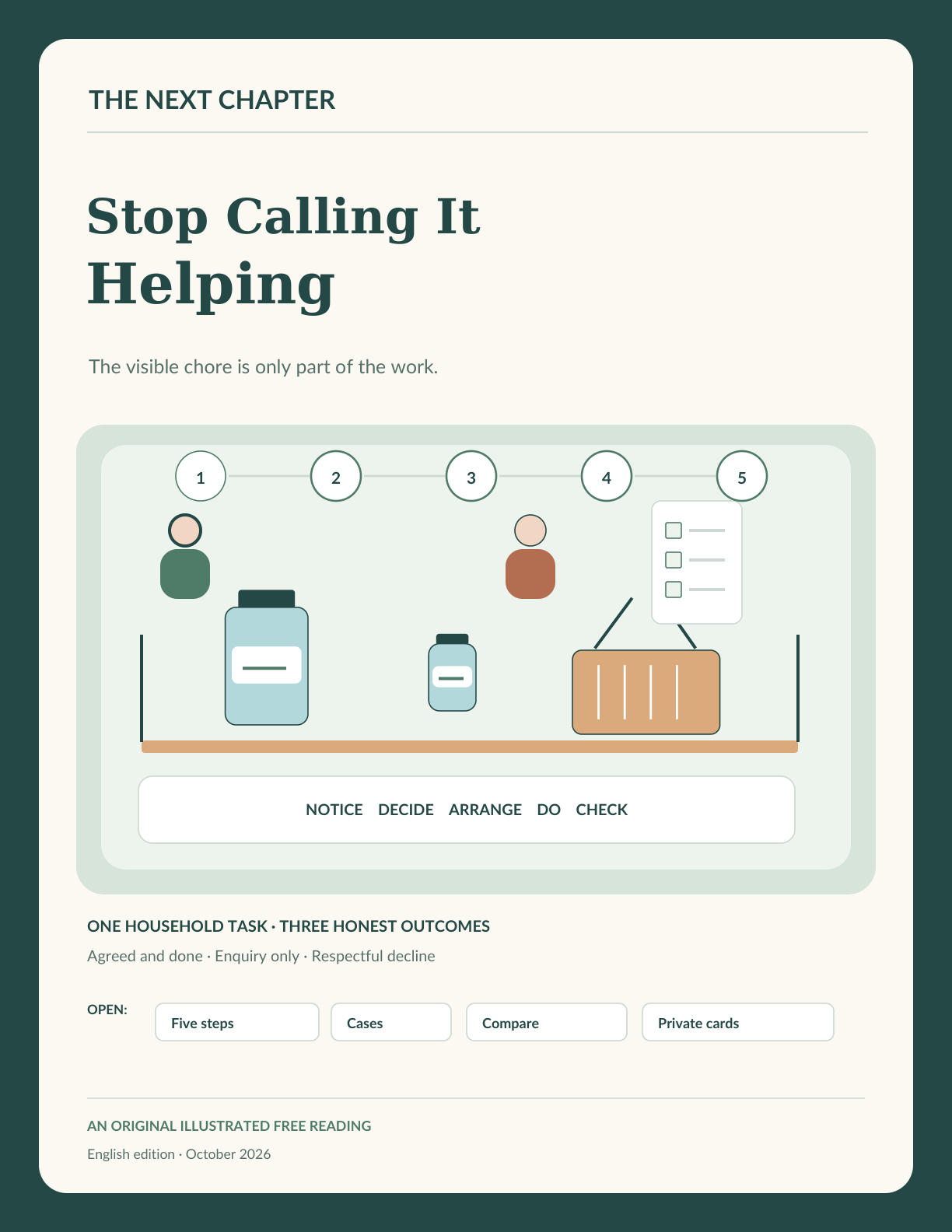
NOTICE · DECIDE · ARRANGE · DO · CHECK
A task may look like a single action because only the action is visible. A bin is carried to the curb. A meal appears on the table. A family birthday is remembered. Yet the work can begin earlier and finish later. To describe that work more accurately, try five plain verbs: notice, decide, arrange, do, and check.
Notice: Someone sees that rubbish collection is tomorrow, or notices an essential item running low. Decide: Someone works out what needs to happen, using the household's real preferences and constraints. Arrange: Someone finds a time, a list, a suitable product, or the relevant information. Do: The visible action takes place. Check: Someone confirms the item was put away, the bin came back in, or the request was actually completed.
This is not a universal five-step law. Some activities need only two steps. Others require safeguards, professional support, or agreed spending authority. The sequence is a conversation aid, not an audit of a partner. A person may reasonably take on some stages and not others. The important thing is that the other stages do not disappear merely because nobody mentions them.
Try saying, “When we talk about this job, are we talking only about doing the last step or about keeping track of the whole thing?” Ask rather than accuse. The question makes room for a practical answer even when memories of who did what are different.
Why “just tell me what to do” can create another job
INSTRUCTIONS ALSO TAKE ATTENTION
Imagine that you know when the recycling is collected, which containers go out, where the bins are stored, and what happens if collection changes for a holiday. Another person says, “I am happy to take the recycling out. Just remind me.” This can be a perfectly welcome arrangement—especially if remembering dates is easier for one person than moving bins. But the offer does not remove the remembering from your list.
The reminder itself is work. Someone must carry the deadline in mind and interrupt another activity to pass it on. If an item was forgotten, someone may need to notice and repair the omission. When the reminder stays permanently with the same person, the visible task changes hands but part of the responsibility does not.
An alternative is to ask, “Would you prefer to keep sending reminders, or would it help if I checked the collection day myself?” The other person can say yes, no, or “not this time.” They may already have an efficient way of doing it. They might want the responsibility to stay together, or they might be glad to hand over the remembering. An offer is not permission to take control unilaterally.
Avoid turning this into a contest about who works hardest. Different people have different capacities and histories. Sometimes a reminder is a sensible accommodation or a freely chosen division. The aim is to make the arrangement explicit, not to label one person the household manager and another the household problem.
Begin with one task, not the entire household
A SMALL CONVERSATION IS EASIER TO FINISH
When someone realizes how much goes into planning everyday life, the temptation is to list every overlooked task: meals, appointments, repairs, family messages, prescriptions, bills, and cleaning. That can become a serious and exhausting conversation before anybody has agreed on one practical next step. For this free exercise, choose only one ordinary, low-risk household task.
A useful starting task is replacing shared soap or paper towels, preparing one uncomplicated meal, or handling the next bin collection. Avoid choosing an urgent safety matter, a medical need, a legal deadline, financial account access, childcare supervision, or another activity requiring special qualifications. Those decisions deserve their own careful arrangements, not a casual experiment.
Write the task in one sentence: “The bathroom soap should be checked and replenished once this week.” That is better than “manage the whole bathroom” because the ending is visible. Next ask which pieces are usually invisible. Perhaps someone needs to check the shelf before shopping; perhaps the household has a preferred product or a spending limit. Knowing those details is not a reason to take over. It is a reason to ask what would make an offer genuinely useful.
If both people want a larger household review later, that is another project. You do not need a scorecard, an argument about the past decade, or an agreement about every domestic role to improve one small exchange today.
Agree on what counts as finished
THE DEFINITION MATTERS MORE THAN THE LABEL
“Take care of the shopping” can mean at least four different things: carry the bags, buy items from a list, decide what is needed and buy it, or oversee an entire household's meals and supplies. These are not interchangeable. A person might sincerely agree to the first while another expects the third. Each later wonders why the other seems dissatisfied.
Choose a sentence with a real finish line. For example: “For this one restocking, I will check the bathroom supplies, add the needed items to our usual grocery list, buy only what we agree is appropriate, and put them away.” It gives the task a beginning and an end, while still allowing discussion if the price or product is uncertain.
There is an equally valid limited offer: “I cannot decide which items to buy this week, but I can pick up the agreed supplies when I go to the shop.” That is useful without pretending the responsibility has been fully transferred. Another person might offer to sort receipts without becoming responsible for paying the bills. Name the slice accurately.
Do not assign a task without permission, and do not treat a one-time trial as a standing weekly commitment. Some households share decisions; others divide them. The goal is that people can tell what was requested, what was offered, and what each person actually accepted. Finishing one clear task often teaches more than signing up for an indefinite role neither person fully understands.
Ask about the workload without making a verdict
CURIOUS QUESTIONS OPEN MORE DOORS THAN A CHARGE SHEET
You can begin at an ordinary moment, when neither person is rushing to leave and the task is not already in crisis. “I realized there is more to this than doing the visible part. Could we talk for a few minutes about what goes into keeping the supplies stocked?” is a different opening from “You never do your share.” The first names something observable and invites another person's view.
One person might reply that the task has never felt difficult. Another might say it takes more thought than the action suggests. Both reports can be true within their own experience. You can ask, “Which part takes the most remembering?” and “Which part could I realistically do without needing another reminder?” A little curiosity is often more useful than an argument about whether a five-minute action should count as a whole chore.
If it is hard to find a neutral moment, you may write a private note and return to the topic later. Do not send a long inventory of complaints and call it an invitation to collaborate. And do not demand that another adult share their personal health, emotional history, or financial details to justify their preferences. A practical task can be discussed in terms of access and willingness.
Some households cannot discuss responsibility safely or respectfully. If raising the topic risks intimidation, retaliation, or harm, this exercise is not an instruction to confront someone. Your safety and autonomy take precedence; seek trusted local support appropriate to the situation. This guide is about ordinary voluntary coordination, not managing coercion or abuse.
Make an offer the other person can understand
ONE ACTION, ONE CYCLE, OR AN ENQUIRY
An offer can be helpful at several levels. One action: “I can carry the groceries inside after you shop.” One cycle: “I can check and replace the bathroom soap this week, from noticing the need to putting it away.” One enquiry: “I am interested in taking this on, but I need to understand the usual process and the spending limit before I decide.” The third is not a commitment yet.
Say what is included and what is not. If the offer covers only this Friday, name Friday. If it requires the household shopping account or transport you do not have, do not imply those are already available. If the other person has preferences about fragrance, size, storage, or budget, ask. Do not make a permanent decision for them under the banner of relieving their burden.
The person receiving the offer remains free to respond. “Thank you, but I prefer to handle the product choice” may be sincere. So may “Yes, please take care of the whole restocking this week.” A polite decline does not erase your willingness, and an accepted offer does not establish a standing obligation beyond its scope.
You can also ask for a short pause: “Would you tell me how you currently do it? I will think about what I can responsibly offer.” That answer respects both people better than saying yes and hoping the details will somehow arrange themselves.
Ability and availability are not character tests
NEITHER PERSON HAS TO EXPLAIN EVERYTHING
A retired person is not automatically free for every weekday appointment. A partner who still works may have responsibilities outside paid employment. A person with pain, fatigue, a disability, limited transport, or an unpredictable schedule may be able to do one part of a chore but not another. None of these facts allows the reader to infer what somebody else should be able to take on.
Ask about the relevant practical limit: “Would this fit before your Tuesday commitment?” or “Could we choose a task that does not require carrying a heavy bag?” A person can give a boundary without revealing a diagnosis. The same courtesy applies to money. “I can cover up to the amount we agreed for these supplies” is a workable boundary. “Tell me the state of your finances or I will not help” is not.
Some people enjoy being the one who keeps track of family dates or supplies. Others would like to stop holding that invisible list. The right arrangement is not determined by a general rule about who is organised or who is better at technology. It is built from the real household's consent, available resources, and definitions of done.
If an arrangement changes, name the change. A one-week responsibility may need to be returned, shared, or replaced. Someone who makes an honest limit visible is not making a promise to compensate for it by taking on a different, unwanted task.
Who remembers? Who follows through?
THE LAST CHECK CAN BE THE FORGOTTEN PART
A chore may be technically done but practically unfinished. Someone bought a replacement bulb but left it unopened on the hall table. Someone took out a bin but did not bring it back. Someone offered to make a call but never confirmed whether it happened. There is no need for surveillance; a small completion message may be enough to keep another person from wondering whether they must step in.
Try a simple ending: “I checked the supplies, bought the agreed items, and put them on the bathroom shelf.” That is a statement about action, not a request for praise. If something remains unresolved, say so: “The shop was out of the product you prefer. I did not buy a substitute, and I have not completed this yet. Shall we choose another option?” Reporting an obstacle is more respectful than silently changing somebody else's preference.
Who remembers the next occurrence? If the commitment was one-time, the answer may be nobody has agreed to take the next cycle yet. That is important. If an adult wants to repeat the arrangement, discuss it afresh or agree on a suitable reminder both can use. An automatic calendar alert is a tool, not proof of consent.
Do not make the person who gave up the task responsible for repeatedly checking that you remembered it; that can quietly reconstruct the original mental burden. A useful arrangement makes the finishing point and the status visible without turning household life into an inspection regime.
Decide in advance what to do when something changes
TAKING RESPONSIBILITY DOES NOT MEAN MAKING EVERY DECISION ALONE
Suppose the brand of soap the household uses is unavailable. You could buy another product without asking, leave empty-handed, or check what alternative is acceptable. If somebody has a fragrance sensitivity or a strong preference, improvising may create more work. A good handover includes a small rule for surprises: “If our usual item is not available, I will ask before substituting.”
Cost is another ordinary exception. The price on a shelf may be different from last month's price. A task owner should know whether there is an agreed limit or whether the purchase needs another decision. Do not assume access to a joint account, passwords, cards, or a particular person's money. If payment authority is unclear, stop at an enquiry. Keep a record of what really happened rather than suggesting that an expected purchase was already made.
Sometimes the exception is time rather than money. The task owner gets called away or discovers that the shop has shortened its hours. A brief message—“I cannot finish this today; can we agree on another date or another person?”—allows a new voluntary decision. The original household member does not silently become the default backup for everything.
The aim is not to anticipate every possible mishap. It is to give the two adults a sensible way to communicate one obstacle without presuming permission, transferring pressure, or making a small errand feel like an emergency.
Keep three different facts apart
REQUESTED IS NOT AGREED; AGREED IS NOT DONE
Household conversations often become confusing because a proposed plan is remembered as a promise, or a promise is remembered as an action. Three labels can prevent that confusion. Requested: somebody asked for a task to be done. Agreed: the adults decided on the actual scope and who will do it. Done: the work that was accepted has genuinely been completed, including the agreed final step.
For example, “Would you handle the next restocking?” is a request. “Yes, I will check the supplies and replace the two agreed items on Friday” is an agreement. “On Friday, I checked, purchased, and put away the items” is a statement of completion. If Friday has not arrived, completion must not be inferred. If one item was unavailable and no substitute was agreed, there may be partial completion plus an open decision.
A fourth label can be useful: enquiry only. “What would taking this on involve?” is not a yes. It is a responsible question. Another valid result is declined. An adult can decide not to accept an ongoing or one-time responsibility without having to invent an alternative task or disclose personal reasons.
The three fictional situations that follow show why this accuracy matters. They are illustrations, not interviews with real households or evidence about what most couples do. Their times and cash figures were invented to make the distinction concrete. No reader should assume they describe actual local retail prices or a recommended household standard.
Fictional case: Mira and Alex complete one cycle
A CLEAR YES, A REAL RESULT
Mira and Alex share an apartment. Mira usually notices when basic supplies are running low and makes the shopping list. Alex often carries bags, but has not previously tracked the supplies. During an ordinary conversation, Alex says, “I can take care of replenishing the bathroom soap and paper towels this Friday only, from checking what we need to putting it away.” Mira agrees, after confirming which items they both use and an acceptable total price.
On the fictional Friday, Alex spends 6 minutes checking the shelf, 7 minutes writing a short list and comparing it with the cupboard, 14 minutes locating the items during an already planned grocery stop, and 6 minutes putting them away. These are 33 minutes of active attention (6 + 7 + 14 + 6), not a promise that every similar errand takes 33 minutes. No extra travel time is attributed to the supply task because this example does not track a separate journey; that does not mean transport in real life is free or effortless.
The two fictional supplies cost USD 5 and USD 7, so Alex actually pays USD 12 for shared household items. This is a purchase, not a fee for labour or a saving achieved by the new arrangement. Alex confirms that both items are on the shelf. The one-time cycle is complete, and the result is accurately described as done.
Mira and Alex have not agreed that Alex will automatically handle every future restocking. They may discuss a repeat next week, or decide to arrange it differently. The important change is not that someone won an argument. For one clearly bounded task, the noticing, arranging, doing, and confirming did not require a series of instructions from Mira.
Fictional case: Ren asks, but does not accept
INFORMATION GATHERING IS A REAL, LIMITED OUTCOME
Ren and their partner Jules sometimes host a simple Sunday lunch for relatives. Jules normally handles the invitation and asks who is coming. Ren sees that arranging dates and checking dietary preferences take attention before any cooking begins. Ren says, “I may be able to handle the next invitation. Could you tell me what you normally need to confirm?” Jules explains the steps without assuming Ren has agreed.
Ren spends 11 minutes asking questions and looking at the household's existing calendar. The conversation clarifies that next month's date is not settled and that guests have not been contacted. Ren replies, “I need to look at my commitments before deciding whether I can take that on.” Jules responds, “That's fine. I will not treat it as assigned.” They do not book the lunch, send invitations, or transfer responsibility.
This invented case has 11 minutes of enquiry, 0 minutes of accepted hosting work, and USD 0 of new cash expenditure. There is no confirmed event, no task handover, and no completed invitation. Ren's offer of interest has not become a promise. Jules is also free to postpone the idea or handle the next invitation without claiming that Ren failed.
The benefit of this conversation is clarity. They can talk again when both have the information they need. A household may function better when uncertainty is admitted early than when a vague agreement later leaves somebody silently managing the details. An enquiry is not a disguised yes.
Fictional case: Priya says no to this task
A KIND NO IS NOT AN INCOMPLETE YES
Priya and Morgan share a home. Morgan asks whether Priya could take responsibility for monitoring and scheduling household repairs. Priya understands why Morgan raised the question, but knows they do not want to become the person who manages contractors and deadlines. Priya says, “I understand that arranging repairs takes work. I cannot accept responsibility for scheduling them. I would rather be clear than promise something I cannot follow through on.”
Morgan can acknowledge the answer without treating it as a judgment about affection or willingness in every other part of life. Priya might choose to discuss a different, narrower task someday, but offers no substitute in this scene. There is no assumption that a neighbour, child, or friend must take over. Morgan has also not been told they have to keep carrying the repair schedule forever; it remains a separate decision for the household.
In this fictional episode, no repair appointment is made, no responsibility is transferred, and USD 0 of new cash is spent. The conversation has happened, but no household work described by the request is completed. That does not make Priya's response defective. Clarity protects both adults from an expectation neither agreed to.
Where recurring household responsibilities are highly uneven, a single no will not solve the broader issue. This guide cannot settle long-running conflicts, establish legal obligations, or replace support when conversation feels unsafe. It can help one person answer one request accurately, without using guilt as a substitute for consent.
Three outcomes are not the same thing
WRITE WHAT OCCURRED, NOT WHAT WAS IMAGINED
Here is a compact way to read the cases. They are fictional; the figures refer only to what occurred in the invented scenes.
| Situation | What happened | Actual active time described | Actual new cash | Status | |---|---|---:|---:|---| | Mira and Alex | One agreed Friday restocking: checked, selected, bought, and put away two items | 33 minutes | USD 12 for household supplies | One cycle DONE; no future cycle agreed | | Ren and Jules | Questions about a possible family-lunch invitation; no acceptance or guest contact | 11 minutes of enquiry | USD 0 | ENQUIRY ONLY; not assigned | | Priya and Morgan | A repair-scheduling responsibility was requested and declined | No task work recorded | USD 0 | DECLINED; no handover |
None of the figures compares the value of relationships. Nor does a time total capture every burden of planning, money, transport, or interruptions. Mira and Alex's example tracks active steps only; it does not calculate a full household cost or infer future savings. Ren's questions have real conversational value, but they are not completed hosting work. Priya's clear no prevents a false commitment.
When you try this method with a real task, use your own true categories. You can record offered, agreed, done, partly done, pending, or declined. If your situation is too private, keep the record in your head instead. Accurate language is more valuable than a clever chart.
One conversation you can actually have
USE THE WORDS THAT FIT YOUR HOUSEHOLD
This is a short script to adapt, not a test to pass. Begin by describing one task: “I noticed that keeping the bathroom supplies ready involves more than buying them.” Ask a real question: “Who currently notices when they are running low, and what needs to happen before we shop?” Listen for details rather than rushing to prove how much you already know.
If you want to offer a complete one-time cycle, try: “Would it be helpful if I took responsibility for checking and replacing those two items this Friday, including putting them away?” If you can offer only a slice, say: “I can pick them up if we agree on the list, but I cannot take on the remembering this week.” If you are uncertain, ask: “What would I need to know before deciding?”
The other person may say yes, no, or suggest a change. Repeat back the scope: “So we have agreed on these two items, the Friday trip, and asking before substitutions. Is that right?” Do not infer a permanent assignment from silence or from a thank-you. Afterward, name the actual result—completed, pending, or not agreed—without embellishment.
You may decide that this task is not worth rearranging. That is a legitimate outcome too. The value of the exercise lies in seeing the work honestly and granting each person room to accept, decline, or make an offer that can be kept. The two following cards are completely optional; they require no personal records or online accounts.
Optional private card: what is behind one task?
FOR YOUR OWN USE; LEAVE EVERY BOX BLANK IF YOU PREFER
Choose one ordinary, low-risk task. This is a private thinking aid, not a contract or a scorecard. Do not write passwords, account numbers, medical diagnoses, other people's private contact details, or information you would not want another person to see.
1. The one task I am considering
What is one small household activity with a clear beginning and end?
Optional private writing space: __________________________________________
2. The visible action
What does a visitor notice being done, such as carrying or putting away?
Optional private writing space: __________________________________________
3. The less visible steps
What noticing, deciding, arranging, or checking also happens?
Optional private writing space: __________________________________________
4. What is confirmed and what is assumed?
What do I actually know about current responsibilities or preferences?
Optional private writing space: __________________________________________
5. My realistic limit
Which date, time, physical step, spending limit, or decision is not mine to promise?
Optional private writing space: __________________________________________
6. My proposed words
What question or one-time offer could I make without assigning anyone else a duty?
Optional private writing space: __________________________________________
You may print this card, fill it privately in a compatible reader, or simply use its questions. Completing it is not required to benefit from the guide.
Optional private card: what really happened?
AN OFFER, AN AGREEMENT, AND A RESULT ARE DIFFERENT
Use only what was freely discussed. Do not treat a trial or an unanswered request as permission for an ongoing responsibility. If no conversation happened, the entire card can remain blank.
1. What was requested?
Describe the actual task in one sentence; do not widen it afterward.
Optional private writing space: __________________________________________
2. What did I offer?
Was it one action, one cycle, an enquiry, or no offer?
Optional private writing space: __________________________________________
3. What did both people agree to?
Record the scope only if an agreement was actually made.
Optional private writing space: __________________________________________
4. What was done—not just planned?
Note a completed step, unfinished step, or no work, as appropriate.
Optional private writing space: __________________________________________
5. What remains undecided?
Is there a preference, date, expense, substitution, or future cycle to ask about?
Optional private writing space: __________________________________________
6. Do we want another conversation?
Would a one-time check-in be useful, or is the answer complete for now?
Optional private writing space: __________________________________________
Neither person is required to sign this page, take a photograph of it, upload it, or show it to anyone. It is an optional memory aid, not evidence of a legal agreement.
A home is shared through actions and attention
ONE CLEAR OFFER IS ENOUGH TO BEGIN
When we think of chores, we often picture the moment someone is visibly busy. A person folds the towels. Another person carries a bag. Someone reaches for a broom. Those actions matter. But noticing what needs to happen, deciding when it matters, making arrangements, and confirming completion can matter too. The less visible work is easier to discuss once it has a name.
You do not need to stop saying “I can help.” Sometimes those words are exactly right. The useful question is whether both people understand the scope. Is one person offering a hand with an action, a genuinely complete one-time cycle, or only a conversation about possibly taking on a task? All three can be honest. Problems tend to arise when an enquiry is heard as a promise or a small action is mistaken for complete ownership.
Try the method once, only if it fits your household: name one task; ask about its hidden steps; make a bounded offer; wait for a real answer; and distinguish what was actually done from what was merely suggested. If the answer is no, or the circumstances are complicated, it is acceptable to stop there. You are not obliged to settle the entire history of household responsibilities in a single evening.
This is general guidance for ordinary voluntary household coordination. It is not legal, financial, medical, accessibility, personal-safety, or relationship-therapy advice. Do not use a conversation template as a substitute for necessary qualified help, and never force a conversation where it is unsafe. No purchase, additional book, registration, or worksheet is required.
A better division of work may begin with a very small sentence: “Here is the part I can take on—and here is what I have not promised.”