THE NEXT CHAPTER — AN ORIGINAL FREE READING
Keep the part that matters. Change the part that does not fit today.
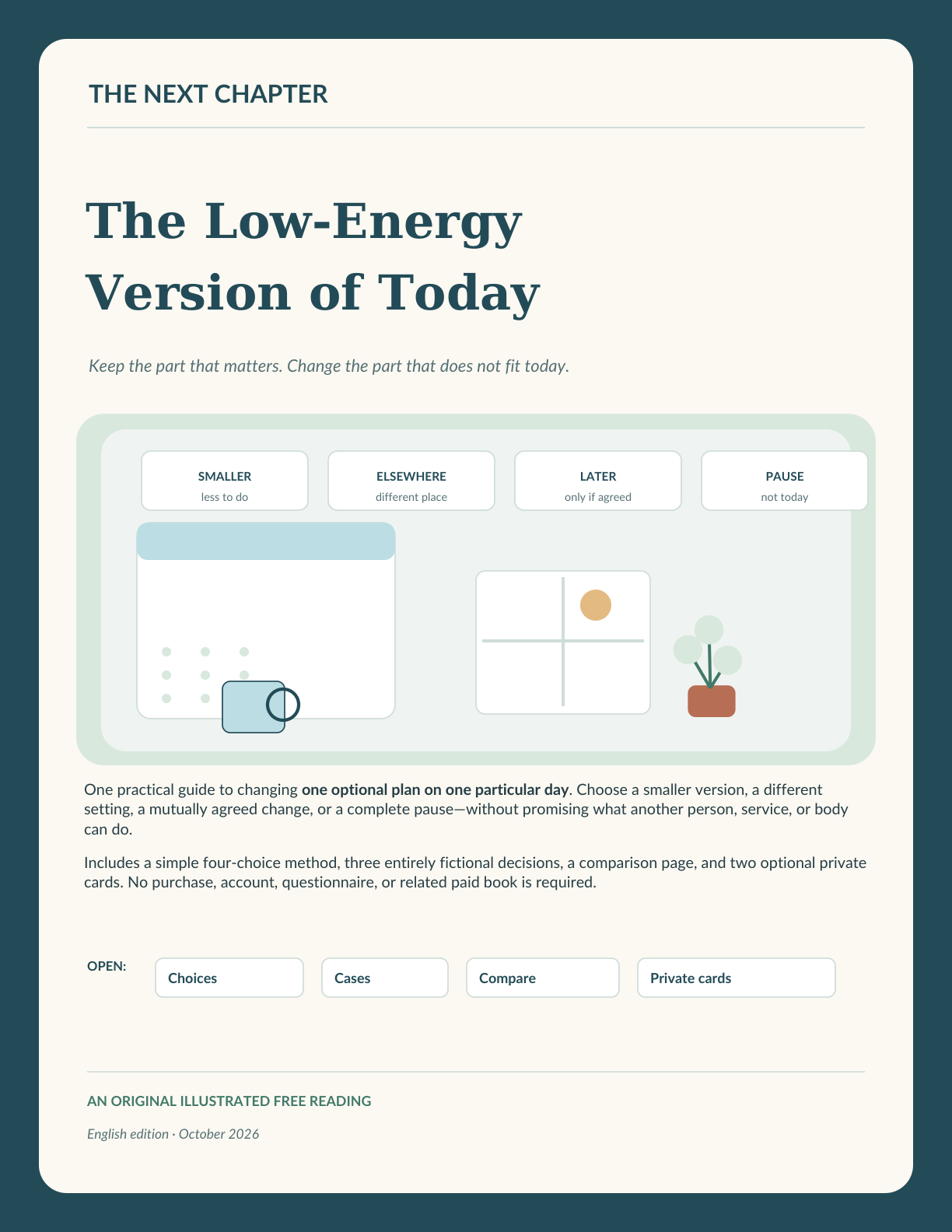
One practical guide to changing one optional plan on one particular day. Choose a smaller version, a different setting, a mutually agreed change, or a complete pause—without promising what another person, service, or body can do.
Includes a simple four-choice method, three entirely fictional decisions, a comparison page, and two optional private cards. No purchase, account, questionnaire, or related paid book is required.
English edition · October 2026
The day you planned is not always the day you have
CHANGE ONE PLAN, NOT YOUR ENTIRE LIFE
Yesterday you pictured visiting a gallery, meeting a friend, or finishing a small household project. You put it on the calendar because you wanted the experience. This morning, the same plan seems less inviting or less manageable. You may be tired, short of time, preoccupied, or simply interested in a quieter day. Sometimes you know why; sometimes you do not. The difference between yesterday's intention and today's capacity can be ordinary, but it can still feel disappointing.
A calendar entry records a plan made at an earlier moment. It is not proof that the plan still fits. You are allowed to reconsider an optional activity without judging your character. You are also allowed to keep a plan that feels right. The point of this guide is not that a quieter day is always better. It is that an adult can make a fresh, informed choice instead of automatically choosing either “push through” or “do nothing.”
There is an important boundary. This guide is about adjusting everyday, optional activities; it cannot decide whether new fatigue, pain, dizziness, weakness, breathlessness, or other symptoms are medically significant. Unexpected, severe, persistent, or worrying symptoms call for appropriate professional advice or urgent help as warranted. Do not use a lifestyle worksheet to overrule personal medical instructions or urgent needs.
For ordinary plans, ask a smaller question: What was I looking forward to, and is there another honest way to have some of it today? You might keep the idea while changing its size, place, or date. Or you might leave it entirely, because nothing needs to be redeemed from every afternoon.
Name what you wanted, not just what you scheduled
THE OUTING AND ITS PURPOSE ARE NOT IDENTICAL
A plan usually contains several layers. “Go to the gallery” describes a destination, but you may have been seeking colour, curiosity, companionship, an easy afternoon outside the house, or just the pleasure of doing something different. “Call an old friend” describes a method, but you may have wanted to say hello and hear a familiar voice. “Make the garden look better” describes work, but you may have wanted to spend a little time near plants.
Choosing the smallest worthwhile part begins with identifying that layer. Write the original plan in plain words. Then finish this sentence: “The part I really wanted was…” Do not write an ambitious goal if the truth was modest. “Look at one interesting painting” is more useful than “become more cultured.” “Enjoy a short conversation” is more precise than “maintain all my friendships.”
Not every plan can be reduced without losing its purpose. If your goal is attending a particular live performance with friends, looking at a programme at home may not be an equivalent event. You can decide to postpone or miss the performance. Calling an alternative “the same thing” when it is not may create unnecessary disappointment.
You also need not extract a cheerful lesson from a day when you simply need rest. The method gives you choices, not a requirement to manufacture an achievement. Your preferences matter, and so do the commitments already made with other people.
Four honest options for one optional activity
SMALLER · ELSEWHERE · LATER · NOT TODAY
Smaller means keeping the activity while reducing its scale. Instead of an hour browsing several exhibits, you might choose one short visit only if travel, admission, seating, and exit remain practical. Instead of a long personal creative session, make a single sketch. Smaller is not necessarily safer or easier; the complete effort, including getting there and returning, still matters.
Elsewhere means changing the setting or medium. Read about one artist at home, use a book you already own, sit on a permitted patio rather than walk a long route, or exchange an in-person conversation for an agreed telephone call. Ask whether the changed setting still offers something you want. An at-home version need not be an imitation of a full outing.
Later means a genuine new date, not a silent assumption that an organizer, friend, or service is available. If another person is involved, propose the change and wait for confirmation. If a booking is involved, verify cancellation, transfer, or refund terms; do not treat a request as accepted merely because you sent it.
Not today is a complete choice for an optional activity. It does not have to lead to a compensating task. If you already committed to someone else's care, a work or volunteer shift, a paid reservation, or an essential errand, communicate and arrange any necessary handover rather than assuming the obligation disappears with your change of mind.
Check whose plan it really is
A PERSONAL IDEA AND A PROMISE ARE DIFFERENT
A solo, optional activity can often be changed privately. A plan made with someone else is not yours alone to rewrite. A museum visit with a friend can become a short coffee meeting if that friend agrees. A telephone call can become a message if the recipient prefers that. An arrangement to drive someone, supervise an activity, or cover a volunteer position may require an actual replacement or explicit acknowledgement from the responsible person.
Before changing anything, classify the plan. Is it a personal idea, a shared arrangement, a confirmed booking, or an accepted responsibility? One outing can contain more than one type: an optional lunch with a friend and a prepaid, non-refundable ticket are separate details. You may choose not to attend while still having to deal with a payment condition or notify the other person.
Ask: Who expects me? Who would incur cost, lose assistance, be left waiting, or need to make another arrangement? Whose permission is needed? Is there a deadline for changing or canceling? If you cannot answer, do not mark the arrangement “cancelled” or “covered.” Mark it confirmation pending and contact the appropriate person by a reliable route.
There is no need to give friends a medical explanation. “I cannot manage the longer visit today. Would a short call suit you instead?” can be complete. Duties involving safety, dependent people, or essential services may need fuller practical communication to ensure continuity, but the details depend on the actual situation and applicable rules.
A shorter activity can still be a long day
COUNT BEFORE, DURING, AND AFTER
Suppose the appealing part of a gallery visit would take twenty minutes. If you need twenty-five minutes to get there, time to wait or enter, and another twenty-five minutes to return, the whole effort is not twenty minutes. It includes preparing, getting out, any uncertainty about seating and access, and what you need to do afterward. A “quick” activity is only quick when the entire arrangement fits.
You do not need to track exertion with a device or score your energy. Ask practical questions you can answer: How long is the journey? Can I leave earlier without difficulty? Is sitting possible where I need it? Can someone confirm the venue's arrangements? Are there steps or costs I have not included? Would the short version require more coordination than the full original plan?
Sometimes going somewhere for only ten minutes makes no sense. In that case, a home version or a later date may respect the purpose better. Sometimes leaving the house for a very brief time is exactly what you want. Neither choice is proof of ability, health, independence, or virtue.
If your preferred activity has no reliable exit route, involves uncertain physical demands, or depends on help that has not been agreed, do not assume the shorter duration alone solves the problem. Verify the facts you need or choose not to go. This is a planning choice, not a medical suitability assessment.
Example: wanting a little time with plants
LET THE ESSENCE GUIDE THE SUBSTITUTE
Imagine you planned an afternoon at a botanical garden because you wanted to notice autumn colours. The trip is optional, and nothing has been booked. Today you would rather stay close to home. A realistic small version might be ten minutes looking at a familiar plant near your window and writing down two colours or changes. Another version might be viewing a garden book you already own. Neither is literally a trip to the garden. Both can offer a piece of the attention you wanted.
What makes this an honest replacement is your own choice. Do not tell a person who wanted fresh outdoor air that a picture book is “just as good.” If the original setting mattered, say so: “I am not going to the garden today. I may go another time.” You are permitted to be disappointed even while making a sensible change.
A useful replacement has a clear starting point and a natural stopping point. “Look at one plant and note two details” can finish. “Find every online garden I could ever visit” turns the change into another large assignment. Keeping the small version small is part of its value.
For someone who shares your home, ask before using their room, possessions, or device. If a book, plant, or photograph belongs to another person, ordinary permission still matters. Your alternative should not create an unexpected obligation for someone else.
Example: a conversation that changes shape
PROPOSE, DO NOT ANNOUNCE ANOTHER PERSON'S ANSWER
You arranged to meet a friend for lunch. The restaurant is a forty-minute journey away, and you do not wish to make the trip today. A short call might preserve the companionship you wanted, but only if your friend wants it too. You could say, “I would like to catch up, but I cannot do lunch today. Would a fifteen-minute call suit you, or would you prefer we leave it for another day?”
That sentence does three helpful things. It says the original lunch will not happen from your side, it offers a real alternative rather than a vague promise, and it leaves the other adult free to choose. The friend may accept, decline, suggest a different time, or not answer. Silence is not consent. A proposed phone call is not a completed phone call, and a suggested future lunch is not a reservation.
If the meeting involved a restaurant reservation, tickets, shared transport, or money already spent, deal with those separately. Confirm venue policies using the official booking details. Do not assume either person will automatically pay the whole bill, receive a refund, or be able to change the reservation without a fee.
A short version may still be worthwhile. A friend may also feel disappointed and need time. A considerate change lets both truths exist without guilt or bargaining. The purpose is a workable conversation, not making the other person reassure you.
Make an at-home version without buying a substitute
LOOK · LISTEN · MAKE — CHOOSE ONLY ONE
An optional activity can sometimes be converted into one modest at-home experience. If you wanted to browse a local art display, choose a picture in a book you already have and notice three details. If you wanted a long walk to listen to birds, open a window only where comfortable and appropriate, or listen to a recording you already own. If you wanted an afternoon workshop, make a six-line observation or a small sketch with materials at hand.
These are different activities from the originals. They are suggestions, not guarantees of equivalent pleasure or safety. Do not force yourself to make a replacement merely because an empty space on the calendar looks awkward. An unused afternoon can stay unused.
Avoid the expensive reflex: “Since I cannot go, perhaps I should buy an app, another kit, or a subscription.” A change of plans does not create a duty to shop. Count new expenditure only if you actually buy something; a price seen on a screen is not money spent. Existing equipment may have cost money previously, even if it requires no new cash today.
If you do make a home version, let it end. A chosen book page, one piece of music, or one drawing is a legitimate small result. The guide does not ask you to develop a recurring programme or track your performance day after day.
“Another day” is not yet a new appointment
A SUGGESTION, A REQUEST, AND A CONFIRMATION ARE THREE STATES
When today's plan does not fit, “We'll do it next week” may sound reassuring. But a future date may involve a friend, instructor, service, booking, or transportation that has not agreed. Keep the language honest. “I would like to ask about next Tuesday” is a proposal. “The organizer has confirmed next Tuesday at three” is an arrangement. “We attended” describes a later completed event. None can be substituted for another.
If you already paid for something, check the actual purchase conditions before cancelling or moving it. Non-refundable deposits, expiry dates, non-transferable tickets, and cancellation windows differ. A gentle plan cannot erase a contractual term. Record the amount actually paid separately from a possible future charge and the refund actually received, if any.
If nothing was booked, moving an idea requires no refund calculation. You can leave the calendar blank. A specific next date is only helpful when you want and can realistically arrange one. Choosing not to reschedule immediately is not giving up a meaningful activity forever.
A later date might be preferable to a home imitation. You can admit that without feeling pressured to reserve it right away. The small decision today is whether to keep, change, or release the current plan—not to settle every future weekend.
Use today's facts instead of assigning yourself a score
YOU ARE NOT A NUMBER ON A BATTERY ICON
It may be tempting to divide days into good and bad ones, or to describe your available energy as a fixed percentage. But an arbitrary number can become another rule to obey. What matters for this ordinary decision is the activity, the conditions, and what you do or do not want to take on. Perhaps you do not want to travel in heavy rain. Perhaps an unexpected telephone conversation used the time you had set aside. Perhaps you simply prefer a slower evening.
Ask four practical questions instead. What do I still want from the plan? What must be true for it to work? Which of those conditions are confirmed? What choice would I be comfortable making today? If your plan involves a person or a service, add: What needs to be agreed with someone else? These questions can be answered in ordinary words, without sharing private medical or financial information.
You may discover that the issue is not “low energy” at all. The bus has been cancelled; the meeting is likely to run late; the venue cannot confirm accessible seating; you do not want to spend the admission fee. This guide can still help you choose a smaller or different plan without pretending to assess why a constraint exists.
A practical change is not a substitute for professional advice. Do not infer that an activity is safe merely because it is short or indoors. If you have a concern about symptoms or a medically limited activity, use your personal guidance and qualified care, not this four-question card.
Take a brief decision pause before you message anyone
YOU DO NOT NEED A COMPLICATED SYSTEM
Here is one possible five-minute sequence. It is an example, not a requirement to wait when urgent action is needed. First, name the original activity in seven or eight words: “Three hours at the market with Elena.” Second, say what mattered: “Talking together while looking at handmade objects.” Third, check the non-negotiables: Was it booked or paid for? Would Elena already be travelling? Is someone depending on the outing for something essential?
Fourth, choose one honest proposal: “Would you prefer a short café visit near home, or shall we skip today?” Fifth, mark the actual status: message drafted, message sent, reply received, change confirmed, or plan unchanged. Only mark the choice confirmed when the person or provider who needs to agree has done so.
You can shorten the sequence to one sentence when appropriate. You can also take longer or ask someone you trust to help you communicate. The aim is not to become efficient at cancelling plans. The aim is to prevent a hasty decision from creating confusion, accidental costs, or obligations for somebody else.
If the plan is entirely personal and unbooked, you may never need to send a message. You can look at your calendar, make a different choice, and continue with the day. The same method remains useful because it asks for an intentional choice rather than an unexamined reaction.
Fictional decision: Asha keeps the art, not the trip
AN ACTUAL SMALLER EXPERIENCE; AN UNPURCHASED OUTING
Asha intended to go to an art gallery that afternoon. The idea was to notice colour and enjoy something new. She had seen a fictional admission price of USD 14 and an illustrative bus fare of USD 3 each way. The trip would have cost USD 14 + USD 3 + USD 3 = USD 20 in these invented circumstances. She had not bought admission or transit tickets, made a reservation, or promised to meet anyone. The USD 20 was a possible future cost, not money she had spent or saved through a verified offer.
When the time approached, Asha preferred not to travel. She chose a book about art already on her shelf, found one image she liked, and spent 15:10–15:35, twenty-five minutes, noticing colours and writing two sentences. She kept the book open at the page and wrote the observations on paper she already owned. Her new cash expenditure for the smaller activity was USD 0. That says nothing about what her book or supplies had cost in the past.
What actually happened? Asha did not visit the gallery. She did complete a twenty-five-minute at-home art observation. No ticket was purchased or refunded, and no new gallery date was booked. The home activity was not a claim that gallery attendance had happened in miniature; it was a different activity Asha freely chose because curiosity was the part she most wanted that day.
The lesson of this invented case is not to stay home whenever travel seems demanding. It is to name accurately what was planned, what was changed, what money actually moved, and what personal value the changed activity retained.
Fictional decision: Luis asks, and Evelyn chooses
A SHORTER SHARED PLAN REQUIRES TWO ANSWERS
Luis and Evelyn had agreed to meet at a neighbourhood café that evening. Luis looked at the travel and preparation the outing involved and realised he no longer wanted the in-person plan. At 16:10 he sent a message: “I would like to catch up, but I can't manage the café trip tonight. Would a short call at six work for you? It's fine if you would rather leave it.” He did not count the proposed call as an arrangement merely because the message went out.
At 16:30, Evelyn answered that she would enjoy a call at 18:00 and confirmed they would not meet at the café. They had no reservation, prepaid purchase, or commitment to a third person. They spoke from 18:00 to 18:16 — sixteen minutes. Both were pleased to exchange news, and neither made another date. They used existing telephone service; new cash expenditure attributable to this call was USD 0, not a claim that all phone service is free.
Record the states separately. The original café visit did not happen. The alternative telephone call was proposed, accepted, and actually completed. The next café meeting was not arranged. Evelyn's yes mattered; Luis did not assign her a convenient new role. If she had not replied, he would not have been entitled to describe a call as agreed.
A different friend might prefer not to talk by telephone or might be disappointed by a last-minute change. You cannot guarantee a pleased response. A respectful invitation leaves the other person room to have their own evening and their own preferences.
Fictional decision: Nora has a duty, not just an idea
DO NOT LET A SMALLER PERSONAL DAY BECOME SOMEONE ELSE'S EMERGENCY
Nora had already accepted a 09:00–12:00 volunteer desk shift at a fictional community centre. That was different from deciding whether to browse a gallery by herself. Someone expected her to be there. In the morning, she did not feel able to do the shift. At 07:10 she contacted the designated coordinator through the agreed route, explained she could not attend, and asked how the staffing responsibility would be covered. She did not simply replace her shift with a private activity and assume the centre would manage.
While awaiting an answer, Nora treated the coverage as unconfirmed. At 07:45, the coordinator explicitly confirmed that a different authorised volunteer had accepted the full 09:00–12:00 shift. Nora recorded that confirmation rather than counting her initial message as a release. She did no volunteer desk work that day, booked no replacement shift for herself, and had USD 0 in new cash expenditure related to the change. Those details are invented and describe this case only, not a general cancellation policy.
The important distinction is not whether Nora ought to have gone in spite of difficulty. This guide cannot judge that or provide medical clearance. The important distinction is that an accepted responsibility involves others and must be managed through real notice and confirmation. If the coordinator had not answered, Nora would need to follow the organisation's actual escalation instructions; she could not honestly mark coverage confirmed.
This case should not be used as advice about safeguarding, employment duties, medical fitness, or a specific volunteer organisation's rules. Follow the real arrangement and its responsible contacts. When a situation affects essential care or safety, use appropriate urgent and professional support rather than a generic planning template.
Compare what actually changed
ONE SMALL COMPLETION, ONE AGREED SUBSTITUTE, ONE RESPONSIBILITY HANDED OVER
These examples are fictional exercises, not verified places, quotations from customers, medical outcomes, or rules of a real programme. They help prevent a common reporting mistake: counting an intention as a completed activity.
| Fictional person | Original proposal or duty | What actually happened | Cash and arrangement status | |---|---|---|---| | Asha | Unbooked art gallery; possible USD 14 admission + USD 6 return transit | Completed a 25-minute home observation, 15:10–15:35; gallery not visited | USD 0 new cash; potential USD 20 never spent; no refund or new booking | | Luis + Evelyn | Café meeting with no reservation | Both agreed to a call; completed 16 minutes, 18:00–18:16; café not visited | USD 0 new cash; existing service used; no next meeting arranged | | Nora | Accepted volunteer shift 09:00–12:00 | Told coordinator at 07:10; full replacement confirmed at 07:45; Nora did not work | USD 0 new cash; coverage confirmed by coordinator; no replacement shift for Nora booked |
In Asha's case, the easier option was entirely her choice. In Luis's case, the alternative required Evelyn's approval. In Nora's case, a change of plans required responsible handover. The three situations are not interchangeable, even though someone could casually say that each person “did less today.”
Notice especially the money terms. USD 20 was a proposed purchase in Asha's story, not actual spending, a refund, or a guaranteed saving. The USD 0 amounts refer to new cash paid for each changed activity, not the historical cost of possessions or ongoing subscriptions. Clear accounting protects readers from attractive but misleading examples.
A one-glance decision for the next changed day
YOU MAY USE THIS WITHOUT COMPLETING A WORKSHEET
Here is the entire method in six questions. First: What was the optional activity I intended to do today? Use an ordinary sentence, not a life goal. Second: Which small part of it still matters to me? Companionship, curiosity, being outdoors, making something, or perhaps nothing at all. Third: What would the whole effort actually involve? Include travel, access, preparation, cost, waiting, and return where relevant.
Fourth: Who is affected by changing it? A purely private plan may need no notification. An agreement, booking, or accepted duty requires the actual steps appropriate to that arrangement. Fifth: Which choice is real today: smaller, elsewhere, later if agreed, or pause? You can choose one, not build a whole menu. Sixth: What can I honestly mark as confirmed or completed? A sent message is not a received answer, an asked-for refund is not an issued refund, and an imagined alternative is not an activity already completed.
You can speak these questions, think them through, or use the optional cards on the next two pages. The cards are private prompts, not a contract, diary requirement, diagnostic screen, or assessment of your resilience. Avoid writing down health records, account details, identifying information about another person, or booking codes on a shared or unsecured device.
If the best answer today is “I will not do an optional activity,” that is a legitimate end to the exercise. A useful change of plans leaves you with an accurate understanding of what is, and is not, expected—not with one more task to perform.
Optional private card: the plan in front of me
KEEP PRIVATE, PRINT, TYPE, OR SKIP
This card concerns one day and one plan. It does not measure physical capacity, make a medical recommendation, or give anyone else permission to change an arrangement. Leave any question blank. Write only the minimum practical information useful to you.
1. The original optional activity
What did I intend to do, without including anyone's private details?
Optional private field 1: Original idea
2. The part I still wanted
Was I hoping for company, curiosity, fresh air, time to make something, or something else?
Optional private field 2: Wanted part
3. The whole-day practical facts
What would travel, preparation, access, cost, or return require?
Optional private field 3: Practical facts
4. What is already agreed or paid
Is this private, shared, booked, paid, or an accepted responsibility? No account numbers.
Optional private field 4: Existing commitment
5. Today's honest option
Smaller, elsewhere, later only if confirmed, or not today?
Optional private field 5: Chosen option
6. One communication I may need
Who should be contacted through an appropriate channel, if anyone?
Optional private field 6: Communication
The card is complete whenever you choose to stop using it. No answer makes another person's agreement automatic.
Optional private card: after I have decided
WRITE WHAT HAPPENED, NOT WHAT YOU HOPE WILL HAPPEN
Use this second card only if a later check would help. You are not obliged to record an activity or prove that it was productive. The fields distinguish messages, agreements, actual results, and new costs.
1. My actual decision
What did I decide today, in plain words?
Optional private field 1: Decision
2. Messages sent or requests made
What did I ask? A message sent does not mean a change was accepted.
Optional private field 2: Requests
3. Confirmations genuinely received
What did the relevant person or provider actually agree or confirm?
Optional private field 3: Confirmed facts
4. What I actually did
Did the small activity happen? Was it postponed, declined, or not done?
Optional private field 4: Actual outcome
5. New cash actually spent or refunded
Separate payments, refund requests, received refunds, and prices you merely considered.
Optional private field 5: Money status
6. What remains open, if anything
Is any reply, booking, replacement, or decision still pending?
Optional private field 6: Open items
Do not put private health information, payment credentials, or third-party identifying details into a publicly shared copy. You may discard this card. It is not a legally binding change, a cancellation notice, or a substitute for actually contacting the responsible party.
A day can change without needing to be rescued
ONE DECISION, HONESTLY MADE, CAN BE ENOUGH
When you imagined the day earlier, you could not know every condition that would be present when the hour arrived. A different day is not necessarily a worse day. You can preserve a little curiosity while staying home, shorten a shared activity when both adults agree, request a later date when it really can be arranged, or decline an optional task and leave the time open.
The useful distinction is between changing your own idea and changing something that other people depend on. Neither should require elaborate explanations, but an agreement deserves clarity. A responsibility deserves actual notice and appropriate coverage. A booking deserves its real terms. An unconfirmed request must remain unconfirmed until someone with authority answers. Those practical facts matter more than a positive slogan about flexibility.
You do not have to thank yourself for every rest, call it a success, or replace leisure with productivity. Some days a small version feels satisfying. Some days the original outing will have to wait. Some days nothing takes its place. You can make an accurate decision and still wish the day had gone differently.
This is general everyday planning information, not personalised medical, emergency, disability assessment, mobility, professional-care, contractual, employment, or financial advice. If symptoms or safety concerns arise, seek the appropriate qualified support; if a duty affects someone else, follow the responsible person's or service's actual procedures. Do not treat fictional prices, services, or confirmations as real offers.
The next time you reconsider an optional plan, ask: What part matters? What is possible? Who must agree? What actually happened? Answer only what you know. Then let today's decision be enough.