THE NEXT CHAPTER
A short, practical look at everyday life in a place you are considering.
A free illustrated field guide. One self-chosen route, four kinds of everyday stops, three fictional decisions and two optional private cards. You can complete a useful first check without booking a tour, paying for a report or committing to a move.
Test an ordinary errand, not a postcard
THE FIRST QUESTION
A beautiful street can make an appealing first impression. But a possible home also comes with Tuesday mornings, groceries to carry, the journey home after an appointment and days when the weather is less inviting. Those ordinary moments are harder to judge from a photograph.
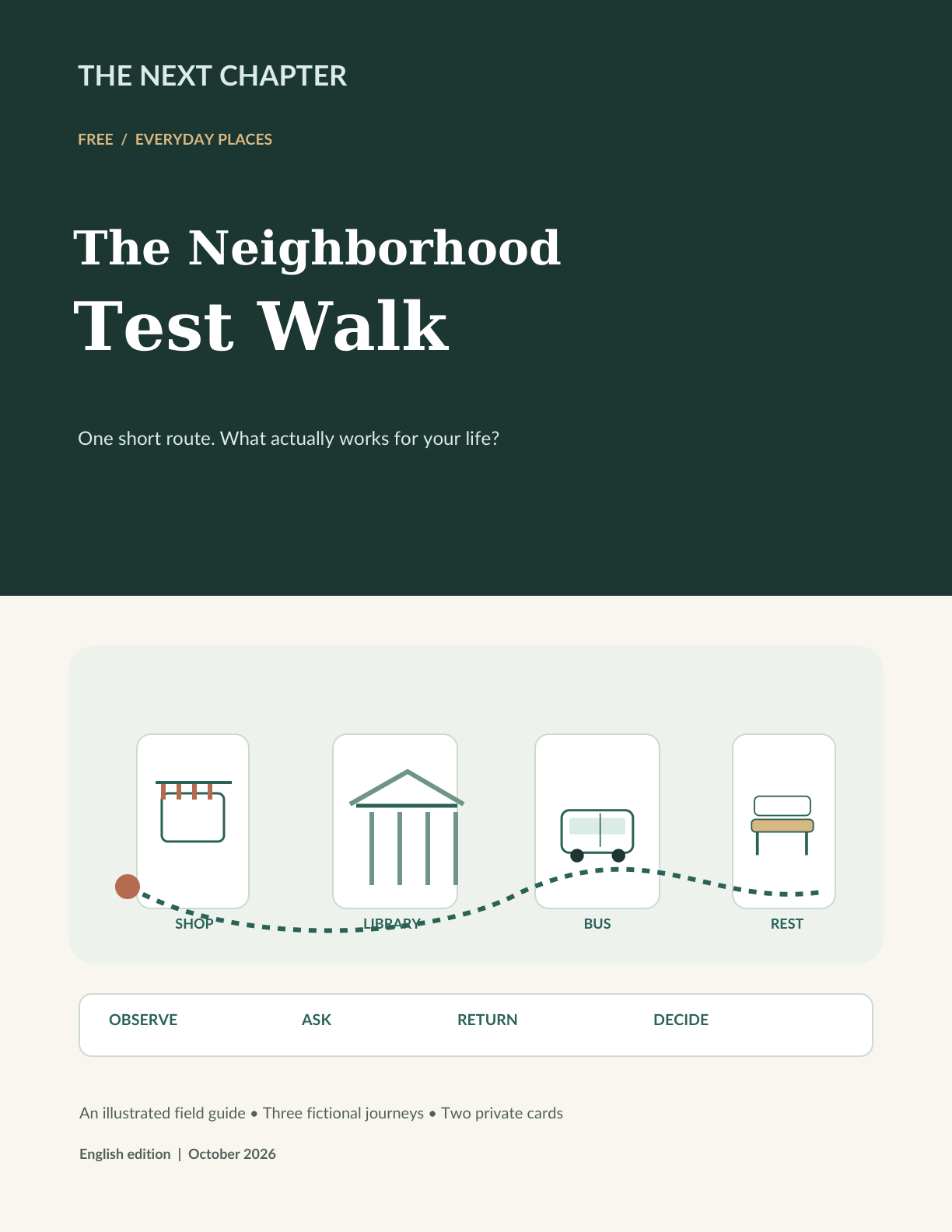
A neighborhood test walk is not a verdict on a place. It is one modest visit, or a carefully labelled at-home check, built around a question from your own daily life. Could you reach a grocery option you would actually use? Can you ask a local library about a service that matters? Is the return trip as clear as the outward journey? Is there a permitted place to sit when you want to pause?
You do not need to cover every street. Choosing two useful stops and one manageable return is better than exhausting yourself in pursuit of a complete picture. You may enjoy the place, find a mismatch, or return with only a better question. All three results have value.
A useful observation has limits
WHAT THIS GUIDE DOES — AND DOES NOT DO
A short outing can tell you something about the route you actually travelled at the time you travelled it. You may notice a crossing that needs more attention, an entrance that is harder to find than expected, or a place to rest that suits you. You can also discover that a map label does not answer an important practical question.
It cannot certify that a neighborhood is safe, accessible, affordable or a good place to live. It cannot verify property conditions, home prices, crime, tenancy rights, medical services or future transit reliability. A shop you see today might change its hours. An accessible-looking entrance may still have barriers inside. A single pleasant encounter does not prove what the street will feel like at other times.
Write I saw, I confirmed with the provider, or I still need to ask. This simple distinction protects you from turning a first impression into an unsupported promise. If a route is unsuitable, you can stop the test without treating the place as a personal failure.
Choose one route and two questions
START WITH YOUR LIFE
Imagine an ordinary address you are considering, not a property you have already decided to buy. From a lawful public starting point nearby, choose one errand that matters and one optional pleasure. For example: a grocery entrance and a library; a transit stop and a quiet public sitting place; or a pharmacy enquiry and a familiar walking route. Check whether these are genuinely relevant to your life rather than generally popular local features.
Now write two small questions: “Could I get there and back in a way that works for me?” and “What still needs confirming before I rely on it?” You can narrow them further: “Can I identify the correct return stop?” or “Does the library offer this specific kind of material to a visitor?”
A phone call or an official website may answer part of the question before you go. That is not cheating. Avoid collecting more addresses and stops than you can use. This is a short observation exercise, not a property inspection or an invitation to enter private land.
Give the visit a comfortable boundary
PERMISSION • ACCESS • A WAY HOME
Before leaving, check the actual operating details of any place you hope to enter. A map pin is not permission to enter, proof of opening hours or a reservation. If the destination requires membership, an appointment, a purchase, an admission fee or a specific entrance, confirm those terms with the operator. For public facilities, ask about the particular access features you need; do not infer that an exterior photograph tells the whole story.
Think about the return before the outward journey. Will you walk the same way? Is a bus or lift available at the time you might be ready? If it is a public transport journey, check the correct direction, boarding point and current service with the actual operator. Travel disruptions and local rules can change.
Choose a stopping point and a way to end early. If walking would be uncomfortable, unsafe or impractical for your circumstances, use a permitted shorter segment or an at-home enquiry instead. No exercise amount, pace or distance is prescribed by this guide.
Count the whole outing
OUT AND BACK ARE ONE DECISION
The destination may be a ten-minute walk away, but that does not make the whole experience a ten-minute task. Include leaving your starting point, reaching the entrance, any waiting, the time spent observing, a pause and the return. If you rely on someone else for a ride, include the arrangement and the possibility that you may need a different return plan.
Make a loose sequence, not an appointment with yourself: leave → see one essential stop → see one optional stop → pause → return. A return that requires an unconfirmed bus, a steep crossing you cannot use, or a late-night trip deserves its own question.
Do not invent a transport timetable. Write what is confirmed, the source and the date you checked it. If you cannot establish a workable return, postponing the visit is a complete and sensible result. You can still examine local public information or contact a service by phone.
Three labels prevent easy mistakes
SAW IT • ASKED ABOUT IT • STILL UNKNOWN
“Nearby,” “open,” and “accessible” sound reassuring, yet each can hide a different question. You might see a bus shelter without knowing when any useful return bus arrives. You might confirm that the library has a publicly stated opening time without knowing whether a particular room is available. You might still need to ask whether the entrance and internal route work for you.
Keep these labels separate in your notes. Saw: something you directly observed at a particular time. Confirmed: a current answer given by the responsible operator, with date and contact method. Unknown: something not yet established, including estimates copied from a search result.
If two sources disagree, do not quietly choose the one you prefer. Record the discrepancy and check with the operator before depending on it. You are not auditing the entire neighborhood; you are making one real-life decision a little less dependent on guesswork.
A shop is more than a map pin
THE EVERYDAY ERRAND
A grocery option may look close enough on a map. Try asking a more useful question: where is the public entrance, and could you make the full journey with what you usually carry? You may care about a direct footpath, a crossing, a bus stop, a place to secure a bicycle, or whether a particular shopping method is offered. What matters varies by person.
You do not need to buy anything to observe a lawful public route. If you want to go inside, follow the shop's current entry conditions. Notice facts that are relevant to you: an entrance location, whether the posted hours agree with your plan, or whether the route back contains an obstacle you had not considered.
Do not claim a store has the goods, prices, assistance or access conditions you need based only on one visit. Ask staff or check current official information where necessary. Your useful note might simply read: “The entrance is farther from the stop than I expected; test the return while carrying groceries.”
A library can be a place to ask
THE PUBLIC SERVICE QUESTION
A library can tell you something about the information and community resources available in a place. But the word library on a map does not mean every visitor can borrow materials, use a room, get a library card or attend every activity. Policies and programs differ by institution.
Pick one question relevant to your life. For example: “May a visitor ask about large-print books?” “Do you have an official information page about public programs?” or “Which entrance should I use for a step-free route?” A brief, respectful question can be more useful than guessing from an old event flyer.
If you visit, use permitted public areas and ask staff about the specific service you need. If you do not visit, the library's actual website or phone number may be an appropriate first step. Record a named answer, date and remaining uncertainty without putting anyone's private details into your card.
Check the direction home
THE RETURN TRIP IS NOT AN AFTERTHOUGHT
A stop sign tells you that a stop exists. It does not prove that a bus runs when you need it or serves the direction in which you must return. Route numbers, platforms, schedules, service notices, accessibility arrangements and fares can change. A trip-planning app is a useful starting hypothesis, not an independent guarantee of service.
Look for the actual transport operator's current information and, where needed, ask about the particular boarding or transfer conditions that affect you. Distinguish outward journey confirmed from return journey confirmed. A route can be easy one way and inconvenient the other.
If an unconfirmed return would leave you stranded or uncomfortable, do not perform a trial that depends on it. Change the timing, take a shorter permitted route, or make an enquiry from home. When no transit is relevant to you, use this same test for parking restrictions, pick-up arrangements or the path back to your starting point.
Find a pause that is actually usable
REST AND BASIC COMFORT
An appealing public square might have a bench. The bench might be occupied, removed, exposed to weather or inaccessible from your route. A café may offer seating only to paying customers. A public building may have toilets or seating, but actual availability and conditions need checking rather than assuming.
Treat a permitted, usable pause as a practical question: “Where could I stop without depending on an unverified promise?” Consider your own preferences for noise, shelter, seating, nearby facilities and company. You may not need a planned pause, and a different person may care about different details.
You are not evaluating whether everyone would find the neighborhood comfortable. You are learning whether this small outing works for you at this particular time. If rest or facilities cannot be confirmed, shorten the route or return another day. No one has to push past personal limits for the sake of completing a worksheet.
Keep real costs separate from possibilities
ONE ILLUSTRATIVE DOOR-TO-DOOR EXAMPLE
Here is a completely invented example, not a local fare or a recommended walking speed. A visitor leaves at 10:00 and arrives back at 11:35: 95 minutes door to door. The parts are 18 minutes travelling out, 12 minutes observing a grocery entrance, 15 minutes at a permitted library counter, 8 minutes pausing, 12 minutes waiting and 30 minutes returning. The six parts add to 95 minutes.
Suppose the illustrative bus fare is CAD 3 outward and CAD 3 back: cash paid for the two journeys is CAD 6. If no groceries or admission were purchased, those costs are CAD 0 paid, not the same as asserting the shop is free or accessible. A hypothetical café drink costing CAD 5, not bought, is not part of the cash actually spent.
In your own record, use paid, confirmed but not paid, optional, and unknown. Include both directions and any unavoidable fee before deciding whether an outing fits a budget. The purpose is a complete picture of the trial, not a universal price comparison.
A useful walk may end early
THE STOPPING DECISION
Suppose you reach a crossing that is busier than you expected, an entrance is closed, or a return service is not confirmed. The test has already taught you something: the first plan cannot be used as written. You do not need to invent a way through the obstacle or keep going to make the outing count.
Choose one of three honest results. Continue only within the route you have confirmed. Change to a shorter, permitted version. Stop and leave the remaining questions for a later call or visit. Any choice can be useful, depending on the actual conditions.
If you are walking with someone, their preferences and constraints deserve equal consideration. A companion's ability to complete a route does not prove it works for you. If you cannot make an informed safe choice from the information available, the sensible result may be to end the test and seek local guidance rather than accept a guess.
You can begin without going anywhere
AN ENQUIRY COUNTS AS PROGRESS
Sometimes leaving home is not practical, or an uncertain return route makes the test unreasonable. You can still learn by checking an official shop, library or transit website, asking about current services, or looking at a public map to prepare precise questions. Save the date of a reply. An unanswered question is a proper result; do not fill the gap with an assumption.
Label the evidence honestly: not visited; information only. A virtual map cannot certify kerb ramps, surfaces, doors, toilets, safe crossings or accessible transport in real use. A phone answer about a service is not the same as personally experiencing the route.
If a real in-person visit later makes sense, keep it optional. The goal is not a compulsory physical walking exercise; it is to investigate whether ordinary journeys in a possible neighborhood might suit your specific life. A shorter experiment can be more informative than a large one that is never feasible.
Inez: one short outing, one unresolved stop
FICTIONAL JOURNEY ONE
Inez, 68, is considering a smaller home in an unfamiliar area. She wants to know whether she could reach a grocery entrance and ask about public library resources without relying on a family member to drive. The place and all figures in her story are invented.
She checks an illustrative outbound and return bus plan with the fictional operator and makes one permitted visit. She leaves at 10:00 and gets back at 11:35, so the complete outing is 95 minutes. Her actual transport cash is CAD 3 + CAD 3 = CAD 6. She does not buy groceries or a café drink.
She finds the grocery entrance, asks at the library counter about a public information page, and notes a permitted place to pause. She still does not know whether the return bus schedule would work for a later evening appointment. Her conclusion is not “This is a good neighborhood.” It is: “This daytime route worked once; the evening return remains unverified.” A first observation becomes one clear next question.
Rowan: a meaningful test from home
FICTIONAL JOURNEY TWO
Rowan uses a powered mobility device and wants to find out whether a public service could be reached independently in a possible new neighborhood. One photograph of a level-looking doorway is not enough to answer that question. Rowan chooses a first enquiry from home rather than an unconfirmed physical trip.
In a fictional 22-minute session, Rowan identifies the relevant public library's official contact, asks which staff member can confirm the actual entrance and service-space route, and checks whether the transport operator provides current information about the outward and return journey. Neither organization has yet confirmed the details. No visit, booking or new purchase has occurred; additional cash spent on this enquiry is CAD 0. That does not mean existing internet or phone service costs nothing.
Rowan records: “Not visited. Library entrance and transport use still to be confirmed directly.” The exercise has made a vague concern into two specific enquiries. A later visit is possible only if its arrangements genuinely work; the guide does not pronounce any route certified or safe for everyone.
Alina and Theo: the same street, different wishes
FICTIONAL JOURNEY THREE
Alina and Theo are considering a move together. Alina wants an easy everyday grocery errand; Theo hopes for a quiet public place to read. They arrange a fictional daytime route together. From 10:10 to 11:05 they spend 55 minutes on permitted public paths. They make no purchases, so the outing adds CAD 0 cash expense, without suggesting travel and time are always free.
They find the shop's public entrance but notice they disagree about a busy crossing. They also see seating in a public square, without verifying its availability at other times. The library has an event poster, but they do not treat the poster as evidence that the event is current or that membership is available. Their interests overlap, but their conclusions are not identical.
Instead of declaring a winner, they record two distinct preferences and one shared uncertainty: “Ask the actual operator about another way home before relying on this route.” Their walk does not reserve a home, certify accessibility or settle a multi-week relocation decision.
Take home three kinds of result
A DECISION, NOT A SCORE
Before assigning a neighborhood a score, try writing three sentences. What worked on this one test? What did not work or could not be checked? Which specific person or organization can answer the next question? Avoid combining three unlike facts into a single “good” or “bad” rating.
| Fictional visitor | What genuinely happened | What stayed unconfirmed | | --- | --- | --- | | Inez | One daytime bus visit; actual CAD 6, 95 minutes | A useful evening return | | Rowan | At-home enquiry; no visit, added cash CAD 0 | Entrance and transport arrangements | | Alina and Theo | Shared daytime route; cash CAD 0, 55 minutes | Alternative route and later conditions |
The results differ because people's needs differ. The honest conclusion from a single outing might be worth a second enquiry, not usable under today's conditions, or enough information to stop considering this place. Each is a valid use of the free guide. Nothing here requires continuing to the separate, more extensive multi-day relocation planner.
My short neighborhood test
OPTIONAL CARD ONE — WRITE, TYPE OR LEAVE BLANK
Use these private prompts on paper or in the PDF. You may skip all of them. Do not include addresses, account details or anyone else's private information unless you choose a suitably secure place to keep them.
My one everyday question: What ordinary errand or return journey would I like to test?
The permitted starting point: Where would I begin, without entering private property?
My essential stop: A shop, library, transit stop or other personally useful place.
My optional stop or pause: A permitted place I might also want to check.
Outward and return plan: What is actually confirmed, by whom and when?
My early-exit option: How could I shorten, change or cancel this trial?
What I saw, and what I still need to ask
OPTIONAL CARD TWO — WRITE, TYPE OR LEAVE BLANK
Record facts only. No field must be completed, no location data is sent anywhere, and you do not need to commit to another visit.
What I directly saw, and when: One observation relevant to my own life.
What the actual operator confirmed: The source and date of one answer, if any.
The important unresolved point: One assumption I will not turn into a fact.
Whole trip time and actual cash: Door to door; paid separately from quoted or optional.
My choice now: Enough to stop, ask once more, change the route, or leave it open.
One optional follow-up contact: Only an official contact, if I choose to enquire.
A neighborhood is more than one afternoon
IMPORTANT BOUNDARIES AND A QUIET ENDING
One short test is not a neighborhood rating, an assurance of personal safety, an accessibility audit, a property or tenancy inspection, a financial or medical recommendation, or verified future transport information. Operators set their own current access, visiting, entry, booking and fare rules. You must check the specific route and service that matters to you rather than rely on a generic map or on these invented examples.
All visitors, times, figures, locations and outcomes in Inez's, Rowan's, and Alina and Theo's journeys are fictional. The CAD examples illustrate how to separate money actually paid from unknown or unpurchased possibilities; they are not market prices. Consult appropriate local sources for current services and qualified professional help where an individual matter requires it. Do not photograph or record other people without permission.
A useful walk does not have to be long. It does not have to happen at all. You can notice one practical detail, ask one respectful question, and decide that you have learned enough for today. The ordinary life you want to live is the measure; the picture on a brochure is not.
No purchase, registration, upload, completed worksheet or future visit is required to use this free guide.