THE NEXT CHAPTER — AN ORIGINAL FREE READING
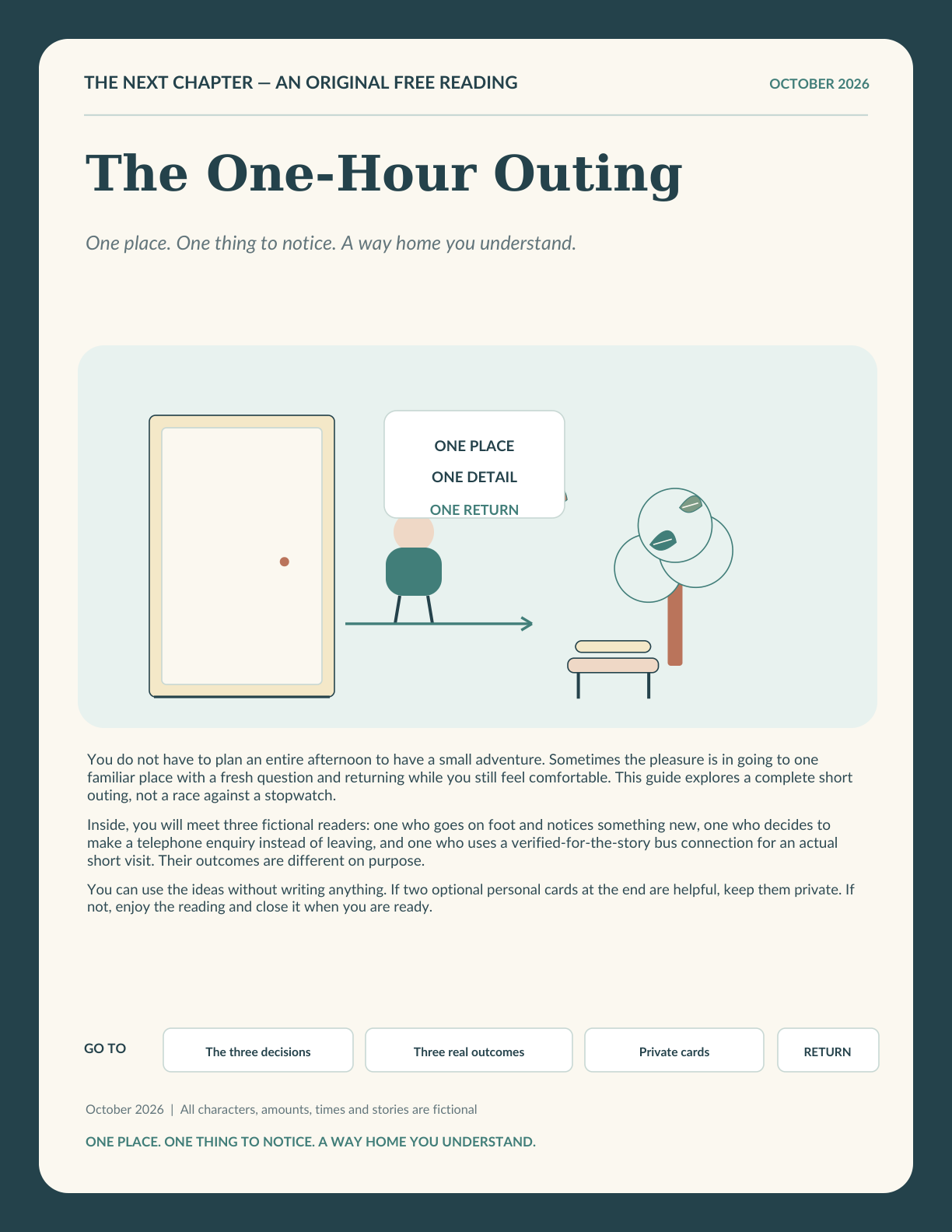
One place. One thing to notice. A way home you understand.
You do not have to plan an entire afternoon to have a small adventure. Sometimes the pleasure is in going to one familiar place with a fresh question and returning while you still feel comfortable. This guide explores a complete short outing, not a race against a stopwatch.
Inside, you will meet three fictional readers: one who goes on foot and notices something new, one who decides to make a telephone enquiry instead of leaving, and one who uses a verified-for-the-story bus connection for an actual short visit. Their outcomes are different on purpose.
You can use the ideas without writing anything. If two optional personal cards at the end are helpful, keep them private. If not, enjoy the reading and close it when you are ready.
A small trip can still feel like a trip
An outing is often described as an occasion. We dress for it, coordinate calendars, look for somewhere worth seeing, consider a meal, and imagine the photographs we might take. These can be pleasures. They can also make the idea of leaving home feel larger than it needs to be.
Imagine an ordinary Tuesday. A certain tree near the corner has been changing color, and you would like to see it from the other side of the road. There is no festival. You need no reservation or specialist equipment. You simply want to step outside your usual rooms, notice something real, and come home. Perhaps you see the tree. Perhaps you discover that the corner is noisier than you remember and choose a different approach another day.
The outing is not defined by how impressive the destination sounds. It is defined by what you actually did. Going to one accessible public place, observing one detail, and returning can be a complete experience. Reading the same street through a window is pleasant too, but it is not an outdoor trip. Making a telephone call to check a bus connection is useful planning, but it is not a trip either. Those distinctions are not judgments. They are ways to keep an honest record of your experience.
The title's one hour is a frame for deciding what might fit, not an achievement to pursue at any cost. A safe twenty-minute walk may fit the idea better than a supposedly sixty-minute excursion with an unreliable return. A necessary appointment does not become optional just because this guide suggests a small pleasure. It can wait.
Think of this as a compact invitation: perhaps there is a place you already know that deserves one more look. You can make that look its own event.
Three decisions, not a long itinerary
Many itineraries begin by adding. First a café, then a gallery, then a shop, then lunch nearby. This one begins by taking away. It asks you to make only three decisions and to leave the rest alone.
One place. Pick a particular destination you can locate and reach lawfully: a public bench, an accessible part of a public library, a shop window you can view from a permitted pedestrian area, or a suitable place in a nearby park. Avoid relying on assumptions about opening hours, entry requirements or the availability of toilets or seating. When those details matter, verify them beforehand using a trustworthy current source or the organization itself.
One observation. Decide on a simple thing you would enjoy noticing. Is the first autumn leaf on a familiar tree changing? How does morning light enter the library's public reading area? Has the mural at the square acquired a new detail? A good observation is specific and not a task someone will grade. You are not collecting evidence for an article or completing research for an institution. You are lending your attention to a place for a few minutes.
One return. Know how you would come back, and where you can stop or turn back before reaching the destination. An outbound route alone is not a finished plan. If someone else will collect you, their agreement is needed; an imagined lift is not a ride. If a service determines your return time, confirm the applicable current schedule and any booking conditions rather than treating a timetable in a fictional story as usable in the real world.
Keep all three decisions small enough to remember. If one is missing, you can pause. Sometimes the most sensible one-hour activity is to discover why the trip should not be attempted today.
The door-to-door clock
A common planning mistake is to count only the interesting part. The destination is fifteen minutes away, so the outing is assumed to take fifteen minutes. But the outward journey and the return journey both belong to the trip. So do the time spent finding a seat, checking a route, or handling an ordinary delay.
Try thinking in four parts: outward, at the place, return, and extra room. The extra room is not a target to consume. It is a margin that makes a decision less fragile. One fictional example might allow eight minutes outward, eighteen minutes at the place, nine minutes returning, and ten minutes of uncommitted margin. Eight plus eighteen plus nine plus ten equals forty-five minutes. The remaining fifteen minutes of a sixty-minute window are simply unused; no one must fill them.
That example only works when the travel estimates, opening conditions and return arrangement are appropriate to the actual person and day. It is not a universal ratio. For somebody living outside town, the drive or transit journey to even the nearest suitable destination may take more than an hour altogether. Their small outing might require a different time window or a different activity. It is better to change the frame than to hurry through an unsafe connection.
In addition, include everything that happens between your door and the place: reaching the stop, waiting for the correct accessible service, entering a building or finding a legal crossing. If you use a mobility aid or travel with someone who needs support, use the real time and arrangements you need. The schedule is meant to serve you, not the other way around.
One useful question is: What time do I want to be comfortably back, and what would make that realistic? Start there. Work backward, and leave room to change your mind.
The return is part of the invitation
Sometimes getting there is straightforward and getting back is not. A friend can drive you to a garden, but cannot promise a ride home. A bus travels outward before lunch, but its afternoon service is uncertain. A beautiful path begins beside a busy road, and you have not identified a comfortable place to cross. An accessible entrance is described on a website, but you do not yet know whether the entrance you will use is available that day.
None of these is a small technicality. A pleasant destination is not enough to establish a suitable outing. The return has to belong to the plan from the beginning. That does not mean travel must be predictable down to the minute. It means you have checked the parts that matter instead of quietly turning uncertainty into a promise.
When the return is unresolved, there are several legitimate decisions. Contact an operator or host through an official channel. Consider a different destination that does not depend on the missing connection. Allow a longer, unhurried outing on another day. Ask a companion whether they are actually willing and able to travel both ways. Or stay home today. A postponed trip is not evidence of laziness, and it does not owe you a compensating adventure.
A simple way to write the distinction is: confirmed for my circumstances, still to ask, and not suitable today. Do not silently move information from the second or third category into the first. In particular, the existence of a map or a route description does not certify safety, personal accessibility, or current service operation.
If you need individual medical or mobility guidance, this booklet cannot provide an assessment. Choose according to your own circumstances and appropriate professional guidance where necessary. The point of a very small outing is pleasure with a credible way home, not proof that you can push through an obstacle.
Different ways of reaching one place
A short outing does not have a preferred method of transport. For one person, walking a few blocks is the most appealing part. For another, a ride to an accessible public place makes a brief visit possible. Someone living outside town might consider public transport, a confirmed lift, or a suitable car journey. The method is not a measure of independence or merit.
If you walk, be realistic about the whole path. Consider legal crossings, lighting, weather, rest opportunities, the return distance and anything relevant to your own mobility. A person who can comfortably travel outward on a pleasant morning may not want to retrace the same path after standing for a long time. You can decide to turn back early or keep the destination very near.
If you use public transport, find out which stop, service direction, fare, transfer, waiting time and return trip would actually apply. The fare shown in this booklet's invented examples is not a current fare anywhere. A schedule that looks efficient on paper may include a long wait or a difficult connection; if it cannot be verified, do not call the ride arranged. Costs you are merely estimating are not costs already paid.
If you use a car or somebody else's ride, count parking, boarding, finding the right entrance, and the full journey home. Do not assume an available driver or safe parking without confirmation. If a particular activity or route feels unsuitable, changing the plan is preferable to forcing it into an artificial sixty-minute limit.
The destination might be only a few minutes away or far enough away that this format does not fit. Either result is useful knowledge. A guide titled The One-Hour Outing cannot make the world one hour wide for everyone.
Give your attention one little job
Once you reach a place, the habit of doing more can take over. You are at the library, so perhaps you should browse every shelf. You are near the gardens, so perhaps you should walk the whole circuit. You have traveled to the square, so perhaps you should buy something to justify the journey. All these ideas are optional. None must be attached to your chosen outing.
A single observation provides a quiet purpose without turning the visit into a project. At a public bench, you might notice where the afternoon shadow falls. Through a shop window, you might look at how an everyday object has changed over the years. In a library's open public space, you might choose one photograph or one sentence on a display to consider. If nothing catches your attention, noticing that fact is enough too.
Here are three questions that stay light: What surprised me? What looked different when I gave it a little time? What would I like to remember? You do not have to answer all three. You are not performing fieldwork on behalf of anyone. You may leave without recording anything at all.
There are places where taking photographs or making recordings is restricted. Respect posted rules, staff instructions, other people's privacy and any relevant permissions. In public areas, avoid treating strangers as scenery to be collected. A written phrase for your own memory may be more satisfying than a photograph of somebody else's day.
One observation can make a familiar route feel different. It is a way of arriving in the moment, not a requirement to produce something from it. If you see only a single ordinary leaf and that is enough for you, the visit has earned its place in the day.
Lena actually goes, and comes home early
Lena's story is invented. She lives near a public planter she has passed for years without much thought. On one particular mild morning, she wants to see whether its leaves have started to redden. The footpath is familiar, the legal crossing is appropriate for her, and she has checked that the short journey is suitable for her circumstances that day. She has no appointment and is not depending on anyone to collect her.
At 10:10 a.m. she leaves her door. At 10:16, she reaches the planter and finds a quiet permitted place to stand. The red leaves are there, though only at the edge of the plant. She spends part of the visit looking at how the color begins along the veins. She also notices a small repaired section of the paving that she had somehow never seen before.
At 10:34, she turns toward home. She is back inside by 10:43. Her whole door-to-door outing lasts 33 minutes, not sixty. She has visited one place, noticed one main thing, and made a straightforward return. In this fictional example she bought nothing, used no paid transport and incurred $0 new cash expenditure.
Lena did not accomplish a health target. She did not complete a route challenge, produce a report or add a new commitment to her calendar. There is no claim that her route would be suitable for another person or even for Lena on a different day. What happened was smaller: she left, she looked, and she came home while the visit was still pleasant.
When someone asks later what she did, she replies, "I went to see the leaves. I had forgotten how much changes on one branch." It is enough of a story because it is true within her imagined day.
What Lena's outing does—and does not—prove
It would be easy to turn Lena's visit into a lesson about what everyone should do. That would spoil its particular usefulness. Her story supports only modest observations about an experience that the imaginary conditions allowed.
What she actually did: she left home at 10:10, reached one public place at 10:16, left at 10:34 and returned at 10:43. It was a genuine, short outing. She spent thirty-three minutes door to door and did not pay for a ticket, purchase a drink, or hire transport. The story presents no unreported expenses.
What she observed: a partial change in leaf color and a repaired piece of paving. She did not check every tree in the neighborhood or establish that the whole town had reached the same season. Her discovery was a personally satisfying detail, not a scientific or civic survey.
What she did not do: she did not make a promise to go every Tuesday, prove that the route is safe for everyone, test a bus, or establish a universal minimum length for an outing. The appealing simplicity of her example depends on the fact that the return was short, known and reasonable for the fictional Lena.
The distinction is liberating. We do not need to inflate an ordinary pleasure to defend it. If Lena had turned around after three minutes, she would still have been entitled to call that a sensible choice. If she had decided not to leave because of unsuitable conditions, there would be no completed outdoor visit to report, but the decision could still be well made.
Rather than asking, "Was it a successful sixty-minute outing?" ask, "Was this a worthwhile use of a little time, given what was actually possible?" The second question keeps the person, rather than the number, at the center.
Noor discovers that today is not the day
Noor, another fictional reader, lives outside a small town. A community display sounds appealing. The brochure makes it look close, but the distance between Noor's door and the town center is not the whole problem. The outbound bus seems possible. The published return details are unclear to Noor, and there is no confirmed alternative ride home.
It is tempting to reason that the display itself would take only twenty minutes. Noor might spend the rest of the hour in transit and still call it a compact outing. But the arithmetic is incomplete: a one-way possibility is not a round-trip plan. Noor would also need to account for the stop, any waiting, getting to and from the venue, and any booking or accessibility conditions that matter to Noor. Those parts cannot be guessed away.
Noor stays home and spends twelve minutes making an enquiry through an official contact channel. The question is simple: "Could you tell me the current return options for this day, including any booking requirements?" The response does not establish a suitable same-day journey. Noor does not book anything, travel anywhere, or pay a fare. Actual new expenditure: $0. Actual outing: none. The twelve minutes are a useful piece of inquiry, not a disguised trip.
Noor might later arrange a different day, a confirmed two-way lift, or a more generous time window. None is promised or counted as already done. Noor also has the option to decide that this particular display is not worth the effort. An unconfirmed return is a reason to change a plan, not to interpret the missing information optimistically.
Noor's story is not as picturesque as Lena's red leaves. It may be more useful for someone whose nearby destinations require complicated transport. A person who recognizes the limit of the proposed outing has not failed the experiment. They have found the precise unanswered question that made the original plan unsuitable.
When the enquiry is the whole activity
A pleasant idea can generate a useful question even when it never becomes a visit. Noor wanted to see a display. The enquiry revealed a missing return arrangement. Nothing prevented Noor from being interested; the particular travel plan simply was not ready. Calling this "a wasted day" would suggest that merely recognizing a problem has no value. Calling it "a successful outing" would be equally inaccurate. It was a useful home-based enquiry, and the display remained unvisited.
The distinction matters most when we are tempted to reassure ourselves with an invented solution. "Someone will probably be able to drive me" sounds like a plan, but no one has agreed to drive. "There must be another service" may be true, but it is not a verified booking. "I will just wait at the stop" treats the existence of a place to wait as proof that suitable transport will arrive. When the consequences of an incorrect assumption could be significant, guessing is not an adequate bridge.
If the idea remains attractive, Noor can keep only the unanswered question: Which actual two-way travel arrangement would work for me? That question can be asked on another day if Noor chooses. There is no obligation to turn an enquiry into a paid transaction. An official operator, venue, friend or qualified source may be able to clarify a relevant part, but do not assume they have done so until they respond.
There are also destinations that simply do not fit a sixty-minute outing from your home. That is a fact about time and geography, not your willingness. You might visit on a different occasion with more room to enjoy the place, or choose a closer point of interest instead. A one-hour idea should make ordinary life more inviting, not make inconvenient distances disappear on paper.
Jules visits one small display
Jules is a third entirely fictional reader. On a day when the applicable transport service, return trip and library opening have been confirmed for the story, Jules decides to visit a small public display in a library. They check the door-to-door route rather than assuming that a ten-minute bus ride is the whole journey. The example includes the waiting and walking that Jules needs, without suggesting that its schedule or fare exists in any particular real place.
Jules leaves home at 2:05 p.m. and reaches the public display at 2:14. They spend a few minutes reading a caption about a collection of old postage stamps. One stamp has an oddly simple design: a bird drawn almost entirely with three lines. Jules does not inspect the entire display and does not borrow a book. They enjoy the idea that a few marks can express something recognizable.
At 2:37, Jules leaves to make the confirmed return connection. They are home by 2:48. The complete door-to-door visit lasts 43 minutes: nine minutes outward, twenty-three minutes at the library, and eleven minutes home. Jules paid an invented $3 fare in each direction, so actual new expenditure within the story is $6. There are no other purchases, bookings or entrance charges in this fictional example.
Jules could have stayed longer at the display, but doing so would have changed the agreed travel frame. Their chosen return was not a punishment or proof of discipline. The display had offered one satisfying detail. Jules preferred to leave while the route home was still straightforward.
It would be wrong to conclude that a similar public library near you is open, that it has a free display, that buses run at those times, or that any real round trip costs six dollars. These were invented circumstances chosen to illustrate how a short visit can be complete when its logistics are genuinely confirmed for the traveler.
Three days, three honest descriptions
Lena, Noor and Jules do not form a ranking. They illustrate three different answers to a practical question: What was suitable and genuinely done today?
| Fictional reader | What actually happened | Door-to-door outing | Actual new cash spent | |---|---|---|---| | Lena | Walked to one public planter, observed leaves, came home | 33 minutes | $0 | | Noor | Made an official enquiry at home; no suitable return confirmed | None (12-minute call) | $0 | | Jules | Visited one library display and used the confirmed fictional return route | 43 minutes | $6 |
Lena and Jules had outings. Noor did not. Noor still made an informed choice. The two visits used less than one hour, and neither visitor needed to linger merely to reach sixty minutes. Jules's cost is a completed expenditure in the imagined story; a fare only mentioned as a possible price would not be spending.
Notice what all three stories leave unproven. None establishes that short outings improve health, guarantee companionship, reduce anxiety, or suit every adult. None promises that a public facility will be open or a journey accessible to any specific reader. The examples also do not demonstrate that a destination must cost money or that free activities are inherently preferable. They simply show how a person might match one desire to one plausible action and name the result accurately.
There is value in this modest standard. We often diminish a small pleasure because it lacks a dramatic destination. We also sometimes describe an intention as an accomplishment to reassure ourselves that the day was not empty. Neither habit is needed here. A little walk may be sufficient. A useful phone call may be sufficient. So may deciding that no outing belongs in the day. Each deserves its own truthful sentence.
Start with the comfortable return
If you would like to try an outing of your own, begin with a question that is not very glamorous: When do I want to be back inside? The answer can be flexible. It might be before a family call, before the light changes, or simply while the outing still feels pleasant. It can also be "I am not going today." This guide cannot decide what timing is appropriate to your personal circumstances.
From that preference, work backward. Is there a reachable place you want to visit? How long would the full return reasonably take with the route and support you actually have? What is the last sensible point at which you could turn back without losing your known way home? Is there a needed check about opening, services, permissions, weather or accessibility? If any essential point is unknown, ask first or simplify the plan.
A turn-back point is not necessarily a street corner or a particular physical landmark. It might be a clock time by which you will decide whether to continue toward the destination, or a condition such as "if the expected return transport is not confirmed, I won't leave." It is a decision aid, not a substitute for assessing travel safety or obtaining suitable assistance.
For a walk, a very modest route from home may be sufficient. For a trip requiring a vehicle, waiting and boarding time can take most of the hour; there may not be any reasonable way to make the trip this short. Avoid compressing your schedule to satisfy the booklet's title. Allow yourself a longer experience another day if that would be better.
You do not need a printed itinerary for this. Three ordinary phrases may do: "I want to see the planter. I know the suitable path home. I can turn back whenever I choose." If the second sentence is not true, it is time to revise the idea, not to pretend certainty.
The same place is not the same every day
A destination that worked last week may be different today. Weather changes the usefulness of a path. A public room may close unexpectedly. Construction can affect an entrance. A comfortable resting place can be occupied or unavailable. The route that feels ordinary in daylight may be unsuitable to a reader at another hour. Circumstances also change within the traveler. No short article can certify the result in advance.
The purpose of checking conditions is not to make an everyday outing complicated. It is to keep confidence attached to facts. If the weather is poor for your circumstances, a short outdoor walk might not be desirable. If the library is closed, you can choose not to travel. If a needed facility or accessible entrance has not been confirmed, a phone call may be the sensible activity for today. Every change can be a reason to alter the plan without embarrassment.
Think of a three-way choice. First, go as planned if the relevant conditions are known and appropriate. Second, substitute a genuinely accessible and appealing nearby option if you can confirm the new arrangements and wish to use them. Third, remain at home or postpone. The third path does not need to be justified by having completed an alternative chore.
Do not treat a pleasant illustration of a bench as a statement that benches exist along every route. Do not rely on invented service times, fictional fares or a map that has not been verified for actual travel. If you need a professional assessment of personal mobility, vision, driving or other health-related considerations, seek suitable individual advice. This reading cannot assess those conditions.
The best adaptation may be surprisingly small. Instead of visiting a distant display, you might watch the changing light through your own window today and plan a suitable public visit on another day. That window moment is not the outing promised in the title. It is still a valid way to enjoy your time.
Turning back belongs in the story
The most useful part of a one-hour plan may be the freedom to abandon it. Imagine reaching a corner and discovering that the route is less comfortable than you expected. Or imagine arriving at a venue where the public space is unexpectedly crowded, where the entrance you intended to use is not available, or where a queue changes the return timing. You do not have to convert those changes into a challenge.
You can turn around. You can return before reaching the observation. You can ask a relevant person for current information from a safe position. You can choose not to travel. How you respond should depend on your actual circumstances and the appropriate support or guidance you may need. Nothing here advises ignoring a safety concern or attempting an unsuitable route.
There is a common temptation to describe the day according to its original plan: "I visited the library." If you never got there, a truer description is, "I set out, found the route unsuitable, and went home." If you made only an enquiry, say that. This is not pedantic. Accurate descriptions help us learn what a future plan would need, and they stop a modest disappointment from becoming a false promise to ourselves.
Sometimes a friend may urge you to make the most of the day because you have already put on your coat or spent time preparing. Preparation does not oblige continuation. Nor does an actual fare already paid require you to ignore an important concern simply to avoid "wasting" the money. Money already spent and decisions still ahead are different things.
You are not accountable to a stopwatch. An outing is an opportunity, not an exam. Your right to stop is part of the design, and a cheerful return after twenty minutes can be an excellent ending to an ordinary morning.
What you might remember afterward
An outing may leave a surprisingly small souvenir: the angle of the light, a phrase on a public display, a detail on a familiar building, or the sound of leaves against a railing. Sometimes it leaves almost nothing, and that too is a real outcome. You do not need to photograph, publish or measure it.
If a quiet note would be pleasant, keep it to three lines. What I actually did. What I noticed. What I might change. The first keeps intention and action separate. The second gives one ordinary detail its rightful place. The third is optional and does not require you to make a repeat booking.
For Lena, the lines might read: "Walked to the public planter and returned in thirty-three minutes. Saw red leaves beginning at the edges. Nothing to arrange for now." For Noor: "Called about a possible return connection for twelve minutes; no outing taken. Learned that the return remained unresolved. Ask again only if I still want to go." For Jules: "Visited a display and returned in forty-three minutes; paid six dollars in fictional fares. Remembered a bird drawn with three lines. No next trip booked."
These are records of imaginary experiences, not testimonials about the benefits of going out. Their usefulness lies in ordinary precision. We do not have to inflate a short day into a turning point or reduce it to a number on a calendar.
The optional cards on the next two pages give you more space if you want it. They can be used before and after an outing, for a plan you later postpone, or not at all. Keep any real notes privately; do not write sensitive personal information in a shared PDF or in a form someone else will receive.
If you would rather close this reading now and see what the afternoon brings, you already have the central idea: a little attention, a credible return, and permission to be finished.
Optional private card: Before I consider going
This is for your own use, not a reservation form. Write only if you wish. Keep it private; do not enter addresses, contact details, account numbers, medical information, access codes or other sensitive facts. An empty card is perfectly fine.
1. One public place I might enjoy (a general description is enough):
2. One small detail I would like to notice there:
3. A suitable full outward-and-return arrangement, if truly known:
4. An important opening, route or support detail still to check:
5. My preferred return-by point or comfortable turning-back decision:
6. My decision today—go, ask first, choose something else, or stay home:
The card is about deciding, not committing. A place written in the first line has not been visited. A transport option written in the third line should not be treated as confirmed unless you actually checked the relevant current arrangement. If you discover that the outward and return trip cannot fit a comfortable interval, change the idea rather than racing the clock.
No one needs to see this card for the guide to be useful. You may use a few words in a private notebook or simply remember the questions.
Optional private card: What really happened
Use this only after an enquiry, an actual visit, or a decision to remain home. Do not turn plans into completed activities. No sensitive personal details, private contact data or financial identifiers are needed.
1. Did I actually go outside for this outing, make an enquiry only, or neither?
2. If I went, the approximate full door-to-door time I really used:
3. One thing I actually noticed, or a useful question I discovered:
4. Actual new cash I spent, if any (not proposed prices or unbought items):
5. Anything important that remained unconfirmed or was not booked:
6. My choice now—leave it there, change it, or consider another day:
For example, Lena could note 33 minutes / $0, Noor enquiry only, no outing / 12-minute call / $0, and Jules 43 minutes / $6 paid. They would not claim their unmade visits or imagined future bookings as completed. They would not need to list where they live or attach a route map containing private details.
If a form starts to feel like homework, ignore it. The best souvenir of a small outing may be something you never write down.
The door can open for one small thing
We often imagine pleasure arriving with an event: a ticket, a plan, a photograph from somewhere far away. But an ordinary life contains smaller doors. A tree may have changed since yesterday. A small public display may hold one surprising detail. A familiar street may look different when we go there with time to notice rather than an errand to complete.
Lena stepped outside and came home with the memory of red leaves. Jules saw a bird drawn with three lines and returned on the service they had confirmed in the imagined story. Noor did not take the proposed trip at all. Noor made one useful enquiry and kept the right not to force an uncertain return. These endings are not grades on a test. They are honest responses to distinct circumstances.
Your own outing need not last sixty minutes. It might be brief, revised or never attempted. You do not have to buy a ticket, justify the time, perform a healthy habit, prove independence, post a photograph or create a repeat schedule. You need one desire that matters to you, the circumstances for a suitable journey if you choose to take it, and an understood way home.
And if your home is where the day should be spent, there is no need to pretend you traveled. A pleasant afternoon indoors is not a lesser form of living. This reading merely offers the possibility that another small doorway may be waiting when the conditions suit you.
Sometimes a memorable afternoon begins with the smallest sentence in the world: I would like to go and look at that.
You may go. You may wait. Either way, the decision is yours.
THE NEXT CHAPTER
Small pleasures. Real choices. A life that still belongs to you.