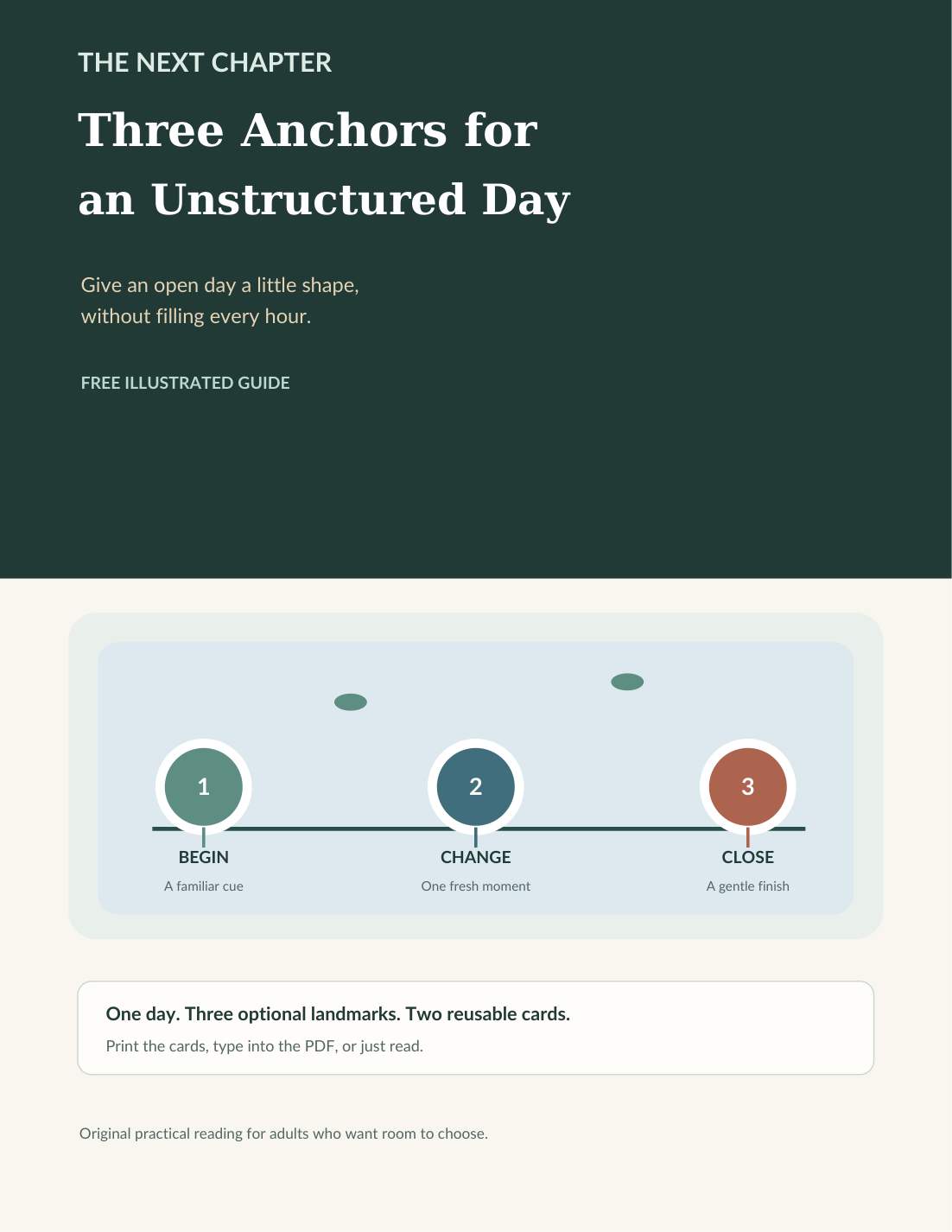
A gentle guide to giving an open day a shape without turning it into a timetable.
A free, illustrated reader from The Next Chapter. Includes two optional cards you may print or type into.
An open day is not an empty one
The first morning without a familiar work timetable can feel like a gift. On another morning, the same openness may make it difficult to decide where to begin. Some people enjoy days without plans; others prefer a little structure. Many feel differently from one day to the next. There is no single correct response to a less structured life.
A day need not contain an impressive achievement to be worthwhile. Preparing a meal, looking through a window, speaking with someone, sorting one small drawer or doing nothing in particular can all belong in an ordinary day. The question in this guide is narrower than how to organise your entire retirement: Would three gentle points of reference make one day easier to inhabit?
We will call those points anchors. An anchor is a moment you can recognise, not an appointment you must keep. You may already have one or two without noticing them. You can choose a beginning, one change of attention somewhere in the day, and a modest closing cue. None needs to happen at a fixed hour.
Try the idea on one ordinary day. There is no seven-day challenge and no need to repeat it. If your day is already comfortable without anchors, you can leave the idea behind. The goal is more choice, not more supervision.
Three anchors, plenty of room
Imagine three stones set a comfortable distance apart on a path. They mark where you are, but they do not tell you how quickly to walk or what to do between them. The spaces are part of the path, too. That is the spirit of these anchors.
A beginning anchor says, “My day has started in a way I recognise.” It might be sitting with breakfast, opening the curtains, feeding a pet or making a cup of tea. It is not a required wake-up time.
A change-of-attention anchor turns your attention toward something other than the previous part of the day. You might step onto a balcony, visit the library, listen to a radio programme, read a few pages, or contact a friend who welcomes your call. It does not have to be exercise or a social outing.
A closing anchor says, “This part of the day can be left here.” It could be washing a cup, putting away a project, changing the music or noting one pleasant detail. It is not a prescribed bedtime or treatment for sleep problems.
These are three kinds of reference point, not three tasks to finish. If one anchor is enough, use one. If an important commitment already divides the day naturally, there is no reason to create another.
Notice what already gives your day shape
Before you add anything, picture a recent ordinary day. You probably did more than the day first seems to contain. You may have opened the door for a delivery, made lunch, watered a plant, helped someone, read a local notice, or watched light move across a wall.
Some of those moments may already be useful anchors. Ask three quiet questions: What made the day feel underway? What changed my attention? What told me I could stop or move on? You do not need to recall every hour or judge whether you were productive.
Consider a fictional Tuesday. Iris eats breakfast near the window. Later, she steps outside to see whether a small plant needs water. Before supper, she puts a newspaper in the recycling. Her day has a beginning, a change of attention and a closing cue without a schedule or a new purchase.
An anchor should be ordinary enough to happen naturally, but not so important that missing it feels like failure. If breakfast changes because a visitor arrives, it can still be a good day. If the plant does not need watering, simply looking at it may be the moment of attention. Keep the person in charge, not the marker.
Start with a welcoming beginning
A beginning anchor works best when it belongs to your real circumstances. A morning can start later than expected. Someone who works part time, cares for another person, or has an appointment may begin with a different rhythm. There is no advantage to borrowing somebody else's ideal morning.
Try naming an action rather than a time: “After I make my first drink, I will sit for a moment,” or “When I finish the essential morning errand, I will open my book.” The words after and when describe a natural sequence, not a clock alarm.
A beginning can be very small. You could open the blinds to look at the weather, place the day's letter on the table, or select a piece of music to hear while you prepare breakfast. If an outing is planned, you might check its actual location and leave yourself enough time for travel. An appealing routine is less useful if it requires inconvenient supplies or a rush.
Try this: Finish the sentence, “My day often feels started when I ______.” Then ask whether you want to keep that moment just as it is. You do not need to invent a better one.
Make room for one different moment
The middle anchor is an opportunity to turn your attention, not a demand to go out. It might introduce a person, a place, a subject, a small task or simply a different view. The change matters more than the size of the activity.
If you enjoy being outdoors, your anchor might be sitting near a window or spending a few minutes in a garden. If you like company, it could be calling someone with whom you already have a comfortable arrangement. If you prefer solitude, a library book, a familiar song or a sketchbook can create a satisfying shift. None is inherently better than the others.
Be specific enough that you know what you mean. “Do something interesting” leaves the whole decision unresolved. “Read the next two pages of the local-history book if I feel like it” gives you a real option. The phrase if I feel like it is not a loophole; it preserves ownership of your day.
If the anchor depends on another person, location or service, check whether it is welcome and actually available. Do not assume a programme is running, a neighbour is free or a public building is open. An at-home alternative is useful precisely because outside conditions can change.
A closing cue without a deadline
By late afternoon or evening, a day can feel unfinished because there is always another small task available. A closing anchor need not declare that all work is done. It simply marks a moment when you may stop carrying one part of the day forward.
Imagine moving a finished book from the table to a shelf, returning a borrowed item to its place, putting away the knitting, or turning off a lamp in the room where you spent the afternoon. Another person might enjoy writing one ordinary sentence: “The best thing I noticed was the rain on the windowsill.” You do not have to keep a daily journal.
A closing cue can happen before dinner or later, depending on what your day contains. It does not measure sleep quality, screen time or any medical outcome. If you need advice about symptoms, sleep or treatment, seek a qualified professional rather than using this guide as a health plan.
One useful test: Does this cue feel like permission to finish, or does it feel like another chore? If it feels like work, choose something smaller or leave it out. An anchor serves the day; the day does not serve the anchor.
Use words that bend, not rules that snap
The wording of an anchor can decide whether it helps or irritates you. Compare “Every day at 9:00 I must walk for half an hour” with “After breakfast, I might step outside or enjoy the view.” The second phrase leaves room for different weather, interests and circumstances. It is an invitation, not a physical-activity prescription.
A helpful anchor names one recognisable cue and one appealing option. For example, “When I clear lunch, I may call a friend or listen to the afternoon broadcast.” Avoid making several activities depend on one another. If the call cannot happen, the whole day should not collapse.
There is also a difference between a commitment and an anchor. Picking up a family member at an agreed time may be a real commitment that must be honoured. Reading beside the window is optional. Keep real promises and obligations clear; do not label an obligation optional merely because you are simplifying your day.
When you write your own anchors, use language you would be comfortable reading on a difficult or interrupted day. “When there is room” may work better than “without fail.” You are designing a small aid to attention, not a rulebook for your future self.
A good day can stay entirely at home
A full outing is not the entrance fee to a meaningful day. Travel may be inconvenient, the weather may be poor, a shared vehicle may be unavailable, or you may simply prefer home. An at-home anchor can be as concrete and engaging as one involving tickets or appointments.
Here is a day with no purchases and no promised visitors. After breakfast, someone chooses the first song on an old playlist. Later, they arrange three postcards on a table and remember where they came from. Before settling into the evening, they put the cards back in a small box. The three moments give the day a gentle shape without scheduling anyone else.
You can change the subject entirely: a plant, a cooking idea, a chapter in a book, a puzzle, a craft or the light outside your door. Choose what appeals to you rather than what sounds admirable to other people. A person who does not like hobbies does not need a hobby to complete a day.
If a place or activity has access requirements, they are individual matters to check, not things that can be inferred from age. A different comfortable option at home is a real choice, not an inferior version of a day.
When other people's plans fill the middle
Not everyone has an uninterrupted day to design. You might share a home with a person who works shifts, help a relative, take occasional paid work or have appointments whose timing changes. In that situation, your three anchors can be extremely modest and deliberately movable.
Suppose an afternoon telephone conversation is your preferred change-of-attention anchor. If a relative needs a ride at that time, the call can move or be skipped. The ride remains a real obligation; the personal anchor does not compete with it. If a friend has agreed to speak with you, however, a change should be communicated rather than silently ignored.
Another approach is to place anchors around transitions that already exist. The beginning cue may come after a completed errand rather than in the early morning. The middle cue may be reading a page while waiting for an appointment. The closing cue may be putting a shared table back in order after a busy afternoon.
An anchor is not a way to hide how much unpaid work you do for others. If the balance of responsibilities is difficult, a conversation about those responsibilities is a separate, important matter. This free guide concerns one day's optional points of reference, not household negotiations or a full weekly plan.
Keep costs and travel visible
Small anchors are easier to try when you know what they ask of your time and money. A free activity may still involve transport, equipment or a ticket to reach the venue. Conversely, sitting with a book you already own can cost nothing additional.
For an outing, write down the real admission or guest fee, return transport, required supplies and the total time from leaving to arriving home. Confirm the current details with the actual organiser; an old online listing is not an approved booking. Do not count a price you saw for a possible future visit as money already spent.
For example, a wholly fictional library outing has no entry fee, a CAD 3 bus fare in each direction and no purchases: CAD 3 + CAD 3 = CAD 6 actually spent. The figure is an arithmetic example, not a quoted fare for a particular town. If the bus were unavailable or the building closed, the visitor could use an at-home alternative without failing the anchor.
An anchor is not worth a financial strain merely because you wrote it on a card. A satisfying day can use the things and places already available to you. You do not have to pay to prove that your time matters.
Let interruptions be ordinary
A telephone call runs long. An appointment is rescheduled. Heavy rain changes a plan to sit outside. A family member comes by unexpectedly. An anchor has done its job only if it can survive events like these without making the day feel spoiled.
You have several valid choices. Keep the anchor but make it smaller. Move it to another part of the day. Replace it with a nearby alternative. Or skip it completely. You do not have to compensate by squeezing two anchors into the evening or starting a formal habit tracker tomorrow.
A short example: A person hopes to visit the library, but an earlier errand takes more time than expected. They choose ten minutes reading at home instead. Another day, they may try the library. The at-home moment is not a pretend visit, and the unmade journey has no cost to add to the day's spending.
If a real commitment is cancelled, follow any applicable cancellation or notification terms. The flexibility of these personal anchors does not cancel obligations to others. Write “changed” rather than “failed” beside an optional anchor. This single word often captures the day more accurately.
Mina's Tuesday: a small outing, no membership
Fictional example. Mina recently left a job that gave most mornings a familiar shape. She does not want to reproduce that timetable. She notices that breakfast by her kitchen window already feels like a beginning, so she keeps it as her first anchor.
For her change-of-attention anchor, she chooses a public-library visit to look through the local-history shelf. She checks the actual opening hours and her route before leaving. In this invented example, the visit is free, she already has the materials she wants, and her bus fares are CAD 3 each way. She spends CAD 6 in total. She does not buy a membership or commit to a class. The exact amount is fictional, not a local price claim.
Her closing cue is simple: after supper, she puts the borrowed book where she can find it again. The library is pleasant, but she decides not to promise another trip next Tuesday. She might go when she feels curious. Her anchors helped her recognise three moments of the day without filling the time between them.
Mina writes one useful observation: “Having somewhere I could choose to go was enough.” She does not need a more ambitious target. Her completed result is a day she enjoyed on terms she chose, not a new weekly obligation.
Robert's Thursday: sharing a busy home
Fictional example. Robert does some part-time work and shares a home with a partner whose timetable varies. He has an agreed afternoon errand for a family member, which is a real obligation rather than an optional anchor. He knows better than to put a strict personal schedule around it.
His first anchor comes after the morning essentials: he carries a cup of tea to a chair beside the window. For the middle, he imagines calling a friend, but the friend is unavailable. He instead spends a little time looking over the community newsletter he already has. His closing cue arrives when he puts away the papers before dinner. Nothing in this example costs him extra money or requires a new booking.
At first he thinks the day would count only if he had made the call. The written card helps him see the difference between the intention—a change of attention—and the particular method—a telephone conversation. The intention was met in another way.
Robert keeps a lesson worth remembering: “A movable idea is more useful to me than a rigid plan.” If the next Thursday looks entirely different, he has no obligation to repeat these anchors. They describe possibilities for one day, not conditions for being a good retiree.
My three anchors: a one-day card
Optional tool: print this page or type in the boxes. Leave anything blank that is not useful.
A beginning that already fits: What ordinary moment makes the day feel underway?
One change of attention: A person, place, subject, small pleasure or view I might welcome.
A gentle closing cue: Something that tells me I may leave this part of the day here.
An easy alternative: If my middle idea is not possible, what would be satisfying without it?
Any real obligation or cost to confirm: Actual appointment, permission, travel or cost - separate from my optional choices.
After the day: notice, don't grade
Optional tool: do not give yourself a score. A blank or changed plan is also an honest result.
What actually happened: Which anchors occurred, changed or were simply unnecessary?
One detail I liked: A sound, person, task, view or pause that belonged to this day.
What made an idea awkward: Was it a cost, an interruption, unclear permission or just not interesting?
Actual outing cost, if any: Count only amounts spent today; leave future possibilities separate.
My next choice: Keep one anchor, change one, try none, or decide later.
Keep the freedom that was there
You now have enough to try three anchors on one day. You also have permission to keep only two, one, or none. You can use this guide when the day feels too open, put it away when life is naturally busy, or return to it after a change of circumstances.
If you use the cards, keep them private unless you want to share them. They are meant to help you remember preferences and practical details, not to collect personal health information. If another person is involved, ask for consent before making a plan that assumes their time.
A helpful result might be “I loved having a reason to visit the library.” Another might be “I am content when I do not plan the afternoon.” Both are real learning. You do not owe anyone a completed worksheet, a series of successful days or an explanation for choosing nothing.
The three anchors are simply a beginning, a change of attention and a closing cue. The hours between them remain yours. This guide is general lifestyle reading, not medical advice or a promise that a particular routine will improve health, mood or sleep. Check local offerings and practical access with the relevant organisers.
Takeaway: Give one ordinary day three possible landmarks. Keep all the open space around them.