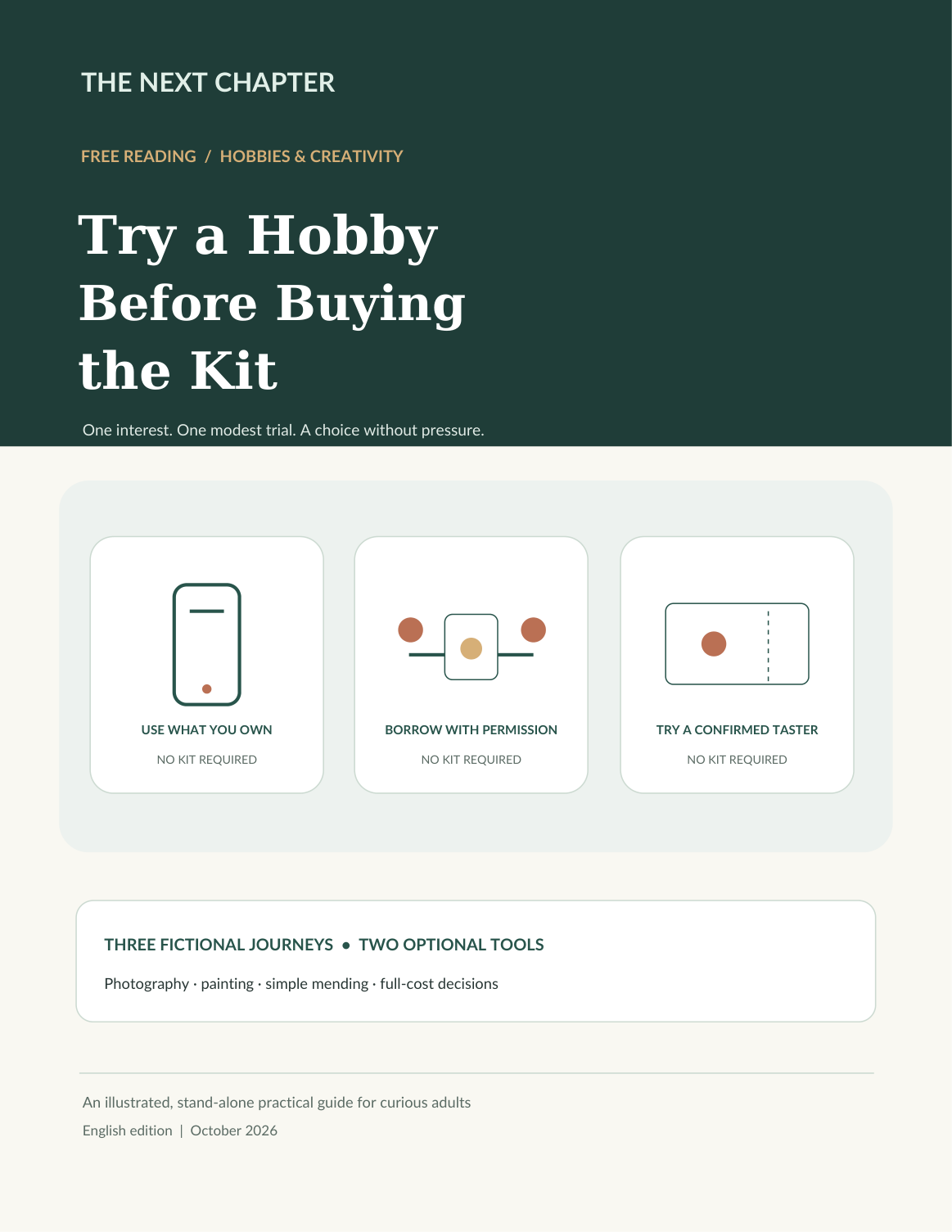
The Next Chapter
One interest. One modest trial. A decision you can make without buying a new identity.
A free illustrated guide for adults who would like to try something creative or practical, but would rather find out whether they enjoy it before purchasing equipment.
Start with the activity, not the shopping list
A new hobby can begin with a peculiar kind of homework: a list of things to buy. The shop window shows beautiful supplies. A beginner video starts with twenty tools lined up on a table. Someone who already loves the activity says, quite sincerely, that a better camera, brush or sewing machine will make everything easier.
Perhaps it will, later. But your first question is smaller: Would I like actually doing a little of this? You cannot answer that by buying the ideal kit. And a collection of equipment can become an uncomfortable reminder of money spent rather than an invitation to play.
This guide follows one interest at a time. Name the smallest enjoyable action, find a lawful and practical way to try it, notice what happened and decide whether to repeat, change, borrow, buy later or stop. All five outcomes count. A pleasant afternoon does not have to become a lifelong pastime.
You will meet three fictional adults. Etta tries photography without purchasing a camera. Sam attends one confirmed art-room taster with borrowed materials. Rowan revisits a basic mending idea and chooses not to buy equipment. Their prices and circumstances are invented examples, not local offers or claims about typical spending.
You may use the two optional cards near the end or simply keep three questions in your head: What do I want to try? What can I use without buying? Would I choose this again?
Make the first experiment smaller than the hobby
"Photography" might mean professional cameras, editing software, long walks or an album of family moments. "Painting" might mean brushes, canvases and a studio. "Sewing" might mean a machine, fitted clothes or an evening with a needle and a favourite worn shirt. Those are not one-size-fits-all introductions.
Choose an action you could finish in one short opportunity, not the identity of "photographer," "artist" or "maker." For instance: take five photographs of light on familiar objects; draw a single leaf with a pencil you own; try one instructor-led printmaking activity at a venue that actually provides the materials; or carefully examine whether a small repair is something you want to learn with proper guidance.
Name what appeals to you: the slow looking, the colours, the conversation, the satisfaction of making, or the quiet concentration. That answer matters more than whether the result could be framed, posted or given as a gift.
A useful first-trial sentence is: "I want to spend about ______ making or noticing ______, using ______ that I already have or can confirm is available." The blank is a preference, not a compulsory time target. You may want ten minutes or an afternoon. If there is no suitable opportunity today, deciding to ask a question first is a perfectly complete step.
Three ways in, none of them requiring a purchase
Door one: use something you already own. A phone you already use may be enough for a few photographs. Ordinary paper and a pencil may be enough to learn whether you like making marks. A notebook can be a first writing surface. Existing materials are not automatically fit for every activity, but they are a sensible place to look.
Door two: borrow, with real permission. A friend may be happy to lend a tool, or a library, makerspace or community group might have a lending or on-site-use programme. Do not assume such programmes exist near you. Ask what can be used, by whom, where, with what supervision, and what happens if something breaks. A friendly offer is not the same as open permission to take equipment home.
Door three: attend an explicitly confirmed introductory session. Some instructors and facilities include the necessary materials in a one-off fee; others charge separately or require registration. A taster is useful only if the actual host says it is appropriate for someone at your present level and confirms the full cost and conditions.
There is also door four: choose not to start yet. You might enjoy the idea more than the activity, need a more accessible arrangement, or prefer another season. That is not a failed trial. The point is to separate curiosity from commitment.
A borrowed tool comes with someone's trust
Borrowing can save money, but it can also create uncertainty. When an item belongs to someone else, agree what borrow means. Is it for use in the room, for a single afternoon, or for a specified period at home? Who demonstrates the relevant setup? Is there a deposit, consumable charge, replacement policy or membership requirement? Are you allowed to photograph or publish the result?
Do not use another person's sharp tools, powered equipment, specialised chemicals or unfamiliar devices without the necessary instruction, permissions and safeguards. This little book is a decision guide, not a woodworking, sewing, ceramics, chemical-handling or electrical-equipment manual. The provider or an appropriately qualified instructor must explain and supervise any activity where that is necessary.
Access matters too. A description such as "wheelchair accessible" may not describe the actual table height, entrance, toilet or work position you need. If a detail is essential, ask about that detail. If a host cannot confirm it, you can keep looking; you do not have to prove that you can manage an unsuitable arrangement.
It is fine to say, "Thank you for offering, but I would rather start with something simpler." Care for a relationship, a body and a borrowed object is part of choosing well, not an inconvenience to push past.
Count the outing, not just the entrance fee
"Free trial" might describe admission alone. It might not include getting there, parking, supplies, refreshments, booking fees or an amount you may have to pay if you cancel. An equipment loan might be free but need a refundable deposit. A one-time class might cost more than trying at home yet reveal more than a large untested purchase.
Before committing, write the actual quoted components and distinguish what is required, optional and unconfirmed. Include the round trip, not only the time spent doing the activity. For a fictional art-room trial, suppose a host explicitly confirms CAD 8 for one adult beginner session with paint and brushes supplied, and the return bus trip costs CAD 3 each way. The planned full cash cost would be CAD 8 + CAD 3 + CAD 3 = CAD 14. This is an illustration, not a verified programme or current fare.
Do not add the price of an optional starter set to money actually spent. A CAD 72 kit displayed on a shelf is a possible later choice, not a cost of the session if you do not buy it. Conversely, a deposit actually charged should be recorded honestly even if it might be refunded. You can note the later refund separately rather than treating it as a guaranteed zero-cost transaction.
The most useful comparison is often between one affordable, confirmed experiment and one larger purchase that can wait. A small trial is not always free; it is meant to be proportionate to your curiosity.
Ask a real host three clear questions
An online advert may say "all welcome" while the actual room is reserved for members, a class is fully booked or visitors are allowed to observe but not participate. A useful enquiry asks about the precise experience you want, not only whether a place is "beginner friendly."
Here is a message you can adapt:
Hello. I am interested in trying a little watercolour painting before purchasing supplies. Do you offer a single adult beginner session, with permission to use brushes and paint there? What are the full required fees, any booking conditions, and the best way to confirm seating and entry access? I would like to decide about further sessions afterward. Thank you.
It is also reasonable to ask whether you may observe rather than take part. Observation and participation are different permissions. The provider may have rules about photography, safeguarding, insurance, age eligibility, deposits or supervised equipment use.
If you receive an incomplete reply, ask one focused follow-up: "Does the fee include the materials used during the session?" If nobody can establish the terms, do not describe the place as confirmed and do not travel assuming you will be admitted.
Avoid sending medical histories, account information or unnecessary private details simply to ask about a first visit. If eligibility or specific support genuinely requires sensitive information, use the provider's appropriate official process and decide whether you wish to proceed.
A first try can be a complete experience
A short trial works best when it is allowed to remain short. Before it begins, know where you are going, whether the activity has been confirmed, how to leave, and what you intend to use. You do not need to buy supplies merely to look prepared. If borrowing equipment, return it in the agreed condition and at the agreed time.
While trying, notice an ordinary sensation: were you curious enough to continue for another few minutes? Did the materials feel pleasant or awkward? Did you enjoy the quiet work, or did you really enjoy the company? Did you need more instruction than the situation offered? None of those observations is a score for your talent.
You might find that the preparation is the interesting part. You might like the atmosphere of a studio but not the particular craft. You might enjoy photographing details yet dislike editing pictures afterward. It is useful to learn which part you would repeat, and which part you would rather skip.
Stop when an agreed session ends, when you choose to stop, or when a condition is unsuitable. This book cannot determine whether a specific physical activity is safe for you; consult appropriately qualified professionals for personal health or injury questions and the instructor for task-specific safety.
An activity can earn a second experiment without earning a major purchase. Enjoyment is information. So is a clear "not for me."
Replace "Am I good?" with three better questions
People often finish a first try by judging the result. Was the drawing good? Were the photographs sharp? Did the repaired seam look tidy? That can obscure a more important choice: do you want to spend another afternoon doing this?
Ask What did I enjoy? Be specific. Perhaps you liked looking for colours, arranging objects or speaking to an instructor. Ask What made it difficult? You may have found the room noisy, the session too long, the travel inconvenient or the tool awkward. Ask What would I change if I tried again? A quieter place, a shorter session, different lighting, a suitable work surface or an instructor-led introduction might make a meaningful difference.
Write a fact rather than a harsh judgement: "The room was difficult to hear in" is more actionable than "I am too old for classes." "The bus home took forty minutes" tells you something useful about repeating the visit. It is fine if the fact points toward not returning.
What if nothing especially enjoyable happened? You are not required to "give it three more chances" or buy better equipment to justify your curiosity. Once is sometimes enough to make an informed decision; if you are unsure, a different, permitted low-cost format may be worth considering.
The equipment decision has a separate door
A hobby trial and a purchase are two decisions, not one. The pleasure of completing a small activity does not prove you need the newest tool. Nor does it mean that buying is always wrong. Good equipment can serve a real and repeated interest once you know what that interest is.
Before spending, make four checks. Repeat: can you name a next occasion when you actually want to do the activity? Function: which specific limitation of your current/borrowed materials would the purchase solve? Whole cost: what are the item, required extras, maintenance, storage, transport, consumables, subscription or repair costs? Exit: can the item be returned, borrowed longer, rented, resold, given away or stored without creating an ongoing burden? Check the actual seller's terms; they vary.
If you cannot answer yet, the decision is wait, not "no forever." If you can borrow again and prefer that, borrowing may remain the right arrangement. If you wish to buy something small after a confirmed enjoyable experiment, that can also be sensible. Nothing here is a recommendation about a particular brand or a financial investment.
Be wary of equipment lists that quietly turn an inexpensive interest into a collection of upgrades. A shopping cart cannot tell you whether you enjoy using the contents.
Does this hobby fit a real corner of your life?
You might love a single class and still decide it should remain an occasional outing. You might discover that you can use what you already have at the kitchen table. Think beyond the moment of enthusiasm to the ordinary conditions under which you would repeat it.
Is there a place to keep supplies where they will not block a shared room? Will anything dry, smell, leak, need ventilation or require safe disposal? Is there a surface suited to the materials, or a height, grip, light or quiet setting you need? Does the activity fit the time available without turning into an obligation to create finished products?
If other people share the home, ask about the actual storage and mess rather than promising that it will be fine. If access to a particular facility is essential, confirm it before committing to fees. You might prefer a hosted session precisely because you do not wish to store equipment at home.
One modest, clearly wanted follow-up is worth more than an imaginary three-year plan. A hobby can stay small. You can enjoy the experience without monetising it, posting it, gifting it or announcing a new identity.
Etta: a camera she did not need to buy
Fictional example — no real person or shop. Etta sees a camera advertised for CAD 240. She misses looking closely at small details in the world but has not taken pictures for pleasure in years. Instead of ordering the camera, she chooses a first trial: photograph five ordinary objects near a window using the phone she already owns.
She checks that the objects belong to her household and chooses not to photograph other people or share pictures publicly. On a quiet afternoon she spends about twenty-five minutes rearranging a cup, a seed packet and a fold of fabric to see how the light changes. She likes the looking more than the editing.
Her additional cash spent for this trial is CAD 0. The CAD 240 camera is a displayed offer she does not purchase. She already owned the phone; this is not a claim that phones or service plans have no cost. She also does not subscribe to new software, travel or attend a paid workshop.
Etta's decision is repeat without buying. She might choose a few outside photographs later, subject to suitable routes, property rules and her own interests. She does not need to promise a weekly project. The smaller experiment has shown her exactly what she liked.
Sam: one class and a clearer question
Fictional example — all prices and services invented. Sam wants to try painting but has no desire to store paints, brushes or a large easel in a shared apartment. She contacts a hypothetical community art room and receives explicit confirmation of one introductory adult watercolour session, with materials provided for use in the room. She checks the booking, seating and exit arrangements.
In this invented example, the session admission is CAD 8 and Sam's actual round-trip bus costs CAD 3 each way. She attends the confirmed session, uses the materials as instructed and returns them there. Her actual spending is CAD 8 + CAD 3 + CAD 3 = CAD 14. A CAD 72 set she considered buying stays on the shelf; it is not paid for, not included in her CAD 14, and not booked.
Sam finds that she likes mixing colour but not transporting wet work. She sends one follow-up enquiry about another instructor-led session rather than buying a home kit. That additional session is only a question, not a confirmed booking or another expense.
Her decision is try a hosted format again only if the host confirms it. She can enjoy painting without owning a studio. The real cost to consider for a second visit would include the session and travel again, subject to that day's actual terms.
Rowan: a good reason to stop
Fictional example — not repair instruction. Rowan thinks about getting a sewing machine to repair clothing and sees one priced at CAD 180. They already have a suitable simple hand-sewing kit at home and choose to explore whether they enjoy making a very small, non-urgent repair. They do not attempt powered equipment or a complex alteration based on this book.
Rowan decides that the patient, repetitive work is not enjoyable. The trial uses supplies already owned, takes a short optional period at home, and leads to CAD 0 additional cash spending. The CAD 180 machine remains unbought. A professional repair service might be a better future choice, but Rowan has not obtained a price or booked one, so no service cost is counted here.
The result is not a failure to learn a useful skill. It is a useful answer to a buying question: owning the machine would not make Rowan want to do the activity more often. Their decision is stop for now, with no new purchase.
If Rowan later wants to revisit the idea, an actual qualified instructor or suitable provider can explain safe options and practical techniques. No person is obliged to turn every home task into a hobby.
Three results, each a complete result
Etta tries photography with an existing phone, spends CAD 0 extra, and chooses to repeat without buying. Sam attends one verified-in-the-story hosted painting session, spends CAD 14, and asks whether another supervised session exists before any purchase. Rowan uses already owned supplies, spends CAD 0 extra, and chooses not to continue. None of the three buys the larger item they first considered.
| Person | Trial actually completed | Additional cash spent | Larger item not bought | Next choice | | --- | --- | ---: | ---: | --- | | Etta | Still-life phone photography at home | CAD 0 | CAD 240 camera | Repeat without buying | | Sam | Confirmed art-room introduction and bus trip | CAD 14 | CAD 72 home kit | Ask about a hosted return | | Rowan | Small exploration with owned hand tools | CAD 0 | CAD 180 machine | Stop for now |
These figures belong only to the invented situations. They are not product recommendations, real local prices, savings claims or evidence that every person can try the same activities at those costs.
Notice what the outcomes have in common: the activity was tested separately from the purchase. A follow-up can stay tentative. An unfinished decision is not a reason to buy something quickly.
My one-interest trial card
Use this only if writing things down helps. It is fine to answer the same questions in your head. Do not record someone else's personal information or details you would not want to keep on your own device.
Interest and tiny action: What would I actually like to try once?
Materials already available: What can I use legitimately without buying?
Borrowing or host permission: Who has explicitly confirmed what I may use?
Actual time and place: What opportunity is available, including travel if relevant?
Required full cost: What fee, supplies and round-trip travel are genuinely needed?
One boundary or question: What must be clarified before I begin?
My after-the-trial and buying pause
You may leave this page blank. Its purpose is to separate experience from expenditure, not to grade your skill.
What actually happened: Was the trial confirmed and completed? What did I do?
What I genuinely enjoyed: A detail about the experience, not a judgement of talent.
What did not suit me: A room, a material, the trip, an instruction gap, or something else?
What I actually spent: Cash paid now; keep possible future costs separate.
A purchase I can defer: Which suggested item is not essential to today's decision?
My next choice: Repeat as-is / try another confirmed format / borrow / buy later / stop.
The useful thing you bring home is an answer
Perhaps your trial ends with a small picture or a handful of photographs. Perhaps it ends with a pleasant conversation. Perhaps nothing is made at all, except an answer: "I enjoy this," "I would enjoy a different version," or "I liked the idea more than the task." Those are useful discoveries.
You can start with what you already have, borrow with explicit permission or try a properly confirmed hosted introduction. Check access, equipment conditions, the full outing cost and any necessary instruction. Then let the experience decide whether a purchase deserves further thought.
A hobby is allowed to remain small. You do not have to collect the tools, master a technique, make gifts, keep scores or post photographs to make the trial worthwhile. Nor must you rule out buying forever: later, repeated enjoyment may give a genuine reason to select the right item for a specific need.
The simplest rule: Try the doing first. Decide about the kit separately.
About this reading: Etta, Sam and Rowan are invented people. All quoted offers, amounts and completed activities in their stories are illustrative. This free guide is not a current directory, product endorsement, medical or safety assessment, skill-training manual, legal explanation of borrowing, or substitute for a provider's actual instructions. No purchase, registration or online data submission is required to use it.