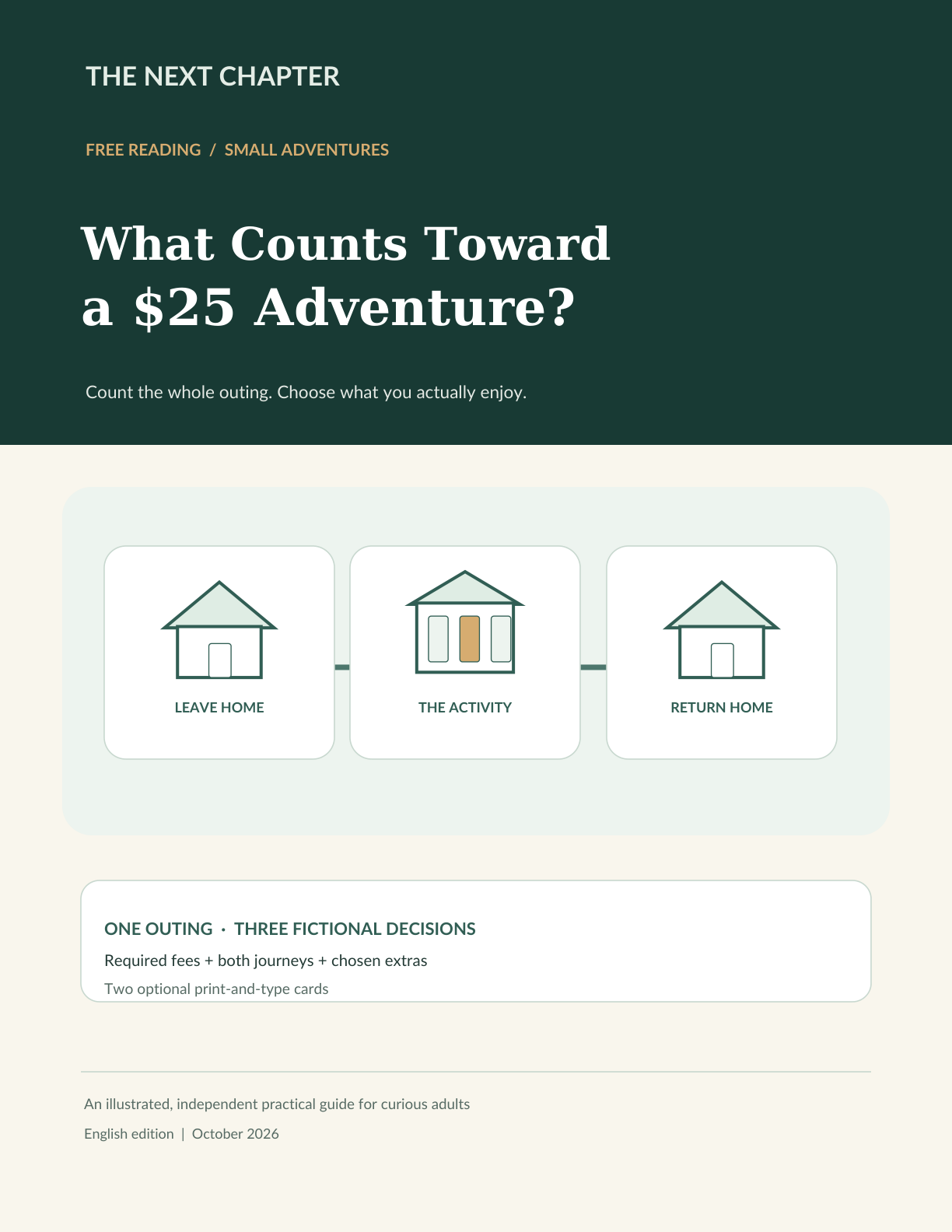
The Next Chapter
A small outing can be a complete adventure. Count the whole trip, then choose what you actually want.
A free, illustrated guide to one manageable outing, with three fictional decisions and two optional cards.
English edition · October 2026
The whole outing is the adventure
Perhaps you would like to visit a little gallery, try a different market, or look through a local exhibit. The activity itself might be free. Getting there, getting back, and the small things that make it comfortable may not be. That is why an outing can feel inexpensive when you first imagine it and more expensive when you reach the door.
This guide is about one outing, not a collection of destinations or a weekly spending programme. It helps you put the entire trip into one picture, compare what is optional with what is necessary, and leave yourself free to change your mind. Your budget could be CAD 25, less, more, or a different currency. The number in the title is a planning example—not a promise that any real outing costs that amount.
A good result might be a trip you enjoy, a more modest choice, an invitation you decline, or a pleasant day at home. There is no travel achievement to earn. The three people in the later examples and every amount they pay or consider are fictional, not verified local offers or typical prices.
Six useful questions, one decision
Start with your own spending limit and the experience you want. Then answer these six questions before deciding whether to go:
- What is the actual activity? Not just “a day out” but a particular place, event or local experience.
- What must be paid? Include any necessary admission, booking charge, supplies or other conditions.
- How will I get there and back? Count both directions, and confirm how the return will work.
- What might I choose to add? A snack or small purchase is optional only if you can genuinely do without it.
- What remains unknown? A price, access arrangement or booking condition needs checking before it is treated as certain.
- Does this still appeal to me? A manageable price is not a reason to attend something you do not want.
You can read pages 4–10 as a practical method, follow three distinct fictional decisions on pages 11–14, compare them on page 15, and use the optional print-or-type cards on pages 16–17. Page 18 offers a simple closing decision. Nothing in the book requires a form, membership or online data entry.
A ceiling is not a target
Suppose your chosen limit is CAD 25 for one person and one complete outing. That does not mean you should try to spend CAD 25. If a worthwhile outing costs CAD 6, the remaining CAD 19 does not need a job. You may put it aside, save it for a different pleasure, or leave it unassigned.
Write down what the ceiling means. Is it the amount of new money you can comfortably spend on this trip? Is it a household budget shared by two people? Does it include already paid tickets or transport you bought earlier? Decide before comparing alternatives. Otherwise a “CAD 25 day” can quietly become CAD 25 per person, plus a separate taxi, plus a meal.
Money already spent is not the same as a fresh choice today. If you own a reusable water bottle, its original purchase price is not a new outing payment. If you must buy a fresh ticket, that price counts. Keep cash actually spent, confirmed amounts due, and possible future spending in separate columns. This is ordinary practical budgeting, not financial advice.
One-line decision: “My maximum new cash for this whole outing is _____, and it covers _____ people.”
Count the trip, not only the ticket
A clear total starts with categories, not complicated calculations. Some are required for a particular trip. Others are a choice, and some may already be covered by an existing pass or something you own.
| Category | Ask this before you go | | --- | --- | | Entry or participation | Is admission genuinely free? Does the activity require a reservation or pass? | | Fees and supplies | Are taxes, booking charges, rented items or a required purchase additional? | | Outbound transport | What is the fare, fuel, parking or other new cost to arrive? | | Return transport | Is the return service running, accessible and affordable at the time you need? | | Food or comfort | Can you bring what you already have? Is any purchase truly optional? | | Companion costs | Is the limit for one person, or does another ticket/fare need counting? |
A hypothetical no-fee local exhibition might still require CAD 4 to travel there and CAD 4 to come home: CAD 0 admission + CAD 4 outward + CAD 4 return = CAD 8. That is a made-up teaching example, not a quoted fare. If a provider confirms additional compulsory charges, add them. If a fee is unknown, label it UNKNOWN rather than assuming zero.
Four different kinds of amounts
An outing plan becomes misleading when imagined choices are added to receipts—or when an uncertain fee is treated as free. Separate these four statuses:
PAID. Money has actually left your pocket. Record what it was for, including both directions of travel if you paid them. This is your completed cash total.
CONFIRMED TO PAY. You have a verified, required price but have not paid it yet. It belongs in your planned total before you decide whether to commit; it is not yet “spent.” A booking deposit can move into PAID when purchased.
OPTIONAL. A treat, extra stop or souvenir you could genuinely skip. Include it only in the version of the outing that contains that choice.
UNKNOWN. A price or condition not yet confirmed by the actual organiser or transport provider. It is neither free nor safe to ignore. Ask the question, choose a different arrangement, or leave the outing undecided.
If an activity is cancelled or you decide not to book, do not describe the quoted price as a completed expense. Refunds also need their own line: money paid and money returned are separate events. A plan and an actual outing are different records.
The ride home belongs in the budget
The pleasant part of an outing happens in the middle. The travel is still part of it. Before deciding that a place is “close,” think about the full route: getting to a stop, the actual journey, waiting, entering the venue, leaving, and returning home.
A return journey might use a different timetable. A special-event shuttle might end early. Some venues have stairs, limited seating or an entrance separate from the address on a poster. The organiser and transport operator—not this guide—must confirm current service, access details, permissions and costs.
Add a little breathing space to the time, as well as to the budget, if your plans would benefit from it. Time is not money, but a hurried connection can make a supposedly easy outing less appealing. If you cannot yet establish a workable return, the total is not ready for approval even when the admission is free.
Try writing there: _____ / back: _____ / full door-to-door time: _____. If it is an outing from your home, include the part of the journey on foot or by mobility aid as relevant to your plans.
One person or two? Say which
“I spent CAD 22 on our outing” and “We each spent CAD 22” are very different statements. If two people are going, write down the shared ceiling or the individual limits before adding costs. There is no correct arrangement for everyone.
Consider a fictional outing for two people with an agreed shared limit of CAD 25. Each person buys a CAD 7 admission ticket. Their combined return bus fares are CAD 8. The full total is CAD 7 + CAD 7 + CAD 8 = CAD 22. The pair has CAD 3 of its shared ceiling unspent. This calculation assumes the two fares together cover both journeys; it does not assume that a CAD 4 fare is an unlimited ride.
One person may pay at the counter while the other pays the fares. Recording the combined total prevents the cost from looking smaller because it was split between wallets. Also check whether companions, support persons or carers have separately applicable entry terms; never presume a free or discounted ticket.
A useful sentence: “We have a CAD 25 limit together. What are the actual costs for both of us, including the return?”
Leave room for the pleasure
A snack, a printed programme or a small purchase may be part of the fun. It need not become an invisible extra. Place optional items beside the essentials and ask which one actually improves the experience.
Suppose a possible day has CAD 8 in required return transport, a free visit, and a CAD 5 drink you would enjoy. Its chosen version would be CAD 13, not CAD 8. If the drink is skipped, it becomes CAD 8. Neither choice is morally better. The point is to decide consciously and still have a trip you look forward to.
A charge is not optional merely because it was missing from the advertisement. If the only approved experience requires a materials fee, include that fee or do not book. Likewise, a taxi you need to return home is not a decorative extra that can be erased to make the arithmetic fit.
You can also move the experience, not only the money: choose a nearer destination, attend a different authorised session, bring a drink you already own, or enjoy an alternative at home. A substitute should be something you actually want, not a penalty for staying within your limit.
What to check with the real organiser
A web listing or a friend’s memory may be a useful lead, but it is not proof of this week’s opening hours, ticket prices or admission conditions. Ask the actual operator or use the operator’s current published information.
A simple enquiry could say: “I’m interested in coming for one visit. Is the activity running on [date]? Is admission available to a visitor? What fees or required supplies are there, including booking charges? Where is the entrance?” Add your specific transport, seating or access question if needed.
Do not supply personal financial details or unnecessary medical information just to make a general enquiry. If a provider requires identification or registration, decide whether you are comfortable with the terms before sharing anything. If booking through a paid provider, use a verified official route rather than a link forwarded by an unknown person.
Your outing is READY TO CONSIDER only when the main required costs, permission and a workable return are known. If an essential detail stays unresolved, the honest result is NOT YET CONFIRMED, not a fictional free ticket or a promise to yourself that it will work out.
Mira: the no-fee exhibition
Fictional example. Mira likes the idea of a temporary art display in a nearby hall. In her invented scenario, the organiser confirms that this particular display charges no admission, requires no supplies and welcomes visitors that morning. Mira also checks the bus services she intends to use.
She has a self-chosen CAD 25 maximum for one outing. Her actual outward bus fare is CAD 4 and her return fare is CAD 4. She decides to buy a CAD 5 tea after the exhibition because she would enjoy a quiet place to sit. She does not buy the CAD 9 illustrated catalogue on display. The amount spent on this completed fictional trip is CAD 4 + CAD 4 + CAD 5 = CAD 13. She leaves CAD 12 of her limit unspent. The catalogue is not counted as cash paid.
Her journey is 10:20 to 12:50, or 150 minutes door to door. The display itself takes 55 minutes; the other 95 minutes cover the full journey, waiting and tea. Mira likes the exhibition. She does not enroll in a membership or plan a series of outings because of one pleasant day.
Her reusable lesson: a free entrance is only one part of the total, and a chosen extra belongs in the number just as much as a necessary fare.
Sol and Bea: one shared limit
Fictional example. Sol and Bea want to attend one small local event. They agree on a single shared CAD 25 ceiling, not CAD 25 each. The fictional organiser confirms two visitor tickets at CAD 7 per person and no additional required charge. Their invented transit arrangement costs a combined CAD 8 for the two people’s outward and return travel.
They attend and pay for both admissions and the confirmed fares. Their actual combined cash is CAD 7 + CAD 7 + CAD 8 = CAD 22. They do not buy an optional CAD 6 snack. Their shared budget retains CAD 3, which they have no obligation to spend. The full outing, measured from leaving home to coming back, lasts 125 minutes in this example.
Sol paid both tickets; Bea paid the return travel. Separating their payments could make each person’s statement of expense look small, but the household outing still cost CAD 22. Neither person is asked to maintain a shared spending rule for all future weeks. This agreement was for this one event.
Their reusable lesson: define whose money is being counted, then add every required charge for the people actually taking part.
Noor: a sensible plan that stays unbooked
Fictional example. Noor notices an evening talk that interests them. The advertisement shows a CAD 14 ticket and CAD 3 compulsory booking charge. Noor can arrange an outward ride for CAD 5 but has only an unconfirmed return option quoted at CAD 12. The possible total would be CAD 14 + CAD 3 + CAD 5 + CAD 12 = CAD 34, nine dollars above Noor’s CAD 25 ceiling.
More importantly, the return arrangement has not been confirmed. Noor therefore does not purchase the ticket, reserve the ride or attend. Their actual cash spent on this proposed event is CAD 0, not CAD 34. The quoted prices are a planning illustration, not verified local rates, and no real safety or accessibility assessment has been made.
That evening Noor chooses to look through a free exhibition catalogue already saved at home. They incur no additional purchase for that alternative, though their home and internet service are not free to own. The cancelled idea is not counted as a completed outing or a failure.
Their reusable lesson: an attractive event can remain an idea. When the total or the way home does not work, stopping before payment is a complete decision.
The numbers are not the story
| Choice | Confirmed outcome | New cash actually spent | Not purchased or not booked | | --- | --- | --- | --- | | Mira, one-person display | Went, including a chosen tea | CAD 13 | CAD 9 catalogue | | Sol and Bea, shared event | Both went under one shared limit | CAD 22 combined | CAD 6 snack | | Noor, possible evening talk | Did not book or go | CAD 0 | Proposed CAD 34 plan |
The columns are deliberately different. The cash totals come from what actually happened in the fictional story, not from the appeal of the original plan. Mira’s admission was free but the outing cost money. Sol and Bea had a shared ceiling rather than individual promises. Noor’s potential expenses were never paid and remain outside the completed-spending column.
A useful comparison looks beyond price. Was the return workable? Did the activity suit the person? Were important details confirmed? Did the proposed outing still sound enjoyable? Three different answers can all be reasonable. A budget can help you make a choice; it cannot tell you what you ought to enjoy.
Three ways a plan can finish well
GO, on confirmed terms. The organiser has confirmed the relevant visit, essential charges and access questions are answered, the entire round trip is workable, and the new spending fits your own limit. A treat can be included if you want it. You are making one outing decision, not promising a new routine.
CHANGE THE PLAN. You may prefer a nearer place, a shorter visit, a different authorised time, a trip without the optional purchase, or a free activity that has a workable return. Update the whole estimate. Do not simply erase a necessary charge to get a pleasant-looking answer.
DO NOT BOOK YET. A compulsory fee, eligibility condition, route or way home is unknown, or the total exceeds what you want to spend. Leave the event unpurchased and either check one important question or stop there. Doing nothing today is allowed.
If you take the outing, you can later record what you actually spent. If you do not take it, the plan card still served you: it helped you avoid an unwanted commitment. The two optional cards on the following pages can be printed, typed into, copied into a notebook, or ignored.
My whole-outing estimate
A print-or-type card for one possible outing. Unknown is a valid answer; do not replace it with zero.
Activity and date: What exactly is the experience, and when would it happen?
My total new-cash ceiling / people included: For example: CAD 25 for one, or CAD 25 shared by two.
Required admission, booking and supplies: Include confirmed amounts; label unresolved fees UNKNOWN.
Transport there and back: Two separate directions, including costs and any unresolved return plan.
Truly optional extras: Include only what you may choose; keep them separate from required items.
Estimated full total and decision: Confirmed essentials + chosen extras; GO / CHANGE / NOT YET.
What actually happened?
Use this only for an outing you took—or record an unbooked plan without pretending it happened.
Outing status: Attended / cancelled / not booked / changed. State what is true.
Cash actually paid: Admission, travel both ways, fees and any extras actually purchased.
Refunds received or still due: Keep actual returned money separate from pending refunds.
Full door-to-door time: Actual departure and return; leave blank if you did not go.
Something worthwhile or disappointing: A fact you noticed, not a score for yourself.
Next choice, including no next outing: Repeat / change / ask a question / stop.
The best number leaves room to choose
If an outing costs less than your limit, you do not have to spend the difference. If its price is too high, you are not required to make the trip work. If the only workable version is something small, local and ordinary, that can be enough. What makes an outing worthwhile is not proof that you travelled far or spent every dollar available.
Try one complete calculation the next time something catches your interest: the actual experience + permission + required fees + both journeys + genuinely chosen extras. Ask about anything important that remains unknown. Then decide whether it fits both your spending limit and the day you actually want to have.
Editorial boundaries: Mira, Sol, Bea, Noor, venues, timetables, fares and prices are entirely fictional teaching examples. All amounts in this edition are CAD unless you substitute your own currency. This guide does not verify live business details, booking rights, public transit access, disability accommodations, equipment suitability, insurance, legal consumer protections or personal safety. Confirm current conditions with the provider and transport operator. It is not financial, legal or clinical advice, and it does not require an email address, a purchase or a completed worksheet.
A smaller adventure can still be a complete day.