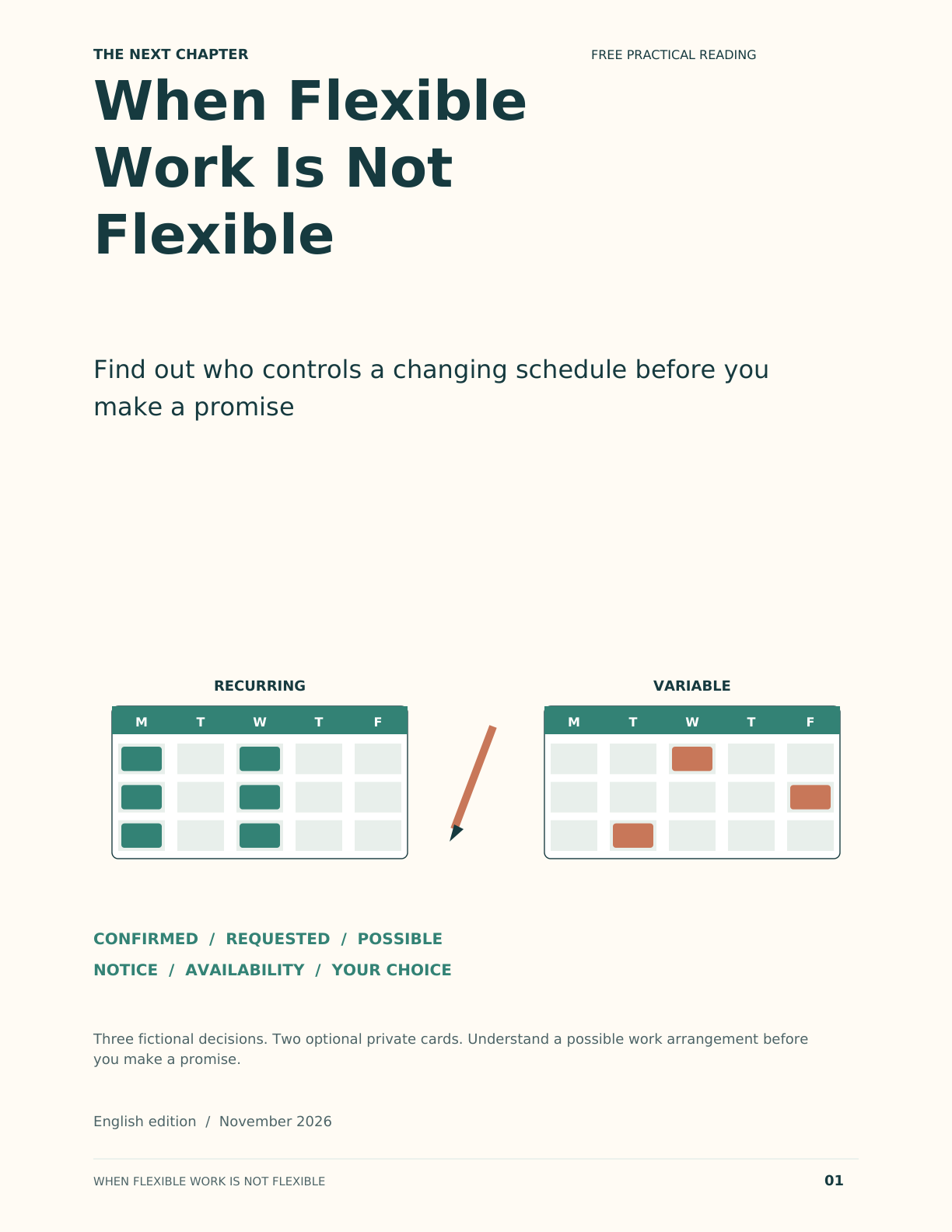
Find out who controls a changing schedule before you make a promise
A few hours of paid work can sound appealing when you do not want another full-time job. Perhaps you would enjoy helping at a shop on two mornings, working during a local festival, or returning to a familiar skill for part of the year. Then you see a job described as flexible. That single word can sound like an invitation to arrange work around the life you already have.
But flexible for whom? Sometimes it means that you may choose when you are available. Sometimes the employer changes the timetable whenever demand changes. Sometimes both sides agree to a new shift. Those are quite different arrangements. The hours on a job advertisement do not necessarily tell you who controls them, how far ahead they are confirmed, or whether you must keep other days free in case a call arrives.
This reading helps you investigate one possible role without assuming you should accept it. You will learn to distinguish a shift you have agreed to, a request you may decline, a possible shift, and a time you are expected to remain available. You will try practical questions, follow three entirely fictional decisions, and keep a six-line private record if that is useful. Nothing here tells you what an employer is legally allowed to do in a particular country; those rules must be checked separately.
1. Three meanings behind the same attractive word
Imagine two advertisements that both promise flexible part-time work. The first says you may select a regular Tuesday or Thursday morning from available shifts. The second says the employer will call whenever extra help is needed, and you are expected to be ready. The first arrangement may give you meaningful control. The second may ask you to make yourself available without telling you whether there will be work. Neither can be judged from the word flexible alone.
A third possibility is genuine negotiation: the employer proposes a change and you may accept or decline it. That arrangement depends on whether declining is truly a permitted option in the actual terms and practice. A recruiter might use the same language for all three. Your job is not to accuse anyone of being misleading. It is to discover which arrangement is actually being offered and what is written down.
One neutral opening is: “When you say the hours are flexible, which parts of the schedule can the worker choose?” Give the person time to explain. If you hear only “we work things out as we go,” ask for a recent ordinary example without requesting private employee details. A concrete example is usually more useful than another reassuring adjective.
2. Separate what is offered from what is merely possible
A genuine offer of eight hours every Thursday is not the same as “up to eight hours in a week.” The first identifies a regular time, though its other conditions still need confirming. The second describes a maximum, not necessarily a minimum. “You could sometimes get extra shifts” is a possibility, not an amount of income you can budget for. If a workplace says a position is seasonal, the season itself may still have uncertain start and end dates.
Make four columns in your notebook: confirmed, requested, possible, unknown. Put each phrase where it belongs. If an interviewer says there are normally two shifts a week but cannot guarantee them, record “usually two, not guaranteed,” not “two confirmed.” If they say staff are often asked to stay late, record that as a request pattern until you understand whether an agreement requires you to accept. Do not turn an optimistic conversation into a personal promise.
You do not need a complicated scoring system. Sometimes one unknown makes the entire role unsuitable. A person with caregiving commitments may be unable to keep an extra weekday free. Another person may genuinely enjoy occasional calls when they are available. The useful result is clarity about your decision, not a universal ranking of good and bad jobs.
3. The difference between scheduled hours and possible hours
Suppose an invented role advertises six to twelve hours a week. It would be easy to imagine twelve hours on the weeks when extra money would be welcome. But the phrase might mean that six hours are typical, twelve are occasionally available, or that even six depends on demand. Without a written or reliable explanation, none of those readings is confirmed.
Ask, “Are there any regularly scheduled hours, or can the weekly total fall to zero?” Then ask when people normally learn their schedules and whether they may refuse additional shifts. A clear answer might include a regular base shift and optional extras. Another answer might reveal that every week is assigned anew. If the employer has no predictable pattern, that is useful information even if the people seem friendly.
Consider the entire week rather than only a wage rate. If you reserve three possible afternoons but work on one, the other two afternoons still affect what you feel free to plan. That does not establish legal entitlement to pay for the unscheduled time. It establishes a personal scheduling cost that matters to you. Keep those two ideas separate: personal inconvenience is one question; legally payable time is another.
4. Ask when the timetable becomes real
Knowing the weekly hours is not enough if the worker learns about each shift only the night before. One person may welcome same-day opportunities, while another needs to arrange transportation, meals, appointments or another commitment. Neither preference needs an apology. You can simply ask what advance notice is normal and what happens when a planned shift changes.
Try: “How many days ahead is the schedule usually confirmed?” Follow with: “If an extra shift becomes available at short notice, can I say no without affecting the arrangement?” Ask whether changes are communicated through an app, email, telephone or a written board. The technology may be simple; the expectations need to be understandable.
If the interviewer says notice is “reasonable,” ask what that usually meant last month. If you hear “generally a week,” distinguish general practice from a guaranteed rule. Some locations have specific laws or contract requirements about notice, cancellations or reporting; this international reading makes no claim about those details. Your next action is to review the actual terms and any local official rules before committing.
5. Offered, accepted and cancelled are different stages
A manager may send, “Can you work Friday?” That might be a genuine request rather than a scheduled shift. If you reply “yes” and the manager confirms, the situation changes. If the Friday work is later cancelled, still more questions arise. What was the agreement? When did the cancellation occur? Was a minimum period of work promised? Was the worker already travelling or at the workplace? Local employment standards may matter, and a general guide cannot answer them in advance.
For practical note-taking, use three verbs: offered, agreed, changed. Do not write “worked” until work actually happened. For example, “Friday 10:00–14:00 was offered Tuesday; I agreed Wednesday; manager cancelled Thursday morning.” That note is more precise than “I had a four-hour job Friday,” which could falsely imply hours or income were earned.
Ask what the employer normally does when a shift is cancelled and which official policy or written terms explain it. You are not demanding a personalised legal ruling during an interview. You are seeking the information needed to decide whether an unpredictable arrangement is acceptable. If no one can explain the rules, the uncertainty itself is worth recording.
6. An availability request can quietly fill your calendar
“Can we put your name down as available most afternoons?” may sound less formal than a shift, but it can influence the way you arrange your life. Does available mean someone might contact you and you may freely decline? Does it mean you are expected to answer immediately? Are there consequences for not taking a call? Is there a designated standby arrangement? These are different questions, and the legal treatment of standby or on-call time varies.
You might ask: “If I mark myself available, may I still make personal plans and turn down a later shift?” Or: “Does the employer expect me to stay near a phone or be able to arrive within a certain time?” A role that expects a rapid response may have an important geographical or transportation implication, even if actual paid hours are few.
Do not infer a universal rule that waiting by a phone is always unpaid or always payable. If standby, call-in or minimum reporting terms matter to you, ask for the written arrangement and the relevant local employment-standards information. This article is about noticing the question early, before a casual availability request becomes a source of confusion.
7. What does a real right to decline look like?
Some organisations genuinely need occasional help and have an honest system for asking. That can be a suitable arrangement when you want occasional work rather than a fixed weekly commitment. The important issue is whether a proposed extra shift is optional in practice. Saying “no” should not depend on guessing the manager's mood.
A natural question is: “If I'm unable to take an extra shift, what should I do?” Listen for a process: reply by a certain time, update a schedule tool, or contact a named supervisor. A specific procedure is more useful than “we'll see.” You may also ask how the employer handles a genuine last-minute absence or an agreed shift that needs changing, without revealing private circumstances.
It is worth writing down the exact answer, particularly if the person uses terms like “optional,” “on-call,” “required” or “priority.” Those words may have different formal meanings in different places and workplaces. You are allowed to want an arrangement that does not penalise you for declining work you never agreed to take. You also need to understand obligations attached to shifts you have agreed to work. Fairness runs in both directions.
8. A short shift still takes a real part of a day
A three-hour shift may be pleasant and manageable. It may also require preparation, travel and waiting for a connection. These personal planning minutes are worth counting even when they do not all count as paid work under local law. This article does not determine wage entitlement. It asks how much of a day an arrangement would occupy, so that the answer matches the life you actually live.
Imagine an invented shift from 10:00 to 13:00. The reader allows ten minutes to prepare and a thirty-minute trip each way. The planned total occupied time is 10 + 30 + 180 + 30 = 250 minutes, or four hours and ten minutes, for a three-hour shift. Two identical visits occupy 500 minutes, or eight hours and twenty minutes, in that fictional week. Neither calculation asserts that the reader was paid for preparation or travel.
Now suppose the employer might cancel at short notice. The wasted travel or altered plans may affect the personal value of the role. You can ask how cancellations are communicated and when you would know the shift is certain enough to leave home. If you do not yet know the route, cost or cancellation practice, mark it as unknown rather than inserting an optimistic estimate.
9. A simple example of money is not a pay promise
Hours alone do not tell you what a real work arrangement will add to your finances. For illustration, imagine a fictional role mentioning USD 18 per paid hour, with two possible three-hour shifts. If both shifts happened and all six hours were paid at that stated rate, the arithmetic would be 6 × 18 = USD 108 gross, before any deductions. If only one three-hour shift happened, the corresponding hypothetical gross figure would be USD 54. If no shift happened, this example records zero gross earnings.
Those are conditional calculations for an entirely invented example. They are not evidence of local wages, a job offer, employment status, minimum pay, legal deductions or what anyone will actually earn. A real worker may have different pay terms, expenses, benefits interactions and legal requirements. The point is not to build a full retirement-income model here; it is to avoid mentally spending money from shifts that are merely possible.
If you choose to compare a real offer, request the actual wage basis and terms through the verified employer. Separate any known travel cost from the gross pay illustration. Do not write an unpaid or unconfirmed shift into your earnings record, and do not rely on an estimate for financial or benefits decisions that require qualified local guidance.
10. Translate reassuring phrases into useful questions
An interviewer may say, “We're like a family,” “Everybody pitches in,” or “We are very flexible.” These phrases can describe a supportive environment, but they do not answer a scheduling question. Rather than arguing with the language, calmly return to the decision you need to make.
If you hear “You can work as much as you want,” ask whether shifts are guaranteed or simply available when demand allows. If you hear “We're flexible about hours,” ask who has final say over changes and how much notice is given. If you hear “We just need people who can help out,” ask what commitment is required and whether additional requests may be declined. If you hear “We'll figure out the details later,” ask which details can be confirmed before you accept.
The pattern is simple: replace a broad description with a question about an ordinary week. You may receive a sensible explanation. You may discover a condition that does not suit you. Or you may learn that the organisation has not yet settled the role. None of those outcomes requires you to make a personal judgement about the interviewer's character. You only need information you can use.
11. Keep a conversation separate from an agreement
After an encouraging discussion, it is tempting to remember the outcome more positively than the facts support. “They sounded very reasonable” can become “They guarantee Tuesdays.” “There may be extra hours” can become “I will be earning more.” A small factual record prevents those leaps without turning an everyday conversation into legal paperwork.
Write down the position or role title, the date of your inquiry, the stated normal schedule, whether extra shifts are optional, how changes are communicated, and any unanswered question. Do not put private account numbers, family circumstances, identity documents or passwords into a casual worksheet. The worksheet is for you and does not have to be given to the employer.
For any actual offer, look for the employer's official written terms and applicable local rules. If terms change after your discussion, update your understanding before accepting. Keep language precise: inquired, applied, interviewed, offered, accepted, worked. These stages are not interchangeable. A good conversation is not a job, and a proposed schedule is not a verified pay record. Precision helps you make decisions without assuming either success or disappointment.
12. Fictional case: Mara accepts two dependable mornings
Mara is considering an invented community arts desk role. During the interview she learns that the arrangement is two confirmed four-hour morning shifts each week, on Monday and Thursday. An occasional Saturday shift may be offered, but the fictional employer says it is not part of the agreed schedule and may be declined. The manager also describes who is responsible for cash handling and who helps when unfamiliar software causes a problem.
Mara estimates a fifteen-minute personal preparation period and a twenty-five-minute journey each way for every confirmed shift. For one ordinary shift, her personal time estimate is 15 + 25 + 240 + 25 = 305 minutes, or five hours and five minutes. Two shifts occupy 610 minutes, or ten hours and ten minutes, of her week. She does not treat those preparation and travel minutes as automatically payable. She checks the written terms before accepting.
In this fictional story, Mara accepts the two-morning arrangement and completes her first Monday shift. She has not accepted any optional Saturday work. The useful result is modest: she has a clearly bounded commitment and knows the distinction between what she agreed to and what may be proposed later. Her example is not a recommendation that everyone should work two mornings.
13. Fictional case: Leo makes an inquiry and stops there
Leo reads an invented advertisement for “up to twelve flexible hours” at a neighbourhood event venue. He is curious, but he has another recurring commitment and does not want evenings to be uncertain. He sends one short message through what he has verified to be the fictional employer's official contact channel: “Is there a recurring shift pattern, and can people decline additional shifts offered at short notice?”
The reply explains that weekly work depends on bookings, and that the employer cannot specify a reliable minimum or a consistent schedule at that point. Leo spends twelve minutes reading and writing the inquiry. He records “information only.” He does not send an application, book an interview, agree to be on call, work any shift or earn money. His new out-of-pocket cost in this example is USD 0.
Leo decides not to proceed under the current uncertainty. He may ask about a different position another time, but no new action is scheduled or promised. His outcome is complete as a decision, even though nothing has been purchased or earned. Research can be successful because it prevents a promise that does not suit the reader.
14. Fictional case: Nina declines a short-notice arrangement
Nina is offered an invented part-time role that sounds enjoyable. During the conversation, however, she discovers that the employer expects workers to keep three afternoons available and be prepared to attend within forty-five minutes of a call. She asks if a worker may make other plans and decline an extra request without consequences. In this fictional example, the answer is that frequent availability is central to the role.
Nina does not accuse the organisation of wrongdoing. She says, “Thank you for explaining the expectation. I can't promise that amount of short-notice availability, so I won't continue with this position.” She has not signed an agreement, undertaken work, or made a financial commitment. Her invented new cash spending is USD 0, and she has earned USD 0.
The story does not establish whether the fictional proposed arrangement would be legally permitted in a real jurisdiction. Nina's decision rests on a personal mismatch between the expectation and the week she wants. A person who enjoys occasional calls might make a different choice after checking the actual terms. The point is to recognise a mismatch early, not to portray every unpredictable job as exploitative.
15. Useful sentences that do not require a personal explanation
It can feel awkward to ask for a limit when you have not yet been offered a position. But clarity about availability is directly relevant to the role. You do not have to defend your retirement, age, family choices, medical history or household routine to ask how a shift system operates.
You might say: “I can commit to a regular Thursday morning. Are those hours actually part of this position?” Or: “I would be happy to consider an occasional extra shift, but I couldn't guarantee same-day availability. Does that fit how your team works?” If you need the written basis: “Could you point me to the written policy or terms about shift changes and cancellations?” If the answer reveals a mismatch: “I appreciate the information. That level of uncertainty isn't a commitment I can make.”
Choose sentences that sound like you. The tone is neither demanding nor submissive. You are asking about real conditions before deciding whether to apply or accept. An employer can also decide whether a proposed pattern fits the role. A respectful mismatch is a clearer outcome than a quick yes that neither party understood.
16. A four-step check before you say yes
First, notice the ambiguity. Circle words such as flexible, variable, casual, as needed, or occasional. They may be perfectly normal descriptions, but they need context. Second, ask for one ordinary example: How are shifts assigned? When are they confirmed? What happens if extra work is offered? Can someone decline? Third, confirm the terms. Match the conversation to the verified employer's written information and the local standards that apply. Fourth, decide according to your own priorities.
You may wish to apply, ask another question, defer or decline. Do not substitute an automatic score for judgment. A role with changing hours might suit someone who values variety and has few fixed commitments; a regular shift might suit someone who wants to protect other parts of the week. A role that is poorly explained remains poorly explained, regardless of how friendly the recruitment conversation feels.
If the interviewer cannot answer a decisive question now, you can leave it marked not confirmed. You do not need to remain in a state of permanent enquiry. A reasonable personal boundary is: “I will reconsider if the hours and notice expectations are confirmed in writing.” You can also choose not to reconsider at all.
17. One ordinary next step is enough
You can use this guide without having a job advertisement in front of you. Think of a role you might possibly consider and write one question about who controls the schedule. That is the entire first exercise. If you already have an advertisement, inspect the parts that describe hours, notice and availability. If there is an official recruiting contact, you may choose to ask there. Nothing requires you to submit a résumé, create an account or spend money merely to practise asking.
If you already have a verbal offer, the sensible next step may be to request the terms you need before deciding. If you have accepted and started a job, the situation may involve actual contractual or legal rights, and official jurisdiction-specific guidance or professional assistance may be appropriate. This general reading does not replace them. It also does not determine whether any shift, training, waiting time or travel must be paid.
The aim is to defend a simple distinction: wanting a modest amount of paid work does not automatically mean promising to be available whenever someone else calls. A flexible arrangement may be a good one, but its flexibility should be understandable. The best question is often plain: “Who can change this schedule, and what happens if I can't?”
Optional private card A — What does flexible mean here?
Keep this for yourself; do not submit it to this site. You may leave any field empty.
- Role or search note (without personal identifiers): __________________________
- Regular hours, if genuinely confirmed: __________________________________
- How far ahead are shifts normally announced? ___________________________
- Are additional shifts optional, required or not confirmed? _________________
- What happens when a shift changes or is cancelled? _______________________
- One written term or official rule I still need to verify: ______________________
Write “unknown” instead of guessing. If you have only made an inquiry, record it as an inquiry—not as a scheduled shift, offer or promise of income.
Optional private card B — One decision I can actually make
Keep this for yourself. No information is collected or transmitted by the reading.
- One arrangement I might consider: _____________________________________
- One schedule condition I cannot promise: _________________________________
- What the employer actually confirmed: __________________________________
- What is still a possibility rather than a commitment: ______________________
- My choice: ask / apply / defer / decline / stop here: _______________________
- The next realistic step, if I choose one: __________________________________
An unanswered question can stay unanswered. The card is a tool for thinking, not an obligation to continue looking for work.
Sources and verification boundaries
The schedule distinctions, questions, fictional dialogues and worksheets are original editorial material. They do not assert actual openings, wage rates, employment contracts, salary expectations, legal entitlements or fixed shift-cancellation rights. Official employment standards are jurisdiction-dependent. An example of a public authority explaining hours-of-work terminology in one jurisdiction is Ontario's Employment Standards Act guide: https://www.ontario.ca/document/your-guide-employment-standards-act-0/hours-work . Do not apply that guide outside its actual jurisdiction. For a genuine role, check the current official rules and the employer's verified written terms before accepting. This article does not solicit personal data, assess a reader's eligibility or guarantee an employment outcome.