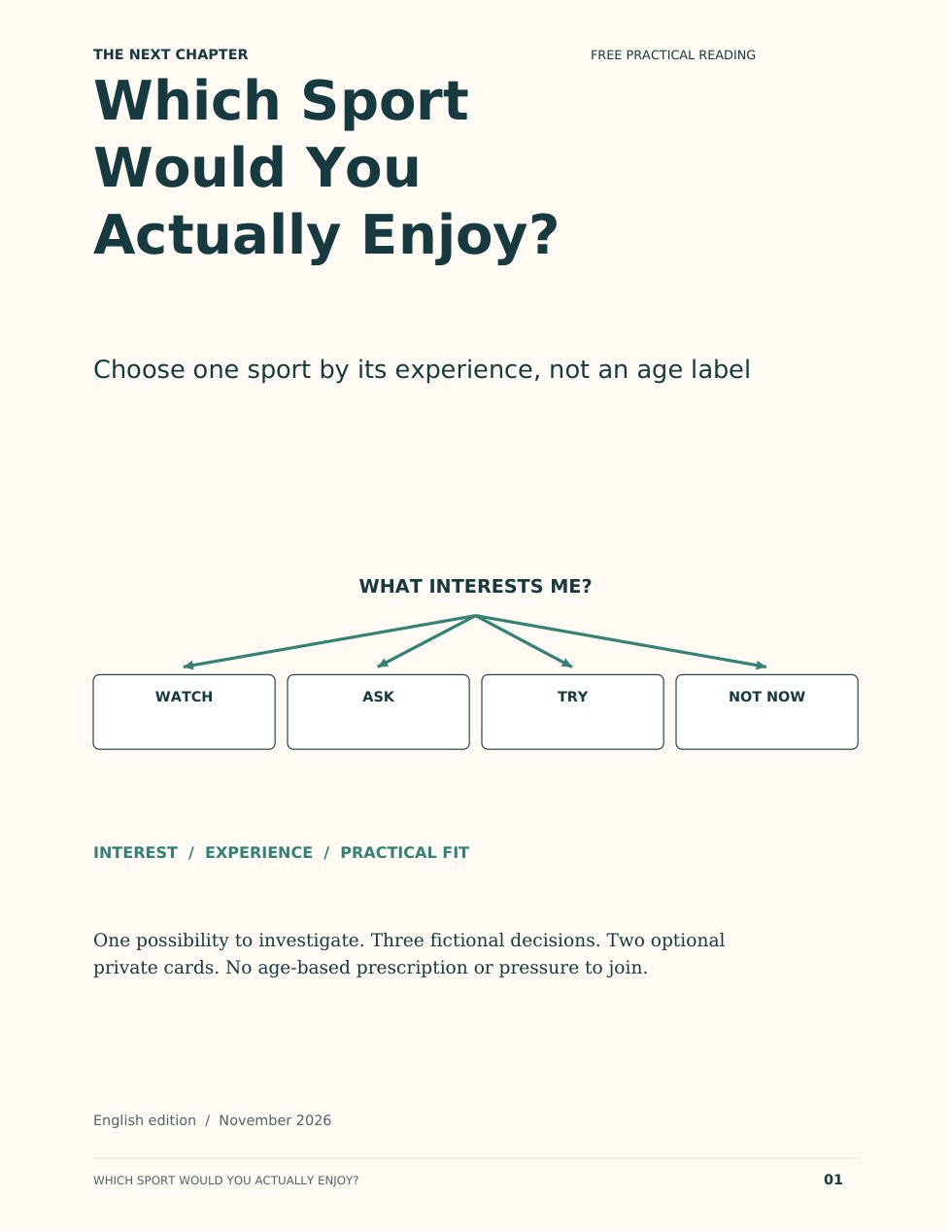
Choose one sport by its experience, not an age label
The question is enjoyment, not your age
A person considering sport after retirement might be surrounded by advice: take up golf, try swimming, join pickleball, return to the sport you played years ago. Some suggestions come from friends who mean well. Others come from advertisements promising that a single activity is ideal for “seniors.” Neither can know what you actually enjoy, whether the local experience is welcoming or what you would be comfortable trying.
Begin with a different question: What part of a sporting experience sounds interesting to me? It could be learning a simple game, watching how a team works, practicing a skill with one partner, having something to talk about at lunch, or being outdoors. You might be drawn to a sport's atmosphere without wishing to play it. Watching, asking questions and declining are legitimate choices, not failed steps toward participation.
This guide is a way to choose one possibility worth learning about. It does not award points for enthusiasm and will not prescribe movements or claim that any sport is medically suitable for you. An honest “not now” can be as useful as an enthusiastic “tell me more.”
Sport has more than one purpose
In the Canadian Sport Policy 2025–2035, participation is described broadly: people can learn or practice sport for fun, social interaction, personal development and relaxation. Winning is not always the priority. This matters when you begin searching, because one club may advertise a competitive league while another offers a guided introduction to the very same sport. The name alone does not reveal what the experience will feel like.
Imagine an acquaintance recommending badminton. They may enjoy scoring and improving technique. You may be interested mainly in laughing through a gentle social session. Both interests can be genuine, but they require different event formats. You can ask which format an organizer actually provides. It is not disrespectful to say that competition is not your goal.
Try finishing the sentence “I would enjoy a sport if it gave me more _____.” Fill it with a quality rather than a performance promise. Curiosity, company, outdoor time, familiar play or a novel skill are all possible answers. Leave it blank if you do not know yet. A little observation may tell you more than an abstract quiz.
Would you rather share the game or keep your own company?
Some people like a team. Other people value a sporting activity because it gives them time alone. Even a sport commonly described as “social” may involve a partner you do not know, repeated small talk or a club calendar. Conversely, an individual activity can have lessons or informal groups if you choose them.
Do not assume a team creates friendship or a solo sport creates isolation. Ask what is organized and what is optional. Will you be assigned a partner? May you attend as an observer? Do you need to join a membership or commit to a season? Is the atmosphere mainly cooperative, instructional, recreational or competitive?
A useful private preference might be: “I like company when I arrive, but I would rather not rely on a fixed team every week.” Another could be: “I would like a named beginner group because going to a new venue alone is intimidating.” Both preferences belong in the decision. You can change your mind after discovering what a particular group is actually like.
Indoor, outdoor, or both?
Indoor activities may offer a predictable roof and familiar facilities, but a venue can be noisy, crowded, difficult to reach or available only at inconvenient hours. Outdoor options may appeal because of the setting and open air, yet weather, surface conditions, lighting and seasonal schedules can change the visit. Neither choice is universally easier or safer.
Think about the trip, not just the playing area. You may need accessible entry, a practical washroom, a place to rest, a convenient bus connection or a safe return route after dusk. If you are looking at an outdoor sport, ask whether a scheduled session moves indoors in poor weather, how changes are announced and whether fees carry forward. If you are looking indoors, ask about noise, temperature and equipment storage.
Do not guess a facility's accessibility from its promotional photograph or assume a location is open on a particular day. A five-minute phone or email enquiry can be more useful than an appealing brochure. Your preference may be a conditional one: “outdoor in good weather; otherwise I would rather do something entirely different.”
Competitive and recreational are descriptions, not identities
A beginner may hesitate because they picture uniforms, elimination games and people who already know the rules. Another beginner may be excited precisely by the possibility of a little competition. What matters is the specific local session. The same venue might run informal drop-ins, coaching, practice groups and formal leagues on different days.
Ask whether scores are recorded and whether new participants rotate through groups. Does the session have a coach? Are demonstrations offered? How long are people expected to stay? Can someone opt out of a match and still enjoy the event? It is reasonable to ask whether a “beginner” session truly welcomes people who have never touched the equipment.
A useful distinction is between your interest in the sport and your interest in the format. You might love watching a team game but dislike the pressure of joining a scheduled team. You might prefer a technical lesson in an otherwise competitive sport. Neither response means that you have chosen the wrong sport. It means you are looking for the right way to encounter it.
The equipment can be a question instead of a purchase
An attractive sport can arrive with a surprisingly long shopping list. A paddle may be inexpensive or expensive; a suitable pair of shoes may be essential at a venue; a club may include equipment in an introductory visit. The right decision is not to buy the most popular kit. It is to learn what is genuinely required, what can be borrowed and what is optional.
Ask whether the group supplies basic equipment, whether a first-time visitor can borrow what they need, and whether there are requirements for footwear or protective gear. If a special item is needed, find out whether it must be purchased before a trial or can be arranged on site. Costs such as travel, parking and mandatory registration should be listed separately from advertised tuition or entry.
A first enquiry should not require you to disclose sensitive financial information or buy equipment from an unfamiliar link. Verify the organizer and its official payment route independently. You can be interested in a game without accepting a membership, subscription or purchase today.
A spectator visit is a real first step
Some local organizations allow visitors to watch. Others may restrict access for safety, privacy or space reasons. Do not arrive assuming that observation is permitted. Ask in advance whether there is a public event, a visitor area or a staff-led introduction. Respect participants' privacy: a viewing visit does not authorize photographing people or publishing their names.
Observation can answer questions no advertisement can. Are instructions easy to hear? Does the group offer a welcoming explanation to a beginner? Does the pace seem appealing? Is the room too loud for your preference? Is there a place to sit, leave belongings or pause? These are personal fit questions, not medical assessments.
You may leave with the conclusion “I enjoyed watching but do not want to play.” That is still an outcome. It is also fine to postpone a decision. A useful visit reveals something true about this particular format and setting, not whether you have succeeded at becoming an athlete.
Access is not a footnote
Not every sport or local event is accessible in the same way, and a person's needs cannot be inferred from age or appearance. Some people may use mobility supports, sensory accommodations, communication assistance or modified equipment. Others may need a straightforward travel route or a quieter session. A welcoming slogan is not a reliable substitute for specific access information.
Ask the organizer about the actual entrance, distance from transport, accessible washroom, seating, equipment options, supervision, and whether the format can be adapted. A question like “Can someone take part while using a wheelchair?” deserves a concrete description of the space and the particular program, not an assurance that everyone is welcome. It may be appropriate to contact an inclusive sport organization or qualified activity professional for additional information.
This article is not a capability test. It cannot determine what an individual should attempt. If medical or physical suitability is uncertain, a relevant qualified professional can help with that separate decision. The organizer is responsible for accurately describing its service.
The whole outing has a cost
Consider the full cost of a first outing. A fictional drop-in might list an entry fee of USD 8, but the journey could require USD 6 in return fares, and a required one-day registration could add USD 4. The hypothetical essential cash total would be USD 18, calculated as 8 + 6 + 4. A coffee afterwards would be optional, not part of what you must spend to attend. These are deliberately invented figures, not local prices.
Also separate what you have actually paid from what has merely been quoted. A club saying “membership is USD 70 per season” does not mean you have purchased that membership, and it says nothing about whether the fee is refundable. Confirm actual terms and payment routes before committing. If the venue asks for special shoes or gear, determine whether they can be borrowed instead of assuming a purchase.
Your private budget can be a boundary rather than a target. “I want to learn what is possible without spending today” is entirely reasonable. So is deciding that a special-interest outing is worth more, after checking the real details.
The whole visit takes more than playing time
An advertised 45-minute introduction may take much more of your day. The event may require early arrival, time to find the facility, or a separate journey on public transit. Before saying yes, think about the entire outing. How will you get there and home? Is there a place to wait if your transport arrives early? Does the session finish in time for another commitment?
In a fictional example, suppose someone leaves at 9:20, reaches a venue at 9:45, attends a 10:00–10:50 demonstration, and is back home at 11:20. The outing lasts 120 minutes door-to-door, while the demonstration is 50 minutes. Both figures matter. Neither predicts anyone else's journey.
If travel is uncertain, keep it marked unknown. Do not automatically treat every proposed outing as already booked, and do not invent a return route to make a schedule appear sensible. The ability to leave comfortably can matter as much as the ability to arrive.
The invitation matters
Sport can be recommended by family, friends or neighbours who are genuinely excited. That excitement may make it harder to explain that their preferred activity is not yours. An invitation is more welcoming when it leaves a real choice. “Would you like to come and watch one session? No need to play” is more useful than “Everyone our age should be doing this.”
If you invite someone, ask about interests without guessing their mobility, energy, finances or social preferences. Offer actual information about the venue and duration instead of an optimistic promise. Accept a no without asking for justification. If you receive an invitation, you can separate curiosity from commitment: “I could be interested in seeing what it is like, but I am not ready to join.”
A sport should not turn into a test of loyalty, retirement success or belonging. A good group lets people explore voluntarily. That is not simply politeness; it is part of determining whether the environment suits you.
Three different reasons to say yes, maybe, or no
The next three cases are fully fictional. They are not real venues, opening hours or offers, and they do not imply that any person should imitate the activity. The people make different decisions because they value different experiences. None of the cases asks you to evaluate health symptoms, score personal capability or purchase a plan.
A completed visit will be described as a completed visit, an information request as an enquiry, and a decision not to attend as a decline. This difference matters because lifestyle advice sometimes writes all three endings as if the person joined a club. That makes a hopeful plan sound like an accomplished outcome.
Use the cases for the decision method rather than the particular sport. Notice the personal appeal, the unanswered practical question and the real status at the end. You are free to make a different choice or no choice at all.
Case: Iris chooses one viewing visit
Iris, a fictional retired librarian, likes games where skill and conversation fit together. She is not interested in league rankings. She enquires about a hypothetical community target-game session. The invented organizer confirms a free public viewing area, a staff member who can answer basic questions and an exit that works with her transport. No playing equipment is needed to watch.
On her imagined Tuesday, she actually attends once. She leaves home at 9:20, arrives at 9:45, watches a 10:00–10:50 introduction, and returns home at 11:20. The whole trip is 120 minutes; the demonstration is 50. Her invented return fare is USD 6, and she spends USD 6 in this case. She does not buy a membership, enrol in a program or promise a second visit.
What did Iris learn? The slower demonstration format interests her more than the neighboring competitive practice. She has a specific question about future beginner sessions, but it remains unanswered. One completed observation is the result, not a new sports hobby.
Case: Malcolm makes an information-only enquiry
Malcolm, a fictional part-time caregiver, enjoys being outside but has uncertain free evenings. He sees an imaginary announcement for an introductory racket game. Before signing up, he asks whether attendance is casual, whether equipment is provided and whether sessions are scheduled far enough ahead for him to plan. He also asks about parking and the location of a quiet place to wait.
In this fictional case, he spends 12 minutes on a telephone enquiry. An organizer describes one possible four-session package priced at a hypothetical USD 48, with optional equipment rental quoted separately at USD 8. Malcolm marks both as quotes only. He makes no booking, no travel, no purchase and no new cash expenditure (USD 0). The total he would need to verify is unknown because transport and mandatory conditions have not been established.
His conclusion is “I am interested, but not ready to decide.” That conclusion respects the difference between information and participation. A quotation is not an invoice, and enthusiasm is not a contract.
Case: Mei chooses not to join
Mei, a fictional amateur illustrator, receives a friendly invitation to join an imaginary evening team sport. The game itself sounds intriguing, but the invented timetable requires an entire season of fixed attendance. She also prefers quiet spaces and does not enjoy the way teams are selected. The invitation offers no informal first visit.
Mei responds that she will not join this season. She thanks her friend and suggests—without arranging—a separate afternoon together to watch another event. There is no attendance, no reservation and no spending (USD 0). The suggested meeting is not a confirmed plan. Her decision does not imply that she lacks confidence or that the sport is unsuitable for people like her.
Mei has simply learned that this organized format is not what she wants. She keeps the option of a different activity or a different social event in the future. Saying no to one version of a sport is not a verdict on the person.
A five-question first-contact script
If you have identified one genuine local program, you can send a short enquiry through a verified organizer contact. For example: “Hello, I am considering visiting a beginner or recreational session. Could you please confirm (1) whether first-time observers are allowed; (2) how the session is run, including competitive or social format; (3) any equipment and clothing requirements; (4) the full cost and cancellation terms for a trial; and (5) the accessible entrance and practical arrival information? I have not booked yet. Thank you.”
Adapt the questions to your own interests. If you do not wish to discuss accessibility or personal needs over email, ask the organizer for a contact person or official information page. You need not disclose health records, personal finances or reasons for declining.
Treat the response as information about that specific program at that time. Check current details before relying on them. A polished reply can still omit important facts, and no one is obligated to commit simply because staff were helpful.
How to compare two possibilities without a score
Imagine two options appeal to you: a casual indoor game and a daytime outdoor target sport. You do not need to assign numeric scores to enjoyment, safety or social pressure. Write one sentence about why each appeals, one practical condition that matters and one question still unanswered. If both are attractive, you may choose the easier one to investigate. If neither is practical, you can stop.
Avoid turning a preference into a prediction of medical benefit. A particular game might be enjoyable, but its suitability or health impact cannot be established by this choice sheet. If you have individual health questions, consult an appropriately qualified professional rather than using a casual comparison to clear yourself for participation.
Remember that “I want to watch” and “I want to play” are different options. Likewise, a free trial advertised online may require registration, transport expenses or equipment. Confirm what is actually included before comparing final costs. You are deciding what deserves a question, not buying an identity.
Optional private card: one sport to investigate
This card is optional. It can be completed privately on paper or in a personal copy of the final reader, or left blank. It is not a form submitted to The Next Chapter. Do not include medical histories, passwords, addresses or other identifiers. A blank field means “not established,” not failure.
- Sport or game I am curious about: Which one, and what appeals?
- Experience I prefer: Solo, shared, instruction, watching, casual play or competition?
- Format to verify: What is the actual session type and first-visit rule?
- Travel and access: Which route, building or communication detail must I ask about?
- Money and equipment: What fees or required items remain unknown?
- My next question: Who can answer the single most important unknown?
You can stop after completing only the first field. You may also decide that watching a public match or reading about the sport is enough for now.
Optional private card: what happened, not what I hoped
Use this second optional private card only if it helps you remember a conversation or visit. Nothing is collected by this website, and a preference may be revised without explanation.
- Contact or visit: Was it an enquiry, a viewing, a trial, or nothing yet?
- Confirmed details: What did the organizer actually say about format and access?
- Actual time: What did the event or enquiry use, including travel if applicable?
- Actual money: What was spent, if anything, separate from quoted future prices?
- My reaction: What part felt appealing, neutral or unappealing?
- Next action: Another question, one trial, a pause, or a clear no?
Write “not booked” where there is no registration and “not yet known” where facts remain open. Do not record another participant's name or disclose anyone's circumstances without consent. The point is a faithful memory of your choice, not a certificate of achievement.
One sport, one honest next step
There is no need to collect a dozen programs, purchase gear for several sports or declare a new athletic identity. Begin with one activity that sounds interesting for your own reasons. Learn enough to decide whether a genuine first enquiry, a viewing visit, a trial or no action would fit your life. The best next step is the one you can describe honestly.
A welcoming sporting life can include curiosity, spectatorship, informal play, lessons, social contact and periods when you prefer something else. A person who tries a new game is not morally better than someone who chooses quiet hobbies. Competitions and medals belong to the formats that value them; they are not required of every reader.
If the practical details do not fit, change the option, not your dignity. If a specific activity creates clinical uncertainty, seek individualized advice from a qualified professional rather than trusting a generic page. Sport may be worth exploring; whether you choose it, and in what form, remains yours.
Sources and further reading (official references, rechecked 1 November 2026)
- Government of Canada, Canadian Sport Policy 2025–2035 (participation): https://www.canada.ca/en/canadian-heritage/services/sport-canada/canadian-sport-policy/sport-policy-2025-2035.html
- WHO, Physical Activity fact sheet (general context, not personal exercise prescription): https://www.who.int/news-room/fact-sheets/detail/physical-activity