THE NEXT CHAPTER — AN ORIGINAL FREE READING
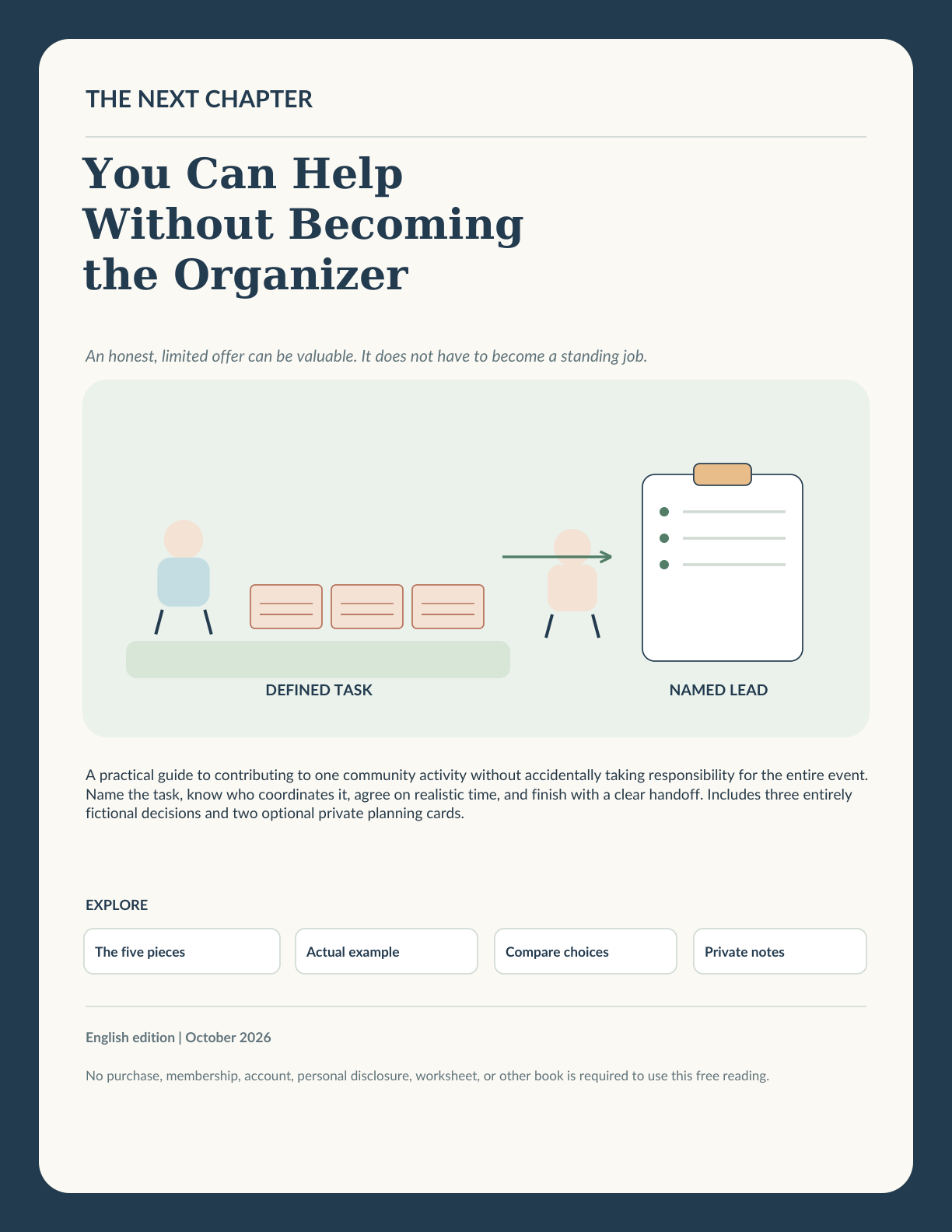
An honest, limited offer can be valuable. It does not have to become a standing job.
A practical guide to contributing to one community activity without accidentally taking responsibility for the entire event. Name the task, know who coordinates it, agree on realistic time, and finish with a clear handoff. Includes three entirely fictional decisions and two optional private planning cards.
English edition | October 2026
No purchase, membership, account, personal disclosure, worksheet, or other book is required to use this free reading.
A small yes can quietly become a large job
THE REQUEST YOU HEARD MAY NOT BE THE REQUEST SOMEONE ELSE UNDERSTOOD
You offer to put chairs away after a neighborhood lecture. The person asking thanks you warmly, then says, “Wonderful. You’re so organized. Could you also coordinate the volunteers?” A few days later someone forwards you a list of names. A new person assumes you are the contact for next month. You meant to help for twenty minutes; everyone else seems to have heard “take charge.”
This can happen without anyone behaving badly. Small organizations and informal gatherings often depend on people generously stepping into gaps. A competent person who answers promptly can become the person everyone asks next. Yet competence is not consent, and appreciation does not make an open-ended role suitable for you.
The solution is not to be less helpful. It is to make the help legible: one task, at one time, under a named coordinator, with a clear end. If the activity actually needs someone to organize the whole effort, that is a separate request and deserves a separate decision. Sometimes the most responsible answer is that you can complete the small job but cannot safely or reliably coordinate the rest.
This guide concentrates on a single request. It offers language that is useful before you agree, while you are helping, and when you hand the task back. It does not promise that your boundary will please everyone or that an organization can operate without qualified leadership. It helps you say precisely what you can provide.
Helping is a task; organizing is a different kind of responsibility
BOTH ROLES MATTER, BUT THEY ARE NOT INTERCHANGEABLE
A helper usually accepts a defined piece of an activity: set out signs supplied by the host, welcome visitors during an agreed shift, pack labelled materials, or read through an approved draft. The task has a beginning, an end, and someone who can answer questions or take over when circumstances change.
An organizer makes the activity possible as a whole. Someone must confirm the venue, decide who is authorized to do what, handle participants' information appropriately, arrange essential cover, and respond when something fails. Depending on the activity, the role may also involve money, supervision, safety procedures, insurance, training, and local rules. These are not details that simply disappear because people are volunteers.
Neither role is inherently more generous. A person can be excellent at the task and uninterested in the surrounding coordination. An organizer may enjoy those broader responsibilities and have the actual authority, resources, and training to carry them. The problem arises when the distinction is unspoken: a helper thinks they were asked to place chairs, while the host thinks they agreed to open the venue, recruit replacements, and close the building.
Before agreeing, ask: “Who is coordinating the whole activity?” A genuine name and contact route should exist, not merely “we all sort of do.” If the activity requires a responsible leader and none is identified, do not improvise a leadership system. You may offer to revisit the request after the organization clarifies its arrangements—or decline it completely.
Put five pieces around your offer
THE SHAPE OF THE OFFER IS AS IMPORTANT AS THE GOOD INTENTION
Make a limited offer by naming five practical pieces. Task: What exactly will I do? Time: On which one date, and during what hours? Lead: Who approves instructions and remains responsible for the wider activity? Materials: What will the host supply, and what am I not expected to purchase or provide? End: How will we know the task is complete, and whom do I tell?
For example: “I can sort the donated paperbacks at the community book table on Saturday from ten until eleven-thirty. Dana will be coordinating the event and will tell me which categories to use. I can work with the labels and boxes you supply. I will report what remains before I leave. I cannot manage the volunteer roster.” That sentence is not cold. It allows both adults to rely on the same information.
Notice the difference between an offer and an agreement. Your offer becomes workable only when the host confirms its details and you accept the clarified request. A text saying “I might be available” is not a confirmed shift. A host's unanswered message does not automatically extend the hours. Nor does doing a one-time task enroll you in every future occurrence.
If your answer is no, you need not provide all five pieces. “I cannot take on organizing this event” is complete. If you do wish to help in a smaller way, state that as a new, separate possibility, not as something already promised. A clear small yes is useful. A clear no is also useful information for planning.
Define the action, not just the topic
“HELP WITH THE EVENT” IS OFTEN TOO VAGUE
Two people may say “help at the book fair” while imagining quite different days. One pictures greeting guests at a staffed table. The other imagines finding donations, deciding prices, carrying heavy boxes, collecting cash, and closing the building. The activity's name does not define the responsibility.
Try a sentence with a verb and a result: “I can place the supplied labels on four already-set-up tables.” “I can check the spelling on the one-page public programme.” “I can put the clean borrowed cups into the marked crates, following the host's instructions.” The result is observable; neither person has to guess whether your task is finished.
Now name adjacent work that is not included. You might not have permission to enter storage areas, collect cash, manage a participant database, post photographs, recruit other people, offer transport, or hold keys. Such boundaries protect other people as well as your time. A helper should not access confidential material simply because someone casually forwarded it.
Ask whether any apparently ordinary task involves special physical demands, screening, supervision, food handling, personal data, or safeguarding. Where the organization requires procedures or training, your kind intention does not replace them. You can ask for an appropriately authorized task instead. If no safe and supported version exists, the reasonable response is to decline. A small offer should be real and safe, not an invitation to be surprised later.
Count the whole commitment, not only the advertised shift
THE REAL DAY HAS TRAVEL AND HANDOFF AT BOTH ENDS
A ninety-minute shift may occupy more than ninety minutes of your day. You may need to travel, find the correct entrance, receive instructions, collect equipment, and return home. If someone asks you to stay until the next volunteer arrives, that is another potential responsibility—not necessarily one already included in your agreement.
Start with an honest window. A task scheduled 10:00–11:30 is ninety minutes of task time. If you leave home at 9:35, arrive at 9:50, depart the venue at 11:40 after the agreed handoff, and reach home at 11:55, the actual door-to-door commitment is 140 minutes. The extra fifty minutes may be manageable; they still exist. These figures are a fictional example, not a recommended shift length.
Ask about preparation before your shift: Will you need to read instructions, collect keys, print signs, or attend training? Is setup included? Who covers the final ten minutes if something runs late? Count required expenses separately from quoted or optional purchases. If travel costs money and the organization has not agreed to reimburse you, do not present the fare as free.
A personal limit can be firm without requiring a private explanation. “I can help between ten and eleven-thirty, with time to hand over before leaving” is clear. “I cannot stay beyond eleven-forty” is also clear. If that timing does not meet the event's genuine needs, it is better to learn that before the event than to leave an essential post unattended.
Find out who gives instructions and handles a problem
IF SOMETHING CHANGES, KNOW WHO CAN ACTUALLY DECIDE
A useful one-hour contribution requires surprisingly little paperwork, but it does need a real route for questions. Ask for the name of the person coordinating your part and the ordinary way to reach them during the activity. What should you do if the materials are missing, the venue changes its entrance, or a visitor asks something beyond your task? Which decisions are yours, and which need approval?
Consider a book table. You can arrange books into host-approved categories, but perhaps only the coordinator can change prices, promise delivery, issue a refund, or decide how donations are recorded. A question from a visitor about the organization's privacy policy should go to the person responsible for that policy. A person who seems to need urgent assistance should not be treated as a routine paperwork question; follow the venue's emergency procedure and contact appropriate emergency services when necessary.
You do not have to learn the entire organization to be helpful. Instead, learn its few essential lines of responsibility. If your task touches children, vulnerable participants, money, personal data, vehicles, medication, or other regulated or sensitive matters, do not substitute informal common sense for the organization's screening, training, consent, or legal obligations. Decline tasks for which you are not appropriately authorized or supported.
A small role becomes easier when nobody is pretending it includes more authority than it does. Knowing when to refer a question is a form of competence, not evidence of inadequacy.
One Saturday does not automatically mean every Saturday
REPEATING AN ACTIVITY IS A NEW COMMITMENT
A host may be grateful enough to say, “That was wonderful; we'll see you next month.” You may be grateful too. Enjoyment can make it tempting to nod along even when you have not looked at the calendar. Yet a successful first shift is evidence that one shift worked under one set of circumstances. It is not proof that a monthly duty will suit either of you indefinitely.
Separate completed, agreed for a specific future date, and not yet discussed. If you helped last Saturday, mark that as completed. If both parties have confirmed a second date and specific scope, mark that as agreed. If the event is usually monthly but you have not accepted the next date, leave it unagreed. The distinctions sound fussy until one side believes they can rely on you while the other believes they merely offered to consider it.
You may ask for a one-off arrangement, a trial followed by a conversation, or an invitation each time rather than an automatic schedule. The host is free to say that a different volunteer arrangement is needed. Your boundaries and the organization's reliability both matter. It may be kinder to say “no ongoing commitment” than to create a standing promise you frequently need to withdraw.
Some roles genuinely require continuity, training, or scheduled cover. There is no duty to accept those roles. Conversely, if you already agreed to a critical shift, do not assume a personal change of plans makes the organization automatically covered. Give timely notice through the agreed channel and confirm what remains to be handled by the responsible coordinator.
Choose one of three honest answers
YOU DO NOT HAVE TO SAY YES TO THE LARGEST VERSION
The first answer is a limited yes: “I can help with the welcome table for one hour on the agreed date, if someone else is coordinating.” This works when the actual task is clear and the host can support it. It leaves larger duties with the right person rather than silently transferring them to you.
The second answer is more information first: “I am interested, but I need to know who is supervising and whether the job includes collecting fees before I decide.” This is not a soft yes. You are asking to understand the offer, not promising to accept whatever details emerge. If no answer comes, you have not signed up by default.
The third answer is a respectful no: “I cannot be the event organizer.” You can stop there. You may add, “Please don't include my name as the contact.” That request is especially useful if people have been circulating an old email chain or relying on assumptions about your availability.
These are not three stages everyone must pass through. A person can decline immediately. A limited yes can be the right answer even when everyone wishes you could offer more. And “I need information” may eventually become either yes or no. A generous community is built from offers that can be kept, not from unlimited offers that sound impressive and then become emergencies for everyone.
Seven questions that make a small offer safer
PICK THE RELEVANT ONES; THIS IS NOT AN APPLICATION FORM
Before accepting a task, you might ask: 1. What exact result do you want from me? 2. Which one date and hours are you asking for? 3. Who is coordinating the wider activity? 4. What materials, access, and instructions will be supplied? 5. Does this task require permission, screening, training, or special precautions? 6. What happens if plans change or the next person does not arrive? 7. How do I report completion and hand the task back?
You need not recite all seven in a ceremonial interview. If someone asks you to carry three labelled boxes across a familiar room, two questions may be enough. If someone asks you to manage children's sign-in information, handle money, or drive participants, considerably more than seven questions may be necessary, and trained or designated staff may need to do the job instead.
Pay attention to answers that describe outcomes without responsibilities. “Just use your judgment” may be reasonable for deciding where to place a decoration; it is not an adequate permission structure for safeguarding, financial records, secure access, or emergencies. “Everyone helps with everything” may describe a friendly culture, but it does not identify who has ultimate responsibility.
A modest task can still feel welcoming. You are seeking clarity so your energy goes toward something useful. The aim is not to force a volunteer to become an administrator. It is to leave no important duties resting on a misunderstanding.
When the task grows while you are doing it
PAUSE BEFORE ACCEPTING THE EXTRA WORK
Suppose you agreed to label books, then someone asks you to manage the volunteer schedule because another person is absent. You can be sympathetic without instantly becoming the scheduling lead. Try: “I can finish the labels I agreed to do. Dana is coordinating the event; please check with her about the roster.” This sentence names your existing promise and redirects a new request to the person able to decide.
If the new request is small and genuinely within your ability, you may decide to extend your help. Make it explicit: “I can place these two signs before eleven-thirty, but I cannot stay beyond my departure time.” Check that you are permitted to do the task and that it does not leave another essential job uncovered. Do not let a series of apparently harmless extras silently replace the role you actually accepted.
The moment may be awkward. Someone may sigh that they are short-staffed. You can acknowledge the shortage without promising to solve it. “I understand that the schedule is difficult” and “I cannot become the coordinator” can both be true. Avoid blaming absent volunteers or speculating about why others cannot help. Their arrangements may be private and may not be yours to judge.
There is an important exception to ordinary boundary-setting: if an immediate safety issue arises, do not simply walk away because it was not on your task list. Follow the setting's emergency guidance, seek appropriately qualified help, and contact emergency services if warranted. A defined role does not excuse neglecting an urgent situation; it does protect against being casually appointed to an ongoing role without consent or preparation.
Leave a clean handoff instead of a vague promise
THE END IS PART OF THE TASK
A finished small contribution needs a final sentence: what was completed, what remains, and who now owns the next step. “I arranged the labelled paperbacks on four tables. Two boxes remain in the host-approved storage corner. Dana has the list and will decide what happens next.” That handoff is more valuable than “Everything should be fine.” It lets the coordinator understand the actual condition of the work.
If nothing remains, say so plainly. If some work remains, do not claim the task is complete in full. If an unexpected issue arose, describe the relevant fact without publishing private information or guessing at causes. Where the organization has a formal incident or safeguarding process, use it rather than an informal public group chat.
Do not transfer credentials, volunteer contact lists, keys, or collected funds to an unauthorized person merely to leave on time. Ask in advance where restricted materials should go and what to do if the intended coordinator is unavailable. For safety-critical roles, approved relief and sign-out arrangements may be mandatory. If you cannot meet those conditions, reconsider accepting the role at all.
You do not have to remain the contact person afterward just because you handled one piece well. If a later question comes to you, you can say, “I only handled the Saturday book labels; Dana is the right person for the event.” You have not failed to help. You have helped with the part you genuinely owned and returned everything else to the right place.
Fictional case: Bea completes the small job she accepted
ONE ACTUAL SHIFT; THE COORDINATING ROLE REMAINS ELSEWHERE
Bea likes the idea of a community book table, but she has no interest in coordinating a sale. Dana, the event's designated coordinator, asks Bea to sort books into categories. They agree in writing: Bea will work at the staffed venue on one Saturday from 10:00 to 11:30, using labels and boxes the host supplies. Dana retains responsibility for the volunteer roster, any public enquiries about pricing, and site arrangements. Bea will say what remains before leaving. This is one date only.
Bea leaves home at 9:35, reaches the venue at 9:50, works from 10:00 to 11:30, reports to Dana and leaves the venue at 11:40, and is home at 11:55. Her actual task time is 90 minutes. The full door-to-door interval is 140 minutes. The local bus fare in this entirely invented story is USD 4 each way, and she actually pays USD 8 in new cash. The host has not promised reimbursement; the fare is not labelled free.
During the shift someone asks if Bea could recruit next month's helpers. She says she cannot do that and directs the question to Dana. Bea sorts four tables' worth of books, describes two remaining unsorted boxes to Dana, and leaves after the agreed handoff. The work she accepted is complete; the entire event is not thereby completed by Bea. No subsequent shift is accepted, booked, or implied.
Bea's useful contribution is deliberately modest. The relationship between her effort and Dana's leadership is clear, the actual expense is accounted for, and neither person needs to pretend that Bea has signed up to run the future event.
Fictional case: Omar makes an enquiry, not a commitment
ASKING ABOUT A ROLE IS NOT PERFORMING IT
Omar once managed busy office projects. A former colleague assumes he would be an ideal volunteer coordinator for a neighborhood lecture series. Omar is curious but cautious: he retired partly because he no longer wants to organize other people's schedules. He asks for a conversation to learn what the request truly entails.
The phone call lasts 14 minutes. The colleague explains that the person handling venue bookings is leaving and that the group also needs someone to gather email addresses, assign shifts, contact speakers, and remain reachable during events. There is no identified replacement lead. This is much more than setting out chairs on a chosen date. Omar asks who would have authority over personal information and whether there are established venue procedures. The colleague does not yet know.
Omar responds: “I am not agreeing to coordinate. I may consider one clearly supervised setup task later if you have a named lead and a specific date. Please don't put my name on the organizer list.” He offers no confirmed shift and makes no promise to locate a replacement. The colleague agrees to clarify the role with the group.
What actually happened? One 14-minute information call. What did not happen? No volunteer attendance, no assigned event duty, no booked future task, and no new cash expense in this invented scenario. Omar's possible later consideration is not a current acceptance. The lack of a named coordinator is a relevant fact, not something Omar is obliged to repair.
Asking careful questions is useful even when the answer is “not yet.” A person should not be counted as a volunteer merely because someone has begun to imagine how helpful they could be.
Fictional case: Mara declines without volunteering someone else
THE PERSON WHO SAYS NO DOES NOT HAVE TO SUPPLY A SUBSTITUTE
Mara is invited to “take care of the participant list” for a neighborhood workshop. The invitation sounds like a small administrative task. When she asks what it involves, the host says she would receive participants' personal contact information, coordinate late cancellations, and keep access to a shared account for the whole season. No individual has explained the organization's privacy practices or who should be responsible for the account.
Mara does not want the role, whether or not a suitable policy eventually exists. She replies: “Thank you for asking. I won't be taking responsibility for the participant list or the shared account. Please don't add me as a contact or send me participant details.” She does not propose a friend, promise to recruit a replacement, or offer to keep data temporarily. She simply refers the host to its own authorized leadership for the next decision.
There is no volunteering shift, travel, booking, cash payment, data access, or future assignment in this fictional case. Mara has not agreed to sort documents later either. She may still attend a public event as an ordinary participant if she wishes and the venue permits it, but that is a different choice from taking a role.
An answer can be respectful without being negotiable. The organization may legitimately need a reliable person for the season. Mara is not that person, and she need not become that person because the need is genuine. Her clear no prevents a particularly unhelpful outcome: personal information and operational responsibility ending up with someone who neither agreed nor was appropriately prepared to hold them.
Compare three different outcomes without exaggeration
DO NOT COUNT A POSSIBLE FUTURE ACTION AS AN ACTUAL ONE
These stories represent three entirely fictional decisions. Bea completed one defined task. Omar conducted an information-only call. Mara declined a proposed role. The people, venues, hours, fares, and conversations are invented teaching examples; they do not describe an actual organization, charge, or experience.
| Question | Bea | Omar | Mara | |---|---|---|---| | What was requested? | Sort books at one event | Consider event coordination | Manage participant list and account | | What did the person accept? | One 10:00–11:30 task under Dana | No role accepted | No role accepted | | What actually occurred? | 90-minute task plus handoff; 140-minute door-to-door interval | 14-minute enquiry call | Respectful refusal only | | New cash actually paid? | USD 8 fictional bus fares | USD 0 | USD 0 | | Recurring responsibility? | None accepted | None accepted | None accepted | | Next event booked by that person? | No | No | No |
The comparison matters because casual language can turn enquiries and intentions into false commitments. “He is helping with the lecture series” is wrong if Omar has only asked about the role. “She is looking after the list” is wrong if Mara declined. “Bea organized the fair” is wrong if she sorted books while Dana coordinated the event. Use accurate verbs: asked, offered, agreed, completed, referred, or declined.
Money needs the same accuracy. Bea actually spent USD 8 in the invented case. Omar and Mara spent no new cash. Neither unused materials nor hypothetical travel charges should be recorded as amounts they paid. No reader should mistake the example figures for prices at a real event.
Useful sentences for the moment someone asks
SHORT WORDS ARE OFTEN THE MOST RELIABLE
Before accepting: “I could help with the labelled materials for one hour on Saturday. Who will be coordinating, and what would the handoff look like?” This sentence offers interest and asks for essential practical facts without agreeing to an undefined job.
When the role is larger than expected: “I understood that you needed someone to set up the room. I cannot manage bookings or the volunteer roster. Would the original setup task still help?” This allows the host to say yes, explain that the small task is not enough, or propose a separate alternative for consideration.
When the request is not suitable: “Thank you for thinking of me. I cannot take that responsibility. Please plan without including me.” Do not add a “maybe next week” unless you genuinely want to be asked next week. The temptation to soften a no with a false future promise usually creates more confusion than kindness.
When you are asked to stay late: “My agreed handoff time is eleven-forty. Who is taking over? I can tell them what remains before I leave.” If there is no approved relief for a role requiring continuous coverage, contact the responsible coordinator and follow the organization's procedures rather than simply abandoning the position.
After finishing: “I finished the book labels and told Dana which two boxes remain. My one-time shift is complete. Please contact Dana about future scheduling.” That is not a demand for praise or payment. It is a clean record of where the agreed work ended.
You can adapt these scripts to your own speaking style. The most important words are the real task, real time, real decision-maker, and real end. The person hearing them should not have to guess what you have accepted.
Optional private card: the one task I might offer
THIS CARD IS FOR YOUR OWN THINKING, NOT A CONTRACT OR ENROLMENT FORM
A useful small offer may fit on one sheet. Write only what helps you remember your own choice. You do not need to include full names, contact details, account numbers, passwords, private information about volunteers or participants, or explanations of medical or family circumstances. The card is entirely optional; you can also speak the answers aloud or leave it blank.
1. The task I am willing to consider
What single action and concrete result would I be comfortable taking on?
2. The specific date and hours
What exact window am I considering, including a reasonable handoff?
3. My whole-day time and unavoidable expenses
What travel, preparation, or actual costs would this involve, and which amounts are not yet known?
4. The named lead, not me
Who would supervise, approve decisions, and own everything outside my task?
5. Materials, access, and safety conditions
What will the host supply or confirm before I can decide responsibly?
6. My current answer
Is it a limited offer, a confirmed agreement, a request for more facts, or a no?
Optional private notes: ____________________________________________
A private card cannot create authority that an organization has not granted, and writing a proposed date here does not book you for it. Confirm a real agreement separately with the correct person if you choose to proceed.
Optional private card: a clean end to one contribution
USE ONLY AFTER AN ACTUAL TASK, OR AS A QUESTION LIST BEFORE ONE
A handoff is clearest when completed work, remaining work, and ownership are not mixed together. This page is a private reminder, not an official incident report, safeguarding record, attendance register, financial ledger, or substitute for the organization's own forms. If no task occurred, you may leave it empty. Do not put other people's sensitive details here.
1. What I actually completed
Which task was done, and what observable result exists?
2. What was only discussed or offered
What possibility must not be mistakenly recorded as completed or booked?
3. What remains unfinished
What is still open, without guessing who will eventually do it?
4. Who received the handoff
Which authorized coordinator or approved process received the relevant information or materials?
5. Time and actual new cash expense
What time did I actually spend, including travel if useful, and what money did I actually pay?
6. Future commitment status
Did I confirm a specific further date, decline it, or leave the matter open with no agreement?
Optional private notes: ____________________________________________
The card is useful precisely because it can record none, not yet, or unknown. Those are honest answers. They prevent goodwill from becoming a fictional chain of promises.
Good help has a beginning, a purpose, and an end
YOUR CONTRIBUTION DOES NOT HAVE TO TAKE OVER YOUR LIFE
Community life needs people willing to give their attention. It also needs people who are able to keep the promises they make. A little help can be meaningful without becoming a standing identity, a substitute for missing staff, or the price of belonging. One carefully defined task may be a better contribution than an ambitious commitment nobody can safely support.
If a request comes your way, remember the five pieces: task, time, lead, materials, and end. Ask whether the wider work has a real organizer. Be truthful about your whole-day time and costs. Name which duties are outside your offer, especially if they involve private information, money, safety, or responsibility for others. Confirm an agreement before treating it as accepted; do not mistake a possible future invitation for a booked shift.
If you complete the job, report what you did and what remains. If you are unsure, ask for the missing information. If you cannot or do not want to take the job, decline clearly and let the organizer decide how the real need will be met. There is no requirement to invent a substitute, share private reasons, or promise to reconsider.
Where an organization needs qualified coordination, emergency cover, permission, or legal compliance, this general reflective guide does not replace its rules or the advice of appropriate professionals. Follow the actual authorized coordinator and applicable local procedures. No document here should be treated as an official agreement, waiver, safeguarding plan, volunteer recruitment record, financial statement, or legal opinion.
A helpful life can contain many kinds of contributions. It can also contain time that belongs to you. The two ideas are not enemies. You can generously give the part you truly mean to give—and then hand the rest back to the person who agreed to carry it.